
茶 FIRST IMPRESSIONS
茶 REVIEW OF BOOKS & FILMS
[ESSAY] “The Authority to Continue in Kiwi Chow’s Deadline” by Qinlei Wang
Kiwi Chow (director). Deadline, 2025. 117 minutes.


By the time a teacher proposes suspending the final examinations at Enshan Secondary School, the strongest defence of the timetable comes from students whose lives have been organised around it. They insist on their freedom to sit the papers even as an anonymous notice threatens a student’s death if the examinations proceed.
Their response in Kiwi Chow’s Deadline (2025) unsettles the familiar picture of young people resisting an authoritarian school, since a postponed assessment can carry costs that fall unevenly upon those expected to benefit from its cancellation. For pupils who have invested years in measurable achievement, the examination offers a means of converting effort into future opportunity. Another pupil’s immediate safety demands an institutional response of equal seriousness. The film places these claims within the same seven days, exposing an authority sustained partly by students who have acquired a genuine interest in its continued operation.
The conflicting interests acquire a sharper social texture through Ruoyan and Peiching, whose academic ambitions arise from different family circumstances. Ruoyan’s hope of escaping economic insecurity makes grades a potential route towards opportunities otherwise difficult to secure, while Peiching faces the pressure of maintaining the standing that her family’s resources have already helped establish. Both inhabit the same system of comparison, yet cancellation may register as a lost opportunity for one student and the collapse of a carefully maintained position for another.
❧

Lauren Berlant’s account of cruel optimism helps describe the attachment that forms when an apparently promising route to a better life also exacts damaging demands from those who pursue it. At Enshan, this attachment retains a rational foundation, since examination results possess real institutional currency beyond the school gates. The difficulty lies in distributing the costs of preserving that currency when students differ in their resources and exposure to harm.
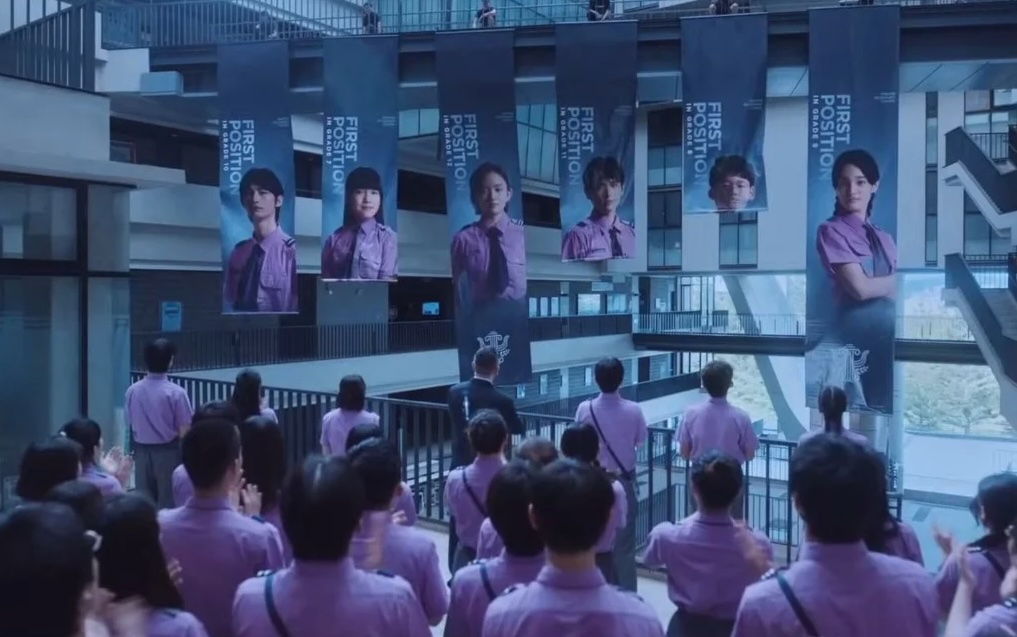
The school’s opening routine gives that unequal bargain a bodily form well before the crisis. Wearing purple uniforms with military inflections, pupils perform strenuous exercises while chanting an assurance that present effort will lead to future success; their arrival continues through paired lines, the depositing of mobile phones, and electronic entry checks. Jeremy Clarke’s detailed screening account describes these successive actions alongside iSmart’s capacity to measure the duration of students’ eye contact with teachers. The arrangement turns attention into a measurable performance alongside attainment and attendance, while the surrender of phones ensures that pupils enter a communications environment largely administered by the school. Each action can be defended through a familiar educational purpose, yet their combination leaves remarkably little of an ordinary morning outside institutional evaluation. The examination timetable gains its force through these repeated concessions of attention and autonomy well in advance of any open defence of its authority.
❧

Enshan turns its preferred forms of attention into public decoration through six enormous portraits of successful pupils suspended above the atrium. Their faces appear as evidence of what this institution can produce, while the falling sheets of the anonymous suicide notice later occupy the same shared space without the author’s identity or credentials. The director’s conversation with the Humanistic Education Foundation establishes the two displays as part of the film’s visual design, although the stronger tension emerges from their opposing relationships to public recognition. The portraits receive visibility through achievement already certified by Enshan; the scattered pages demand a hearing without first satisfying its standards of credibility. Even the Chinese title, Zisha Tonggao, invokes the authority of an official announcement, appropriating a form ordinarily used to inform pupils of decisions already made for them. The school’s publicity machinery thereby encounters a message whose circulation it cannot authorise and whose urgency it cannot safely disregard.
Enshan’s power to determine which student voices deserve public recognition has its professional counterpart in Principal Kung’s treatment of an evaluation that Miss Tien believes should be reconsidered. Miss Tien brings Principal Kung an observation list and explains that Gao has improved, yet Kung insists upon keeping his name under review; elsewhere, Gao gives a struggling student a textbook with difficult exercises marked for further attention. The contrast offers two different accounts of professional practice, one expressed through formal inspection and the other through a small encounter whose educational effect may emerge gradually. In Stephen J. Ball’s analysis of teacher performativity, targets and indicators influence the kinds of professional selves that practitioners learn to present, producing carefully maintained appearances alongside pressures towards measurable success. Kung’s confidence in evaluation consequently involves a choice about which observations deserve authority, particularly when evidence of improvement competes with an established assessment of a teacher’s suitability. Gao’s attentiveness complicates his professional reputation without resolving the later allegations surrounding his conduct.
Miss Tien challenges Kung’s refusal to reconsider Gao’s performance, yet her own handling of a pupil’s request reveals how professional judgement can be constrained by the everyday allocation of time. During an online conversation, Peiching approaches her to discuss the wording of the anonymous notice and agrees to return the next day. The exchange is ordinary enough to escape attention in a school where adults constantly balance competing appointments, although a story organised around seven remaining days gives tomorrow an alarming scarcity. Peiching’s academic success has made her legible to Enshan, yet her wish to talk asks for a form of recognition that a ranking can scarcely anticipate. Miss Tien offers an identifiable person and a specific future moment, which differs appreciably from the indifference of an administrator refusing to listen. Their meeting nevertheless remains subject to the calendar that also governs examinations, staff performance, and institutional crisis management. Chow draws the strain of educational care from an entirely plausible scheduling decision, placing professional busyness beside a student’s uncertain opportunity to speak.
❧
The same timetable that makes Peiching’s request vulnerable to postponement now governs a school response divided between immediate safeguarding obligations and anxiety over its institutional reputation. The Taiwan Creative Content Agency’s official synopsis identifies both concerns, making clear that the institution fears distress spreading among students while urgently seeking an unknown person. Finding that pupil may allow intervention in an imminent crisis and provide frightened classmates with reassurance; the same inquiry also offers the administration the prospect of restoring an examination schedule on which its prestige depends. Institutional intentions therefore cannot be inferred from an investigation’s existence alone. The decisive distinction lies in what follows identification, particularly whether protecting the person at risk is accompanied by attention to the practices named in the warning and to classmates whose own educational interests have become uncertain.
The student council’s campaign against suicide illustrates the attraction of a visible response that can be organised quickly and understood by the whole school. Its leader invites peers to affirm their opposition to student suicide, while Ruoyan struggles as the collective undertaking circulates around her. Public commitments can reassure pupils who feel frightened by the notice and give adults a recognisable signal that concern has reached the student body. For someone already finding daily life unbearable, however, a declaration of collective resolve may demand another performance of composure among witnesses whose reactions remain unpredictable. The contrast between the campaign’s confident language and Ruoyan’s vulnerability illuminates the gap between a school’s capacity to display solidarity and a student’s ability to receive help without exposing herself to fresh scrutiny. It also complicates the portrayal of student agency, since peers themselves participate in defining the acceptable vocabulary through which suffering may be expressed.
❧
The film’s mystery gradually draws viewers into the school’s effort to replace an unidentified accusation with a named individual, a tendency made especially clear by the project’s earlier form. In the 2018 Hong Kong Asia Film Financing Forum proposal, seven students sign a collective notice announcing their intention to die and alleging unfair examinations. The completed film’s unidentified author makes the accusation available through suspense, encouraging teachers and audiences to examine the conduct of particular pupils for evidence of authorship. Chow has explained that the screenplay changed partly in response to the practical demands of feature length, yet the revised premise also alters where the narrative locates explanatory authority. Seven signatories openly confront the institution as a group; the mystery invites a search for a singular origin that could make the disturbance appear containable. The danger arises when finding a person supplies the emotional satisfaction of solving a puzzle while the allegations concerning educational practice await a substantive response.
Heng’s ADHD diagnosis encounters a similarly unforgiving process of classification, acquiring social stigma within a school that expects students with different needs to demonstrate their worth through comparable results. Bullied for a condition that affects his learning, Heng seeks recognition through the very grades that expose him to unfavourable comparison, giving the apparent neutrality of performance criteria a painfully uneven meaning. Meanwhile, the narrative introduces medication used to pursue stronger examination results, drawing clinical treatment and competitive enhancement into a single atmosphere of suspicion. The two circumstances entail different obligations, since treatment prescribed for a diagnosed condition responds to an individual’s medical needs, while the pursuit of medication for academic advantage raises separate concerns about pressure and access. Taiwanese production coverage confirms these intersecting character arcs, which give the film’s treatment of educational fairness greater complexity than an uncomplicated condemnation of drugs. Under Enshan’s ranking system, even legitimate support risks being judged according to the advantage it supposedly confers upon competing students.
The eventual testing for performance-enhancing substances on examination day reveals how fragile the school’s appetite for comprehensive information becomes when disclosure threatens its own achievement culture. As Clarke’s screening account records, tests implicate around half the students, and a senior official halts the process, curtailing an investigation whose results have exceeded the administrative convenience of individual punishment. The magnitude of the finding changes the meaning of the alleged misconduct. A small number of cases could be incorporated into an account of personal rule-breaking; widespread use threatens the assumption that examination results transparently reflect effort and aptitude under shared conditions. The abrupt cessation of testing also leaves affected students facing unresolved practical uncertainties over accountability, medical care, and the status of their results. Here, Enshan’s measurement culture encounters knowledge with consequences for the legitimacy of the very outcomes it exists to certify.
❧
Enshan’s authority over achievement extends into its control of access to the garden, where Chun pursues an interest whose personal value remains independent of the hierarchy of grades. When his access card fails at the entrance, Peiching uses her phone to admit him, briefly turning the privileges associated with academic success towards another person’s interest in living plants. The scene offers a concrete form of cooperation between pupils whose priorities differ, while the mechanism of entry exposes how thoroughly school facilities have been organised around permission. Chun later breaks the glass barrier to enter the same space, transforming a previously mediated request into an action with consequences for his own standing and the safety of those around him. The destruction of a door scarcely offers a sustainable substitute for shared access, yet the sequence locates an ordinary desire inside a system that distributes even opportunities for quiet pleasure according to institutional eligibility. His attachment to the garden gives individuality a presence grounded in an activity, free from the grand declarations that dominate the examination dispute.
The garden’s significance acquires particular force from the film’s otherwise severe spatial vocabulary, which places purple figures against grey concrete and arranges the campus around open corridors, elevated bridges, and restricted entrances. In an interview with Funscreen, Chow describes a wide 2.35:1 composition, architectural backgrounds held in focus, and warmer colouring for the exterior garden setting. Views from within a locker divide the visible scene at intimate range, whereas intersecting walkways separate people across an expansive public space; the difference in scale creates related experiences of constrained access. The earlier arrival ritual gives this geometry its social consequences, since students must repeatedly present credentials and submit their bodies to inspection while crossing the building. Against those routines, movement towards the garden becomes a dispute over whose reasons for entering a space the institution is willing to recognise. The visual design attains its greatest specificity whenever architecture changes an action a character is able to perform.
Chun’s pursuit of the garden and Peiching’s interrupted approach to Miss Tien provide the film with quieter moments of human particularity, although their emotional promise competes with an investigation organised around revelation and escalating crisis. The stern uniformity of the campus offers a compelling environment for suspense, while the succession of accusations and crises sometimes leaves ordinary friendship and disagreement insufficient room to alter the drama’s prevailing intensity. Peiching’s interrupted request to Miss Tien and Chun’s reliance upon her phone are especially affecting precisely through their modest scale, since each briefly allows a relationship to exceed the roles assigned by attainment. Such moments also give the film a standard by which its more emphatic symbolism can be judged. Institutional pressure acquires its greatest emotional weight when an interaction reveals something particular about the person enduring it, allowing the audience’s concern to extend beyond the anticipated solution to the mystery.
❧
Principal Kung’s eventual acknowledgement of students’ humanity returns the film to his opening promise that endurance secures future success, while his change in language leaves the practical authority of the examination timetable largely intact. His initial insistence that suffering prepares pupils for future success eventually gives way to an acknowledgement of their worth beyond examination scores. In the Humanistic Education Foundation interview, Chow explains that he removed a scene in which the principal bowed in apology, seeking a conclusion that recognised responsibility across generations. The omission helps the film avoid presenting public contrition as the completion of institutional reform, particularly when pupils continue to move towards their examinations after their headmaster has revised his values. Those students carry accumulated investments, deadlines, and expectations that have already acquired independence from his personal convictions. His speech can change what the institution says about them; the persistence of their examination routine shows how much further any alteration of its obligations would have to reach.
As students continue towards the examinations under a principal newly conscious of their humanity, the film leaves the costs of either proceeding or postponing unequally distributed among pupils whose futures remain at stake. Students facing immediate danger require timely protection, while classmates may have reasonable concerns about delayed results or the effects of an interrupted assessment on applications that recognise academic achievement. Their resistance to postponement has consequences beyond an attachment to disciplinary authority, since the examination remains a scarce means of being compared with applicants whose circumstances they cannot control. A responsible institution would have to address these consequences through fair rescheduling, reliable communication, and support capable of continuing after the immediate emergency. Chow gives little sustained attention to such administrative possibilities, yet their absence helps explain why pupils can appear to defend a damaging system even as they recognise its injuries. The promise of an examination remains persuasive where alternatives lack the practical credibility required to protect students’ futures.
❧

The production history of Deadline places these conflicts within a wider Hong Kong cultural experience while preserving their relevance beyond a single political analogy. Developed from 2017 and presented as a Hong Kong project in 2018, the film eventually took shape through a shoot in Taiwan after financing and casting difficulties, with university architecture adapted into the fictional school’s highly managed environment. Chow’s work on “Self-Immolator” for the 2015 dystopian anthology Ten Years (2015) and Revolution of Our Times (2021) inevitably informs how audiences approach his treatment of dissent, while the movement of this production across jurisdictions also belongs to the material history of making contemporary Hong Kong cinema. Reporting on the film’s blocked Hong Kong release documents the censorship authority’s refusal of local theatrical approval in December 2025. That restriction gives the act of encountering Deadline a geographical inequality of its own, even as its account of examinations and educational responsibility speaks to cultural expectations shared across the region.
Enshan’s most enduring achievement is the authority it has acquired over the imaginable futures of its students, allowing the examination timetable to retain their allegiance even after the principal has lost confidence in the values that once justified it. At Enshan, a student who depends upon examination success may demand continuation while another urgently requires protection from its consequences; a teacher may recognise distress yet defer an encounter, and a principal may revise his convictions after the routines he cultivated have become self-sustaining. The film’s final return to the examination queue renders that accumulation of decisions difficult to dismiss through a single apology or disclosure. Education retains legitimate reasons to assess achievement, and students retain legitimate claims to have their efforts recognised fairly. An authority worthy of those claims must also make interruption possible without transferring its cost onto the most vulnerable, ensuring that a timetable designed to recognise pupils’ futures remains answerable to the lives they are living.
How to cite: Wang, Qinlei. “The Authority to Continue in Kiwi Chow’s Deadline.” Cha: An Asian Literary Journal, 21 Oct. 2026, chajournal.com/2026/10/21/kiwi-chow-deadline.


Qinlei Wang is a graduate of King’s College London and a researcher working across political sociology, cultural studies and critical institutional analysis. Her research examines the relationships between institutional authority, public participation and the conditions under which individual experiences gain political and social recognition. Her interests in film criticism centre on representations of political conflict, moral responsibility and the relationship between personal testimony and collective memory. She is particularly interested in how cinematic narrative and visual form construct competing claims to legitimacy while revealing tensions between institutional power and individual agency. Her broader work explores questions of social inequality, democratic participation and the politics of representation, with particular attention to how cultural texts articulate experiences of political uncertainty and contested authority.