
茶 FIRST IMPRESSIONS
茶 REVIEW OF BOOKS & FILMS
[REVIEW] “Literature in the Age of Information: Anatoly Detwyler’s Seeing Through Abstraction” by Julie Xinzhu Chen
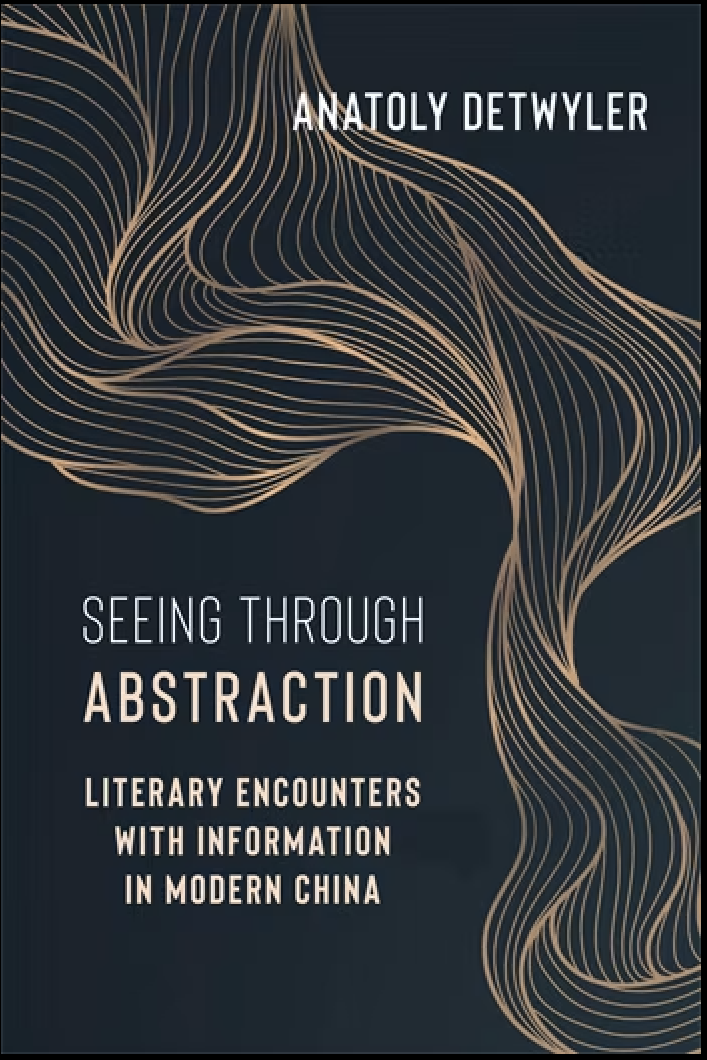
Anatoly Detwyler. Seeing Through Abstraction: Literary Encounters with Information in Modern China, Columbia University Press, 2025. 272 pgs.


Anatoly Detwyler’s Seeing Through Abstraction: Literary Encounters with Information in Modern China is an exceptionally well-researched, beautifully written monograph that contributes significantly to the fields of modern Chinese literature, information studies, and media studies. The author’s close analyses are rich in clear insights, and the argumentative structure is equally well organised. Interested readers will find much to learn or revisit as they turn the pages.
❧
Chapter one excavates examples of “seeing through abstraction” in the literary culture of New Culture China, specifically in forms such as “diagrams” (tu) and “tables” (biao), which coincided with the establishment of modern disciplines such as geography, psychology, and economics at a historical moment of contestation and reorganisation of knowledge. Detwyler sketches out the continuity between the psychologist Zhang Yaoxiang’s “scientific” methodology of measurement, which abstracts literary texts into “psychological data” through decontextualisation and enumeration, shifts between different visual scales in new poetry, and other interesting literary and graphic examples. Their significance lies in the epistemological organisation through which “diagrammatic analysis expands the reader’s ability to treat literature as a medium” (p. 60). Innovatively invoking and elaborating on the analytical and interpretative mechanisms of “distant reading”, Detwyler artfully demonstrates how modes of writing, reading, and organising information in early twentieth-century China are fundamentally akin to our contemporary habits embedded in a digital environment. A methodology akin to “media archaeology”, combined with masterful literary close reading, proves especially astute in mapping the cognitive mediating effects of form, an attention sustained throughout the book that fascinates readers from the outset.
❧

Chapter two investigates Mao Dun’s market-themed fiction, Midnight and Polygonal Relations, written in the 1930s. Departing from previous critical readings of the literary realism of Midnight and engaging with Mao’s own critique of the “ledgeristic” descriptive techniques found in traditional serial novels (zhanghui xiaoshuo), Detwyler challenges the subordination of the depiction of information flowing across the stock market and its subjects, in Mao’s novelistic experimentation with information, to literary techniques that merely reinforce verisimilitude. Instead, Detwyler goes further to show how information (xiaoxi), misinformation, and a self-reflexive demonstration of the fictitiousness of capital in numerical and transmissible forms fundamentally structure the novels, where, in the end, “it takes literary realism to judge finance capital’s fictitiousness in its own fictionality” (p. 95). By attending to what he conceptualises as “noise” and the literary figuration instantiated by informational forms such as account books, Detwyler shows how misinformation mediates social relations and knowledge production across class divides in Mao Dun’s works.
❧

Chapter three moves from xiaoxi to xuanchuan to investigate an information order situated within and rippling across an “ether” medium in the propaganda era. Revisiting the speech and telegraphy scene in Liang Qichao’s A Future Record of New China and dissecting the role of broadcasting and speech-making in the politics of sound and the language of wireless communication in Ding Ling’s early propaganda literature, which has seldom been taken seriously by scholars, Detwyler centres his attention on the entire “atmosphere” across literary and pictorial works that “reveal a dialectic of signal and noise that unfolds across different media and spaces” (p. 100) and “not merely thematize information but rather situate themselves directly within the information order as they imagine it” (p. 100).
The final, and indeed most dazzlingly analysed, part of this chapter focuses on modern Chinese woodcut artworks that visualise electrified and electrifying sounds in an “etherscape” saturated by intermedial penetration. Lines and horizons become visible material markers of ideological contestations and transmediation across visuality and sonicality. In his artful observations of Zhang Hui’s Xiaoxi (1935), which shares its title with Ding Ling’s short story “Xiaoxi”, Detwyler discerns the symbolic parallel between the “angular incidence” (p. 136) of the visualised lines at the horizons, which symbolise multidirectional signals, and “the human figures’ multivalent postures” (p. 136). Crucially, this best exemplifies “the environmental medium of the ether…(and) the most paradigmatic example of an emerging, reflexive aesthetic of the propaganda era”, one that renders the modern information order “not as content, but as climate” (p. 136).

Detwyler aptly cites Weihong Bao’s study of the “ether” as an ur-medium that transcends its own ontology as a medium by incorporating a broad range of other media (p. 105). It is not entirely clear, though, whether the author continues to use “ether” as a metaphorical tool for analysis or seeks to establish it as the actual atmospheric medium spanning the contexts of works by Liang Qichao, Tan Sitong, Ding Ling, and the woodcut artists, and understood as such by these historical figures.
❧
Chapter four ventures to unravel the rhizomatic and networked topological arrangements in Shen Congwen’s literary craft and the materiality of language, from the telephone switchboard as a narrative device in Shen’s short story “Unemployed” to his sustained methodology of literary arrangement, shaped by his encounters with newspapers and a distinct encyclopaedic information order, as seen in the first modern Chinese lexicon, Ciyuan. Detwyler argues that a Bakhtinian sense of “heteroglossia” in Shen’s works stands in opposition to political and cultural authority, and that this heteroglossia is formally effectuated by Shen’s “more fragmentary and bottom-up approach to storytelling” and “the encyclopedic and woven quality of Shen’s literary craft” (p. 154), which resist the structural, diagrammatic visualisation envisioned by He Yubo and the linearisation of propagandistic information organisation.
Detwyler proceeds to conduct a “medio-logical reading of the river” as a river-medium, examining communication and communion as enacted in the social life of information in Shen’s long novel Long River, a work itself created in the social milieu of wartime propaganda production and the collectivisation of writing. The final part of this chapter deals with Shen’s engagement with Chinese material culture and handicraft art in the new socialist era. Detwyler shows how the study of fabrics and weaving in Shen’s “second career as a historian of material culture” (p. 174), at a time when rural artisan crafts declined under the drive towards industrialisation, reveals forms that “collectively exude the kind of heteroglossia he (Shen) strove for in his fictional narratives” (p. 175).
Shen’s research into Chinese silk patterns and design “also poses a study in technique and arrangement: how an image emerges from warp and weft, how pattern arises through visual repetition” (p. 177). In Detwyler’s insightful interpretation, Shen’s dual-register, inferential arrangement of a historical silk fragment and its emerging full pattern, extracted from the fragment and presented at another visual scale, constitutes an image with a metapictorial quality, which, “in its totality, is nevertheless more than a document of a partial thing, indexing a broader, living structure of meaning” (p. 177).
The dual registers are “an analog of Shen’s two careers” that offers a critique of “mass politics via the figure of the network: as the eye shuttles between the two registers, it moves from fragment to emergent pattern and back again”, and ultimately returns to the fragment, “now newly seen” (p. 177). Like Shen, Detwyler also stitches together a full picture of Shen’s concerted efforts towards “small narratives” and fragmented aesthetics against socialist revolutionary ideology across the remarkably interconnected sections of this chapter.
One contribution especially worth acknowledging is Detwyler’s sustained engagement with the overarching framework of information and his careful attention to literary forms, which meaningfully complicate our understanding of the long-debated relationship between “modern Chinese literature” and realism, a relationship that is still sometimes glossed over through simplistic, long-inherited impressions.
❧
A few further lines of readerly inquiry, rather than criticism, are worth considering. While the author’s delineation of the interplay between visuality and sonicality offers valuable insights into how an “information order” is dynamically constituted within its media climate, readers might be curious to learn more about the transmutation between the two modes of perception in more concrete and embodied terms, and how other senses might also participate in instantiating, transmitting, and contesting information in modern China. Admittedly, such inquiries might be difficult to verify, given the nature of the sources and methodologies required. Meanwhile, the author distinguishes in passing between “information” and “knowledge” in chapters two and three but leaves readers wondering about the precise theoretical assumptions underlying these two heuristic categories and their historical transformations. Further elaboration might enrich the author’s adept illustration of how forms mediate aesthetics and politics.
One might also wish to see more historically particularised and theoretically conscious elaborations on the group of Chinese terms related to “information”, both in their historical manifestations and modern scholarly usages, as discussed by the author, such as xiaoxi, xinxi, xuanchuan, and baogao wenxue. Each of these terms carries layered semantic histories and came to take shape within the translingual environment of Chinese literary modernity (Liu, 1995), as they collided across contexts.
Related to this is the question of how these “Chinese” terms converge with, or diverge from, the key analytical concepts adopted by the author in this book, particularly “information” and the constellation of concepts that follow it, such as “signal”, “noise”, and “counter-signal”, each bearing theoretical assumptions debated by media theorists such as Friedrich Kittler and Wolfgang Ernst. To be clear, this is neither to suggest that the “Chinese” terms are more culturally authentic nor to invoke the older presumption that modern China is excluded from “information” or other markers of modernisation. The value of paying meticulous attention to nominal markers lies in acknowledging the historical conditions in which those signifiers were destabilised, circulated, and reconstituted, as well as in remaining continually self-reflexive about the analytical categories we must adopt.
Last but not least, one might be excited to see how this significant study of literary encounters with information in modern China could enter interdisciplinary conversations with the growing field of infrastructure and technology studies pursued by scholars who identify themselves as historians of science. This also raises the question of how the literary and artistic works of canonical writers such as Liang Qichao, Hu Shi, Mao Dun, Ding Ling, and Shen Congwen, so masterfully investigated in this book, might connect with less canonical, less ostensibly “literary” materials, if our ultimate goal is to attend to an atmospheric media ecology as a whole.
In sum, Seeing Through Abstraction is an exciting monograph that convincingly demonstrates how encounters with information and historically inflected, artistically versatile experiments with informational forms fundamentally shaped modern Chinese literature. It is a highly recommended read for those interested in modern China, literary studies, and information studies, as well as anyone who appreciates fine, close analysis.
Bibliography
▚ Bao, Weihong. Fiery Cinema: The Emergence of an Affective Medium in China, 1915-1945. University of Minnesota Press, 2015.
▚ Detwyler, Anatoly. Seeing Through Abstraction: Literary Encounters with Information in Modern China. Columbia University Press, 2025.
▚ Ernst, Wolfgang. Sonic Time Machines: Explicit Sound, Sirenic Voices, and Implicit Sonicity. Amsterdam University Press, 2016.
▚ Kittler, Friedrich A. Gramophone, Film, Typewriter. Translated by Geoffrey Winthrop-Young and Michael Wutz. Stanford University Press, 1999.
▚ Liu, Lydia H. Translingual Practice: Literature, National Culture, and Translated Modernity in China, 1900-1937. Stanford University Press, 1995.
How to cite: Chen, Julie Xinzhu. “Literature in the Age of Information: Anatoly Detwyler’s Seeing Through Abstraction.” Cha: An Asian Literary Journal, 21 Oct. 2026, chajournal.com/2026/10/21/abstraction.


Julie Xinzhu Chen is a PhD student in East Asian Studies at Princeton University. Her research interests lie at the intersection of literature and the history of knowledge and science in early modern and modern China and East Asia. She is particularly interested in issues and archives related to biological knowledge circuits, scientific and religious knowledge repertoires, and Sinographic writings as contested media shaping literary cultures in early modern and modern East Asia. She holds a BA in Comparative Literature & Society and East Asian Studies from Columbia University, where she wrote two senior honours theses, respectively on the formation of fungal and microbial knowledge in Chinese writings and on literati self-identification through the textualisation of alternative maritime spaces in early modern Chinese novels.