
茶 FIRST IMPRESSIONS
茶 REVIEW OF BOOKS & FILMS
[ESSAY] “Straight from the Horse’s Mouth: Timothy Billings and Li Bai’s Farewell” by Will Buckingham
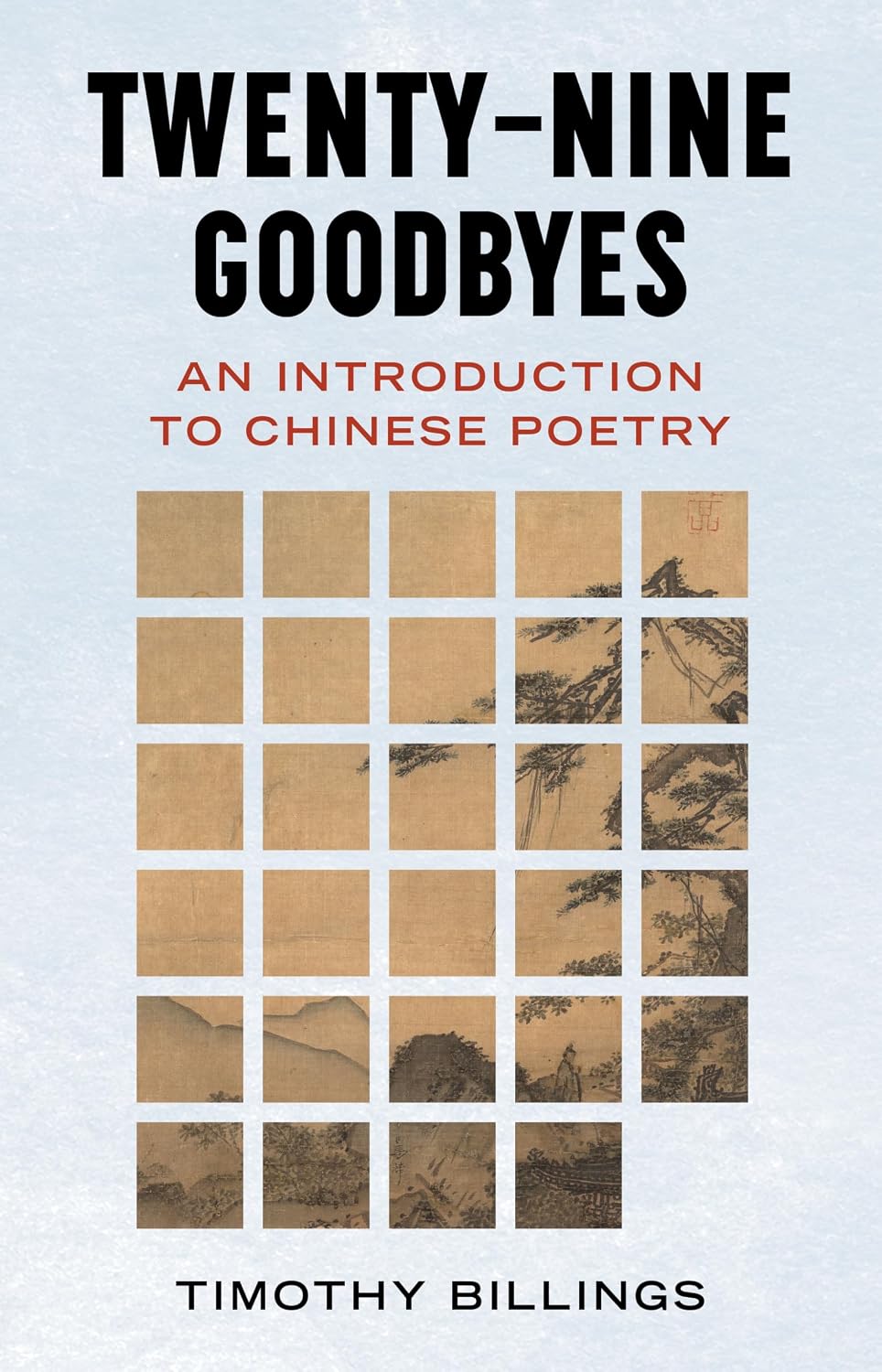
Timothy Billings. Twenty-Nine Goodbyes: An Introduction to Chinese Poetry, Fordham University Press, 2025.


Somewhere beyond the city walls, two travellers are saying their farewells. They are friends, and once they have said goodbye, they do not know if they will see each other again. This is long before Instagram, WhatsApp, WeChat. It’s the Tang dynasty, after all, and distance means something in a way it doesn’t these days. Once the travellers have said goodbye and headed over the horizon, that may be that.
Far off, beyond this scene of parting, there are mountains. They are bluish or greenish, or perhaps of some darker hue. It is surprisingly hard to say. There is a river, too. The river is white, or bright, or somewhat frothy, or else it glimmers. There is something about the sunset as well (perhaps one of the travellers is heading off into it), about tumbleweed, about drifting clouds. And there is a certain amount of waving, for this is, of course, a farewell.
The travellers, it seems, are on horseback. Or else they are standing beside some horses. Or beside a single horse. Or, at the very least, horses are somehow involved in the story. Perhaps the horses, however many there may be, have nothing to do with the travellers at all, and have simply wandered into the frame of the poem in search of fresh grass to graze on. At any rate, the last word comes straight from the horse’s mouth: with a final whinny, Li Bai’s celebrated poem “Seeing Off a Friend” draws to a close.
❧
In the original Chinese, the poem looks like this. On the page, it is a masterpiece of compression: a mere forty characters (with a further three for the title) that somehow conjure into being a whole world, not unlike the one sketched above.
送友人
青山橫北郭,白水繞東城。
此地一為別,孤蓬萬里征。
浮雲遊子意,落日故人情。
揮手自茲去,蕭蕭班馬鳴。
But how is one to render such a thing in another language? Timothy Billings’s Twenty-Nine Goodbyes offers the reader twenty-nine attempts to answer this question.
In this bravura collection of mini-essays on Chinese poetry and the art of translation, Billings covers a great deal of ground. Not all of the translations are into English: Billings wishes to remind us that, although Anglophone readers may sometimes forget it, other languages are possible. So there are translations here into French, into German, into contemporary Chinese paraphrase, into Latin (those Jesuits!), and even into the universal language of emojis. And as Billings guides the reader through these variant translations, it is hard to escape the curious sense of Li Bai’s poem becoming at once more concrete (the horses, however many there may be, become more unarguably there) and more diffuse (where “there” is, how many horses there are, and what they are up to all become harder to establish). This double movement is part of what makes the book such a rich and fascinating resource for anyone interested in Chinese poetry, in language, and in the art of translation.
❧

Billings’s book recalls Eliot Weinberger’s 1987 classic Nineteen Ways of Looking at Wang Wei, itself inspired by Wallace Stevens’s “Thirteen Ways of Looking at a Blackbird”, although Billings outdoes Weinberger by ten poems (and the blackbird by sixteen). And while he confesses his debt to Weinberger’s book in a somewhat buried footnote, Billings brings a more resolute focus to the task than did his predecessor.
Nineteen Ways of Looking at Wang Wei might be seen as a kind of bestiary of Chinese poetry. Weinberger writes that the translations he has gathered together, be they more or less faithful, have “become their own beings, set out on their own wanderings. Some live long, and some don’t. What kind of creatures are they?” But Billings is no bestiarist. He is closer to an ethnozoologist, concerned with tracing the genealogy of each of these variants and, in doing so, opening up a more robust set of questions about writing, translation and the nature of classical Chinese poetry.
❧
Billings opens the book with the uncontentious claim that “every translation of a poem is a reinvention of that poem” (on this point, he agrees with Weinberger). What interests him, however, throughout his astute and frequently very funny commentaries, is how this reinvention comes about: according to what logic or illogic, and proceeding from what commitments. In other words, the book is at once a treatise on the arts of translation, a primer in the poetic traditions of China, and a reflection on what we are actually doing when we sit down to translate.
The very first version of Li Bai’s poem that Billings offers is Ezra Pound’s, because it is Pound, for better or worse, who has done more than anyone else to shape English-language readers’ expectations of how Chinese poetry in translation should sound. Here, for the record, are Pound’s opening lines:
Blue mountains to the north of the walls,
White river winding about them;
Here we must make separation
And go out through a thousand miles of dead grass.
This sounds so much like Chinese poetry, we don’t even notice how weird it is that this should be the case, not least because Pound himself knew no Chinese, relying instead on the notes of Ernest Fenollosa—who knew some Chinese, but not much. As a result, Pound’s versions are less translations than, in Billings’s words, “reinventions of other people’s reinventions”. And yet, somehow, it is Pound who has become the standard for how we hear Chinese poetry in English. As Billings puts it, “any translation that doesn’t sound like Pound doesn’t sound like Chinese poetry”. The oddness of this combination of distance (Pound had no Chinese) and a sense of rightness (this sounds like Chinese poetry, right?) leads Weinberger to reach for the idea of a spiritual kinship, claiming that Pound’s genius lay in “the discovery of the living matter, the force, of the Chinese poem”. Well, perhaps. But Billings is more cautious, and to show why, he shrewdly circles back to what Chinese poetry in English looked like before Pound got his hands on it, presenting Herbert Giles’s 1898 translation of the same poem. Unlike Pound, Giles knew Chinese well. Here are his opening lines:
Where blue hills cross the northern sky,
Beyond the moat which girds the town,
’Twas there we stopped to say Goodbye!
And one white sail alone dropped down.
Pound is spare and imagistic, and his translation has a rolling, almost prophetic cadence. Giles, on the other hand, trots along in a strict metre that makes his version feel fussy, staid and somehow quintessentially English. The effect is to make Li Bai’s poem sound like something a Victorian clergyman (Giles was the son of an Anglican priest) might recite on horseback while riding through the Cotswolds (horses again!). Arguably, Giles’s version, with its strict form, is closer to the formal rigour of Li Bai, even though Li Bai in the original does not sound remotely fussy, nor in the least Anglican. And yet it is hard to prefer Giles’s version, if only because it simply does not sound like Chinese poetry. Perhaps Weinberger is right about Pound’s mystical channelling of the spirit of the Chinese poets. And perhaps Poundian spirit mediumship is the translator’s only hope.
❧
Or perhaps not. Having set out the problem, Billings sensibly returns to the Chinese source. In three short chapters, he provides the background to Li Bai’s poem in its original language and leads the reader through the art of Tang dynasty lüshi (律詩), or regulated verse. Billings refers to this form as the “Chinese sonnet”, and sets out its basic structure: the use of couplets, the strict parallelism between couplets, and the progression of the poem from “head” to “chin”, from “chin” to “neck”, and from “neck” to “tail”. Having done so, he turns to the linguist Wang Li’s analyses of Li Bai’s use of parallelism, offering a compact masterclass in reading Chinese poetry through both word and image. Finally, he walks the reader through a character-by-character crib in English, one that preserves the grammatical ambiguities of the original.
This is just enough machinery to let us approach questions of translation as better-informed readers, and it lays useful groundwork for what follows: a wide-ranging discussion of individual translations and translation strategies. It is at this point the book opens out into a riot of languages, translations, and translation strategies. The chapters are short, snappy and illuminating, and Billings’s analyses are both remarkably insightful and often savagely funny. And, as is only fair, he ends the book with his own attempt at translation, before subjecting it to the same spirited critique he has brought to bear on the other versions. It is worth lingering over these variant translations and Billings’s accompanying commentaries, for here the reader stands to learn a great deal about a great deal: about poetry in Chinese, in English and in other languages; about translation; about the private lives of translators; about the status of classical Chinese poetry in contemporary China; and about horses. All of these are things worth knowing.
❧
The book concludes with a defence of poetic form. This is not so much a vindication of Giles’s trotting tetrameters as a call to recognise the formal constraints that account for so much of Li Bai’s greatness, hence the term “Chinese sonnet”. In other words, there is more to translating Li Bai (or anyone, for that matter) than channelling their living force, whatever that might be. And even if form remains stubbornly resistant to translation, Li Bai’s poem, in all its maddening untranslatability and seemingly inexhaustible richness, would not exist at all without these formal constraints, without this “demanding, arbitrary, and artificial form” that was the stone from which the poets of the Tang dynasty carved their verse.
Where all this leaves the would-be translator is exactly where it ought to: with more and better questions to ask, and with more creative, more sinuous ways of answering them. Armed with these questions, we can go on translating and retranslating, alive to the complexities of our ceaseless invention and reinvention, even if we remain, all the while, unsure what those horses are getting up to, or indeed how many of them there are.
How to cite: Buckingham, Will. “Straight from the Horse’s Mouth: Timothy Billings and Li Bai’s Farewell.” Cha: An Asian Literary Journal, 14 Oct. 2026. chajournal.com/2026/10/14/li-bai-farewell.


Will Buckingham is Professor of Social Sciences and Humanities at Parami University, Myanmar. His most recent books include Hello, Stranger (Granta 2021) and the translation project Tâigael: Stories from Taiwanese & Gaelic (Wind&Bones Books 2025). He divides his time between Scotland and Taiwan. Visit his website for more information.