
[ESSAY] “On the Banks of Bereavement: The Cultural Confluence of Vietnamese Grief, Memory, and Familial Hydro-history” by Tommy Vinh Bui

Author espying seabirds on the Channel Islands
Most people don’t look at a glass of water and feel the waterline of existential dread bubble and percolate up to their necks. But that’s what’s happening as I reach for the complimentary water at this phở restaurant. And I start treading water as best I can through the high tide of bygone memories and waterlogged family histories crashing against the rocks of my craggy medulla.
Water holds a deeply symbolic and spiritual significance in Vietnamese culture and is entwined with traditional taboos, folk remedies and household beliefs. Water represents harmonious flow and restorative life force, and certain bodies of water can be epicentres of metaphysical meaning and myth. Folklore and superstitions abound around specific river bends or ponds, with explicit warnings to avoid them after dark. It’s not just rivers that are dangerous, but rather this river, at this crossing, at this time of night, that should be avoided at all costs. The spectral river ghosts (Ma Da) certainly have a particular modus operandi and are not to be trifled with. According to the World Health Organization, drowning is the single leading cause of accidental death among adolescents in Vietnam, with an estimated 2,000 deaths annually. This grave statistic is exacerbated by the country’s extensive network of rivers, expansive coastline and abundance of ponds and lakes. Factor in seasonal monsoons and flooding, along with the fact that 70% of students lack basic swimming skills, and the potential for tragedy increases exponentially.
❧

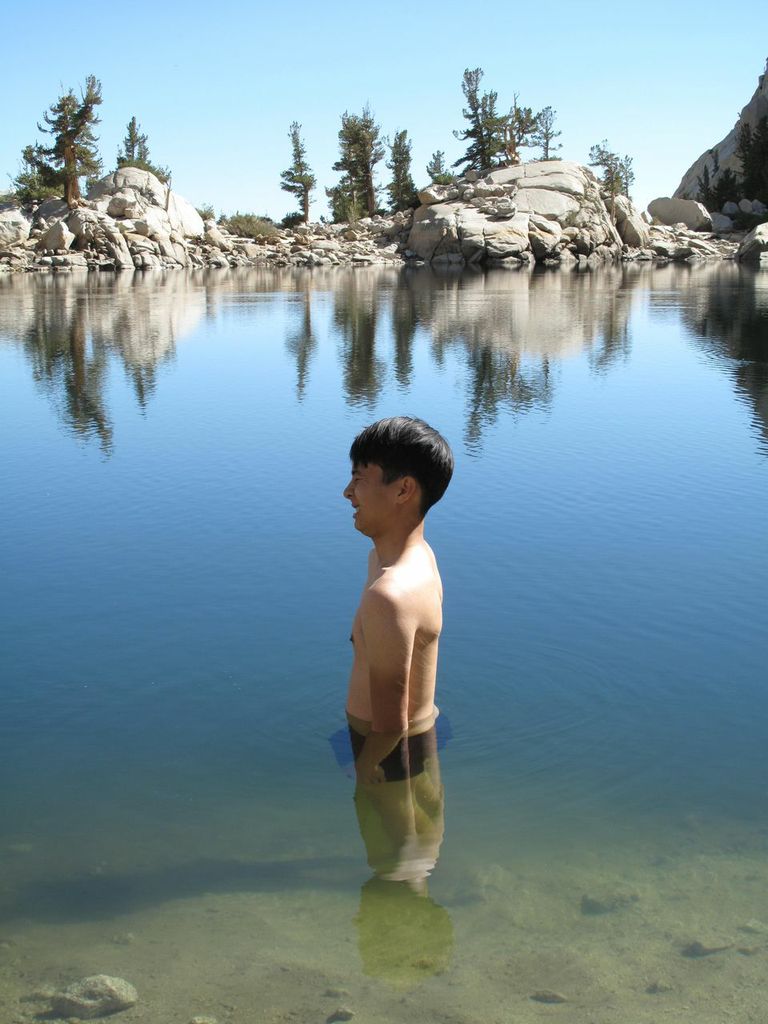
Author considering the waterways of the High Sierra
My family has a troubled history with water. Mostly unspoken, but certainly perennially sloshing beneath the surface. The sibilant fizzing of waves serves as the perpetual ambient soundtrack to everyday actions and outlooks. Our timeline is soaked through and squelching with unaddressed, repressed memories. We’re ceaselessly waterlogged with waylaid recollections.
I had an uncle who drowned in Hội An, Vietnam. My father escaped with our family to California in the 1980s during the postwar diaspora, leaving behind his siblings floundering in the uncertainty of a country shrouded in communism, recovery and retribution. According to long-recounted family lore, my uncle was out drinking one night when he fell off a bridge and was swept away by the waters of the Hoai River. Seemingly another unsuspecting victim of the unforgiving Ma Da. Perhaps this was the version of events that allowed the family to save the most face, as the notion of suicide would invite stigma and shame. Even discussing the possibility of suicide is considered bad luck in Vietnamese culture. It has become a sensitive subject for my father, whom I’ve rarely been able to cajole into speaking openly about his brother’s death. Suicide in contemporary Vietnam remains a growing public-health challenge, discussed only in whispers behind closed doors because of prevailing attitudes towards mental-health struggles. According to the Ministry of Health, as of 2021, the suicide rate in Vietnam was approximately 7.3 per 100,000 people, indicating a slight upward trend in recent years, with young men constituting a particularly high-risk group owing to certain societal pressures. Moreover, given the intense social stigma, these rates are likely to be underreported in official statistics.
And the memories continue to pour down like rain at the height of monsoon season. I recall how incongruous it felt to learn that, despite growing up a stone’s throw from the beach, my mother had never learnt to swim. Whenever we went to the beach as children, we would wade no further than knee-deep water, lest a rogue wave carry us off, leaving her helpless to retrieve us from the briny grip of the Pacific.
More memories sluice through my brainpan like water through a warped sieve. I had an older cousin who died in a motorbike accident many moons ago in Vietnam. It was the aftermath of heavy rain, and traction on the road was poor, making conditions perilous. His front wheel was heading towards what appeared to be a harmless puddle, but its yawning, obsidian reflection actually concealed a cavernous pothole that snatched the bike’s equilibrium from beneath him and sent him hurtling headfirst at high velocity. Apparently, angry water spirits can even lurk within a thimbleful of water.
The legend goes that the Ma Da is the vengeful ghost of a trapped soul, someone who died violently by drowning, doomed to tread water forever in a watery purgatory until they can drag another hapless soul down to take their place, thus perpetuating an endless cycle of suffering. I have a vivid memory of falling into a swimming pool when I was five, while chasing an errant ball that had bounced out of my grasp. Thrashing, my clothes sodden and weighing me down further and further into the indigo abyss of the deep end. Gulping ocean after ocean of angry water into my lungs. Am I misremembering the cold, clammy hands of the Ma Da around my ankles? My older brother quickly dived in, retrieved me and pulled me to safety. I was forced to stay indoors, swaddled in a towel, for the rest of the afternoon. I had to endure the muffled sounds of my cousins enjoying the diving board and pool noodles in the distance, while my eyes burned with a mixture of FOMO and chlorine.

Author lakeside on the John Muir Trail
❧
I bob from one memory to the next, riding the current from buoy to buoy of half-recalled remembrances. I recall the oft-repeated stories of my family’s escape from communist Vietnam on a rickety vessel, joining the vast exodus of boat people fleeing a crumbling country. How the boat was overloaded with families and desperation, and how that little, determined diesel engine wheezed weakly as it hauled a boatload of dreams and aspirations farther and farther into international waters. Braving the gauntlet of pirate attacks, a maelstrom of storms and the unrelenting broil of sun exposure. Drinking water was severely rationed, and everyone was reduced to a bottlecap-sized sip each day. My infant siblings clinging to a mother who couldn’t swim, swallowed by a horizon of cresting waves that fitfully tossed this unsteady skiff, carrying an ecosystem of faith and stalwart hope, to and fro.
The little ship that could was eventually rescued at sea. A large freighter approached and tossed canisters of drinking water and dry food in a plastic bag towards them. But by that point, everyone aboard the little boat was too emaciated and weakened by the journey to swim out and retrieve the precious sustenance. It was my father who ultimately slipped into the frothing swells and mustered the strength to swim out and back for the sorely needed provisions. A hero who weighed all of ninety pounds soaking wet. A hero who would eventually find himself marooned at the bottom of a bottle for years because of the experience, which is a different kind of drowning altogether.
My parents took no pleasure in reminiscing about that harrowing boat journey. They would be evasive and redirect the conversation to almost any topic other than our precarious nautical origin story. I witnessed firsthand the lingering trauma and long-term effects of their maritime ordeal on our first recreational fishing excursion. It was a school field trip, and I was eleven. I had never been out on the open sea, apart from when I was a zygote and my pregnant mother climbed aboard that ramshackle sampan many years earlier. My parents were chaperones, and once we were out on that choppy open water, they immediately wilted and were wracked with seasickness. With their heads buried in their arms, I heard my mother mutter that this wretched voyage reminded her of vượt biên. I kept a vigilant eye on my fishing rod for the slightest shudder of a bite, unaware that the gnashing jaws of the past were already snapping all around us.

Author’s mother in Hội An circa 1970
❧
I’m jostled out of my erstwhile reverie and hurled back to more recent events. A cannonball into the roiling waters of present memory. Like my wife’s waters breaking and the arrival of our mewling, placenta-laced twins. And I can wring further retrospection from a washcloth as I bathe my infant children, buoyantly optimistic that this watery ablution can cleanse the vexations of history and that my family might emerge anew, free from the deeply entrenched impediments of the past.
The trickle of an ocean of promise contained in a rivulet of suds beading on my child’s eyelash.
How to cite: Bui, Tommy Vinh. “On the Banks of Bereavement: The Cultural Confluence of Vietnamese Grief, Memory, and Familial Hydro-history.” Cha: An Asian Literary Journal, 14 Oct. 2026, chajournal.com/2026/10/14/hydro-history.


Tommy Vinh Bui is a librarian and doctoral student. He served as a Peace Corps volunteer in Central Asia and was a 2018-19 Arts for LA Cultural Policy Fellow for the City of Inglewood. His work has been featured in the Wende Museum exhibition Vietnam in Transition, 1976-present, which explores the multifaceted intersections of art, history, and memory since the end of the Vietnam War.