
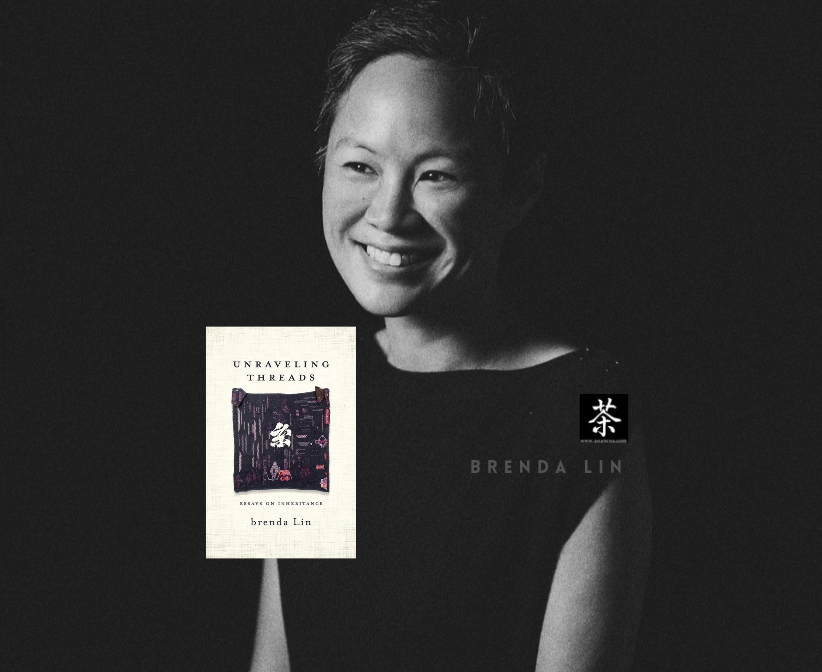
[CONVERSATION] “Between Text and Textile: On Unravelling Threads” by Tiffany Troy and brenda Lin
brenda Lin. Unraveling Threads: Essays on Inheritance. The Ohio State University Press, 2026. 216 pgs.


Tiffany Troy (Tiffany): You begin the essay collection with “Umbilical Cord 繫”, where you write: “Before my mother’s wedding day, my grandmother gifted her the umbilical cord that had dried up and fallen off her newborn belly, which Ama had carefully saved all those years.” Why begin there? How does this beginning scene help introduce the reader to the essays that follow?
brenda Lin (brenda): I remember the day my mother showed me this umbilical cord, which my grandmother had saved for her. It was the first time I experienced seeing a metaphor in its material form. This dried-up umbilical cord was simultaneously the physical thing that tethered a baby to her mother and the thing that represented all that is shared between a mother and her child. Of course, as a young, self-centred child, the first thing I asked when my mother showed me her umbilical cord was where ours was. I was stunned when my mother told me she didn’t save ours. Now, the absence of this tiny relic represented to me all that distanced me from my mother. This was the energy that fuelled my first book, Wealth Ribbon, about leaving Taiwan when I was seventeen, and the twin desires of yearning for my mother’s approval and needing a wide berth from her. In many ways, I was looking for and re-braiding the umbilical cord that I knew still held me to my mother.

I returned to Taiwan a mother of three children, after a twenty-year absence, and this book, Unraveling Threads, is about the process of that homecoming. It is also about motherhood and inheritance, which is another way of framing what it means to be a daughter, an adult child of ageing parents. It felt, in many ways, like I was being pulled back home by this umbilical cord, back to my mother and back towards Taiwan.
Because my parents are in the children’s apparel business, my mother became a children’s textile collector, and over the years, I have worked with her on several books about her collection. After I returned to Taiwan, I started doing some archival work for her collection. Every essay title is accompanied by a Chinese character that has the radical 糸. Characters with this radical indicate that the word has something to do with thread or silk. These characters and my mother’s textile collection serve as the central theme and metaphor for all the essays. The character 繫, in the title essay, means to connect, to tie (the radical is on the bottom of the character). I wanted to begin the collection with this image of ties that simultaneously pull us close and hurl us outward; ties that become knots and ties that loosen and unravel.
❧
Tiffany: I feel that unravelling through the radical as a motif throughout your essay collection. In your “Acknowledgements”, you write: “This book took ten years to complete. Most of the time, I didn’t know it was a book.” What was your process in writing and putting together the essay collection, which has “strands of stories in the repetitions and patterns between my mother’s textile collection and my early days of motherhood”? How were you able to work through these strands by writing?
brenda: Most of this book was written when my three children were very young. For the first six years after having children, I stayed at home with the kids. Physically, this was demanding work, and my time became spliced into increments, wholly dependent upon the children’s always-urgent needs and schedules. The writing I was able to slip into those in-between times was more like note-taking. I honestly didn’t know what I was writing towards; I simply jotted observations and scrawled out scraps of ideas. Ironically, it wasn’t until we moved back to Taiwan and I started working (with my parents and later, teaching) and had less time that I was able to gather my notes and weave the disparate strands into something somewhat cohesive. Of course, my children were growing up, too, and needed me in different ways, and I saw how my energy was able to be channelled towards reading and writing with more clarity.
Early in this process, maybe the second or third year after we’d moved back to Taiwan, I had the opportunity to meet the writer Sandra Cisneros. She was so kind and generous with her attention and gentle with her encouragement. When she asked what I was writing, I told her I wasn’t really writing, that I was just scribbling and taking notes, and she looked at me very seriously and said, “But that’s writing! Those bits! They add up!” That’s all she said. But suddenly, I was able to see that she was right. There was still a lot of reading and research and thinking I had to do to add up those bits, but simply having her tell me that they weren’t nothing, that gave me the courage to see the shape of what I had been gathering.
❧

Tiffany: Your encounter with Sandra Cisneros and the resulting revelation call to mind Ursula Le Guin’s 1986 essay “The Carrier Bag Theory of Fiction”. Can you talk to us about what it is and how it influences your writing within the context of the collection?
brenda: I was first introduced to Le Guin’s “Carrier Bag Theory of Fiction” through a David Naimon interview with the writer Lidia Yuknavitch. Le Guin’s version is actually based on an earlier idea, the Carrier Bag Theory of Evolution, put forth by the writer Elizabeth Fisher in her 1979 book, Woman’s Creation: Sexual Evolution and the Shaping of Society, where Fisher proposes an alternative way of understanding human evolution, which, until then, was filtered through a patriarchal lens. Fisher suggests that the earliest inventions must have been some sort of container to hold things that have been gathered for survival. Building on this, Le Guin considers how we are so used to centring stories on the hero’s journey, that trajectory of the hunter/explorer going out and coming back to tell the tale. So she reconsiders and asks, what about the women who stay behind, carrying their babies on their bodies in baby carriers, while putting the foods they gather into sacks? What about those stories?
This was a turning point for me. We were talking earlier about writing bits and pieces and not really knowing what I was writing towards in the beginning. I think learning about Le Guin’s Carrier Bag Theory of Fiction allowed me to begin seeing a shape to all the strands I had been writing and gave me a way to weave them together. In writing, we often talk about form and shape, both of which are really synonyms for containers and bags.
For many years, I did archival work for my mother’s textile collection and translated her writing into English. She collected century-old handmade children’s textiles from China, Taiwan, and Southeast Asia: baby carriers, baby hats, bibs and collars, shoes, and clothes. My first introduction to my mother’s collection was through the baby carrier. If you think about it, the baby carrier is the first container we know after we are born. Of course, before that, we are contained within our mother’s uterine sac, the original container! After becoming a mother and carrying all three of my children, I understood why baby carriers were so highly regarded in many cultures. Textiles have memory. You ever notice how every person’s wardrobe has its own distinct smell? It’s because textiles are imprinted with the person’s oils and perfumes and sweat and all the activity and thinking and living they do in their clothes. You can imagine how much of a baby’s essence is imprinted into the fabric of the baby carrier if they are carried in it all day. In fact, in many Indigenous and ethnic minority cultures in China, the ties of the baby carrier represent the umbilical cord that once tied the baby to their mother.
You can see how Le Guin’s Carrier Bag Theory of Fiction really helped me tie all of these strands together!
❧

Tiffany: Speaking of process, what do you write with or on? How does the very act of writing influence your thought process as a daughter, wife, mother, professional and now educator as well?
brenda: I write every morning in a journal or in a notebook. Currently, the journals I like to use are A5 hardbound Leuchtturm1917 journals that are lined with dots. This is where I process and reflect on any and everything in the current moment. I like these journals because they’re paginated and have an index. After I’ve finished a journal, I re-read each entry for patterns and note them in the index. I use Muji notebooks for ideation and research and for first drafts and translations. I always use Pilot FriXion pens (I wrote about this in the book) because the ink disappears in heat. My writing is my most important creative practice, but at the same time, I don’t want to be too precious about it. Writing with FriXion pens reminds me that all of it, writing, this life, is impermanent.
It has been well documented that writing by hand activates many more neural pathways in the brain than typing does, especially because it connects motor, sensory, and cognitive processing. I really enjoy the tactility of writing by hand. I believe most practices have meditative effects, and writing by hand is definitely one way I am able to ground myself. Starting my days this way is essential because in my profession as a teacher, and even when I come home to my children or if I spend time with my parents, the energy I have is being shared out. Writing is how I gather the energy I need throughout the day. It’s how I refill my energetic pool.
You asked about writing and processing. I think they are the same thing. At least for me. One of my best friends was surprised when I described myself as an overthinker. We’ve been friends for 40 years, and she said she’s never thought of me as someone who fixates on things. I think it’s because I write things down. I process on the page, and because there’s this physical place I can set things down, it opens up space in my mind for other forms of connection when I’m away from my writing.
❧
Tiffany: Speaking of writing by hand, the motif of the matrilineal script comes up as naturally as the women you quote. Who are the women writers who have influenced this collection in terms of both the artefact of the day-to-day of motherhood and that process as ritual?
brenda: Elizabeth Wayland Barber’s Women’s Work introduced me to the history of textiles and women’s roles in ancient societies and showed me how this thread has been pulled all the way to today, and specifically, how I move through the world as a woman writer, a mother, and as a daughter. Ursula K. Le Guin, of course, is another woman writer who has influenced my thinking a lot, especially through her Carrier Bag Theory of Fiction, which we discussed earlier.
But I must say that perhaps even more than women writers, the women artists who have guided me in the day-to-day demands and rituals of motherhood are famous textile artists like Anni Albers, as well as the countless mothers and grandmothers who hand-stitched all the textile pieces in my mother’s collection. It’s by studying the material outcome of women’s work, this repetitive motion of the needle pushing into a cloth and being pulled out from the cloth, that I have been able to embody the spirit of this work and what it means and how it might look in my own life.

Anni Albers, Knot, 1947, gouache on paper, 43.2 x 51 cm, 17 x 20 in., © The Josef and Anni Albers Foundation, © Photo: Tim Nighswander, © ADAGP, Paris
❧
Tiffany: I am interested in how the objects that you describe become a jumping-off point or a mirror through which you view your journey as a student studying on the north-east coast of the United States and then your journey home. What is the act of literary translation to you and how is it related to your writing?
brenda: I came to literary translation without intending to. My first experience of translation was through the objects in my mother’s textile collection. As I mentioned, she wrote books about the different categories in her collection (baby shoes, baby carriers, baby bibs/collars, and one on purses and containers), and I helped translate her books from Mandarin to English. This was when I was living in New York, so in a way, translation was the way I communicated with my mom when we were separated by great distances.
After I moved back to Taiwan, I noticed that my Mandarin had worsened significantly, so I worked to get it back by reading Taiwanese literature. I came across a book of essays by an Indigenous writer named Apyang Imiq, writing about returning to his Truku village in Hualien, on the east coast of Taiwan, and was so moved by the writing that I started translating his essays, just so I could understand the language more intimately.
For me, literary translation is another form of close reading and writing. I also think that all writing is a form of translation. What I mean is that we write to get to the closest approximate description of how we experience this world, which is an embodied, sensorial experience that words could never fully encapsulate. But that’s the thing with writers: we can’t help but keep on trying.
❧
Tiffany: I really appreciate hearing about your legacy and relationship with language(s), especially given how those stories are central to your work. What are you working on today?
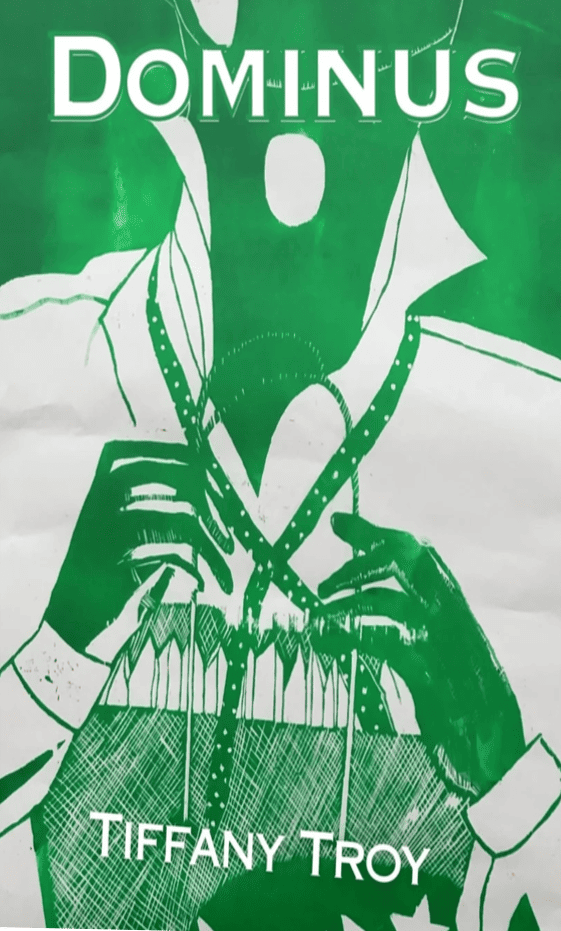
brenda: I’m back to writing bits and pieces, little folded-up scraps of I-don’t-know-what-yet. I don’t know if you felt this way after you completed your poetry collection, Dominus, that there’s almost this feeling of end-of-summer-camp blues? I miss the feeling of being elbow-deep in a project. But I’m also excited for the patterns that will emerge from the notes I’m taking right now. I am translating some of Apyang Imiq’s short stories and am looking for other translation projects as well. There’s never a shortage of things to write/translate!
❧
Tiffany: There was definitely that sense of blues after Dominus, and I would say that it is through the process of writing (in part) that I found myself again, amid larger-than-life forces that seek to destroy the lyrical self in some ways. Do you have any closing thoughts for your readers of the world?
brenda: I love what you said about the process of writing as a way to find yourself again and again, and perhaps just as importantly, as a way to gird yourself against all the other responsibilities and distractions in life. I’m at my best when it feels like all these different facets work in concert with each other. It doesn’t happen often, but when it does, it’s magical.
Because of the work I did around my mother’s textile collection (translating and archiving), I felt pulled to learn basic embroidery and have also taken a few weaving classes. I’m a novice, but I do love working with threads. I really encourage people to try it, especially if you’re a writer. It’s the perfect parallel practice. You understand, physically, why text and textile share the same root.
Thank you, Tiffany, for your beautiful questions. It was so lovely to be in conversation with you! And I want to wish you good luck with your writing, too!
How to cite: Troy, Tiffany and brenda Lin. “Between Text and Textile: On Unravelling Threads.” Cha: An Asian Literary Journal, 13 Oct. 2026, chajournal.com/2026/10/13/threads.


Tiffany Troy is the author of Dominus (BlazeVOX [books]). She translated Catalina Vergara’s diamonds & rust (Toad Press International Chapbook Series). She is Managing Editor at Tupelo Quarterly, Associate Editor of Tupelo Press, Book Review Co-Editor at The Los Angeles Review, and Co-Editor of Matter. In 2025–2026, she is a Co-Curator in Residence at the MinEastry of Postcollapse Art and Culture. In that role, she co-curates The American Wing, which features poets who shape the rich, polyglot and ever-evolving landscape of American poetry. [All contributions by Tiffany Troy.]
[All contributions by Tiffany Troy.]


brenda Lin is a writer, literary translator, and educator based in Taipei, Taiwan. She is the author of Wealth Ribbon: Taiwan Bound, America Bound (University of Indianapolis Press, 2004) and Unraveling Threads: Essays on Inheritance (Mad Creek Books, 2026). Her writing has appeared in Fourth Genre, WSQ, and Seventh Wave; her translations have appeared in Asymptote, Gulf Coast Journal, and The Kenyon Review. brenda writes frequently about family and the intersection between text and textile. Visit her website for more information.