
茶 FIRST IMPRESSIONS
茶 REVIEW OF BOOKS & FILMS
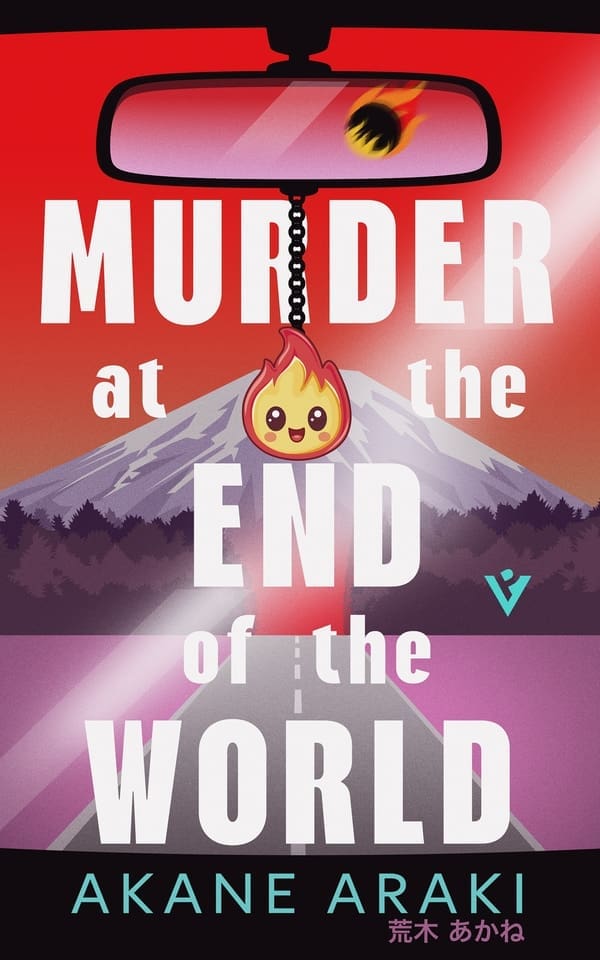
[REVIEW] “The Right to Remain: Akane Araki’s Murder at the End of the World” by Tyran Grillo
Akane Araki (author), Jesse Kirkwood (translator). Murder at the End of the World. Pushkin Press, 2026. 336 pgs.


Humanity has sixty-seven days left, and Haru is still being told to check her mirrors. While the asteroid Telos approaches its appointed collision with Japan, the twenty-three-year-old narrator of Akane Araki’s Murder at the End of the World continues taking driving lessons through the deserted streets of Dazaifu.
Most people have fled, but she wants to drive towards the impact site, accompanied for now by an instructor, Isagawa, whose conversation makes her almost as nervous as the road. Jesse Kirkwood’s wonderfully biting translation captures the absurd intimacy of this predicament, allowing horror to surface through ordinary complaints. When a murdered woman is discovered in the boot of a training car, however, Isagawa’s former career as a police inspector reasserts itself, and her determination to investigate draws Haru into a web of moral obligations in a world that has descended into chaos.
❧
Haru’s reluctance becomes understandable once we enter the household she has been struggling to maintain. Her mother has disappeared, leaving her with a brother who barely emerges from his room, while her father’s suicide confronts her with the exhausting task of moving his body outside. Through such grotesque practicalities, Araki reduces extinction to the dimensions of a hallway, where the dead continue to make demands upon the living. Even suicide has acquired its own etiquette, with the vogue for “dying wild” encouraging the desperate to dispose of themselves considerately in picturesque mountain settings. “The last bestseller in the world had been a suicide manual,” Haru recalls, and her own readiness to disappear arises from a humdrum existence she has little desire to reclaim. She makes the implication painfully clear when she admits, “Even if the asteroid somehow veered off course and the planet was saved, I’d probably rather die than go back to the life I used to have.”
Driving promises her a way to give that longing a destination, although the lessons immediately expose the limits of travelling on her own terms. Before the murdered woman is discovered, a young suicide’s body falls onto the windscreen during a lesson, thrusting somebody else’s death into the path of her private departure. Isagawa’s ability to apply the instructor’s brake makes their arrangement an uneasy negotiation between autonomy and intervention, a tension that deepens as motorway training becomes a pretext for pursuing a seemingly connected series of homicides across Fukuoka. Haru has enrolled to master the means of leaving, yet each journey brings her into contact with people whose lives demand her attention. Her admission that “I found it hard enough to understand people when they were alive, never mind after they’d died” begins to sound increasingly inadequate as a justification for looking away.
❧
With police stations closing, their investigation depends on whoever remains willing to help, including the doctor who performs the murdered woman’s autopsy. While they wait on the clinic roof, elderly residents gather around the faint possibility of a phone signal, their attempts to reach someone complicating Haru’s sense that the world has already emptied itself. The dead, too, have found a means of calling out. A business card recovered from the victim’s stomach identifies her as a lawyer who had trusted that somebody would investigate, even under these circumstances. By recording the evidence on her phone, Haru begins to honour that trust, and the anxious preparation that once seemed merely fussy acquires a purpose beyond her own survival.
A local sergeant gives this emerging obligation its clearest expression when he hands over evidence and asks them to continue. “I want you to find out who did this. Nobody deserves to die like that.” His plea insists that the manner of dying retains its significance even when death itself is inevitable, bringing the novel into conversation with Philosophy for an Ending World (2024), in which Tim Mulgan imagines cosmic rays extinguishing life on Earth in two hundred years and asks how inherited values might change so that future generations could flourish within that limit. Araki’s shorter countdown brings these questions into immediate, bodily proximity. Deontology asks what duties remain regardless of their usefulness, while existential ethics concerns the values we choose without posterity to endorse them. In Haru’s immediate predicament, the time left to suffer is also time in which suffering might still be prevented.

❧
Those obligations become harder to disentangle from personal feeling when the investigation brings Haru and Isagawa to an abandoned oyster shack. There they encounter Hikaru and Akihito, brothers whose criminal entanglements unsettle the categories Isagawa would ordinarily use to judge them. Her questioning provokes a brawl involving a kettle, yet the canned oysters being grilled over a heater somehow survive to become a shared meal. The brothers’ gloriously inept singing and easy laughter reveal a closeness unfamiliar to Haru, who begins to discover what companionship can offer while she still has time to embrace it. Their presence lends the inquiry a human richness that deductions alone could never supply.
The warmth of that encounter makes their subsequent visit to Kasagi, another victim’s mother, especially disturbing. A teacher who speaks the language of benevolence, she uses her authority to humiliate someone dependent upon her, exposing the danger concealed within claims of protection. Isagawa’s response reveals her own dangerous impulses, since her instinct to defend the vulnerable can readily become a willingness to decide who deserves to live. Her abrasiveness remains wonderfully entertaining when she declares, over a meal, “Listen, asteroid or no asteroid, the world’s a pretty meaningless place,” before discussing the food’s eventual conversion into waste. When Haru searches for a personal tragedy that might explain this appetite for punishment, Isagawa replies, “I’m not the tragic lead in some cop drama, lugging my trauma around and taking it out on people.” The refusal leaves Haru confronting an authority figure whose anger can issue its own warrants, and learning from her increasingly requires knowing when to object.
That difficulty follows the investigators into a deserted shopping centre, where armed holdouts detain them and confiscate their belongings. Surrounded by mannequins in a clothes shop, they wait on the floor to discover what their captors want. The encounter becomes another uneasy negotiation between suspicion and tenderness, as the need for safety generates new claims to authority after the state has withdrawn. Moving between such improvised communities, Haru must learn to recognise what people do with the power they possess. A criminal history may coexist with generosity, while respected credentials can provide cover for cruelty. Her growing attentiveness also challenges our eagerness to classify the people she meets, as the investigation continues to reveal lives that resist the descriptions imposed upon them.
❧
Against these efforts to attend to particular lives, the killer’s reasoning transforms indifference into a grotesque experiment. The collapse of law enforcement provides an opportunity to manufacture suffering, which then becomes evidence for the claim that nobody cares. This circular philosophy reduces other people to material for an argument about humanity, disguising a coward’s preference for vulnerable victims beneath an appetite for power without resistance. As the clues accumulate, the question of why anyone would kill when everyone is dying acquires a more disturbing companion. What allows someone to believe that another person’s remaining time belongs to them? The question draws us closer to injuries that were already consuming lives before Telos appeared.
Bullying consequently emerges as the novel’s more intimate machinery for ending worlds, capable of driving a child out of shared life while the school day continues punctually around them. Its effects reach into the present through an apology that may serve the aggressor’s hunger for relief, requiring the injured person to make the perpetrator who hurt them feel better. Araki understands the cruelty of such a request, and recognising someone’s capacity to change does not diminish the victim’s right to anger. Through this difficult freedom, the closing movement gathers the investigation’s moral uncertainties into an ending whose remaining time feels strangely expansive. Even language resists being prematurely embalmed into a statement for the record, preserving a space in which people can still decide what they owe one another.
That resistance to premature closure draws us towards the childhoods that continue to inhabit the adults who have survived them. The bullied child remains seated somewhere in the nervous system, waiting for a room to become safe, and the mere passage of time cannot release that child. Even cosmic destruction cannot retrospectively make the room hospitable, leaving care with the task of entering without demanding that its injured occupant surrender the evidence. What would it mean to offer asylum to a moment in time? Araki brings us to the threshold of that impossible shelter, where someone might enter carrying an anger nobody requires them to leave at the door. Even there, at humanity’s terminal border, the injured past might be granted a right of residence.
How to cite: Grillo, Tyran. “The Right to Remain: Akane Araki’s Murder at the End of the World.” Cha: An Asian Literary Journal, 13 Oct. 2026, chajournal.com/2026/10/13/murder.


Tyran Grillo holds a PhD in Japanese Literature from Cornell University and is an avid reader, translator, music critic, and photographer. His latest book, Fuzzy Traumas: Animals and Errors in Contemporary Japanese Literature (2024, Cornell East Asia Series), explores complex interspecies relationships through a posthumanist lens. Although he has left academia to pursue a full-time career as a professional editor, he remains deeply engaged with his fields of interest through lived experience and creative practice. [All contributions by Tyran Grillo.]