
茶 FIRST IMPRESSIONS
茶 REVIEW OF BOOKS & FILMS
[FIRST IMPRESSIONS] “The Limits of Universality in Mary Stephen’s Palimpsest” by NLL
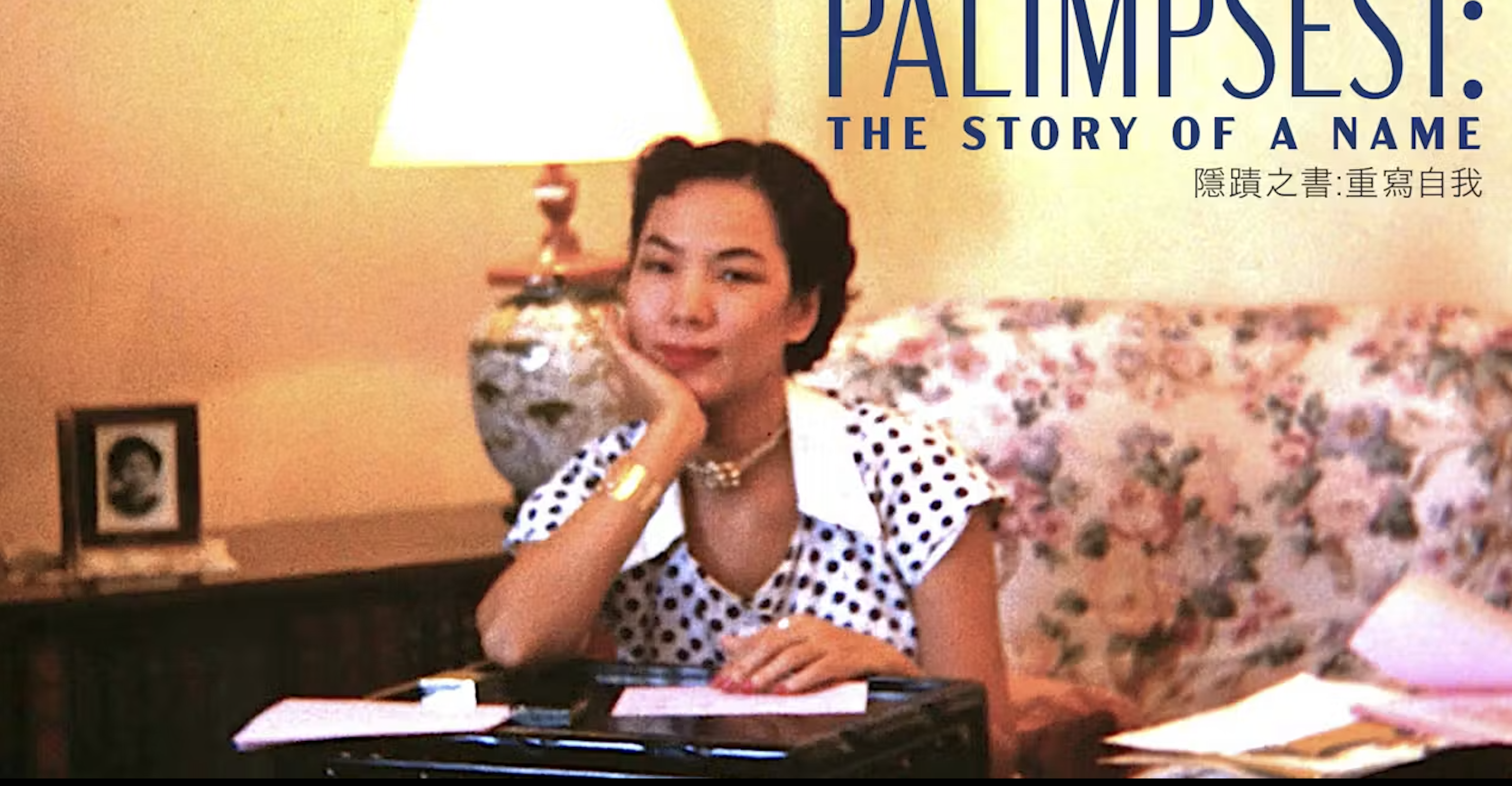
Mary Stephen (director), Palimpsest: The Story of a Name, 2025. 108 min.


I live in the middle of nowhere in relation to London. During the Hong Kong Film Festival UK, I therefore felt particularly provincial. Luckily, I managed to find one of the screenings, Palimpsest: The Story of a Name, on Arte. I happily projected it onto the wall of our living room, which has two rusted, bare hooks in the middle.

According to my film-scholar husband, who happens to be white, male, and well beyond middle age, it is nonetheless a “repetitive” and “never-ending” documentary with “fragmented commentaries”. This I took personally. I know it is more about spectatorship than the film itself: the fact that I chose to watch a film and enjoyed it without seeking his approval is a transgression in itself.
Precisely. One of the questions that the director, Mary Stephen, repeatedly (and rightly) raises concerns the historical and enduring imbalance of power between East and West. “Why am I still subjugated?” “Is this need for Western validation and identification so ingrained?” “Why does our work, our art, our science have to be validated in a Western festival, an Occidental institution, before we give it the value it deserves?”
After all, the “Stephens’ story” could have been unsympathetically interpreted as an impostor’s story, that of an ethnic Chinese couple who adopted a Western identity in a colonial society to climb the social ladder, the kind of minor characters one might encounter in Eileen Chang‘s sharp observations of Hong Kong. And their daughter, now a director, followed in their footsteps by drawing an impressive parallel between herself and her sister and the famed “Stephen sisters” (i.e. Virginia Woolf and Vanessa Bell, née Stephen).

The famed “Stephen sisters”. Left: Vanessa Bell; Right: Virginia Woolf.
❧
This imbalance, and the ways in which one might have internalised colonial values by reproducing it, do not go unchallenged in the film. Yet the director’s constant reflections reveal something beyond the binary struggle between coloniser and colonised. In a Machiavellian manner, the Chans achieved a form of self-invention that transcended the colour of their skin through a persistent exercise of creativity and the enactment of make-believe, all while adhering to a colonial order they could not dismantle. In becoming “Stephens”, they became consummate storytellers, inhabiting the very diegesis they had created. Behind their remarkable achievement lay both a passionate and a pragmatic desire for Western recognition, a desire that could be as self-subjugating as it was transgressive.
Through self-reflective monologues (I suspect this is where the accusation of being “fragmented” originates) and montages of archival footage, family videos, and re-enactments, the director avoids constructing a linear exposé that would distinguish truth from falsehood or right from wrong in her parents’ storytelling. Even when she visits her uncle (undoubtedly her father’s brother) in China, she manages to avoid framing the encounter as a root-seeking narrative of a Jook Sing, in marked contrast to Ann Hui’s semi-autobiographical Song of the Exile (1990). After all, had Hui’s mother not also concealed her ethnic identity?

A still from Song of the Exile (1990)
The director further shows us an image of a banyan tree whose roots hang in the air as she speaks with her own daughter, who has chosen the double-barrelled surname “Stephen-Pons”, combining surnames from the maternal sides of the family, for her offspring, the director’s grandchild. Such a choice not only reflects an individual’s aspiration to be a “citizen of the world” but also echoes the director’s narrative of her transcontinental upbringing. In a scene featuring a speech at a film festival, the director proclaims, “I lost my mother tongue, Cantonese […] was compensated by finding a new language: the film language”. That sense of global belonging, that belief in a universal film language, seems a natural progression beyond the older East-versus-West struggle.
❧
Yet, as spectators, should we regard this notion of globality, of transcendence, as a utopian projection or a naïve dream? And if film language is truly universal, why can I, as an Asian woman, relate so deeply to the film while my white male husband cannot? Are my gender, my own lived experience of colonialism and postcolonialism, and the extension of such hierarchies into my domestic environment not crucial to my viewing experience? Even the fact that I could enjoy the fluid transitions between English, Mandarin, Cantonese, and French with little assistance from subtitles must have afforded me a particular kind of pleasure, quite distinct from the experience of a monolingual English speaker like my husband, who was, at the most elementary level, struggling to distinguish one yellow face from another.
I have no definitive answers to any of these questions. What I am certain of is that I can understand and appreciate this film in ways my husband cannot. And I do not need to seek his validation.
How to cite: NLL. “The Limits of Universality in Mary Stephen’s Palimpsest.” Cha: An Asian Literary Journal, 13 Oct. 2026, chajournal.com/2026/10/13/palimpsest.


Born and bred in Hong Kong, NLL now resides in Scotland.