
茶 FIRST IMPRESSIONS
茶 REVIEW OF BOOKS & FILMS
[ESSAY] “Bodies That Exceed the Frame: Reading Andrea Mendoza’s Transpacific Nonencounters” by Tyran Grillo
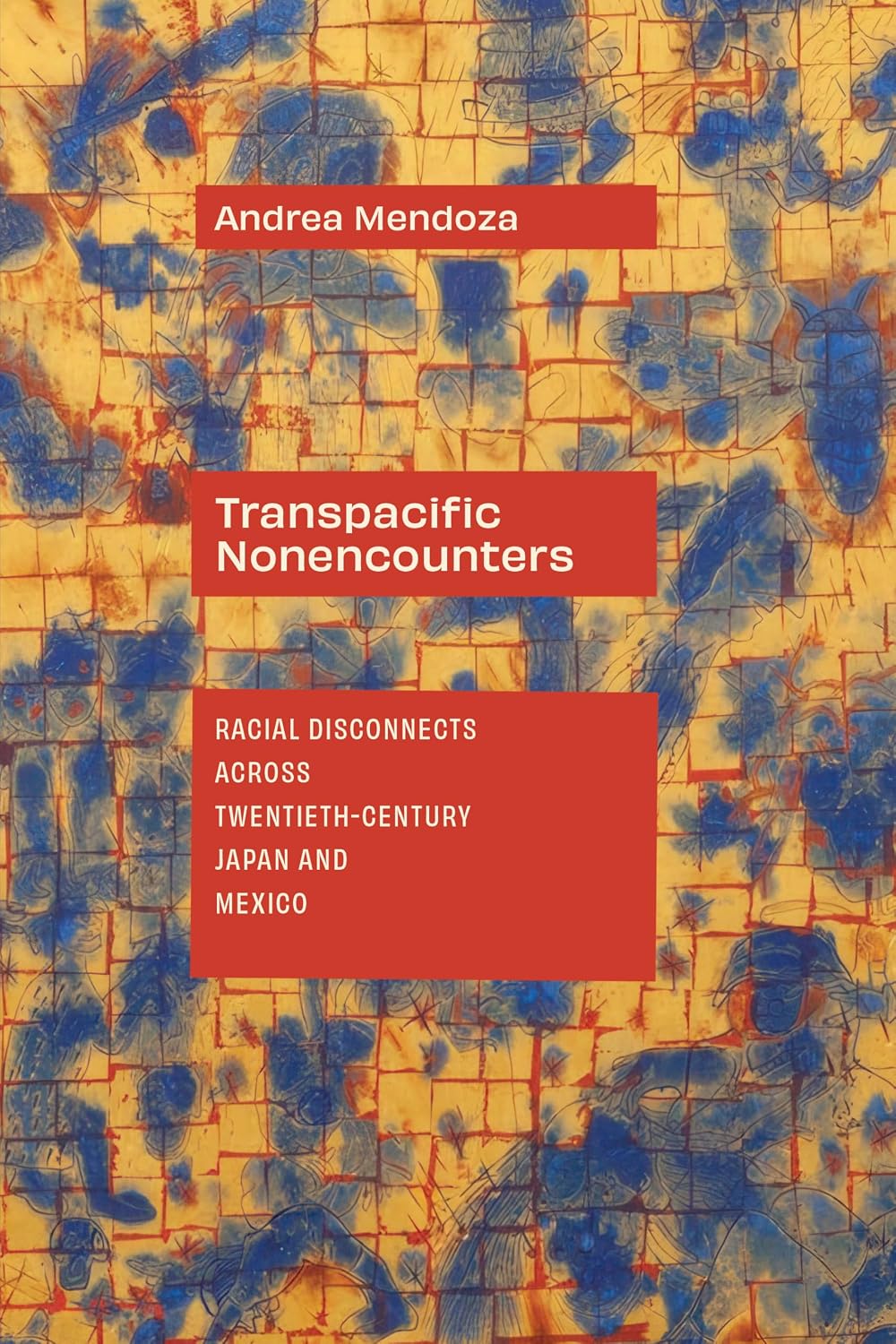
Andrea Mendoza. Transpacific Nonencounters: Racial Disconnects Across Twentieth-Century Japan and Mexico, Duke University Press, 2026. 208 pgs.

Mifune Toshirō arrived in Mexico having learned his lines phonetically. For Ismael Rodríguez’s Ánimas Trujano (The Important Man) (1962), he would portray an impoverished Zapotec man whose desire to become important ends in banishment.
Yet the Spanish heard in the film belongs to Narciso Busquets, who also voices its opening account of Indigenous village life. The man explaining the community to us speaks again through the body it expels. In Andrea Mendoza’s reading, dubbing produces a racialised register of Indianness while erasing Mifune’s access to the language he had practised. The film makes him audible on terms that have already determined what his body can mean. Listening, here, requires attending to the authority that has entered the voice.
This technical history carries much of the unsettling force of Transpacific Nonencounters: Racial Disconnects Across Twentieth-Century Japan and Mexico. Mendoza traces the philosophical and cultural productions through which Japanese Pan-Asianism and Mexican mestizaje, an ideology of racial and cultural mixing rooted in Mexico’s colonial history, particularly between Indigenous peoples and Europeans, fashioned modern national belonging. Both could profess multiracial inclusion while authorising colonial domination. Their resonances challenge the familiar opposition between a homogeneous Japan and a heterogeneous Mexico. That contrast obscures the imperial uses of Japanese multiracialism and the exclusions inherent in Mexican racial mixture. Mendoza does not suggest that these ideologies directly generated one another. Rather, her inquiry concerns the conditions that make their racial and gendered operations appear unrelated, including our own disciplinary habits of reading.
The distinction is crucial. Recovered connection can satisfy the same appetite for possession as absolute separation. The first gives the critic a world to assemble; the second, a province to administer. Mendoza asks what becomes perceptible when neither arrangement receives our automatic consent. Her nonencounter names the production of distance: what archives, disciplinary traditions and colonial ways of knowing erase or keep apart. An apparent blank acquires a history without inviting us to write anything we please across it.
❧

Her introduction begins with Kum Soni’s short documentary Beast of Me (2005) and Mare Advertencia Lirika’s Cuando una mujer avanza (When a Woman Steps Forward) (2012). Kum recounts violence against Zainichi Korean girls and women in Japan; Advertencia Lirika locates Zapotec feminist resistance within colonial and religious justifications for suffering. Each creates an archive where official history has withheld recognition. Their works remain answerable to distinct genealogies, which Mendoza places within hearing distance without asking either to become the other’s mouthpiece. The intimacy lies partly in that withheld demand.

Already, this is a queer inquiry. Mendoza draws on Sara Ahmed’s queer phenomenology to ask how inherited orientations make some relations available and others almost inconceivable. I would also add a queer/crip suspicion of the supposedly complete, independent subject whose welcome determines everyone else’s admission. In my readings of guide dog narratives, for example, human and canine interdependence becomes an inspirational route towards independence, even as the relationship unsettles that ideal. Such stories praise the overcoming of a condition while relying on it to make praise possible. Inclusion can thus leave its measure of worth untouched.
Robert McRuer’s account of compulsory able-bodiedness, interwoven with compulsory heterosexuality, identifies the demand beneath such generosity: bodily norms present themselves as the desirable destination of every life. Mendoza cites Sony Corañez Bolton’s work on the racism, ableism and colonial violence of mestizaje, giving this conversation a transpacific genealogy within her argument. Its imperial grammars echo a related demand for conformity, though their histories and effects require separate accounting. The racialised subject becomes admissible by approaching an authorised image of humanity. Academic inquiry can interrogate that image; it cannot turn racialisation into an impairment or make disability a synonym for exclusion.
❧
Chapter 1 gives this demand philosophical scaffolding. Mexican and Japanese intellectuals contest European universalism while making their own states vehicles of universal belonging. In Tanabe Hajime’s logic of species, the imperial state mediates the individual’s approach to the universal, requiring the disavowal of differences that interrupt its claim. Bolívar Echeverría’s blanquitud describes a hegemonising whiteness operating beyond white skin: an ethical and civilisational arrangement through which domination becomes the qualification for modern life. A hierarchy can change custodians without loosening its demands.
Mendoza’s use of Hortense Spillers’s grammar makes these demands legible. The universal has a household. Drawing on Yoko Fayolle Irie, she finds women’s reproductive labour beneath Tanabe’s philosophical system, even where women go unnamed. Likewise, Justo Sierra’s account of a foundational kiss between Cortés and Malintzin romanticises conquest, while his programme for national development privileges European blood. Normatively inflected romance supplies a consoling surface to coercive racial reproduction. Queering this grammar means asking whose apparent consent makes the nation’s desire sound mutual.
The body politic also has a diagnosis. Mendoza recounts how Mexican politicians defended anti-Chinese persecution through claims that eliminating Chinese residents would prevent illness and protect national health. The violence enters a medicalised vocabulary already prepared to pronounce it compulsory. How does the ideal of a vigorous national body make some lives appear as threats to its survival? The question concerns the authority to designate expendable lives by borrowing the language of care. A promise to protect becomes a method of deciding who merits protection.

Gloria Anzaldúa belongs in this conversation, with a complication intact. In Borderlands/La Frontera, the chapter on mestiza consciousness invokes Vasconcelos’s cosmic race as inclusive before developing a feminist practice of sustaining contradiction and ambiguity. Reading it alongside Mendoza makes that inheritance difficult to overlook. Anzaldúa’s challenge to patriarchal belonging transforms the position from which mixture is spoken, yet her hopes for synthesis cannot absolve the racial vocabulary she reworks. Does mixture preserve the friction of incompatible claims, or promise to resolve their histories into an improved human type? Mendoza keeps this question open even in a text whose possibilities we nourish. Affinity need not require exemption from critique.
❧
Chapter 2 condenses these tensions into the meeting of Kuwaki Gen’yoku and Adalberto García de Mendoza. Kuwaki had imagined Mexico largely through Anglo-American accounts of conquest and the Southwest. García de Mendoza’s familiarity with European philosophy unsettles those expectations; the visitor, in turn, expresses surprise at Kuwaki’s modern philosophical knowledge. Their recognition travels through the European traditions that had made them unlikely to recognise one another. Kuwaki’s handwritten greeting, in German, describes Mexico as a tierra incógnita. Two men meet, and an inherited map arrives between them.
Ignorance of a place can become a judgement of the knowledge it holds. The cartographic unknown carries the prospect of appropriation, as those already living and thinking there become difficult to perceive. Through Sylvia Wynter’s distinction between humanity and the overrepresentation of Man, Mendoza shows how philosophical capacity functions as a credential. The philosophers’ wounded recognition does not place them outside power. Their class and gender privileges shape both the injury they register and the recognition they seek.
When García de Mendoza describes the formation of Manchukuo as a phase of Japanese philosophy, colonial violence acquires intellectual dignity within an argument contesting Japan’s exclusion from European recognition. Mendoza’s careful reading prevents non-European solidarity from becoming its own alibi. Being denied recognition can coexist with the desire to command its distribution. What has enlarged here is partly the permission to occupy other lives. The participants still meet through the authority that made their meeting improbable. Nonencounter survives their handshake.
❧

Returning to Mifune, Chapter 3 follows these grammars into popular representation. Publicity surrounding Ánimas Trujano (1962) treats the actor’s supposed resemblance to Zapotec people as evidence of authentic casting. That resemblance is manufactured by a racial imagination, while his international celebrity supplies a commercial advantage that the language of authenticity obscures. Asian visibility becomes a means of managing Indigenous visibility. Mendoza draws on Jodi A. Byrd’s cacophony to hear the incompatible histories sounding within this apparently coherent image. Listening for them resists the agreeable language of cultural exchange.
Ánimas’s ambition also has an economic underside. As mayordomo, he must spend his resources on a religious celebration; the prestige he covets deepens his subjection. His wife Juana’s labour and moral rectitude make her the sympathetic figure of prospective national belonging. When their daughter is raped by a white landowner’s son, the narrative redirects attention towards Ánimas’s uncivil response, for which he is imprisoned. Sympathy thus cranes its neck around the violence that should trouble it. The audience learns to distinguish the assimilable from the disposable.
Ánimas’s excess merits care. His failure to embody the diligent, respectable patriarch disturbs the national ideal, supplying neither innocence nor an uncomplicated politics of refusal. The film scripts his failures as warnings; his conduct also harms those around him. A porous reading can register the trouble he poses to normativity without making him an emblem of liberation. Queer interpretation remains answerable to unequal relations within a marginalised community, however distant from the state.

Ōe Kenzaburō’s An Echo of Heaven offers another form of disappearance. Its narrator, K, reconstructs the life of Marie Kuraki, a scholar and mother who leaves Japan after her sons’ suicides and eventually dies of cancer in Mexico. The men memorialising her make her a saintly image for Indigenous and mestizo workers. Drawing on Anne Anlin Cheng’s ornamentalism, Mendoza shows how Marie’s racialised body becomes an object of religious and erotic projection. Canonisation is also a practice of editing. What cannot be accommodated by the image recedes from the life.
Disability sharpens this violence. K interprets Marie’s raising of her disabled son as atonement for having pursued her own desires and achievements. Care becomes a debt owed by a woman who has exceeded her allotted place. Her children’s deaths feed the narrator’s anxieties and sexual fixations; her illness helps authorise the image of perpetual sacrifice. Yet Mendoza also notes Ōe’s exposure of K’s motivations. The novel discloses possessiveness through the possessive narration that brings Marie to us. Its compromised telling is part of the evidence.
My critique of inspirational disability narratives finds an uneasy resonance here. Suffering becomes valuable because it improves somebody else’s moral or emotional life, leaving the sufferer to make that improvement legible. A crip extension of Mendoza’s reading would ask what care Marie’s canonisation leaves unavailable to thought: care with support and limits, permitting fatigue and ordinary continuation without demanding that the recipient redeem the caregiver. Her story solicits attention to the infrastructures that could sustain such relations, even where the narration prefers a beautiful death. The saint’s image gives little room for the person to ask something back.
❧

Chapter 4 makes the ethics of this solicitation harder still. Reading Abe Kōbō’s The Face of Another alongside Carlos Fuentes’s The Death of Artemio Cruz, Mendoza places anti-Blackness within the constitution of their literary worlds, where the history of slavery continues to organise the environments in which recognition occurs. Cultural distance cannot grant a text exemption from those environments.
Abe’s unnamed scientist, facially scarred by a laboratory explosion, commissions a prosthetic face that he hopes will restore social access. His project becomes entangled with revenge against his wife, whom he seeks to seduce under his assumed identity. She knew it was him all along, undoing his fantasy of control. Mendoza interprets the novel’s injured embodiment through its references to anti-Korean discrimination and anti-Black violence, asking how those references sustain the protagonist’s self-concern. His woundedness troubles his membership in a dominant community without dissolving his privileges or entitlements.
The televised account of the 1964 Harlem protests makes that limitation explicit. The narrator imagines a brotherhood of the faceless alongside Black resistance, then distinguishes the social gravity of anti-Black racism from his personal predicament. This partial recognition leaves the structure of racial violence insufficiently confronted. Black life offers him a means of understanding himself while remaining distant from the understanding he produces. The passage offers an uncomfortable corrective: pain cannot certify the legitimacy of a comparison. Attention must follow the relations of power an analogy may interrupt, preserve or quietly borrow.
The prosthetic face also asks something of crip criticism. A wish for bodily alteration need not entail the surrender of political agency; assistance and adaptation can make life more liveable. What deserves scrutiny is the demand that a body approximate a norm before social life becomes available to it. Narratives of restored independence can disavow the interdependence that enables movement. In Abe, the mask’s promise becomes bound to the scientist’s desire for mastery.
Fuentes’s novel moves through another concealment. Artemio Cruz, a former revolutionary turned land magnate, approaches death as the narrative returns to the Black maternal history suppressed within his social ascent. His mother’s name circulates as Isabel Cruz and Cruz Isabel, while the surname he carries retains a relation that his pursuit of paternal recognition has obscured. Mendoza reveals in this unstable naming the violence constituting the supposedly integrated nation. Artemio’s fragmented reflection makes that integration difficult to sustain. History returns through what his authority has required him to set aside.
Lunero, his maternal uncle and caregiver, introduces a different relation to inheritance. His love and labour preserve the child’s life, yet the narrative makes his death a condition of Artemio’s separation from that past. Alongside Marie, Lunero raises the question of how often another person’s disappearance becomes the price of a protagonist’s becoming. Attention to dependence can press on this price without gathering their distinct racial and gendered histories into a universal economy of woundedness. Recognising a pattern leaves us owing each life its particular account.
Mendoza’s recovery of the whole body concerns histories withheld by racial inscription. A crip inquiry can extend that recovery by questioning the values attached to wholeness. What if bodily integrity ceases to be the horizon against which a life is understood? What becomes visible when a disabled body persists without serving as the image of an injured nation or the occasion of its repair? The novels make a loss of coherence dramatically available. Yet a life need not have lost an intact earlier self to deserve an account of its present.
❧
Elsewhere, I have considered a representation of Shirai Noriko, born with limb differences, who explains that she has never known the sensation of having hands and has not experienced their absence as a personal loss. Her statement interrupts the chronology that makes disability legible as a departure from an original completeness. Bringing that interruption to Mendoza’s archive would ask how far the language of wounding can accommodate bodies whose differences do not announce a rupture. Her close readings make injury historically specific; a crip extension would also make persistence specific, including its pleasures and the practical arrangements it requires.
Departures from prescribed function can expose the limits of the categories judging them, with destructive as well as generative consequences. Colonial violence, however, owes us no intellectual dividend. Its victims need not become the occasion of our improved thinking. An error worth cultivating belongs to the critic’s arrangement of knowledge: a failure to deliver the coherent comparison or consoling conclusion our methods have trained us to expect. Such a failure becomes useful only insofar as it changes our obligations towards what those expectations obscure.
❧
The coda returns to Kum and Advertencia Lirika and the critical possibilities of their works. With Lee Chonghwa’s politics of murmurs, Mendoza considers words that can be received without being consumed. Lee’s bē, carrying meanings of stomach and boat across Korean and Japanese, gives inheritance an embodied, unsettled vessel. The murmur asks something of the listener while retaining a life beyond that listener’s comprehension. The difference from Mifune’s replaced voice becomes palpable. In Beast of Me, Kum speaks in Korean and Japanese and dubs her words in English; the layers retain the difficulty of their address. She shapes the mediation through which we hear her experience. Audibility need not be purchased through the authority of someone else’s explanation.

Foreign Sky, video, 2005, 70 min.
Kum’s Foreign Sky, as Mendoza describes it, includes attempts to bury and mourn animals killed by drivers in California. My concern with traumatic animality finds a material point of conversation here. These deaths do not stand in for Zainichi suffering. Mourning confronts infrastructures that make certain deaths pass without attention. Mendoza lets this gesture remain uneasy, situated within distinct histories of land, war and capitalist expansion. It also puts pressure on my own invitation to recognise shared traumas. A relation can require care before it offers the satisfaction of knowing what has been shared.
The book’s openness is exacting. Mendoza acknowledges the limits of her Japanese, Spanish and English archive and its dependence on conversations with Indigenous and other Asian languages. She also returns to state apologies staged apart from the people whose suffering supposedly occasions them, exposing the distance between public recognition and material redress. An institution can learn the language of acknowledgement while retaining command of who may answer. A critical vocabulary remains vulnerable to the same arrangement.
Carrying Mendoza’s work forward means accepting limits on the authority of my own additions. Queer inquiry must ask what access to interpretation conceals about access to care, and whose opacity the reader respects without withdrawing responsibility. Mendoza distinguishes a hermeneutic of nonencounter from a praxis of liberation. This reserve gives her speculative method its seriousness. Perceiving an arrangement does not supply the means to dismantle it, and permission to speak does not ensure that someone else has been heard. Her work leaves the critic with obligations that the finished interpretation cannot finish for us.
I return, then, to the voice the film has made Mifune’s, and to the practised lines beneath it. Mendoza teaches me to hear their distance without imagining that I can restore an unmediated original. Beyond that distance, Kum and Advertencia Lirika continue to address histories whose endings the state has too readily announced. A murmur need not swell into my own voice for me to receive it. I can loosen the frame, attend to what it has held out, and let the next words arrive with demands I have not yet learned to meet.
How to cite: Grillo, Tyran. “Bodies That Exceed the Frame: Reading Andrea Mendoza’s Transpacific Nonencounters.” Cha: An Asian Literary Journal, 10 Oct. 2026, chajournal.com/2026/10/10/transpacific


Tyran Grillo holds a PhD in Japanese Literature from Cornell University and is an avid reader, translator, music critic, and photographer. His latest book, Fuzzy Traumas: Animals and Errors in Contemporary Japanese Literature (2024, Cornell East Asia Series), explores complex interspecies relationships through a posthumanist lens. Although he has left academia to pursue a full-time career as a professional editor, he remains deeply engaged with his fields of interest through lived experience and creative practice. [All contributions by Tyran Grillo.]