
[ESSAY] “How Do You Care for Your Horses After a Break-up?” by Ilaria Maria Sala
To Usman Saeed

In the streets of Lahore, even on days when they are clogged with traffic, you can sometimes see young men leading a white horse by the halter and shank, usually adorned with a green saddle blanket and, at times, a head covering. The small group of humans and animal walks slowly, unperturbed by its surroundings, while cars steer respectfully around them. The drivers know better than to frighten the animal by sounding their horns, and this unusual group forms a pocket of unhurried calm amid the surrounding bustle. These white horses represent Zuljanah, the faithful horse of Imam Hussain. The grandson of the Prophet Muhammad, Imam Hussain was killed at the Battle of Karbala in 680 CE, in what remains a pivotal episode in the history of Islam, one of the great tragedies remembered to this day, particularly by the Shia community. It is a historical moment that allows us to remember, to feel, to deepen our love for the divine and to experience the acute, humbling devotional pain that such love can cause. It is said that after Imam Hussain was killed, a distraught Zuljanah dipped its head into his blood, staining its whiteness a deep crimson. Having thus painted itself with heartbreak, it walked towards Hussain’s surviving family (many of his close relatives had also been slaughtered in that battle) to convey the unfathomable news. After becoming the bearer of this impossibility, the now companionless Zuljanah struck its bloodied head against a wall until it, too, perished.
Made to carry the memory of such a tragic story, the white horses of Lahore walk protected. Remembrance and religious symbolism cloak them like a charm, and I think we can be sure that, should anything ever happen to them, barring unforeseen circumstances, they will receive the best veterinary care their carers can afford. They amble through the busy commercial streets or alongside the red walls that enclose gardens, mosques and other examples of Mughal architectural heritage, past fruit sellers tempting passers-by with their wares.


The first time I saw a white horse being led through the former Mughal capital, still unaware of its story, I was surprised: most contemporary cities are not particularly horse-friendly, unless we think of those horses that have been pressed into the service of authoritarian power and become the mounts of guards and police officers. I know that these horses, too, often form a special emotional bond with their riders (after all, horses and dogs are the animals that, despite all their wisdom, trust and love us humans the most; indeed, love makes everyone rather uncritical, although horses retain a greater degree of unpredictability), yet I shudder to think of them being used against protesters. Still, as far as horses are concerned, the white Zuljanahs that amble through Lahore (and other Pakistani cities, I hear, although I have yet to visit those) should not be seen as an alien addition to the landscape. Horses have inhabited these lands for as long as anyone can remember, and probably long before human memories began to be recorded.
The horse, in fact, has a dual origin. It first appeared on Earth as a wild animal roaming the vast expanses of the Americas, where it eventually became extinct. It was reintroduced there much later by European invaders, a beautiful, if involuntary, gift, although we should not regard it as compensation for the devastation wrought by colonialism. Meanwhile, the ancestors of the horses we see today had also crossed into Central Asia, back when the landmass still allowed such passage. There, the horse developed into a highly prized companion and weapon of war. It is a rare case of parallel development: DNA studies agree that the domestic horses we now see around the world all descend from horses originating in the Volga and Don river basin. The American and Asian horses are related, but represent different stages of their evolution.
Humans do have a way of complicating the lives of others.

For millennia, then, horses have roamed these very lands, now divided into a number of countries. Once domesticated and drawn into warfare, these strong, capable and agile animals continued to forge emotional bonds with their riders.
I have brought you this far by telling you about horses, but my story, while ostensibly about horses, is not really about horses.
To show you what I have been thinking about so insistently, we need to cross the Punjabi border, the one that divides Punjab into two, even if today this journey can take place only in the imagination. The border between India and Pakistan, which has separated a single Punjab into two distinct Punjabi entities since Partition in 1947, is currently closed, and has been so since 1 May 2025, following the Pahalgam attack of 22 April (a terrorist attack that killed 26 people holidaying in Kashmir, for which the Indian government blamed Pakistan without publicly presenting proof to substantiate its claims, which Islamabad rejected). Still, we need to cross that border, mentally, that is, allowing our thoughts to fly all the way to Chandigarh, the capital of Indian Punjab, after Lahore, once the capital of all Punjabis, ended up on the other side of the line drawn by Sir Cyril Radcliffe.
Apologies for the many subordinate clauses in my clumsy retelling: heartbreaks must be described with precision. Radcliffe, then. He was the British lawyer entrusted by London with the task of drawing the frontier between the soon-to-be-born independent countries of India and Pakistan, complete abstractions in themselves, and all the more so to a man who had never set foot anywhere near these lands before being asked to determine their destiny. And yet, in the space of a week, there you go, and here you are: on this side of the line I draw, you have Pakistan. And on that side, I give you India. A partition. A separation. A wound. A very bloody new beginning. A trauma so profound that, at times, it feels almost like a physical presence, something you could reach out and touch, when it is not pushing you against a wall, brutal and violent to this day.

It was not simply a matter of deciding which land belonged to whom, which would have been bad enough, but everything else had to be separated, too. People, for example. The Muslims of India had better move across to the western side (there was also an eastern side, present-day Bangladesh, but East Pakistan back then: another catastrophe and, in 1947, a catastrophe with another catastrophe yet to come. But today we will not delve into that, as my story is already too painful and convoluted). The Hindus of newly minted Pakistan, on the other hand, fled towards India. So much blood was spilled, so many women violated, so much intoxicating, frenzied hatred materialised that, even now, when we read about or enquire into what happened, what we encounter is that inscrutable mystery within the human heart, that recurrent bloodlust which erupts and engulfs thousands, turning neighbours into devils, only to leave us spending decades, or even generations, trying to invent a reason, a justification, for having yet again succumbed to monstrosity.
While people were killing one another, Partition was not yet complete. On 10 April 1948, the Lahore Museum, too, was divided, with 40% of its collection sent to India, where, after several years without a permanent home, it was finally housed, in 1968, in Chandigarh’s new Government Museum and Art Gallery. The museum was designed by the French-Swiss architect Le Corbusier, who planned much of Chandigarh in his modernist, Brutalist style of brick and concrete, intended here to embody a forward-looking new beginning, at least as far as Jawaharlal Nehru, the Indian Prime Minister who commissioned him, was concerned. The museum is austere in style: straight lines forming a horizontal parallelepiped resting on slender white columns, with large, white-walled rooms inside. It must have felt strange, disorientating even, for the collection to find itself there, separated from the other 60%. Its former home in Lahore was built in what is known as the Indo-Saracenic style, a highly ornate, Islamicate fantasy that the British deemed best suited to their architectural ambitions in British India. In Lahore, most rooms are lined with wood panelling, which lends them an ornate yet softer, cosier atmosphere for visitors.
And you may be wondering now, but most of us have actually read about this museum: “He sat, in defiance of municipal orders, astride the gun Zam-Zammah on her brick platform opposite the old Ajaib-Gher, the Wonder House, as the natives call the Lahore Museum. Who hold Zam-Zammah, that ‘fire-breathing dragon’, hold the Punjab; for the great green-bronze piece is always first of the conqueror’s loot.” Does it sound familiar? These are the opening lines of Rudyard Kipling’s Kim, that overwhelmingly colonial novel that has inspired innumerable boys to dream of a life of adventure. But let us leave that aside for now. Rudyard’s father, John Lockwood Kipling, was the first chief curator of the museum in Lahore, from 1875 to 1893. He was also the principal of the then Mayo School of Industrial Arts, just next door, now known as the National College of Arts. His portrait still hangs on the wall, gazing out in its ambiguously colonial manner, its subject sporting a rather long white beard. We could try to probe Rudyard’s father complex by examining how he placed a rebellious boy just outside the institution his father was running, but this would take us too far from our horses.
Kipling the father was fascinated by the Buddhist Gandharan sculptures found further north, and had them brought into the museum’s collection. Among these is the haunting Fasting Siddhartha, a grey-schist sculpture of an emaciated Buddha sitting cross-legged, depicting the holy man as he contemplated whether enlightenment could be achieved through the mortification and denial of the flesh (before eventually deciding that this was not the way). Many other Gandharan wonders were moved to Chandigarh, along with numerous exquisite miniature paintings in the Mughal, Indo-Persian and Pahari traditions. As you venture deeper into the galleries of what is now an Indian museum, you notice that the collection is particularly rich in some of the most beautiful animal paintings anyone has ever seen.

There is a Black-Crowned Night Heron from the Pahari school, dating from the early nineteenth century, which is especially endearing to anyone who calls Hong Kong home, where these birds can so readily be seen. There is a study of birds, featuring a sparrow, a myna and a yellow bulbul, all on the same sheet of paper, painted a century earlier in the same Pahari tradition. And parrots, pelicans, starlings and egrets, all rendered naturalistically, perched slightly off-centre. Do you think they fly back to Lahore whenever they wish, and roam around? Otherwise, their displacement might be too cruel: the label says they were all painted in Kangra, which was part of Punjab until 1966, when it became part of Himachal Pradesh, in northern India. Borders, frontiers and their lines, and the identities they purport to define, are always so arbitrary.


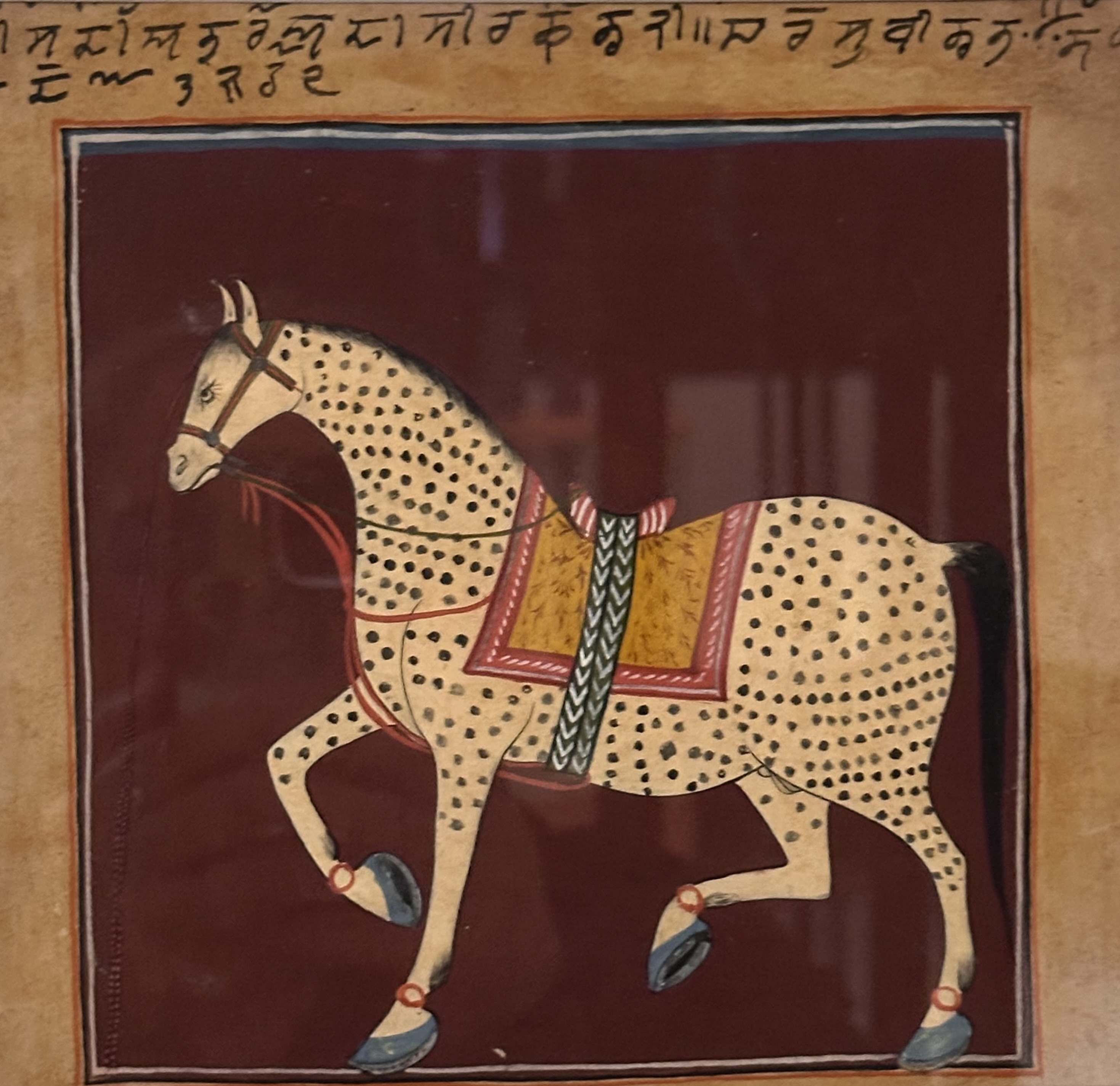
But then! Without any warning, you see the horses. An entire folio of them, which has been divided (more divisions!) into individual pages, with one horse on each. One ill horse on each. These are, in fact, illustrations of horses afflicted by various ailments, drawn from a treatise on equine health written by Shalihotra, a pioneering veterinarian who most likely lived in what is now Uttar Pradesh in the third century BCE. The folio, called the Shalihotra Samhita, or “The Compilation of Shalihotra”, is a medical compendium on horses and elephants, offering clear instructions on how to treat horses afflicted with boils or other skin diseases, pain in the hind legs, urethral and other urinary tract infections (UTIs), gastritis, swollen lymph nodes, diarrhoea or respiratory diseases. There are also illustrations of horses which, alas, cannot be cured. It was once an illustrated text, but the written portion has been cut away, leaving us with these near-perfect images. White, black and grey horses, all looking a little nervous, surely because of their ailments, once again occupying only part of the frame: a hind hoof here, a long tail there, extending beyond their allocated border. Most wear a light saddle blanket and look as though they are ready to break into a gallop, but are not entirely sure. How ill am I? they seem to ask. And perhaps, just perhaps, they are also wondering whether they are in the right place, with their illnesses and their treatments: because what are Lahore’s Zuljanahs supposed to do if they develop a UTI or boils on their skin? And what is a Lahori horse to do if its brothers and sisters have been partitioned away so thoughtlessly?
The fact is, truly, whether horse, bird or human, I still do not know how we survive a separation. How do we fend off illness and despair after insurmountable break-ups? And how can we learn to be ourselves when confronted with such barriers, such boundaries, such frontiers? And, really, I long for a talking horse, one enlightened enough to explain how break-ups are even possible when so much is at stake.
Editor’s note: All photographs featured in this essay were taken by Ilaria Maria Sala at the Government Museum and Art Gallery in Chandigarh, India. The photographs of horses show illustrations from the Shalihotra Samhita, painted around 1690 in Chamba, Himachal Pradesh.
How to cite: Sala, Ilaria Maria. “How Do You Care for Your Horses After a Break-up.” Cha: An Asian Literary Journal, 10 Oct. 2026, chajournal.com/2026/10/10/horses.


Ilaria Maria Sala is a writer and ceramicist based in Hong Kong. She writes in English and Italian, and occasionally in other languages, and is the author of five books. Her latest book is Flower Power, Storie di Fiori e Giardini dall’Asia (HopefulMonster Editore, 2026). She writes for ArtReview, Artomity, Cha, The New York Times, Il Domani, Internazionale and many other publications. People eat, drink and put flowers in her ceramics on three continents. [All contributions by Ilaria Maria Sala.]