
[ESSAY] “The Punch and the Punchline: How Two Wongs from Hong Kong Made Me Right” by Felix Cheong
Singapore is very multicultural in that way.
Two Wongs have made me right, at least in my imagination.
I am referring to Tony Wong and Alfonso Wong,1 two Hong Kong cartoonists who entered my head when I was a boy and, as far as I can tell, never moved out. Influence is rude, presumptuous even, in that way. It does not knock, introduce itself and announce that it will infiltrate your writing forty or fifty years later.
I first encountered both Wongs, of all places, in an Indian barber’s shop in Geylang Lorong 3, a small lane just a five-minute walk from my flat. My father used to haul my brothers and me there for haircuts until we were old enough to make the trip ourselves. I remember very little about the barber, except that he used to give a mean massage when he was done with us.
What I remember vividly was his mini-library: stacks of battered Chinese comics, Singapore is very multicultural in that way, lying around for customers, with curled corners, slack staples and the occasional cover hanging on for dear life. Among them were Tony Wong’s Little Rascals, later retitled Dragon Tiger Gate and known in English as Oriental Heroes, and Alfonso Wong’s Old Master Q.

Tony Wong’s Little Rascals

Alfonso Wong and the famous cartoon character Old Master Q that he created
There was one hitch. I could not read Chinese. So I read everything else. With Little Rascals, that was more than enough. Even at six, I could crack the code.
A man enters the scene angry. Another man looks guilty. Somebody points. Someone throws the first fist. Before long, people are getting hammered. The motion is the emotion. My eyes followed bodies, faces and reversals that became rehearsals for the next showdown. I could usually work out who was the hero, who was the villain and who occupied the gutters in between.
Long before I knew terms such as visual literacy or sequential art, I had developed what comics scholar Karin Kukkonen calls a “pre-conscious way” of reading comics. I could not read the words, so I read the blows, who blew whom away and why.
❧
By then, Hong Kong had already been kneading my imagination for several years. I grew up on a diet of Patrick Tse melodramas, sitting with my great-aunt and mother while the late actor suffered in black-and-white silence towards, away from and eventually, by a turn of cliché, back to his love interest, typically played by Josephine Siao Fong-fong, Connie Chan Po-chu or Patsy Kar Ling. It was a formula that worked, and worked wonders on five-year-old me. We cried because the poverty felt real to us, and the man’s aspirations even more so.

Then came television. By the late 1970s, TVB serials were part of the household conversation: Gu Long‘s Luk Siu-fung (1976) and Little Li Flying Dagger (1978). Heroes were double-crossed, crossed swords, crossed paths and survived injuries that would have sent any layabout in Geylang across town to Tan Tock Seng Hospital. Cantopop popped up then too, tipping my hat here in remembrance of Roman Tam, and gave the wuxia heroes a grandiose chorus. Later, the Hui brothers taught me that another kind of Hong Kong existed above and below the poverty line, populated by fifty shades of fools. I loved the soundtrack of The Last Message (1975) so much that I ran off to buy a two-dollar pirated cassette of it.

❧
But all this Hong Kong pop-culture fare eventually slid off my back and out of my mind. At most, it left behind anecdotes I would revisit with my late mother, trying to jolt her memory.
The two Wongs did something else entirely. With the 6/6 vision of hindsight, I can now see that they were the teachers I never knew I had. I only spotted the resemblance while looking back over my own work. I had never consciously borrowed from either Wong, but once I started lining up the evidence, their fingerprints were here, there and everywhere.
Alfonso Wong mostly built his Old Master Q comics around sight gags, but the construction is as recognisable as any stand-up comedian’s joke: a set-up, a complication and a payoff. I did not need to understand every speech bubble, and there were not that many anyway, to know when Old Master Q and his squat sidekick, Big Potato, had got themselves into trouble.
A man wants something he cannot have. He misreads the situation. Somebody else makes matters worse. He tries to fix it. The fix becomes the problem. The problem becomes the last panel and, cue comedy sound effects, the punchline hits us between the eyes.
I thought I was simply killing time before a haircut. In fact, I was learning timing, and how to make a killing with it.
❧
This sense of timing came in useful in my professional life when, in my twenties, I produced Gotcha!, a Candid Camera-style series for the Singapore Broadcasting Corporation, now Mediacorp. We would set up a gag and spring it on unsuspecting passers-by, often filming hours of unfunny, unusable footage that I then had to whittle down to a two- to three-minute segment that still drew laughs. I was not conscious of it then, but the pattern was already lodged somewhere in my head: set-up, problem, escalation, punchline. Repeat.
More importantly, beneath the banana-peel silliness, Old Master Q had an eye for human behaviour, and occasionally the good-looking girl: vanity, impatience, greed, the follies, foibles and foolishness of people who think they are acting perfectly reasonably. Alfonso Wong knew where the pain points were, usually near the funny bone, and he needled them just enough to draw a wince and a chuckle.
Decades later, that instinct surfaced in my Singapore Siu Dai series, published between 2014 and 2016. The trilogy featured short satirical pieces that poked fun at Singaporeans being Singaporean: kiasuism (the fear of losing out), social pretensions, bureaucracy, petty entitlement and the Autobot transformations decent citizens undergo when confronted by a queue, a bargain or the possibility that someone else might get there first.
Here is an example from “The Queue”:
Four hours inching up the queue, Mrs KS Tan could feel her varicose veins hardening. The things she had to do for a piece of real estate.
Finally, she reached the end of the line. What greeted her was a brusque example of womanhood.
“What do you want?” the woman, on the forested end of fifty, snapped.
“A micro mini-Mickey Mouse apartment.”
“Ten or twelve square metres?”
“Ten.”
The woman handed her a slip of paper with the number “44”.
“Balloting Room, to your right.”
Balloting? She had queued four hours just for a balloting number?
❧
Looking back on those stories now, I can picture Alfonso Wong looking over my shoulder, wondering how much of his work I had lifted. But he might have approved, since I had picked up the tricks of his trade: the sense that satire works best when a character’s own logic tightens around him until it becomes ridiculous, a punchline that needs a punch.
Tony Wong, on the other hand, left a different bruise.
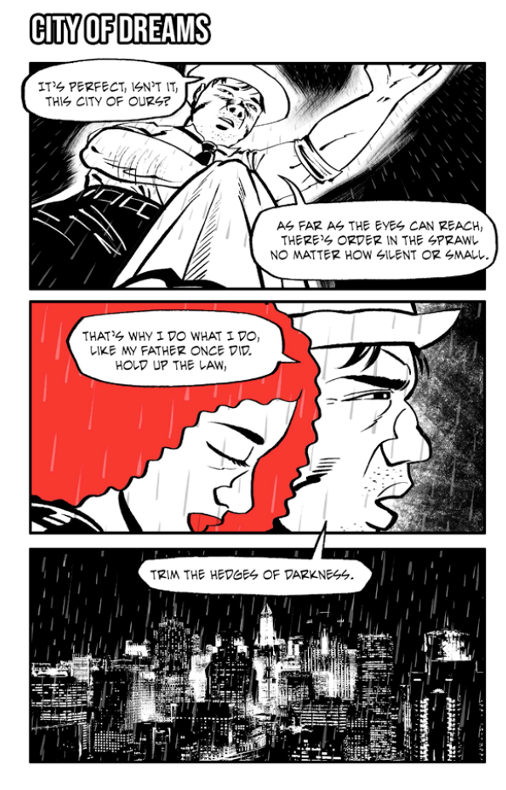
When I began writing my first graphic novel, Sprawl (2021),2 I thought its lineage lay largely in noir: damaged men, manhandled morality, corruption, the city misbehaving after dark. Detective Sam Chua belongs recognisably to that family. He moves through a broken world, trying, however imperfectly, to impose some moral order on it. But when I look at him now, I can also see a much older figure underneath the trench coat.
There is something of the jianghu hero in him.

The world of Little Rascals was built around brotherhood, loyalty, injustice, revenge and the obligation to act when red tape ties people up in inaction. Tony Wong’s martial-arts characters did not wait for systems to correct themselves. They stepped in, usually with both fists, or better still, with a pair of nunchaku. Sam carries some of that reflex, with an unholstered gun, of course. He fights injustice. He protects the vulnerable. There is even, I admit with some embarrassment, a little of the old save-the-girl chivalry in there.
In the sequel, Sprawl: God’s Lonely Man (2022), the resemblance becomes stronger. The protagonist Jack, a taxi driver in the mould of Travis Bickle, is wronged and answers violence with violence. Tony Wong would recognise the world immediately.
❧
That is what interests me about delayed influence. You do not necessarily grow up to reproduce the stories that formed you. Sometimes you grow up to argue with them.
Tony Wong gave me the heroic punch. Alfonso Wong, meanwhile, had already given me another kind of punch entirely: the punchline.
Between those two impacts lies more of my writing than I realised. And it took me half a lifetime to notice the two Wongs in my own work.
A full recording of Gotcha!
A book trailer of Sprawl: God’s Lonely Man
Notes
- I am referring to Tony Wong Chun-loong 黃振隆, better known as Tony Wong or Wong Yuk-long 黃玉朗, and Alfonso Wong Kar-Hei 王家禧, also known by his pen name Wong Chak. A BBC tribute, in pictures, to Alfonso Wong, can be found here. ↩︎
- An interview I did with the Australian literary website, StylusLit, on the writing of Sprawl, can be found here. ↩︎
How to cite: Cheong, Felix. “The Punch and the Punchline: How Two Wongs from Hong Kong Made Me Right.” Cha: An Asian Literary Journal, 28 Sept. 2026, chajournal.com/2026/09/28/two-wongs.


Felix Cheong is the bestselling author of 33 books across different genres, from poetry to fiction. He has also published twelve graphic novels, five of which are bestsellers on Amazon. His first graphic novel, Sprawl, was named by Comics Beat as one of the 75 most anticipated graphic novels of summer 2022. Three of his graphic novels were shortlisted for the Singapore Book Awards. His latest book is A Mild Case of Mass Hysteria. A recipient of the Young Artist Award in 2000, Felix has been invited to writers’ festivals around the world, including those in Edinburgh, Austin, Sydney, Brisbane and Christchurch. He holds a master’s degree in creative writing from the University of Queensland and is currently an adjunct lecturer at a university. Visit his website for more information. [All contributions by Felix Cheong.]