
茶 FIRST IMPRESSIONS
茶 REVIEW OF BOOKS & FILMS
[REVIEW] “Tenderness Persists Amidst Looming Displacement in When Heaven Inched Towards Earth” by Lorence Lozano
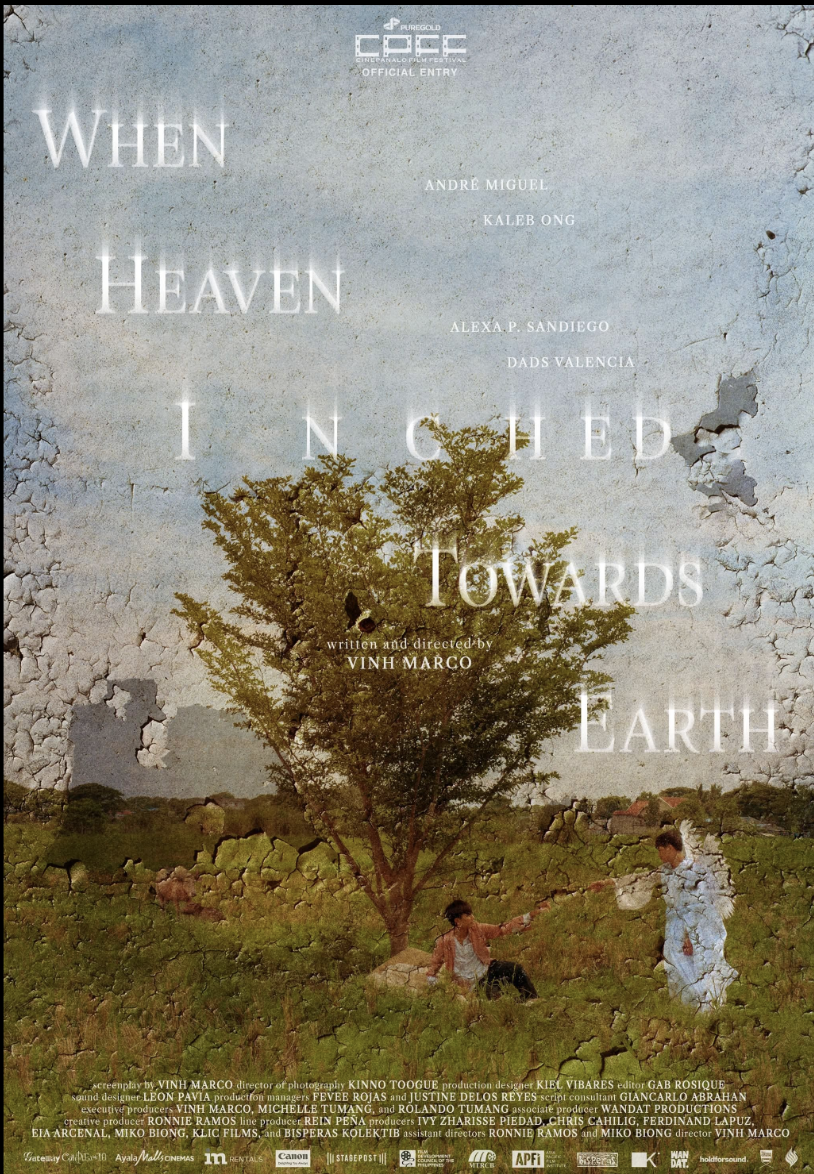
Vinh Marco Tumang (director). When Heaven Inched Towards Earth, 2026. 20 min.


Cinepanalo has gone theme-free this year, having focused on “mga kuwentong panalo ng buhay” (stories of life’s triumphs) during the first two years since its inaugural film festival. It is safe to say that two outcomes have emerged from this shift: first, dynamic and at times radical narratives that resist predictable resolutions; second, stories that remain on-brand in being heartwarming and touching.
The second programme of short films, drawn from the 20 finalists, comprises Alumahan, When Heaven Inched Towards Earth, No Mad is an Island, Tingi, and Huling Banlaw ni Susan. In brief, before focusing on the entry that stands out in this line-up, No mad is an Island grapples with the expectations of manhood. While it foregrounds an approaching storm that prevents local fishermen from going to sea, the narrative hesitates to fully embrace this central constraint, leaving the film divided between two competing directions. Much the same is true of Tingi, whose narrative progression struggles to connect with the driving force of its story.

Alumahan, meanwhile, traces the corruption of a child’s innocence by placing its young protagonist in a tense situation, yet the film ultimately loses its way in establishing its narrative foundation. Ang Huling Banlaw ni Susan, for its part, highlights the fantasies of the marginalised and explores an alternative conception of power when they hold agency. Though the film is promising on the surface, closer scrutiny reveals that its ending undermines this subversion through its portrayal of madness, ultimately thwarting its aim of granting agency to Susan and others in her impoverished position.
❧

Inside the catholic school
Left: Kaleb Ong as Angelo; Right: Andre Miguel as David
It is through its deliberate visualisation of othering as it intersects with looming displacement that When Heaven Inched Towards Earth stands out from the other shorts in its programme. At this year’s CCP Gawad Alternatibo, Vinh Marco Tumang also screened their experimental short Walang Bakla sa Langit, which tackles the relationship between religion and sexuality and draws on the poem of the same title, “Walang Bakla sa Langit”, by the award-winning trans woman author Klara Espedido. In this Cinepanalo short, Tumang continues to interrogate this relationship, extending it to encompass its connection with land by tracing a burgeoning romance and exposing the restrictions imposed by the spaces inhabited by its two characters, David and Angelo.
From the outset, the film clearly references Catholic figures through character names such as David, enigmatically portrayed by Andre Miguel. It also draws cinematic parallels with the Renaissance master Michelangelo’s The Creation of Adam, features a wardrobe reminiscent of Andrea del Castagno’s The Youthful David, and closes on an image that recalls Michelangelo’s Pietà.
These references appear integral to the narrative, yet they do not fully drive the story. Their presence at its very foundation feels at once intentional and accidental. On the one hand, they could have deepened the exploration of confining spaces and tested the limits of the beliefs they carry, an opportunity the film never firmly grasps. On the other, they effectively emphasise the constraints troubling David and Angelo. Taken a step further, these biblical and religious references might even have been set against the story of San Isidro in the town of Pulilan, Bulacan.

The Land
Nevertheless, it is worth examining how the film visualises the othering experienced by David and Angelo, a condition deeply entwined with the land on which David and his family live and the spaces they inhabit. Inside the church and the Catholic school, David and Angelo’s expressions of intimacy feel distinct because of watchful forces that extend beyond their teacher. Yet it is precisely from these acts that the film draws its subversion of Catholicism’s dogmatic and confining beliefs regarding homosexuality.
The camera guides the viewer’s gaze towards the deep, hidden corners of a wide yet suffocating space, shifting from the brightly lit to the shadow-stained. Only in these moments does revealing their vulnerable, authentic selves feel warranted. The covert playfulness of their feet beneath the desk, their hesitation to hold hands, and their pushing against tension by choosing sensory desire over Catholic doctrine all underscore the othering that exposes the patriarchal society David and Angelo inhabit. It is in its stillness, however, that the camera renders the film’s intricacies as it delves into David’s unspoken desire for belonging.

Andre Miguel as David
It is also remarkable how the camera places them at the margins; they seem to be “not there”, as their voices are heard only while the frame lingers on the vast land or the spaces they occupy. Moreover, as the scenes draw out, even when the two are alone, David and Angelo still seem unable to express fully and freely their desire to be completely consumed by a longing for tenderness that hooks into their restraint and accumulated tension.

David looking at the land
Through this rhythm, the film elevates the land into a character in its own right, one that shapes David’s becoming. The land is alive, acting as both observer and bearer of disasters that mirror, though of course not in their entirety, David’s struggle with restriction and precarity as their displacement looms ever closer.
It is also noteworthy how Andre Miguel, drawing on his background in theatre, conveys these restraints through gestures of refusal and through his character’s shift from uncertainty to boldness. His performance renders David’s familiar dilemma as something imbued with a deep, recognisable tenderness.
It is precisely through this tenderness, found within the mundane, everyday queer experiences of the characters and resisting a patriarchal and religious environment that surveils desire and becoming, that the film dissects the othering of a world in which David and Angelo strive to resist the ever-oppressive rules of external forces (the church, the school, society at large, and, by extension, their families). These restraints, moreover, heighten the film’s intimate introspection on queerness and the tragedy of an almost-unfolding romance.
The film renders its final image as a poignant and intimate surrender: a child finally embracing all his flaws under the pressures that have formed him. Ultimately, the film traverses the ever-present contradictions and contestations of identity and land, the latter stripped away as both shelter and site of becoming as the world shrinks for the benefit of the powers that be.

David looking at himself in the mirror
How to cite: Lozano, Lorence. “Tenderness Persists Amidst Looming Displacement in When Heaven Inched Towards Earth.” Cha: An Asian Literary Journal, 28 Sept. 2026, chajournal.com/2026/09/28/towards-earth.


Lorence Lozano is a film critic based in the Philippines. They have contributed to various student short films as a script consultant. Their interests lie at the intersections of gender, politics, and temporalities within Southeast Asian cinema. [All contributions by Lorence Lozano.]