
[ESSAY] “Vietnam, 1982: Xuân Quỳnh Translating the War on Palestine” by Nguyễn Bình
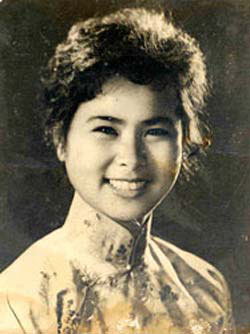
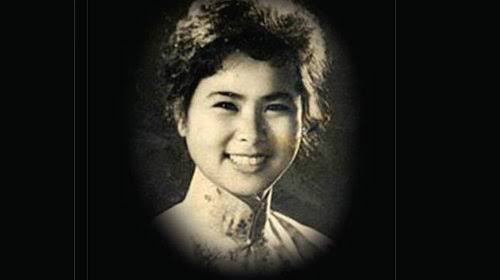
Xuân Quỳnh
In the summer of 1982, a war was raging between political entities whose names Vietnamese people across the continent struggled to pronounce. The state of Ít-xra-en, armed with some of the same advanced weaponry that had previously battered Vietnam, was attacking with the aim of destroying the armed resistance of the Pa-le-xtin people, who had been displaced from the land Ít-xra-en now occupied and were operating from the neighbouring country of Li-bǎng to reclaim their home. Meanwhile, on the other side of Asia, the poet Xuân Quỳnh (1942–1988) began translating poems from Pa-le-xtin into Vietnamese, despite having scarcely translated before. When examined alongside her own work, this brief endeavour in her life suggests a deeply romantic writer who, by virtue of her wartime experience, was drawn to the pursuit of justice and national liberation.
At the time of these translations, Xuân Quỳnh was a prolific poet, but her path had been rife with setbacks. Coming of age in the Democratic Republic during the early 1960s, she began as a dancer in the national troupe, but at the age of twenty enrolled in writing classes and was soon hired as an editor for Văn Nghệ, the country’s most prominent magazine on the arts and literature at the time. However, scorned because of her age and gender, she was sent to the countryside to distribute food aid and notify local people of their agricultural taxes. Upset by this mistreatment, she applied elsewhere and was taken on by Phụ Nữ magazine, which was dedicated to women’s voices. Yet within just two months, the magazine dismissed her after learning of her pregnancy. In a cadre résumé (lý lịch cán bộ) completed on 29 August 1982 and submitted to the Writers’ Association, Xuân Quỳnh attributed her motivation to write to both her innate passion and the “indignance” (uất ức) she had experienced during this period. “When I first entered the profession,” she admitted, “I was pushed around and scorned, so I was determined to live; and in order to live, I must write.”
Her fortunes changed in 1965, when Văn Nghệ underwent a change of staff and Xuân Quỳnh was rehired into a more permanent editorial position. From then on, through regular field trips along the Hồ Chí Minh Trail and to the Demilitarised Zone, she found new artistic inspiration. In 1968, she published her collection Hoa dọc chiến hào(Flowers Along the Trenches), which charmed readers with its themes of love, motherhood, and resistance, expressed tenderly in five-syllable lines. After Vietnam was reunified, she travelled to Eastern Bloc conferences, where she met Asian and African writers. Reflecting in her 1982 résumé, she felt that her proficiency in French was inadequate and hoped to improve it in order to translate poetry. Indeed, translation seemed to represent a new horizon. That same year, on 22 May, Văn Nghệ featured her first known translation, a poem by a Ugandan writer whose name was phonetically rendered as Pê-tơ Mu-oa-thi. I have not been able to link this name to any actual writer. Two months later, she published another translation. It would be the first in her series of poems from the land of Pa-le-xtin, or Palestine.
❧
I first learned of Xuân Quỳnh’s engagement with Palestine through the researcher Lại Nguyên Ân, who has digitised the decadal publication catalogues (biên niên hoạt động) of the Vietnam Writers’ Association on his website. Scanning his archives for 1982, I noticed the titles of three Palestinian poems for which Xuân Quỳnh was credited as translator: “Ri-ta và khẩu súng trường” (“Rita and the Rifle”) by Mahmoud Darwish; “Điều không thể được” (“The Impossible”) by Tawfiq Ziad, also known as “We Shall Remain” (“Hunā bāqūn” هنا باقون); and an unidentified “Di chúc” (“The Will?”) by a poet credited only as “Kasem”, possibly Samih al-Qasim.
Such extensive engagement with Palestinian literature was not limited to Xuân Quỳnh or to these three poems. A more thorough examination of the catalogues from the period of the 1982 Lebanon War reveals the names of writers such as Fadwa Tuqan, Muin Bseiso, Yahya Yakhlif, and Rashad Abu Shawar. Those who introduced them included Thuý Toàn, translator of Tolstoy and Pushkin; Nguyễn Đăng Bẩy, translator of Octavio Paz; and Vương Trọng, a friend of my family.
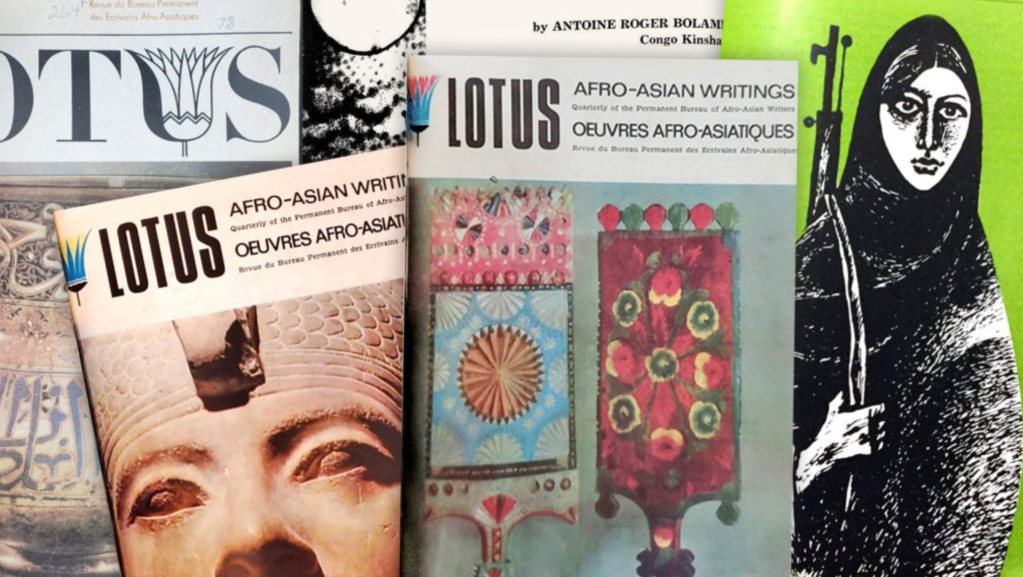
Through my text exchange with Vương Trọng, I learned that the translators drew on a common intermediary: Lotus, a trilingual quarterly published by the Afro-Asian Writers’ Association in Arabic, English, and French. Supported financially by Egypt, the Soviet Union, and the German Democratic Republic, the magazine brought African and Asian writers together within a transnational literary forum shaped by anti-colonial solidarity. As Trọng recalled, until Lotus ceased publication with the fall of the USSR, the Writers’ Association regularly received editions in both English and French. This circulation speaks to a far-reaching effort by socialist internationalism to unite colonised peoples through literature. From these foundations, the Vietnamese wave of translating Palestinian literature in 1982 emerged as a response to global struggles articulated by writers of the Third World.
❧
Let us now consider Xuân Quỳnh’s translations. Of the three works, I was able to find only “Ri-ta và khẩu súng trường” through the thivien.net online archive. Unable to locate the French intermediary that appeared in Lotus, I simply compare this translation with Darwish’s original, “Rita wal-bunduqiya” (ريتا والبندقية).
The first notable feature of Xuân Quỳnh’s translation is her attempt to fit it into the five-syllable form for which she is known. In her own poems, the form works because her wording is simple and every line manages to contain a sentence or sentence unit, as in this stanza from “Thuyền và biển” (“The Boat and the Sea”): “Chỉ có thuyền mới hiểu / Biển mênh mông nhường nào / Chỉ có biển mới biết / Thuyền đi đâu, về đâu” (“Only the boat understands / How vast the sea is / Only the sea understands / Where the boat comes and goes”). Yet her translation breaks lines in a way that comes across as clumsy to me: “Chúng ta gắn liền nhau / Bằng cái hôn bốc lửa / Hai lần ta cùng nhau / Hồi sinh, em có nhớ?” (“We were conjoined to each other / By a burning kiss / The two times we together / Were resurrected, do you remember?”). Elsewhere, in order to preserve the form, Xuân Quỳnh opted for redundancy. Darwish’s lines, “kān yā mā kān/yā ṣamt al-ʻashiyya” (“Once upon a time / O silence of dusk”), became: “Đêm sao mà câm lặng / Ngày xưa… ôi ngày xưa!” (“How silent the night was / The bygone days… Oh, the bygone days!”). The added exclamation reads awkwardly, assigning unnecessary emotional weight to what should have been a simple marker of time.
Beyond formalisation, Xuân Quỳnh also made word choices that complicate the poem’s meaning. Near the end, describing the inevitable separation between himself and Rita, Darwish wrote: “qamarī hājar fī al-ṣubḥ baʻīdan/fī al-ʻuyūn al-ʻasaliyya” (“In the morning, my moon has migrated far away / Into the honey-coloured eyes”). Xuân Quỳnh’s rendering is strange: “Một vầng trăng ra đi/Vào lúc trời mờ sáng / Xa xôi trong đôi mắt / Biết bao nhiêu ngọt ngào” (“A moon has departed / When the sky is dim at dawn / Distant in the eyes / Of immeasurable sweetness”). The movement of the moon is now obscured. Compounded by the rigid line breaks, one may be inclined to read “xa xôi trong đôi mắt” as an abrupt and ungainly reference to the location of the sky, unrelated to the moon at the beginning of the sentence. My hypothesis is that the French intermediary Xuân Quỳnh used rendered the original preposition “fī” as “dans”, which could be read as either “into”, the original meaning, or “in”, the meaning reflected by Xuân Quỳnh’s use of “trong”. From this perspective, her limited grasp of French, which she acknowledged in her cadre résumé, appears to have been a clear hindrance.
Still, the translation is not without charm. At the opening of the original, Darwish presented the core obstacle in his relationship with Rita, whom he knew to be Israeli and thus on the side that brutalised his people: “bayna Rītā wa ʻuyūnī… bunduqiya” (“between Rita and my eyes… a rifle”). Xuân Quỳnh, either committed to form or convinced that a word-for-word rendering would not suffice, framed the rifle with a striking word: “Giữa Ri-ta và mắt tôi/Khẩu súng trường sừng sững.” The adjective “sừng sững”, born from the Vietnamese language’s unparalleled art of reduplication (phép láy), presents the rifle as a tall, looming barricade, the kind that, years after Xuân Quỳnh’s death, would emerge to separate and isolate West Bank Palestinians. In a more romantic example, when the narrator described his passion as “wa ‘anā ḍiʻtu bi-Rītā” (“and I was lost in Rita”), Xuân Quỳnh reimagined this as “Anh đã hoà trong em”, choosing the word “hoà”, which evokes a thorough and harmonious blending of materials until they become indistinguishable. Both choices exemplify the unique lexical possibilities of the Vietnamese language and are unlikely to have been inherited from an intermediary. Despite her misreadings, the novice translator was also able to bring an inventive flair to her work by drawing upon her own Vietnamese sensibilities.
❧
Yet all her meticulous efforts also make us wonder why. Clearly, judging from the names that appeared alongside Xuân Quỳnh throughout 1982, Văn Nghệ magazine had more than enough capable translators. What compelled her to join them, even though she knew, based on the cadre résumé she completed around the same time, that her foreign-language skills needed improvement? The answer lies in her choice of poems. Scanning the publication catalogues, I notice that while other translators spotlighted the just cause and unbowed heroism of Palestinian fighters, Xuân Quỳnh chose to tell, among other subjects, a doomed love story under the shadow of war and division. That turn towards love was exactly what distinguished her from her contemporaries and would continue to shape her legacy as a poet.
It is difficult to encapsulate how much love courses through Xuân Quỳnh’s work. Some of her best-known poems were written in the late 1960s and early 1970s, under ferocious American airstrikes, yet are filled with deep, desirous emotion. In “Sóng” (“Waves”), a masterpiece from her 1968 collection Flowers Along the Trenches, she depicted her loving self as ocean waves yearning for the coast in defiance of the wartime demarcations of north and south: “Dẫu xuôi về phương bắc/Dẫu ngược về phương nam/Nơi nào em cũng nghĩ/Hướng về anh – một phương” (“Though downstream to the north/Or upstream to the south/Wherever I go, I think/Of you, my only direction”). While these poems have become classics, their path to publication was arduous, as magazines at the time preferred to promote a more collective-minded, nation-building kind of passion. Yet this does not mean that Xuân Quỳnh never addressed such grander sentiments. Her poem “Những năm ấy…” (“Those Years…”) envisions a union between love and the fighting spirit of its time: “Em ước sao chúng ta được đi cùng/Chặng đường ấy trên con tàu kháng chiến […]/Chỉ nghe tiếng trái tim mình đập/Ta nghĩ đến con đường ta nghĩ đến nhau” (“I wish we could go together/Along that road on the train of resistance […]/Only hearing the beats of our hearts,/We think of the road, we think of each other”). Love in her poetry is not merely an individual feeling divorced from circumstance. It stirs the lover day and night, urges them to seek the company of their loved one, and moves them to fight with words and weapons for a loving, liberated peace.
After 1982, Xuân Quỳnh’s translation output diminished. She would appear as a translator roughly once a year in the Writers’ Association catalogues, her name in parentheses beside poets from Bulgaria and Japan. We may never know whether she eventually honed her skills or gave her voice to other watersheds in the Palestinian cause, for on 29 August 1988, eight months into the First Intifada, Xuân Quỳnh and her family were killed in a car crash while returning from a seaside holiday. In November of that year, the Palestinian Declaration of Independence was proclaimed in Algiers, written by Mahmoud Darwish, the poet she had translated. It is tempting to ask what Xuân Quỳnh would have thought, and how many more poets, young and old, she might have translated had she lived to bear witness longer, through the Oslo Accords, the Second Intifada, perhaps even through the Gaza genocide of our time, when she would have been eighty-four.
How to cite: Nguyen, Binh. “Vietnam, 1982: Xuân Quỳnh Translating the War on Palestine.” Cha: An Asian Literary Journal, 26 Sept. 2026, chajournal.com/2026/09/26/war-on-palestine.

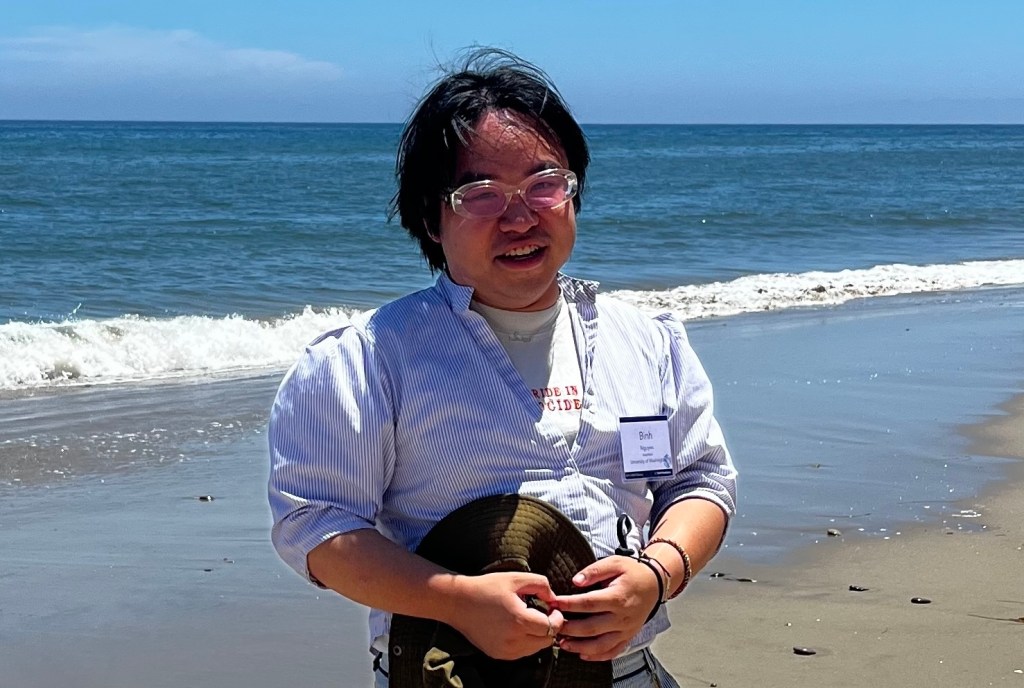
Nguyễn Bình is a writer and astronomer from Hanoi. At the age of eleven, Bình published the Vietnamese science-fiction novel series Cuộc chiến với hành tinh Fantom [Battle with the Fantom Planet]. Having since moved towards more literary pursuits, they are the translator of The Tale of Kiều: A New Cry of Heart-Rending Pain (Major Books, 2025) and Treasury of Vietnamese Folk Tales: Volume 1 (Major Books, 2026). Bình’s poetry and essays have appeared in The London Magazine, Ultra Dogme, Literary Hub, The Common, among others. Bình is currently seeking publication for their debut English-language novel, which centres on a missing bronze drum from the British Museum.

