
茶 FIRST IMPRESSIONS
茶 REVIEW OF BOOKS & FILMS
[FIRST IMPRESSIONS] “Where God Seems Absent: Suffering and Survival in Blessy’s The Goat Life” by Pradip Mondal
Blessy (director). The Goat Life (Aadujeevitham), 2024. 170 min.

To live is to suffer, to survive is to find some meaning in the suffering.
—Nietzsche
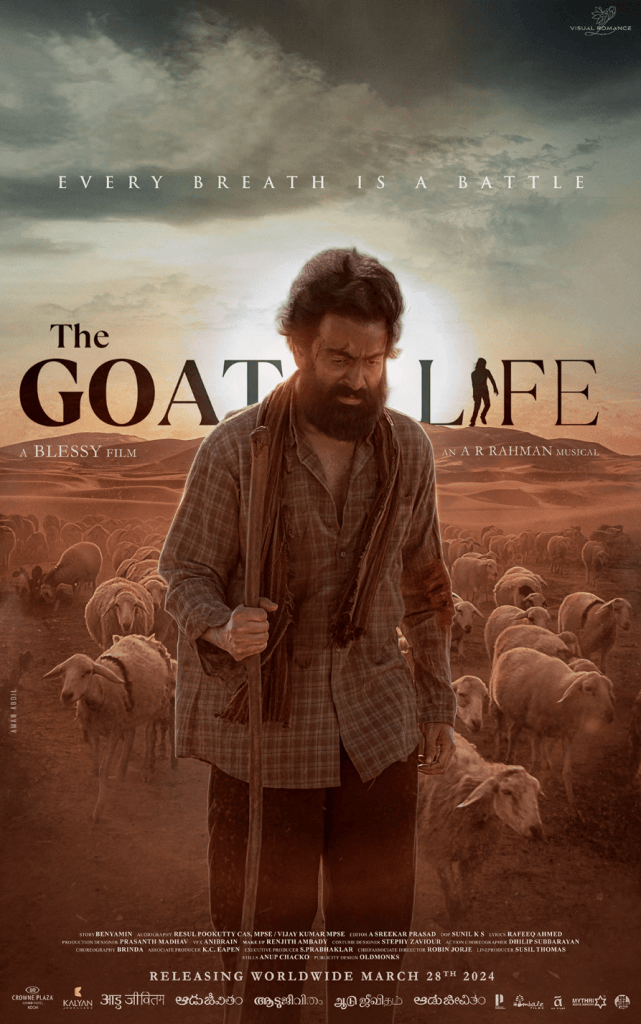
Nietzsche’s words could hardly be more relevant to Blessy’s Malayalam masterpiece The Goat Life (2024), which is based on true events. With its stunning visuals of the Arabian desert and gripping narrative, the film is certain to touch viewers deeply. Adapted from Benyamin’s eponymous Malayalam novel, the film is an epic tale of the survival of Najeeb, played with remarkable conviction by Prithviraj Sukumaran.
Through its effective use of flashbacks, rich imagery, and objective correlatives, the film holds the audience’s attention. Its powerful plot, strong performances, realistic settings, superb cinematography by Sunil K. S., and evocative score by A. R. Rahman take the viewer on an emotional journey.
A daily labourer in Kerala, Najeeb sells gold and other belongings before travelling to Saudi Arabia with an acquaintance named Hakim in the hope of changing his fortunes. It is Najeeb’s version of the “American dream”, through which he hopes to achieve economic prosperity through hard work and determination. Instead, faced with a harsh climate, meagre food, and unhygienic conditions, he is forced to work as a goatherd in a remote desert. When his kafeel, or master, tears up his passport, it becomes clear that his journey home will be anything but a cakewalk. The visual transitions between the Arabian desert and Kerala’s lush greenery and abundant waterways are splendidly realised.
In one particularly heart-wrenching scene, Najeeb utters the word “God”, only to adopt an atheistic stance immediately afterwards: “Why should I pray to God? If there were a God, my fate wouldn’t be like this.” He is trapped in the desert, where even finding and reaching the main road, which functions as a symbol of civilisation, appears utterly impossible.
In his increasingly deranged state, he sees vultures hovering over the dead body of a shepherd below a cliff. Blessy also uses the vultures as objective correlatives for Najeeb’s impending death, as they soon begin to scratch at his head and neck. The scene recalls a frightening sequence from Alfred Hitchcock’s The Birds (1963), in which birds begin launching fatal attacks on the inhabitants of a coastal town.
At times, Najeeb resembles a deranged Moses with his herd of goats. Interestingly, the film itself also makes reference to Moses. The crucial difference is that, unlike the prophet, Najeeb has no knowledge of his own fate. He wins our sympathy through his eyes, gestures, and body language in his dishevelled state. In one scene, Najeeb looks at himself in a car mirror and can scarcely believe that the face reflected there is his own, covered by an untidy, dishevelled beard. The cracked car mirror becomes symptomatic of Najeeb’s own fractured self.
The determination Najeeb displays in attempting to escape his intolerable existence in the desert can be compared with the hardships endured by Chuck Noland, played by Tom Hanks, in Cast Away (2000). The film also invites comparison with The Revenant (2015), in which Hugh Glass, played by Leonardo DiCaprio, survives against extraordinary odds. In all these films, each day seems to stretch into eternity for the protagonist, while God appears absent.
Blessy meticulously develops the character of Najeeb for Sukumaran, who performs the role with élan. The character’s strained gazes towards distant objects speak volumes about the anguish within his heart and soul. Nature itself becomes exploitative, compounding the brutality inflicted by his masters. Najeeb’s robust physique upon his arrival at the airport is starkly juxtaposed with the emaciated body he later inhabits.
When Najeeb finally reaches the long-sought road, he is picked up by a Good Samaritan in a car. Yet another twist follows. At this juncture, I am reminded of Samuel Beckett’s words: “Go on failing. Go on. Only next time, try to fail better.”
Blessy masterfully evokes overwhelming feelings of “pity and fear” as viewers are drawn into Najeeb’s mindscape, itself seemingly parched by the bleak desert landscape. The Goat Life is a powerful film about suffering, endurance, and survival, one that asks viewers to consider whether even the most broken emotions can ultimately find some measure of healing.
An earlier version of this review was published on the Boloji blog on 11 May 2025.
How to cite: Mondal, Pradip. “Where God Seems Absent: Suffering and Survival in Blessy’s The Goat Life.” Cha: An Asian Literary Journal, 26 Sept. 2026, chajournal.com/2026/09/26/the-goat-life.



Pradip Mondal was awarded a JRF in English by the UGC. He obtained his PhD from Visva-Bharati (India) in 2021. He teaches at L.B.S. Government P.G. College, Halduchaur, Nainital (India). His poems and book reviews have appeared in journals such as Suburban Witchcraft (Serbia), Muse India (India), Borderless Journal (Singapore), Indialogs (Spain), and Setu (USA). He has edited the book Dystopian Deliberations: Essays on Dystopian Fictions and Films (Atlantic). [All contributions by Pradip Mondal.]

