
[ESSAY] “One Poet, Two Translators: Preserving the Essence of Voice” by Yvette Neisser
All entries in Cha
on Madame Mao.
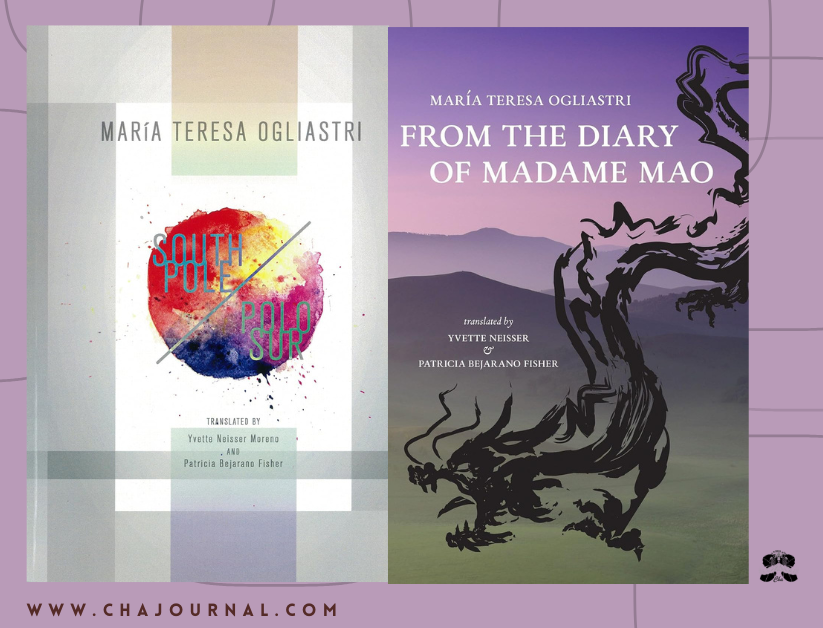
María Teresa Ogliastri (author), Yvette Neisser and Patricia Bejarano Fisher (translators). From the Diary of Madame Mao. Carnegie Mellon University Press, 2026. 136 pgs.


From the Diary of Madame Mao (originally Del diario de la Señora Mao) is an unusual poetry collection. Written in 2011 by María Teresa Ogliastri, a Venezuelan poet residing in Caracas, the book is a fictionalised autobiography in verse. Drawing on her vast imagination and extensive research, Ogliastri places herself in the mind and heart of Jiang Qing, the wife of Chairman Mao Zedong and the vilified leader of the Gang of Four during China’s Cultural Revolution. Writing in the voice of such a despised authoritarian figure, who was responsible for the deaths of thousands of Chinese intellectuals and political opponents, is a daring undertaking. Yet Ogliastri manages to show “compassion” for Jiang, as noted in her prologue, by portraying her difficult childhood in a poor family while also depicting the violence for which she was responsible at the height of her power.
How We Came
to Translate the Book

This is the second of Ogliastri’s poetry collections that Patricia Bejarano Fisher and I have co-translated. When our first translation, South Pole/Polo Sur, was published by Settlement House Press in 2011, Ogliastri was working on From the Diary of Madame Mao. We were immediately eager to read the book when she told us about it, so she sent us the manuscript, and we asked to translate it.
Background
Broadly speaking, I came to the task as “the poet” and Patricia as “the linguist”. I had been writing and publishing my own poetry for many years. Patricia brought to the undertaking two decades of experience as a professional translator, Spanish instructor, and developer of language-learning materials. Since retiring, she had pursued her lifelong passion for literature by taking courses in literary translation and had begun translating poems by a variety of poets. Thus, at the outset of the project, Patricia’s strength as a translator lay in her extensive knowledge of both languages, while mine lay in my ear for poetry. Nevertheless, we approached the translation as equal partners, both contributing fully to every stage of the process.
Translation Process: Nuts and Bolts
During our first collaborative translation project, Ogliastri’s South Pole/Polo Sur, we developed a translation process that we also applied to From the Diary of Madame Mao. At the initial stage, each of us drafted translations of a group of poems. We would then meet to discuss and revise them. My draft translations often “sounded like poetry” but missed the deeper meaning of a word or two, while Patricia’s drafts conveyed the meaning impeccably but contained some lines that did not sound quite poetic. This process allowed us to work simultaneously on the poetic, linguistic, and stylistic elements of the translations.
Our monthly meetings, usually held over morning coffee at my dining-room table, constituted the most critical stage. Before meeting, we would exchange our newest draft translations by email and make written notes of any suggestions or questions. At the meetings, we would begin by reading the poems aloud, first in the original Spanish and then in English, to gain a sense of the sound, tone, and overall meaning. We would then examine each translation, reviewing one another’s suggestions, researching the context and specific words, and tackling particular phrases.
Preserving
the Essence of Voice
Arguably, the most critical element of literary translation is recreating the author’s voice in a new language. The most common question people ask when I say that I am a poetry translator is some variation of “Doesn’t the poetry get lost in translation?”
Collaborating on Ogliastri’s poetry compelled Patricia and me to develop a method of ensuring that the poetry does not get lost. The word “translate” literally means “carry over”. Since each translator has her own writing voice or style, it was essential to identify the defining elements of Ogliastri’s style so that we could maintain consistency in the voice of the translations, regardless of who was working on them. Ultimately, we identified the following key elements: using as few words as possible to convey the desired image or feeling; using images to convey meaning; using line and stanza breaks, rather than punctuation, to indicate syntactical relationships; and employing capitalisation sparingly. We came to rely on one another to ensure that the translation of each poem retained these characteristics. In other words, we sought to carry these elements from Spanish into English.
Notably, Spanish is a highly multisyllabic language in which most words end in a vowel, whereas English has a wealth of monosyllabic words, often ending in a consonant. Thus, the most concise expression of a simple phrase in Spanish may require many more syllables than its English equivalent. I believe that, if Ogliastri were writing in English, she would choose the sparsest words with which to convey her meaning. For example, in “Alfalfa Sprouts”, a tender poem about Jiang’s mother, the closing line in Spanish is “ese es el recuerdo más antiguo que tengo del amor” (16 syllables). In English, we were able to render this sentiment in only 10 syllables: “it is my oldest memory of love”.
Again and again, we found ourselves seeking creative ways to make a line or phrase more concise in order to retain the transparent, liquid quality of Ogliastri’s writing, whether by altering the syntax slightly or eliminating a single article or preposition to reduce the syllable count of a particular line. Through this process, the translation of each poem evolved from being “my translation” or “Pat’s translation” into our translation. We both touched and retouched the poems so many times that, in some cases, we genuinely do not remember who produced the initial translation.
In many poems, we found that we needed to translate image by image rather than word by word or phrase by phrase. We had to be able to visualise the scene or action being described. To do so, we discussed the image that each of us imagined when reading the verses. If we could not agree on the image, we conducted further research or, on occasion, consulted the author to clarify images about which we were uncertain. Ogliastri often uses animal behaviour to convey or symbolise human emotions. For example, the poem “Outside a Frog Is Croaking” depicts Chairman Mao’s infamous sexual ritual of deflowering young virgins by describing one girl’s experience of crossing the garden to enter Mao’s chamber. Rather than describing the sexual encounter, Ogliastri portrays two stags in the distance:
detrás de las celosías sombras en movimiento
reflejan una lucha entre alces
entrelazan sus astas y forcejean
hasta que uno cede
y se entrega
These verses are laden with metaphor and emotion. The literal image is of two male deer fighting. The verb “forcejean” means to wrestle or grapple physically. In the context of the poem, we interpreted this image as representing the physical struggle between Mao and the girl, who perhaps resists his sexual advances. Ultimately, however, one of the deer prevails and the other yields. We had to ensure that the English words conveyed two deer fighting realistically while also implying a sexual encounter metaphorically. Thus, the word “surrenders” was crucial in suggesting the girl’s surrender to Mao.
far from these jealousies moving shadows
reflect a battle between stags
they lock antlers and struggle
until one gives up
and surrenders
Two-Layered Translation:
Chinese Context Conveyed through the Spanish Language
Despite our established translation process, From the Diary of Madame Mao presented a new challenge. Although the poems were written in Spanish, their cultural and historical context was Chinese. Neither of us was familiar with this context. We felt that, in order to translate the book, we needed to understand both Jiang Qing’s life and the broader social context in which she lived. I believe that, in order to translate poems, I must become the poet, or at least become her voice in English. That is, I must write the poems as she would write them if she were writing in English.

We also knew that Ogliastri had never visited China and was not a scholar of Chinese history. Our first step, therefore, was to ask her about her research. She said that she had read two essential books that guided and inspired the collection: The White-Boned Demon, a biography of Jiang by Ross Terrill, and Becoming Madame Mao, a novel by Anchee Min. Pat and I read both books, as well as Terrill’s biography of Mao Zedong.
As we immersed ourselves in the translation, we developed what I call a “two-layered translation” process. This involved researching and understanding the context of each poem, including its historical period, the corresponding period in Jiang’s life, and any specific references, before translating the language from Spanish into English. In other words, we had to delve beneath the words to uncover their meaning and references. For example, the poem “Para ser emperatriz” (“To Be Empress”) includes the following lines:
cuando se vive tan cerca del peligro
debemos conocer el camino
a la Vía de los Espíritus
y esperar la bondad de los dioses
“[L]a Vía de los Espíritus” is capitalised, so we realised that it must refer to something specific. The phrase, which literally means “the path or way of the spirits”, can be translated in several ways, but we needed to determine precisely what it referred to in the Chinese context and how it is commonly rendered in English. We discovered that the term is generally translated as “Spirit Path” or “Sacred Way”, sometimes, but not always, capitalised, and refers to the path leading to the tomb of an emperor or major dignitary. In this instance, as in many others, what mattered was not translating the Spanish words themselves but understanding the contextual reference and identifying the correct way to express it in English.
The poem “Demonio de huesos blancos” takes its title from the epithet used by Jiang Qing’s opponents to vilify her: “White-Boned Demon”. Ogliastri writes:
si él me decía ataca
yo atacaba
el ejército era mi daga
yo era el perro de mi amo
su hueso
su lado oscuro
She also plays on a famous statement made by Jiang during her trial: “I was Chairman Mao’s dog; whoever he said to bite, I bit.” Understanding this reference was essential to ensuring that the English version of the poem would likewise allude to the statement:
if he said attack
I attacked
the army was my dagger
I was my master’s dog
his bone
his dark side
The Collection
as a Whole
We considered and debated innumerable questions throughout the translation process. What was the book’s overall message? What aspects of Madame Mao’s character was Ogliastri seeking to convey, and how could we preserve this nuanced complexity in English? Would the average American reader understand the poems without historical context? How would the poems, and the book as a whole, be received by people who had suffered under Mao’s regime?
We grappled with these questions while focusing on the translation of the individual poems, often consulting the author to clarify her intentions.
Although many poems in the collection refer to specific historical events or periods in Jiang’s life, they are not organised chronologically, which we sometimes found confusing as readers. At one point, we asked Ogliastri whether she would consider arranging the English edition chronologically. Rather than giving an immediate answer, she waited several days before responding. We then received an email asking us to include the following text at the beginning of the book: “For a long time, these poems were in a chest belonging to Madame Mao, left to the brutal devices of mice. They were rescued by a boy’s hand while he was flying a kite. They came to me in a beautiful disarray like fall leaves scattered by wind.”
Author’s note: An earlier version of this essay was first published in the Fall 2026 issue of The Writer’s Center Magazine.

How to cite: Neisser, Yvette. “One Poet, Two Translators: Preserving the Essence of Voice.” Cha: An Asian Literary Journal, 16 Sept. 2026, chajournal.com/2026/09/16/two-translators.


Yvette Neisser is an award-winning poet, translator from Spanish, and founder of the DC Area Literary Translators Network (DC-ALT). Her poems, translations, and essays have appeared in Foreign Policy in Focus, Tikkun, Virginia Quarterly Review, and Split This Rock’s The Quarry. She has taught writing and translation at The George Washington University, The Writer’s Center (Bethesda, MD), and elsewhere. She lives in Silver Spring, MD. Visit her website for more information.