
[FICTION] “A Jar of Tears” by Anh Thu Tran
Anh Thu Tran on her story: “A Jar of Tears” is a work of fiction inspired by the heartbreaking realities and poignant stories of my paternal grandmother, who lived in Sa Dec, in southern Vietnam. She was a contemporary of Marguerite Duras, the French author of the celebrated novel L’Amant, and lived in the same town.
It was during the wake following my grandmother’s funeral, surrounded by family members sharing memories of her life, that I heard these stories, which deepened my love and admiration for her. All of them inspired me to write about her life. Yet I did not feel ready to tell her story as it truly happened. Instead, I began by writing a work of fiction, a short story whose emotional core and many of its events were drawn from her real life, even as the story itself remained an imagined one.
My grandmother’s story reflects the complex reality of many women who married young in traditional societies. Like many women of her generation, she had to adapt to the expectations imposed upon her by marriage and family. She was confronted with the authority of her in-laws and the challenges of adapting to a new household. Yet she created her own sources of fulfilment, particularly through the love and care she devoted to her children.

A Jar of Tears
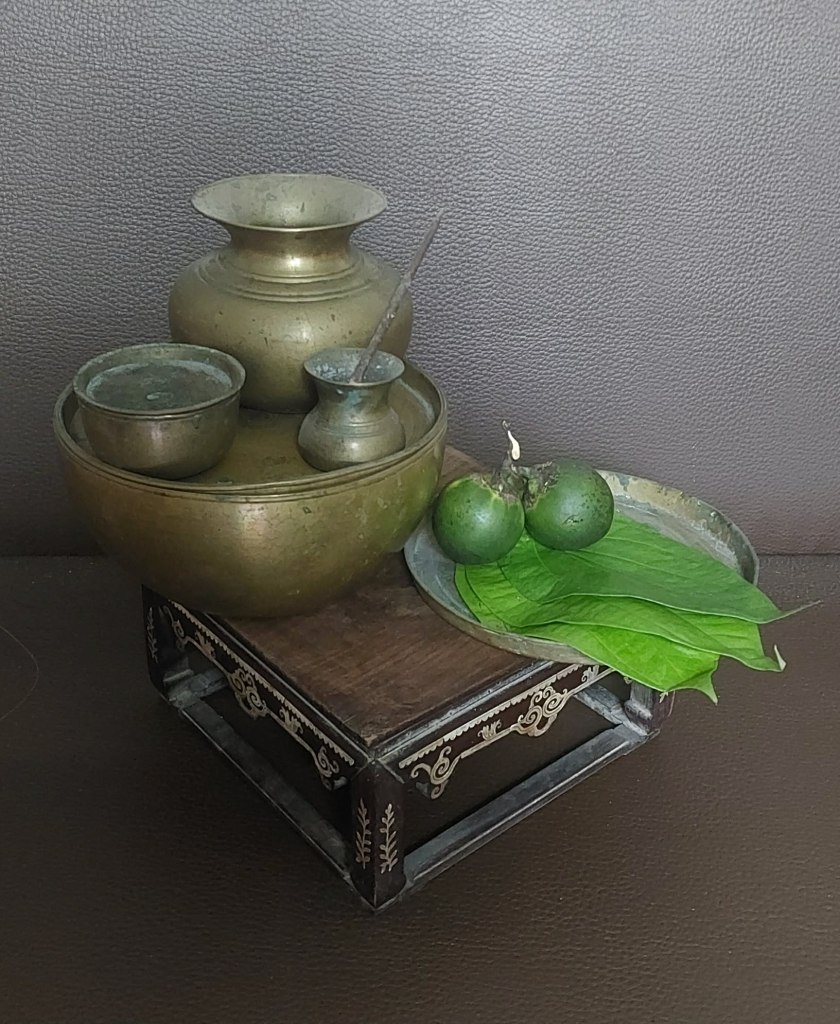
My grandmother’s brass set for betel and areca nut chewing, with fresh betel leaves and areca nuts, evoking a tradition shared by many southern Vietnamese women of her generation.
Sa Dec, Vietnam, 1931
A magnificent bridal sampan decorated with bright red flowers glides on the muddy waters of the Snake Arroyo. It moves forward smoothly, fairly fast. Dong seems quite satisfied, almost happy, much less nervous.
“The boat has not yet hit any floating coconut, nor mangrove roots. That’s a good omen!”
Lai wonders whether her brand new husband was talking to her, or to the sampan paddler. Probably to both. She does not dare turn her head towards her spouse. Barely one hour ago, for the first time in her young life, she eventually had the opportunity to look him up and down, to scrutinise his features.
Lai is anticipating her husband Dong’s worries: should the hull happen to collide with anything, floating or half-immersed, in the brownish water of the arroyo connecting her parents’ house to the branching waterway which will take them to her in-laws’ house, to her new home. A bump, even very slight and harmless, would have been interpreted as an unfortunate sign of fate, a disastrous preamble to their marriage. Each time she went to the floating market on the river, an itinerary she was following by herself for two years now, Lai’s rowboat was always slightly pitching each time it bumped into a floating object on the Snake Arroyo, then on the Two Bridges Waterway. Lai never paid much attention to her surroundings when she was steering her small rowboat’s course, because she tended to daydream and to let her mind wander far to the tops of the coconut trees and to the high blue sky above, on her way from her native hamlet in the depths of orchards and rice fields to the market square of Sa Dec. But today, on her wedding day, Lai knows that the paddler of their sampan will be extremely cautious not to bump into any coconut and will manage to avoid all mangrove roots, to please the young monsieur Dong, her husband, and receive a good tip from the young teacher.
Lai dares not look at this spouse who is seated next to her, at this young man that her parents have assigned to be her husband. She barely dares to move. Only once, three months ago, this young man went to Lai’s home with his family, accompanied by the matchmaker. Lai’s parents asked her to serve tea, so that the guests could assess her face, her youthfulness, her body and her manners. And so that Lai herself could have a look at her would-be fiancé. However diligent she was with her tea-serving task and mostly intimidated by so many people in her home, she made sure to continuously keep her eyes down all the time she was in front of the guests. And after having accomplished her duty Lai hastily retreated to the kitchen. Without having caught sight of her prospective fiancé’s features. After that, the lady matchmaker and Dong’s parents came back to Lai’s home a few more times to discuss, to negotiate, to select the soothsayer, the diviner and the wedding date. Without the future groom.
Today Lai has been made a married woman, but she knows nothing about love. She did start asking herself some questions about this powerful and non-rational feeling called love, following recent rumours and gossip about the passionate love affair between the son of a rich merchant and a very young French girl, who was the same age as Lai, and who was the daughter of Sa Dec Girls’ School Headmistress. Furthermore, Dong’s parents’ house, by the Mekong River, is located upstream of and not far from this rich merchant’s magnificent house, a blue villa looking on Sa Dec River behind Tan Hung River Island. Lai’s mother told her that maybe she would have the chance to get a glimpse at that poor disgraced French lady, who would never be officially wedded, even as a concubine.
“You will forge an alliance with a scholars’ family, your daughter will enter a well-off and honourable household,” the matchmaker repeated a good dozen times, her most favourite and powerful argument, as she was in a hurry to wrap up this deal. Even though she knew Lai’s parents were too relieved to find such a good catch for their daughter who was already 17 years old. The matchmaker just wanted to put some pressure on them, to make a show of insisting so they could feel a sense of self-worth. Because the social class differences were obvious, to the disadvantage of the bride-to-be’s family. But eventually Lai had been chosen. Lai, the girl who was slightly over the age of a perfect bride, as girls under 16 years old were preferred. Moreover, Lai was born in the year of the Tiger. The elders grant Tiger women a fate and personality traits which put off families in search of a submissive and fertile spouse for their sons. But the decisive argument eventually was that three famous diviners, one of whom was extremely trusted for the certainty of her predictions, had all confirmed that Lai would produce male heirs.
However, although Lai is a Tiger, she is a Water Tiger. She was born under the signs of the tiger and of water. Dong’s element is Earth. And earth absorbs water, earth feeds on it and is invigorated by it. Water and earth together give life to plants and trees. That was the astrologer’s statement about their union. So even if Dong’s birth sign was the Rooster, which is very vulnerable when confronted with a Tiger, the elements linked to their signs were respectively Earth and Water. An advantageous alliance for the element earth. The astrologer had wisely avoided revealing that from this marriage, extremely beneficial for Dong’s family, loads of tears would flow, so abundantly that one only jar would not be enough to collect them. Tears of the young bride.
Finally, the best diviner had decided a propitious date for the wedding celebration. Seated on her sampan, Lai let her worries and her fears glide on the arroyo’s murky waters, and let them swim away far behind her. Her fate had been sealed. She had become a teacher’s wife, she would fulfil her duties and responsibilities as the daughter-in-law of a wealthy sharecroppers’ family, whose head of household got the privilege of being responsible for ceremonies and rituals at Tan Hung communal house. She would live in a beautiful three-bay house made of precious wood, almost on the Mekong River, on the big river island of Tan Hung village, where more than twenty years ago French colonists had built a big hospital, the best one in Southern Vietnam.
“Rain! Another good omen!” Her young husband, thrilled, shrieks, startling Lai. She dares not react, nor look at him. She just gives a faint smile while staring at the little drops of fine rain which speckle the surface of the water. Indeed, this downpour, which occurred while the sampan is midway towards her future domicile, is boding very well. All this water which is falling so lightly from the sky will repress negative things from the past and will bring new energy to the couple’s new life.
The French believe “Mariage pluvieux, mariage heureux”, which means “Rain on one’s wedding day brings good luck.”
Sa Dec, Vietnam, 1936
The famous diviner’s predictions were challenged, the matchmaker’s promises were questioned. Their renown was shaken. Incense sticks were burnt on family ancestor altars, at pagodas, temples, and even at Tan Hung communal house. Offerings were presented to these almighty spiritual places.
As soon as Lai arrived within the Tran family, the young bride completely pleased her in-laws. [work hard, khéo tay] Less than one month after her arrival in their house, the young Dong announced to his grandmother and his parents that his wife was pregnant with an heir for their family. This first child was welcomed with a joy laced with slight disappointment, it was a girl. All the family pinned their confidence and their hope on the next pregnancy.
The next year, at 19 years old, Lai gave birth to a second baby girl. Women of the family took good care and pampered the young mother according to traditions and habits. Meanwhile, the young father went with a boatman to the other bank of Tien Giang River and stayed a week at his cousin’s at Cao Lanh Town to heal the wounds of his ego from the outrage of still not having a son and to express discontent towards his young wife.
This second child died of severe dehydration following acute diarrhoea at only four months old. Lai’s maternal instinct vaguely urged her to give some water to her baby. However, the young daughter-in-law dared not challenge the orders of her elders: don’t give any drink to the baby as her body was evacuating water right away.
Today, Lai is watching the heavy downpour that started without any warning signs. Fat raindrops crackle like gravel on the bottom of the upside-down cast-iron pot forgotten in the back yard. The sound of the rain reminds Lai of the time, one and a half years ago, when she had realised that life had left the small body of her child. At the time when her baby had not enough water in her, when her so tiny baby girl was unable to keep in her the essential fluid of life, outside a torrential rain was flooding yards and gardens. Eventually Lai went outside and stood motionless under the monsoon, waiting for all this water pouring out of the sky to drown her in her distress.
But today, despite the deluge which is coming crashing down the big river and which is reminding her of that day, of how she wanted so much to die with her child, when she thought that her tears would never dry up, Lai is feeling happy like a freshly watered green plant. Her in-laws are finally pleased. Lai’s third pregnancy produced a male heir. She fulfilled her duty. And tomorrow her baby boy will have lived for a year. Tomorrow the whole family will solemnly conduct the Twelve Midwives offering ceremony for their first-born grandson’s first birthday, to express their thankfulness to the Twelve Midwives for their protection.
Even if in her heart she will forever pray for the soul of her baby girl who died because of lack of water, Lai is happy to have two children to love, her five-year-old little girl and her son who will be one year old tomorrow. And she feels confident that she will be blessed with a lot more other children.
“My great-grandson, heir of our family, will go study in France!” proclaimed Grandfather yesterday, while the family was discussing preparations of the great ceremony for the little boy’s first birthday. Lai shivered with fear at the thought of her son setting sail on the seas and going far from her. “My great-grandson will board a big ocean liner, which will take him there, in France, to learn everything needed to become a doctor or an engineer. He will come back with a good job and will take care of the whole family! As he is the future chief of our big and honourable household!” the patriarch carried on, oblivious to the worrying eyes of his daughter-in-law. Lai clutched her baby boy tighter in her arms.
That was yesterday, when Lai was scared by the idea that her little son could sail on the seas. Tomorrow, around fifty guests will celebrate the first year of life of the little male heir of the family. But today, in spite of the heavy noisy rain outside, the little boy is sleeping soundly. Lai wipes some drool from the corners of the baby’s mouth with the tip of a white muslin square she always keeps in her pocket. She thoughtfully watches this son of hers, so long hoped for, so long awaited, this son who did save her from her in-laws and her husband’s wrath. He doesn’t know it yet, and he will be aware of that while growing up, but he had changed his mother’s fate simply by being born a boy and coming into her life at the right time. Lai is cherishing this brief moment of respite, taking the time to admire her son and revel in the overwhelming love she feels for him.
Sa Dec, Vietnam, 1959
Lai still feels this pang of sadness, when a warm and viscous liquid flow is suddenly flowing a little more freely from her. Lai has bled for three days now. And it has been three days since her heart tightens each time blood leaves her insides in a stronger stream. But she does not regret her decision to end this eighth pregnancy. She needed to do that for the sake of decency, of social conventions.
When the two families agreed on the wedding date of her eldest daughter, Lai knew that this last child she feels so alive inside her would never see the light of day. It would be very improper to be pregnant at her daughter’s wedding. Also more improper to be a future grandmother who would be giving birth only a few months before her own daughter would. Lai decided to have an abortion with a heaviness in her heart, but without regret. Lai gave birth to seven children, four sons and two daughters.
Her eldest son regularly writes letters which take months to arrive to Sa Dec. These missives travelled on huge waves across the ocean, someone explained to Lai, on a big boat, like the one which took away her eldest son five years ago. As per her husband and her father-in-law’s wishes, this male heir of the family studied engineering in France and now works as a researcher in a big company near Paris. Her son did not want to become a doctor, just as his grandfather dreamed.
Lai’s two other sons are studying in Saigon and will probably join their older brother over there in France, in a few years. At least, one of them is certain to leave, her husband Dong had said to Lai. The other isn’t very studious, he doesn’t seem cut out for academics. So the family hesitates to pay for his expensive studies in France. The eldest recently graduated as an engineer and got married. He will already have enough trouble supporting one brother’s education financially. His father does not want to burden him with two brothers, especially to make him be responsible for the brother who has limited aptitude for learning.
Her grown-up sons went far away from Sa Dec for their studies. Her daughter will very soon leave the family home to live with her in-laws. However, Lai is still happy to have two children with her, her beautiful eleven-year-old little girl and her seven-year-old boisterous last-born son. Her eldest daughter, who was so reluctant to get married and who needed to be forced into marriage, will soon give grandchildren to her in-laws. Lai hopes she will get to see them from time to time.
So, even though she feels sadness in her heart with every slightly heavier flow, even though she is thinking intensely about her eighth child, who will not be born, Lai forces herself to think about all the tasks that need to be done: looking after her last two children, of course, preparing her eldest daughter for her future life as a wife, daughter-in-law, and mother, and, above all, moving out of this beautiful three-bay house made of precious wood, where she has lived for more than a quarter of a century, where she gave birth to seven children, buried one of them and decided to get rid of the eighth. For the banks of the great river are drawing near, slowly and surely. The Mékong River gnaws at their lands, and from time to time swallows a large chunk. They need to leave, to move elsewhere, to leave that beautiful old family home.
For the past four months, her husband has been renting a sturdy concrete townhouse by the Sa Dec River from an Indian merchant, near the floating market. A few pieces of furniture and many objects were transported there. The move was decided by the husband, Dong, his soul in pain and his heart broken. He tells himself that at least his grandfather and his father are no longer in this world to witness this forced abandonment of their ancestral home. They will not witness the family taking apart their fine wooden house as they prepare to leave their stately land behind. Two years earlier, Dong’s father had begun to fear the relentless advance of the great Mekong River’s raging waters.
Tan Hung riverbanks’ erosion began in 1948. For more than ten years, the great destructive river has been relentlessly eating away at this vast river island. Tracts of land, uprooted trees, then houses and plantations were gradually swallowed by the Mekong River before the helpless eyes of Tan Hung’s residents.
The population of Sa Dec is worried about its large hospital, the oldest hospital in the South of Vietnam, built on Tan Hung in 1905, and about the antique and magnificent Tan Hung communal house. For over a decade, the Tran family’s patriarch had made countless offerings to Ha Ba, the river deity who rules over their lives, imploring him to spare Tan Hung and soothe the destructive currents of the great Mekong River. Not to mention the many rituals of worship dedicated to the community’s tutelary spirits.
Despite all the pleading and the thousands of incense sticks burned in prayer, the century-old house, the respected doyen’s beautiful three-bay house, and finally the ancient Sa Dec hospital would both be engulfed by the waters of the great Mekong River ten years later.
Ho Chi Minh City, Vietnam, 1995
“Promise me you’ll bury me next to my mother!”
Lai tirelessly repeats her litany, as soon as one of her sons comes to visit her or stops at her bed, even if she knows her children barely listen to her and don’t even answer her anymore. For the past few years, Lai dwells constantly on her fear of being buried at her in-laws’ plot and of being subjected again to their bullying in her afterlife.
Lai left her mother at seventeen years old to get married, to become an outsider in the Tran family, the family of Tan Hung hamlet’s respected doyen, for nearly forty years. Even if she gave them seven descendants, even if she shouldered the burden of household chores, Lai was never really considered a member of the family. It was always made clear to her that she lived with them but was not of their blood. That she was there only to produce children. Lai is very aware that her children are not able to understand her, as they are of Tran’s blood.
Lai knows that clearly, however her need to be reassured about a peaceful living in the afterlife urges her to harp on about her will not to rest beside her in-laws. It is now her favourite topic of conversation with her sons as well as with her adult grandchildren. To the latter, especially to her married granddaughters, sometimes Grandma Lai tells in detail all the torments and persecutions inflicted by her in-laws’ family’s women, in particular by her sister-in-law, their great-aunt. Lai’s mother had prepared her to undergo and accept annoyances and indignities. This education conditioned Lai to resign herself to being invisible in front of her in-laws’ eyes, even if she was blamed for any mistake, even a futile one, whether rightly or wrongly. Her only means of expression has been to cry, to shed so many tears that only one jar was not enough to collect them all.
However, Lai’s life softened gradually with deaths in her in-laws’ family: the fussy grandma, the hamlet’s doyen granddad, then the demanding mother-in-law, the rigorous father-in-law, and finally her husband who had eventually started to show her some affection. Amongst authoritative in-laws’ family members who were terrorising Lai, only her sister-in-law remains, who eventually calmed down with age and with the gradual disappearance of parental figures.
Dong died of cancer in 1969, Lai became a widow at the age of fifty-five. A short time after her husband’s funeral, Lai left for France for a few months, by air, as no one travelled by sea anymore, to visit her two sons, her two daughters-in-law and her four grandchildren. Her sons insisted that Lai travel by plane, that their mother take her mind off things after her husband’s death. And Lai took advantage of her stay in France to advise her two sons to take good care of the little brother, her youngest boy, who was due to arrive in France next year.
As he grew up, Lai’s eldest son had become aware that his mother didn’t really seem to be part of the family. He loved all the members of his family who treated him like a little king, but more particularly his mother. Over the years, he was gradually realising that his mother was treated like a servant in the house, like a maid at everyone’s beck and call. Lai only went to the living room to serve the men of the family and most of the time stayed at her place, in the kitchen. Lai was different when she talked to her children, alone. She lost her deferential, submissive and shy manner. Later, Lai would confide in her children that during the first decade at her in-laws’, she didn’t dare eat her fill and even on rare occasions she had had to chew a few leaves torn from the garden to quiet her rumbling stomach. Lai would value her whole life at more than a jar of tears shed at her in-laws’ house.
Lai’s eldest son wanted to somehow compensate for his mother’s hardship by a travel to France, a stay in this country where her sons obtained their engineering degrees, found a job and started a family.
Today is Tuesday 18 April 1995, the date of the sixtieth birthday of Lai’s eldest son. It’s been exactly sixty years since Lai gave birth to the first male heir to her in-laws. And it has been about ten years since Lai left Sa Dec, her native region interlaced with streams and waterways, on the Mekong River, to settle in Saigon at her last-born son’s. Her heart remembers the smell of the mangroves, her memory remains imbued with the wind from arroyos and rivers teeming with fish and shrimp. She loves living surrounded by water, she is a Water Tiger. Lai finds the great city of Saigon barely tolerable, a city made of concrete. However, she is happy to be near to her children and daughters-in-law, to her grandchildren and great-grandchildren. You can’t have everything in life. During the final years of her life, Lai chose to leave this water landscape where she was born, to live next to her offspring.
Of the three sons who went to study in France, two have returned to their mother in the 1980s. Lai often thinks of her son, who has settled permanently in France. She would have loved so much to have all her children by her side. But a woman shouldn’t ask too much of life. Only one of her children lives on the other side of the world, oceans away from her, but all the others are there, right close to her, in Saigon. Lai accepts what life grants her, her mind is at peace. Despite her children’s objections, Lai has followed a strict Buddhist vegetarian diet for about twenty years, to purify her heart, and she feels ready to leave this earthly world without any regrets.
For the past few months, Lai has been insisting on discussing her future funeral. And she keeps harping on “Promise me you’ll bury me next to my mother!” to her sons, who always answer her that she will live for many more years, even though her vegetarian diet weakened her a lot. And they add that we’ll talk about it later, when the time comes. Lai is aware that she is hurting her sons by speaking to them about that, but after so many years of hard work and worry, she wants nothing more than her peace of mind and the love of her loved ones.
Because her body is worn out from all these lives that she brought into the world and from all these household chores which were her duty as a daughter-in-law. Because her mind is exhausted by the strain and the sacrifices. Because her energy is drained by the struggles and the inevitable compromises. Despite a now happy and peaceful existence, Lai longs for eternal rest beside her mother, as far as possible from her in-laws.
Three years later, on 18 June 1998, at Ho Chi Minh City, Lai’s spirit will leave her tired body and journey into the afterlife, right under the eyes of her last-born son and daughter. Her cypress coffin will be so heavy that many times the six pallbearers’ tough feet and strong legs will nearly skid on the muddy and slippery path. Her family will take her back to her native hamlet in Sa Dec where she will rest peacefully, according to her wishes, right next to her mother.
Lai will have had seven children and thirteen grandchildren and, a dozen years later, twenty-five grandchildren and two great-grandsons in all, who will scatter to the four corners of the world, across four of the continents of our terrestrial and aquatic globe.
How to cite: Tran, Anh Thu. “A Jar of Tears.” Cha: An Asian Literary Journal, 15 Sept. 2026, chajournal.com/2026/09/15/jar-of-tears.

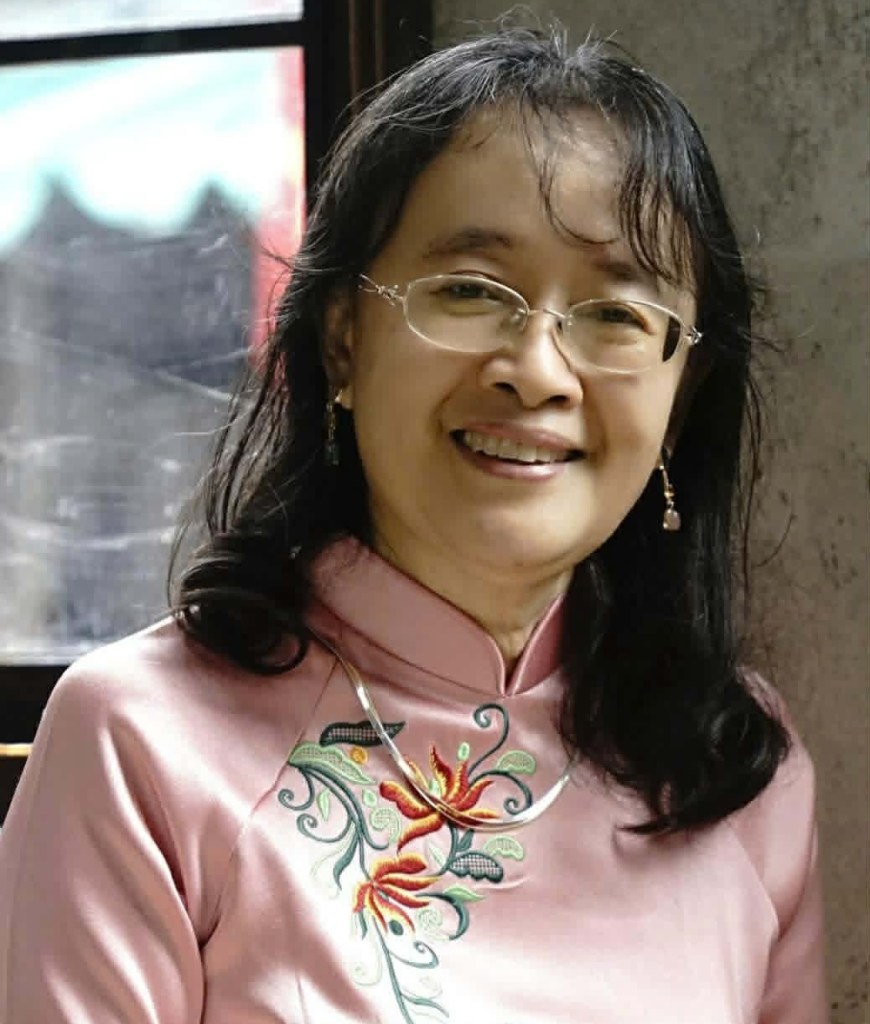

Anh Thu Tran was born in Paris, graduated from the Moscow Institute of Fine Chemical Technology with a degree in chemical engineering, and currently lives in Ho Chi Minh City, where she works as a freelance translator. Her published works include mainly educational books and stories for children, as well as a few novels. “A Jar of Tears” is her first published work of fiction.
 Cha
Cha 