
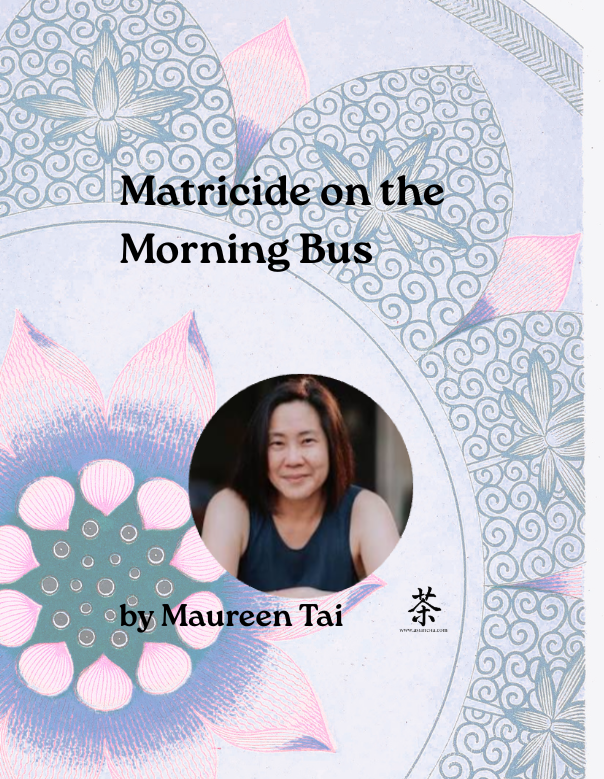
[FICTION] “Matricide on the Morning Bus” by Maureen Tai
Maureen Tai on her story: There is always a kernel of truth in everything I write. In “Matricide on the Morning Bus”, there are many kernels, mostly drawn from having lived in Hong Kong for just a few years shy of two decades, and from raising my two children there. Snippets of my son’s and daughter’s experiences as international school-goers and fragments of our lives as helper-assisted apartment dwellers are woven together with memories from my infinitely more modest childhood spent in a small mining town in Malaysia.
I never set out to deliberately hide these so-called Easter eggs in my stories, but because so much of what I write has its genesis in real-life moments, past or present, joyful or grief-stricken, it has become an inevitable part of my creative process. Now, after I have released a piece of writing into the world, I would like to imagine that a reader, hopefully one who has been affected by my writing in some way, is left with the additional teasing task of picking out the truths from the fiction.
Spoiler alert: yes, in “Matricide”, the vibrator-shaped sculpture really does exist, as do the congee-loving teenager, the soccer-mad younger brother, and the crush, who was my crush almost 40 years ago, when I was a secondary student at an all-girls’ Convent school. Glimpses of him during after-school tuition classes were all that was available to me. Not a single word was ever exchanged between us, but oh! I remember how ardently I waited for that smile every week!

Matricide
on the Morning Bus

“I didn’t mean to kill my mother. Honest, I didn’t. It wasn’t even really my fault. It was mostly Eric’s. He’s my… well, I don’t know for sure, but I think he’s my boyfriend? He’s over there, getting our siu mai from the food truck. The tall guy, the six-footer.”
[Pause, listening to question]
“Yeah, he gets asked if he’s a model, like A LOT. Now that you mention it, I guess he does look a bit like Timothée Chalamet. Or like someone from a Gucci ad, like those you see in the malls. But you know [voice lowering], my favourite thing about Eric is his smile. It’s gorgeous. So warm, and kind.”
[Pause and girlish blush]
“Before I knew him, whenever I saw his smile from a distance, and for years, it was always from a distance, I would feel faint. Even though I’d never gotten The Smile, you know, like full force. Except the day when I did.”
“That is, the day I killed my mother.”

It started like any other morning. My alarm woke everybody else up. But me? I slept right through it.
Ben, my pest of a younger brother, stormed into my room at Mum’s command, without knocking, of course, and yanked the pillow from under my head, calling me names he’d never dare say out loud in front of grown-ups. Honestly, he is the most foul-mouthed eleven-year-old on the planet. While I was putting on my school uniform, Dad was yelling “Where’s my towel?” from the shower and Mum was huffing “You’re going to be late!” from the living room as she did her Pilates stretches in front of the TV. The morning news was going at full blast, but I could still hear the thump-thump-thump of Ben kicking and chasing his foam football all over the apartment and the frenzied barking of our rescue dog, Char Siu, as she chased and nipped at Ben’s ankles. The morning madhouse.
By the time I was ready for breakfast, I was the only one at the dining table. My congee, which had been sitting out for at least an hour, I swear, had developed an unappetising layer of skin that clung to the bottom of my spoon like a desperate girlfriend. I glared at our domestic helper, Tessa, but she pointedly ignored me as she noisily cleared away the other dishes. Her thick skin’s something she’s cultivated during the sixteen years of working with us. You would think that raising me from a baby would’ve made her love me enough to serve me warm food for breakfast, but nooooo! All I got these days, in addition to cold congee, was a cold shoulder. I couldn’t miss the bus, so I just pushed the skin off to one side and swallowed a few mouthfuls of the congealed slop. Ugh! Mental note: ask Tessa politely to give me cereal and milk next time, like what high schoolers eat in America.
By the time Ben and I got downstairs, that loud kid who’d just moved into our building was in my seat again. Ben pushed past me and torpedoed himself into the last free seat towards the back, so I had to sit near the front of the bus, next to the bus mother. Even though I was six rows up, I could still hear Ben’s rap music from his headphones. I swear, he’s going to go deaf before he gets to high school.
Sighing, I twisted my body to face the window. I could barely see through the streaks of dust and grime. The school bus roared to a start, jolted its way past the rhododendron bushes and circled the hideous sculpture that was supposed to be “Hope, Emerging from the Earth” (according to the artist’s statement engraved on its base) but instead looked like a massive vibrator. That’s what I overheard my Mum say, sniggering to her yoga buddies one day. I had no idea what a vibrator was, so I googled it and yup, I hated to admit it, but Mum was right.
Rumbling through the gilded gates of our apartment building, the bus coughed its way through the silent streets of Hong Kong. The city was only half-awake. Shop fronts lit up, but the shutters still pulled down, eyes closed to the world. Half-naked men with rippling dragon tattoos on their arms and backs were unloading Styrofoam boxes of fresh meat and vegetables from a truck. A granny with her hand trolley of flattened cardboard boxes was shuffling across a road even though the traffic light flashed red and bright. A security guard was standing in a dark alleyway, pulling on his cigarette like how I drink my peach-flavoured jasmine boba. Most kids hated the bus ride to school, but I didn’t mind it. It was like watching YouTube videos without the volume on. It was weird, but I found the street scenes calming, in fact so calming that I’d almost nodded off when someone rudely bumped against my shoulder. Irritated, I lifted my head to discover that the bus mother had given up her seat to Eric Chin.
OH. MY. GOD. THE Eric Chin. The secret love of my life.
I felt as if I was falling through the floor into a bottomless abyss, all sound drowned out by the thumping of my heart, miraculously beating even though I was holding my breath. My entire body tensed up, my senses on high alert. Eric’s muscular arm, nestled against mine, radiated a raw, molten heat. Flustered, I lowered my head and stared at my hands. They lay within the folds of my regulation beige skirt, suddenly looking big and awkward and clumsy.
The bus driver was still grumbling about the unanticipated pick-up. “Since when do we allow unregistered kids to ride on the school bus, eh?” he muttered loudly, his eyes flitting irritably to the rear-view mirror. The bus mother shushed him. She was perched on top of her makeshift seat, an upturned plastic waste basket near the bus door, her bus-mothering duties temporarily abandoned. She smiled reassuringly at the new passenger who was by now fully belted into the seat next to mine. She too, like me, was mesmerised by his stunning good looks.
As the bus driver rounded a corner, the sudden lurch launched Eric’s books out of his hands, and they scattered like marbles onto the floor in front of us. Instinctively, I reached forward, as did he. I passed him a dog-eared library book, hoping that he didn’t notice that I was trembling. For the first time in all our years together in the same school, Eric Chin looked at me squarely in the face.
“Thanks!” He flashed that permafrost-melting smile of his. KA-POW! I thought I’d died and gone to heaven.
Then he paused and squinted slightly.
“What’s that on your chin?” he asked curiously, before catching himself and suddenly reddening at the obvious audacity of his question.
My fingers moved instinctively to touch the skin around my mouth, and I gasped softly, horrified. In the blur of the morning, I’d forgotten to apply cover-up cream to hide the hideous mark on my face, the shadow that spread out like spilt red wine.
I was seven years old again. Standing by the swings in the playground, wearing my striped pinafore, my lunch box tossed into the bushes. Surrounded by the hateful gazes of Ella and her gang of meanies. I willed them to leave me alone, my fingers crossed, not just on one but on both hands, a charm my aunt had once taught me and that I knew didn’t work but I was desperate and when you’re desperate, you’ll hang on to any rope, no matter how frayed.
“What’s that on your chin?” taunted Ella in her singsong voice. Even the glittery pink nail polish at the end of her pointing finger jeered at me. “Did you eat spaghetti again and get it all over your face? Huh? Huh??”
Blushing at the memory, I blurted out words I hadn’t used in a long, long time.
“This? Ummm, this… is the forever mark that … that my mother gave me,” I stammered, unable to make eye contact with Eric, as I realised how sandpaper-dry my mouth had become. “So… so that she’d be able to find me, no matter how far away she was … even,” my lower lip trembled as I inexplicably added, in a whisper, “… even if she died.”
OH. MY. GOD. I couldn’t believe it. I sounded like a baby, like an idiot! I had one chance to say something interesting or smart or funny to the boy of my fantasies and I blew it!
Eric’s gorgeously lashed eyes misted over. His cheeks rippled almost imperceptibly as his jaws tightened. Impulsively, he covered my quivering hand with his. My vision blurred.
“I’m so sorry,” he murmured gently, taking a deep, shaky breath.
There was a pause.
“If it helps, I know exactly how you feel.”
As his words sank into that part of my brain that wasn’t foggy with a heady mix of confusion and euphoria, I bit my lower lip. How could the most perfectly formed boy in the entire school know how it felt to live with an unsightly birthmark like mine?
Before I could say anything, he continued, in a voice heavy with sadness, “I lost my mother too. When I was ten.”
“So yeah. By the time the bus dropped us off at school, Eric had my name and my phone number saved on his phone. I didn’t really think about it at the time, but I guess I also killed off my Mum on that same bus ride.”
[Nervous giggle. Pause, listening to question]
“Yeah, I know, I know, I can’t hide it from him forever, I’ll have to tell him the truth at some point. I mean, he’ll have to meet my Mum, right? Like if we get married and stuff…”
[Pause]
“But just not today.”
[Sighing]
“I mean, look at his smile. It’s gorgeous, isn’t it?”
How to cite: Tai, Maureen. “Matricide.” Cha: An Asian Literary Journal, 13 Sept. 2026, chajournal.com/2026/09/13/matricide.


Maureen Tai is an award-winning Malaysian writer whose creative work has appeared in Cha, the Asian American Writers’ Workshop, The Baltimore Review, Kyoto Journal, Voice & Verse Poetry Magazine, Every Day Fiction, Does It Have Pockets, Ricepaper Magazine, Porch Lit Magazine, and The Hooghly Review, among others. Primarily writing for children and teenagers, she has published short stories for children with Oxford University Press and Marshall Cavendish (Asia). Her time as Programme Director of the Hong Kong International Literary Festival in 2023 remains the highlight of her literary career to date. Currently based in Toronto, Maureen manages two locations for The Children’s Book Bank, a literacy-focused charity. Visit her website to read more about her work and book reviews. [All contributions by Maureen Tai.]