
茶 FIRST IMPRESSIONS
茶 REVIEW OF BOOKS & FILMS
[ESSAY] “Singing in Hiragana: On The Chronicles of Japan” by Mario Rustan
All entries in Cha
on The Chronicles of Japan
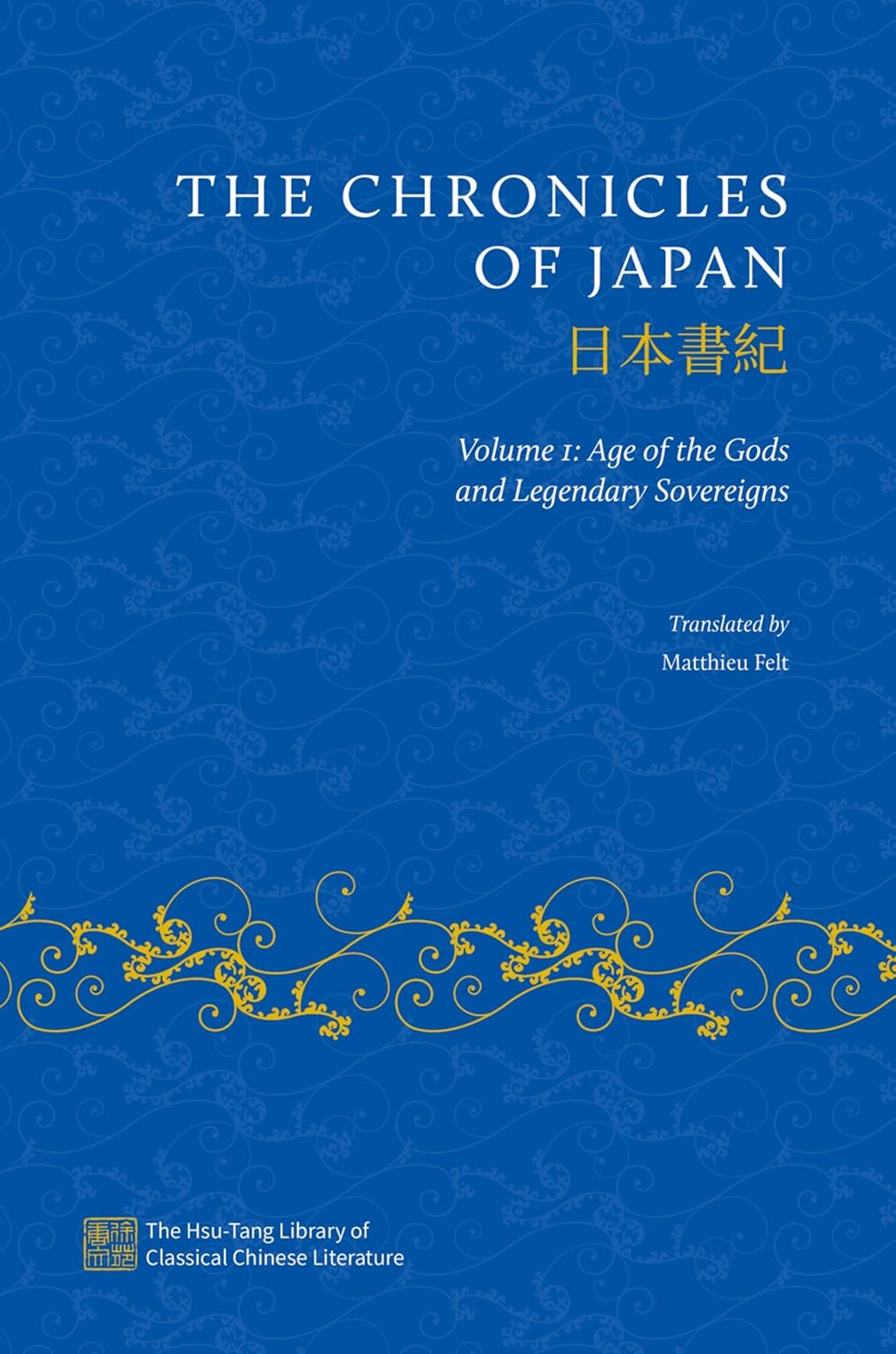
Matthieu Felt (translator). The Chronicles of Japan—Volume I: Age of the Gods and Legendary Sovereigns, Oxford University Press, 2026. 752 pgs.

The early 1990s were a time of new-age music, including the single “Matsuri” by Kitarō from his album Kojiki. The liner notes introduced me to Japanese mythology, including the story of the world’s creation by Izanagi and Izanami. When I expressed an interest in reviewing a new translation of The Chronicles of Japan, part of Oxford University Press’s The Hsu-Tang Library of Classical Chinese Literature, I thought it was Kojiki, but they are two different books.
Both chronicles were completed in the early eighth century as court projects, modelled on Chinese imperial histories. Kojiki is often translated into English as Records of Ancient Matters, while The Chronicles of Japan is known in Japanese as Nihon Shoki or Nihongi. Ō no Yasumaro might have been responsible for compiling both chronicles, which were published just eight years apart and commissioned by different empresses, Genmei, who reigned from 707 to 715, and then Genshō, who reigned from 715 to 724. The editor of The Chronicles of Japan is Prince Toneri.

The new translation of The Chronicles of Japan under consideration is by Matthieu Felt, an associate professor of Japanese at the University of Florida. In his previous book, Meanings of Antiquity, Felt charts the changing meanings and significance of both Kojiki and Nihon Shoki, or Records and Chronicles, respectively, in relation to Japan’s self-image, the meaning of being Japanese, and Japan’s place in the world order.
Felt’s edition of Chronicles is a more detailed translation of Nihon Shoki, with additional information, and its first volume covers the first sixteen books, or chapters, out of thirty. The chronicle is written in Classical, or Literary, Chinese, which was used until the twentieth century in China, alongside notes and poems written in hiragana syllables. Both Chronicles and Records are the oldest surviving books written in Chinese by non-Chinese people, as there are no surviving examples from Korea. Both books are also valuable sources of Old Japanese, preserved in the poems.
)
Traditionally, the sovereign commissioned an official history to create a canonical narrative about the nation’s journey, from the creation of the world to the time of writing, while the commissioning ruler represented the stable present. Although modern Japan understands that the first verified states in the archipelago were established around 1,500 years ago, it maintains the belief that the imperial family has preserved a single hereditary line from Jimmu, credited as the first emperor, who ascended in 660 BC. Japan is not unique in this regard, as many nations retain some belief in their mythical founders and ancient histories.
Both Records and Chronicles form the basis of Shinto belief in kami, spirits and divinities that are present everywhere, from the sun to rocks. Shinto has no founder or scripture and is usually defined as worship of and devotion to kami. The early chapters of Chronicles describe how Izanagi and Izanami create the world, how their descendants form the most famous gods, such as the sun goddess Amaterasu and the storm god Susano-o, and how the emperors and human figures of ancient Japan interact with kami.
A chapter in Felt’s presentation of Chronicles begins with the text written in Literary Chinese, horizontally from left to right. He then presents the English translation of the main version, followed by variant texts in a smaller font, along with footnotes commenting on the translation and its variations.
)
One purpose of the creation myth is to outline the geography of the realm, and Felt helpfully includes maps of locations in Chronicles, from the islands of Japan born by Izanami to the journeys of several emperors and heroes in later chapters. He also presents charts and tables to help readers keep track of the family trees presented in the various narrative arcs, as well as the points covered and omitted in different versions of the text. It is all Herculean work.
The wedding song of Susano-o from Book 2, written in Chinese with a Japanese translation in hiragana, is the oldest vernacular poem recited in Japanese. It attests to the respectable status of Japanese as an elite language at the Japanese court by the time of publication.

Emperor Jimmu is the mythical founder of Japan and is regarded as its first emperor. Like many other mythical founders, his legitimacy comes from military victories rather than a divine bloodline, and after six years of war he completes his migration from south-eastern Kyushu to the Nara Basin, the heartland of ancient Japan. Although the imperial cult surrounding his figure has declined, Japan celebrates National Foundation Day on 11 February, based on the narrative that Jimmu became emperor on the first day of the first month in the Chinese calendar. The Meiji Constitution was also proclaimed on that date in 1889.
As Felt explains, the narrative moves from mythology into a plausible history of early Japan, based on memories, folklore and hindsight concerning the emergence of Yamato and its contacts with states on the Korean peninsula. What is known in Japanese history as Yamato kingship had emerged from what is now Nara Prefecture to encompass the western half of modern Japan by the fourth century. A central figure who is still well known and revered as a Japanese hero is not an emperor but Prince Yamato Takeru, translated by Felt as Yamato Take. Felt maintains that Takeru is a nineteenth-century reading. He fits the archetype of the tragic hero.
The Brave of Yamato wins one battle after another with his sword, Kusanagi, a name familiar to fans of the anime franchise Ghost in the Shell, whose protagonist is named Motoko Kusanagi. However, he loses his wife, who sacrifices her life during a sea storm, and dies from a kami’s curse, fated never to rule Japan. This makes him a legendary hero, with statues in Shinto shrines and historical gardens. As the stories approach the time of writing, however, I gained the impression that Confucianism had influenced the writers’ understanding of Shinto, suggesting that success comes from following the guidance of kami, rather than creating one’s own path.
The will of kami becomes something that the emperors are wise to pursue for their own good. Empress Jingū, one of the important women in Chronicles, alongside the goddesses Izanami and Amaterasu, follows the will of kami to invade Korea after leading a ceremony in which she is both priestess and medium.
The typical punching bag in this part of Chronicles is Silla, which is said to surrender immediately to Jingū. The peninsula itself had experienced wars for centuries, and Silla, facing Korea’s eastern shore, was the kingdom most familiar to Japan. Ironically, by the time of the publication of Chronicles, Silla was the dominant power in Korea.
)
While Chronicles portrays Japan as a more powerful state, it is also aware of Korea’s equal sophistication and of China as the measure of culture and civilisation. The book implies that descendants of immigrants from the west are more cultured because of their proximity to China. It emphasises that Jingū is recognised by Cao Wei in northern China. Isonokami Shrine in Nara Prefecture has a seven-branched sword given by the king of Paekche, or Baekje, to the king of Wa. It is not displayed to the public. Chronicles obviously speaks of the Empire of Japan, not the kingdom of Wa, but that is what is written in the inscription.

A replica of the seven-branched sword at the War Memorial in Seoul, South Korea.

As Records of Three Kingdoms identifies Himiko, or Pimiko, the queen of Wa, as a friend of Cao Wei, the same kingdom ruled by the Cao family in Romances of the Three Kingdoms, Chronicles seeks to associate her with Jingū. If anything, China’s Records of Three Kingdoms, published immediately after the period in the late third century, points to contacts between Japan and China. Wa was read as “distant dwarf” and is still used in China and the Koreas as an insult against Japan.
One consequence of diplomatic relations with China was that China considered other polities subordinate to it. Trade was interpreted as tribute, and gifts were interpreted as offerings, even when China sometimes had to pay tribute to northern neighbours such as the Xiongnu Confederation in order to maintain peace. Chronicles also records times when Silla does not pay tribute, warranting invasions.
These two facts, a larger China and the deep seas separating Japan from continental Asia, drove Japan to identify itself as an empire. This was not because it controlled vast territories, but because it positioned itself as China’s equal rather than as a subordinate. Korea stood in the middle, as China considered Japan, called either Wa or Yamato, or Nihon/Nippon, the Land of the Rising Sun, to be a contact of Baekje, while Chronicles inserts Yamato into historical conflicts between Korean kingdoms that did not involve Japan. During the imperial era of the late nineteenth and early twentieth centuries, Chronicles was used to justify Japanese colonisation of Korea.
)

The final part of the first volume offers another interesting female figure, Princess Iidoyo, or Iitoyo. She lives during a time of fratricide, which Felt illustrates with a diagram. The document states that she is not interested in marriage after losing her virginity, and while she might not have been a reigning empress, Chronicles titles her Mikoto, meaning “Honourable”. The title, at least, treats her as another important figure alongside Yamato Take.
The volume ends darkly with the records of Emperor Buretsu, who is wicked enough to cut open the belly of a pregnant woman simply to observe the embryo. His general debauchery gives this translation an eerie ending, and imperial Japan’s school education usually overlooked him.
Since this is a translation of a single classical work, there is no afterword from the translator, although it might be included in Volume 2. There are two helpful appendices, one listing the kami mentioned and another listing the songs featured. Probably the most famous song is “Yamato is”, as the word mahoraba, or mahorama, used in the poem remains in modern Japanese as an expression for Japan as the “beautiful homeland”. More interestingly, while many Japanese people associate the song with Yamato Take based on Records, here it is attributed to Emperor Keikō, a subject of Book 7. The appearances of dragonflies that save emperors from mosquito bites also help explain another poetic name for Japan: Akizushima, Dragonfly Island.

Reading through the pages, from the Literary Chinese, or Sinitic, text and Japanese songs to their English translations and commentaries, I admire Felt’s hard work and dedication in presenting this work from almost 1,500 years ago to modern English readers. This translation will be invaluable to scholars and students of Japanese history, and perhaps to Japanese readers interested in seeing a modern American interpretation and study of one of the oldest texts on Japanese civilisation.
How to cite: Rustan, Mario. “Singing in Hiragana: On The Chronicles of Japan.“ Cha: An Asian Literary Journal, 7 Sept. 2026, chajournal.com/2026/09/07/chronicles-japan.


Mario Rustan is a writer and reviewer living in Bandung, Indonesia. [All contributions by Mario Rustan.]