
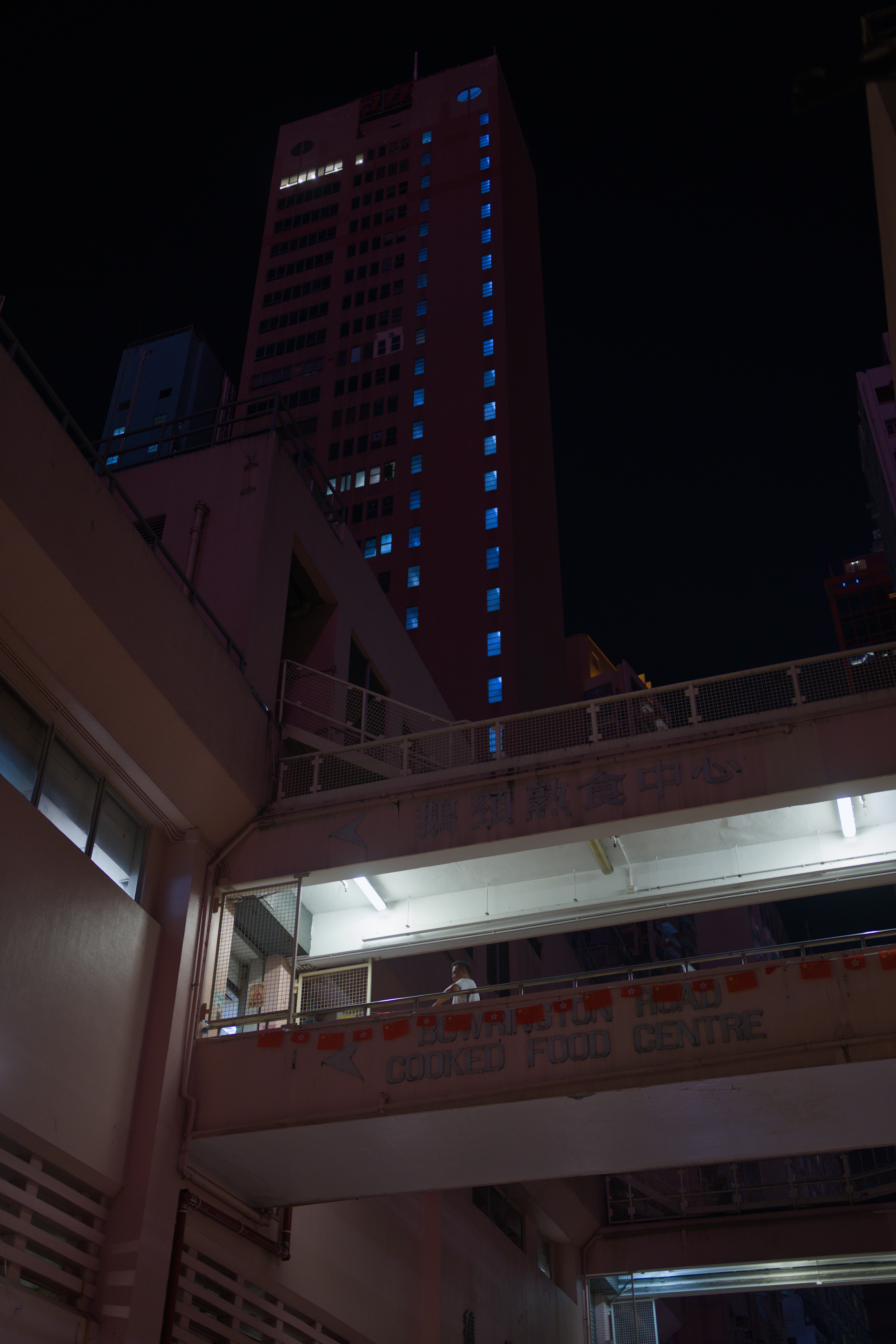
[ESSAY] “To Belong: Impressions of Hong Kong” by Raimondo Vanitelli


Photograph © Raimondo Vanitelli
You take in the city and the city accepts you, even if momentarily.

1
The intersection feels timeless. Red cabs with white roofs honk at each other, squirming through the traffic like metal blood cells. There are voices everywhere, shouting and hawking and giggling and crying, and then there are the voices coming from the buildings, drills hissing, hammers pounding, knives cleaving, matches striking. The smell of the sea barely emerges from the waves of scorched pig skin, iodised soy sauce, stale imitation leather, damp porous concrete and pungent incense. Billboards promote luxury brands beside massage parlours beside the Freshest Fish Imaginable. A snow crab larger than most kids scuttles inside a musty tank, bubbles forming on the surface of the clean water. There are birds singing, somewhere between the tinkling hearing aid of pedestrian signals turning green and the incessant rolling of tyres on the looming overpass. Somebody is hitting a doll with a shoe, somebody bites down on a rice ball, somebody loses their grip on a little girl’s hand and she starts to cry, her shriek almost mute. There’s so much music blaring from all sides that it almost turns into white noise, botched parts of melodies and lyrics chopped like fresh cuts of meat. The sun draws yellow geometries on the pavement, on the sides of the buildings; it reflects on the windowpanes and on the marbly glass of the highest towers sprawling above. There’s wind, an artificial current that pushes and pulls everything and everyone in every direction. One moment it smells of exhaust oil, one moment of seagull feathers, one moment of nail polish remover. The popping of countless footsteps rises from below and mixes with the whirring of myriads of AC systems perched on precarious frames. People emerge and disappear from the market below, from the shops beside, from the stairwell above.
Where are you?

Photograph © Raimondo Vanitelli
2
The stairs are covered in a mosaic of perfect mint-green squares. The heels of your shoes tap on the dented ceramic as you ascend, moving with the breath of the queue. Three steps, a pause, two steps forward, one back. Repeat. Move to the side. Look that woman in the eyes as she descends, going back exactly where you came from, her hair too slick to be sweaty or oily. The smell of a newly opened shampoo bottle you never bought before. And she’s gone, in her place something that looks like a salaryman, a child, a violet and orange ad for cough syrup, framed by bent aluminium bars and frayed translucent plastic.
People flow in streams on the mezzanine, some of them swaying, stopping by the railing to watch the traffic below. They tessellate like odd jigsaw pieces, never aligning perfectly, always assembling in unglamorous, unsatisfying ways. The noise from below is ever-present, muffled by the vibration of the cars trampling above. Everything vibrates gently, an unstable condition that oozes reliability from the dusty corners of welded iron bars. Two men are commenting on a basketball game; one of them mimics a sweeping motion before running three wide steps and air-shooting an invisible ball over the formless mass that swallows him back in. Where he belongs. His laughter doesn’t immediately dissipate and joins the chorus of sounds, letting in the screaming of a street vendor selling rattling watches, their quartz ticking as loud as the spinning of atoms. He’s perched in a corner, under a sign that reads “No Spitting, No Hawking, No Soliciting” in two different languages. Somebody stops to look at the shining dials, but that’s not you, no.
Where are you?
3
You’re descending the stairs, following a new pattern of marbled steps that is leading you back to street level. A miasma of burnt sugar and a wisp of dark engine exhaust make a middle-aged man’s eye water. A cough, maybe, but you’re beyond that.
If you were to cross the street in front of you, you’d be back where you were before, at the intersection.
Why don’t you do that?
Come on. Cross the street, go back a couple of paragraphs and take it all in again, then come back here.
It’s that easy!
Just go.
4
Somebody watches as you cross the street back and forth, moving beside towering concrete pillars holding the loud overpass, enveloping all of you inside a dark, hooting shell. Around the pillar, people are selling miracles, little golden and red rectangles with wishful words written on them. They hit dolls with fake-leather shoes, light bunches of incense and envelop the heads of customers in azure, dense smoke. They all sit on shiny red stools, so low that everyone’s knees pop when they rise and go back to the migrating tide, crossing the street. Turning left, the stalls give way to shops, perched one on top of the other in an almost disgusting manner. A green, white and orange convenience store becomes a jade seller that morphs into a mechanic’s shop from which a van with blackened windows emerges, halting the progress of hundreds of feet for a fleeting moment. When it resumes, you realise that you’re not following anyone, but don’t know where you’re going, either.
You take in the city and the city accepts you, even if momentarily. You’re going to leave this place, yes, but some part of you will always be crossing this street, attracted by the red plastic tent of a market spreading between pink, blue and green high-rises, inscribed in a wider frame of even taller, glass-clad buildings. The huge sign of a bank guides the flock across the street, muttering engines idling at the red traffic light just inches from your fragile waists. From here, you can see the stairs leading to the minty mezzanine you just crossed, so easily approachable from where you stand.
Should you go back there? You sure can.
You could also stop and look back at the whole intersection. Or you could progress through the market.
Wherever you are, you’re learning how this works.
Right?

Photograph © Raimondo Vanitelli
5
The briny scent of rushing seawater spurting out of yellowed hoses strapped to old tanks pushes against the acrid iron-laced stink of carcasses exposed above wooden, bloated chopping boards. Cleavers made of flattened tubes shine and cut and penetrate tissue as the bones in everyone’s legs push against the muscle and propel the bodies closer, farther, accidentally touching for brief intervals that are as inevitable as they are undesirable. The different-sized eyes belonging to entrapped schools of fish monitor the passage of all the people reflected in their tanks, the bubbles gurgling on the surface giving their habitat a sense of dynamic tranquillity. Somebody buys iridescent molluscs, the crisp crushing of their weight on the milky plastic bag hitting the same note as fresh, colourful bills being passed from hand to hand. There are vegetables everywhere, tufts of green and red and pale turnip-white expanding and exploding around the red light bulbs that make the meat look meatier. The road is drenched in fluids, the stalls so densely packed it might be easy to forget about the colossal buildings above, about the cast-iron manholes bearing the weight of countless steps.
Then, the sudden realisation that there’s a lit cigarette nearby, even if you can’t locate it.
Where is it?
Where are you?

Photograph © Raimondo Vanitelli
6
How could you answer, when you can barely locate yourself?
(Or can you?)
Focus.
(Close your eyes, inhale)
Feel the city moving around you, in you.
Through you.
(Open your eyes, exhale)
If you turn left, you’ll end up back where this all started, at the steps of the mezzanine, beside the miracle sellers.
You could go back, yes.
Or you could go deeper into the market.
Your choice.
I’ll be sure to follow.
7
It’s darker here. A red hue of dark, what little sunlight survives the tangle of buildings shielded by plastic tents. Bones are exposed, hanging silently from iron hooks. A bespectacled man cleaves a stalk of celery in half; you almost hear the sputter of water cells exploding under the thin, rectangular blade, spraying his gloved hand. He smiles. It’s less crowded here.
The road twists on itself to the right. From the alleyways, you see people dumping huge black sacks into crusty containers. Somebody bumps into you, but they’re gone before you feel your body register the hit.
A ray of light pierces through an opening in the tents and when it hits your left eye for a second, you see the sky. How can it look so clear when you’re breathing in the humid air filled with particles of skin, dust, blood, rust, sweat, ink, tears, sediments of calcium crusting up every wet corner like man-made barnacles? Are you like those, clinging to the side of this mammoth of an entity that is the city? Are you a cell, a parasite, a visitor, a host, a symbiotic species that feeds off the city just by traversing it?
You realise you haven’t spoken in hours, days maybe.
You also realise, emerging from the quaint ecosystem of the market, that in the distance you can still make out the shape of the mezzanine, the traffic light below it barely surfacing over countless car roofs and dark-haired heads, bobbing up and down.
You know that place now, don’t you?
Go back there once more.
How does it feel to know where you are?
8
It feels like something has been unlocked in the secret language of the bursting megalopolis. People are not just people, billboards and signs speak of a language that is hinted at but never spoken, sounds merge in a forgotten, primal chant that you shouldn’t know, but recognise as your own. It’s a verb only the leviathan can speak, but now you feel it grow from your own two lungs, vibrating in your throat just like the moving cars, the tapping feet, the turning eyes, the torn wishes, the severed sinew. You tune into a frequency you didn’t know existed and yet it sounds so familiar that, when you see the intersection again, your eyes almost water with senseless joy. You’ve been wandering but are far from being lost, indulging the volition of a labyrinth of bodies and skyscrapers and trees and streets that is not enveloping you, for you are now part of it. Your feet move on their own now, enticing you to go back to a now-familiar place, to scratch that itch of slotting nicely into a known environment, of feeling your body becoming part of the pattern. Somebody cries, somebody talks into a phone, a car honks, a billboard plays a tune, a radio spouts some song and you dance to this collective hum with your own walking.
Behind you, the tent of the market looks so distant, but you know you could go back in an instant, just retracing a few steps, even fewer pages. But it’s what’s in front of you that matters the most, doesn’t it? Go back to the intersection, come on. One last time.
Read it out loud, feel the city, then come back here.
You deserved it.
!
To which you can now answer: “I am home.”
How to cite: Vanitelli, Raimondo. “To Belong: Impressions of Hong Kong.” Cha: An Asian Literary Journal, 3 Sept. 2026. chajournal.com/2026/09/03/to-belong.


Raimondo Vanitelli is a writer and PhD candidate at Brown University. When not in Providence, he divides his time between Italy, Japan, and Hong Kong. His research explores broadcast media and the ways in which political power becomes atmospheric, something people breathe rather than obey. He is writing his first novel, cooks more seriously than he writes, and photographs the small details of the cities he visits and the people he encounters.