
茶 FIRST IMPRESSIONS
茶 REVIEW OF BOOKS & FILMS
[REVIEW] “Jiang Qing, Power, and Historical Vilification: María Teresa Ogliastri’s From the Diary of Madame Mao” by Jennifer Eagleton
All entries in Cha
on Madame Mao.
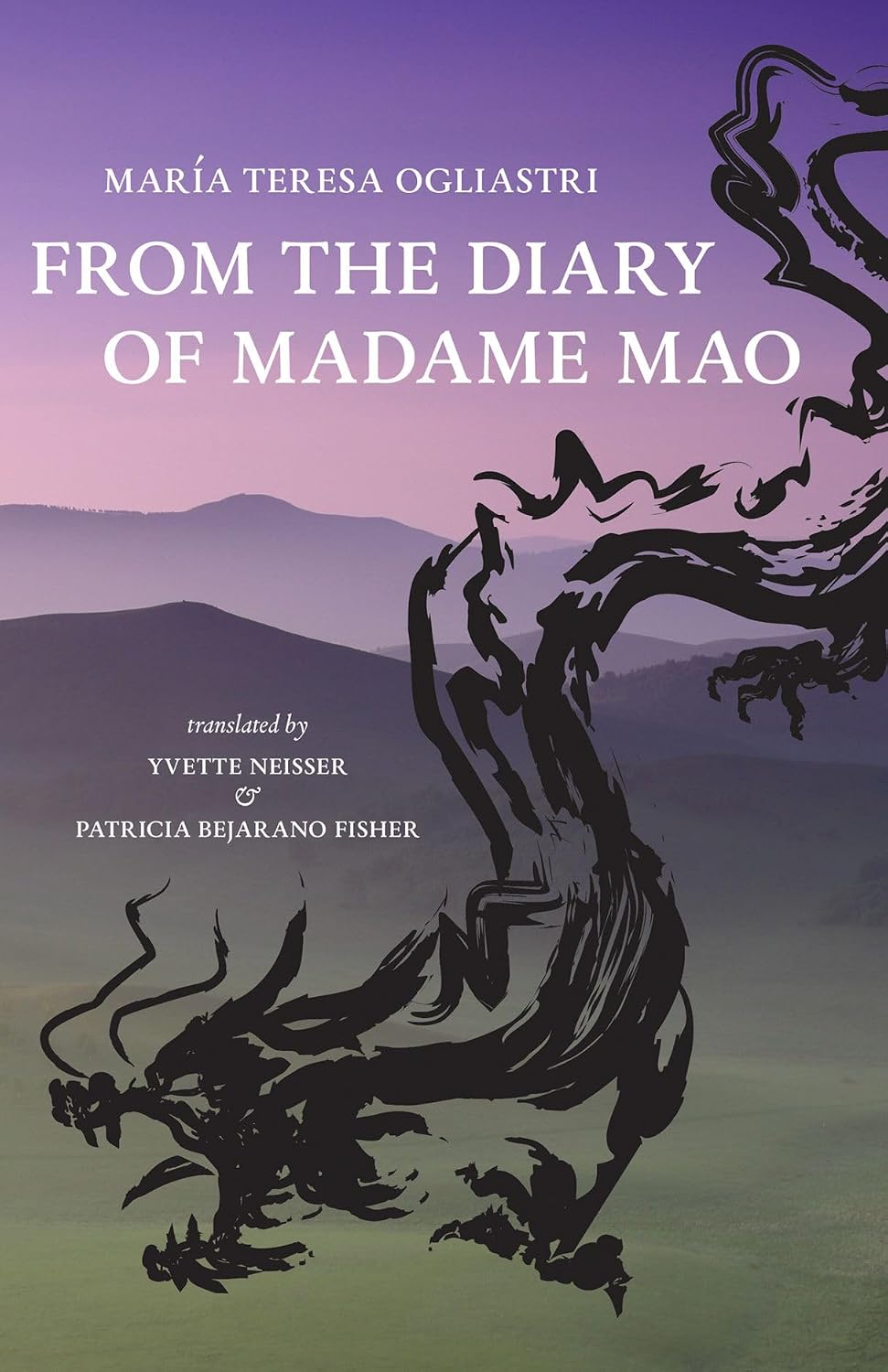
María Teresa Ogliastri (author), Yvette Neisser and Patricia Bejarano Fisher (translators). From the Diary of Madame Mao. Carnegie Mellon University Press, 2026. 136 pgs.

From the Diary of Madame Mao is a bilingual Spanish-English poetry collection of fictionalised diary entries in the voice of Jiang Qing, wife of Mao Zedong and a leader of the “Gang of Four”, who was regarded as one of the architects of the Cultural Revolution.
Venezuelan poet María Teresa Ogliastri chooses “compassion” in devising these “imagined (poetic) inner thoughts” of the woman who was called the “white-boned demon”. She does so because, “To face these totalitarian entities, one must understand why they lost their humanity” (p. 5), and why power is an “illness of the soul”. The work moves between Jiang Qing’s public trial and her private prison diary, which captures her imprisonment and reflections on the past.
Ogliastri explores, searches for, and ponders the sources of a woman’s attraction to power: childhood, poverty, a violent father, ambition, opportunism, social humiliation, and a career as an actress. The poet closes by imagining Madame Mao’s final days, alone and desperate in a prison cell. Ogliastri does not overlook Madame Mao’s guilt or the gravity of her actions. Instead, from prison, she compels her to reflect upon her past. By contrasting these two periods of her downfall, the collection explores the friction between the Chinese state’s historical narrative, which has largely shaped perceptions in the West, and Jiang’s psychological reality.
As readers, we are required to disentangle the “truth” that lies between the two, although I am not sure that we can do so successfully. Attempting to enter the mind of a historically vilified person may seem problematic, since it risks appearing to absolve that person of her “sins”. Nevertheless, the attempt is worthwhile if it allows us to gain some understanding of the process by which a person develops into a vilified historical figure. Can we truly say that someone is pure evil and practises evil simply because she can, without any other pragmatic or political motivation?
Jiang Qing’s first act of defiance against authority occurs when she tears off the foul-smelling foot-binding strips and refuses to allow her mother to rewrap them. The poem “Lotus Feet” (pp. 23-24) perhaps represents one of the most significant events in her life and one that profoundly shapes her developing persona:
My mother promised
that binding my feet would bring good fortune
that after the pain I would be beautiful
next morning the rice cakes
remained untouched
the spirits hadn’t come
the binding failed and my feet came out
gnarled like an old tree
Bound feet, a symbol of subjugation designed to restrict women’s mobility, represent a form of confinement that Jiang explicitly rejects. She must be able to run, act, dance, and climb the ranks of the new order, all actions impossible under the traditional “lotus” ideal. Thus, the poem anchors her later hunger for absolute control in a direct reaction to the fear of being bound and rendered helpless by men.
This contrasts with “White-Boned Demon” (pp. 80-81). The White-Boned Demon is a shape-shifting antagonist from the classical Chinese epic Journey to the West, known for deceiving heroes by assuming human disguises. After Jiang Qing’s arrest in 1976, Chinese state media heavily weaponised this particular mythological caricature, portraying her as an inherently evil and manipulative seductress who had corrupted Mao’s vision:
I am Jiang Qing
the fourth wife
they called me the white-boned demon
when he kissed me
I felt the tongue of the beast
nesting in my body
my loyalty proved me a hyena
if he said attack
I attacked
the army was my dagger
I was my master’s dog
his bone
his dark side
“White bone” then becomes a metaphor for a hardened shell, one required to oversee brutal political purges but which ultimately leaves her isolated and condemned. Jiang moves from victim to villain. Together, these two themes form a tragic arc. “Lotus Feet” presents Jiang Qing as the hunted and restricted female child struggling to escape patriarchal violence. “White-Boned Demon” presents her as the feared political figure who, in her determination never to become a victim again, constructs her own apparatus of terror.
“A Tiger’s Leap in the Brush” (pp. 38-39) marks her transformation from prey to predator, tracing her strategic political ascent and political shrewdness. The poet uses imagery that invokes the tiger’s power, courage, and ferocity. The phrase “in the brush” suggests secrecy, guerrilla tactics, and patient waiting. It reflects her time in Yan’an, absorbing Maoist ideology and assessing her political rivals. The poem refers to her sudden entry into the political arena during the late 1950s and early 1960s. It captures the speed with which an overlooked woman can sometimes weaponise her supposed insignificance to strike down her enemies.

“The Sleeping Beauty” (pp. 46-47) offers a dark critique of the commodification and violation of vulnerable women by powerful men. We are told that the poem’s title and imagery are drawn not from the European fairy tale but from Yasunari Kawabata’s novella The House of the Sleeping Beauties, in which elderly men pay to sleep beside young, drugged, unconscious women. The poem features a client requesting “the feet of the sleeping maiden”. This again evokes the fetishisation of feet and masculine control over women’s bodies, which are treated merely as passive objects. The worst fate for Jiang Qing is to acquiesce to passivity. To be a “sleeping beauty” is to be completely helpless and used without consent. Her subsequent political ferocity is thus revealed as a desperate, lifelong refusal ever to become the sleeping girl on the mattress.
“If You Raise Crows” (pp. 70-71) draws upon the raw panic and psychological collapse that follow the downfall of the Gang of Four. The speaker finds herself suddenly stripped of power, exclaiming, “I am left / at the mercy of the mob / where are my guards”. The line “they used to eat from my hand / now they deny knowing me” illustrates how rapidly loyalty can disappear in a volatile political environment in which survival demands the denunciation of former allies. It is a pattern that seems to recur throughout history.
“In a Vessel” (pp. 76-77) serves as a metaphor for containment, emotional suppression, and the psychological “moulding” of Jiang. A vessel is, initially, an empty container that shapes whatever fills it. In this poem, the “vessel” represents the rigid, suffocating boundaries of the cold political identity Jiang Qing must adopt in order to exist within the highly patriarchal milieu of the Chinese Communist Party. Yet compressed power, like a confined liquid, eventually breaks its container, sometimes with catastrophic consequences.
“From a Chinese Legend” (pp. 78-79) uses classical folklore to reframe Jiang’s vilification by contrasting historical Chinese myths with modern political reality. Her voice looks back to ancient legends to find historical precedents for her own ambition and eventual ruin, of which there are many. Throughout Chinese history, dynastic downfalls were frequently blamed on manipulative consorts who allegedly brought about the ruin of an emperor. This tradition lends Jiang’s own downfall a sense of inevitability. Like the tragic figures of classical folklore, her rise to the summit of power carries within it the inevitability of a fall.
In “Just Following Orders” (pp. 86-87), we encounter the image of a mantis pinning down its prey with its forelegs. The phrase “there are circumstances/just following orders” directly echoes the defence employed by perpetrators of mass political atrocities throughout modern history. At her trial, Jiang refused to apologise and argued that her actions were not crimes because she had merely followed direct orders from Chairman Mao.
In several poems, Ogliastri employs natural imagery to define Mao’s overwhelming presence in Jiang’s life. Most notably, Mao is represented as a vast, spreading tree, while Jiang Qing is the growth beneath it. He is a shelter, but one that consumes her identity. In these verses, the speaker expresses a haunting desire for “the tree’s forgiveness” in “Teach Me Tree” (pp. 100-101). This highlights her internalised servility. Even as she wielded immense totalitarian power during the Cultural Revolution, she ultimately viewed herself as acting entirely in service to Mao’s “roots” and historical legacy. After Mao’s death in 1976, with the “tree gone”, Jiang Qing is left entirely at the mercy of an angry public and her political enemies. She is forced to confront the possibility that she has been scapegoated by the Party in order to preserve Mao’s historical legacy and myth.
For the poems focusing on Jiang’s political rule and public trial, Ogliastri adopts a style that mimics authoritarian propaganda. In depicting the public trial, she directly channels Jiang Qing’s real-life background as a film actress. The courtroom is treated not as a place of justice but as the stage for her final grand performance. In poems depicting the trial, Jiang’s lyric voice refuses to play the submissive penitent. Instead, she weaponises the state’s own revolutionary rhetoric against her prosecutors.
The public-trial poems demonstrate how totalitarian power shapes a person’s outward actions, while the more intimate private-prison poems reveal how that same power hollows out her internal humanity. Jiang Qing’s “voice” is sharp in the poems concerning her public trial but softer in those depicting her private reflections. The language is concise, employing line and stanza breaks in place of punctuation, allowing the imagery associated with the different stages of Jiang Qing’s life to emerge more vividly.
Ogliastri and her translators have clearly undertaken considerable work in establishing the historical, biographical, and cultural background necessary for the attempt to enter Jiang Qing’s “shoes”. In doing so, they invite us to “see” how the pre-Mao and imperial worlds helped to shape the woman she ultimately became.

How to cite, Eagleton, Jennifer. “Jiang Qing, Power, and Historical Vilification: María Teresa Ogliastri’s From the Diary of Madame Mao.” Cha: An Asian Literary Journal, 3 Sept. 2026. chajournal.com/2026/09/03/madame-mao.


Jennifer Eagleton, a Hong Kong resident since October 1997, is a close observer of Hong Kong society and politics. Jennifer has written for Hong Kong Free Press, Mekong Review, and Education about Asia. She has published two books on Hong Kong political discourse: Discursive Change in Hong Kong(Rowman & Littlefield, 2022) and Hong Kong’s Second Return to China, A Critical Discourse Study of the National Security Law and its Aftermath(Palgrave Macmillan, 2025). Her poetry has appeared in Voice & Verse Poetry Magazine, People, Pandemic & ####### (Verve Poetry Press, 2020), and Making Space: A Collection of Writing and Art (Cart Noodles Press, 2023). [All contributions by Jennifer Eagleton.]