
茶 FIRST IMPRESSIONS
茶 REVIEW OF BOOKS & FILMS
[ESSAY] “Writing After Malaya: Literature, Revolution, and the Silences of History” by Elias König
All things Jeremy Tiang in Cha.
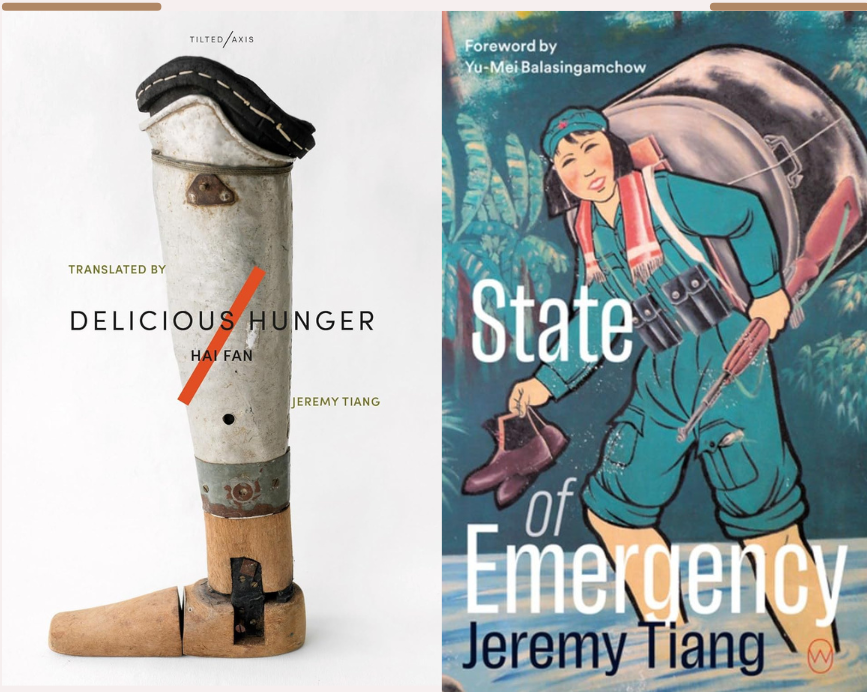
❀ Hai Fan (author), Jeremy Tiang (translator). Delicious Hunger, Tilted Axis Press, 2025. 272 pgs.
❀ Jeremy Tiang. State of Emergency, World Editions, 2025. 280 pgs.

Peace Village Number 10 lies nestled idyllically in the hills of Thailand’s southernmost district, just a short jungle trek from the Malaysian border. It is connected to the outside world by a small paved road passing endless rubber groves, durian orchards, and swathes of tropical rainforest. In these rugged borderlands, the hustle and bustle of Bangkok or Singapore could not seem further away. Elephants and tigers still roam freely, and visitors are warned not to leave their houses alone at night. Most of the guests staying in the village are here to photograph rare insects and exotic plants.
Those who look more closely will find that the lush forests around the village still carry fresh traces of a less peaceful past. On a nearby hill, a majestic obelisk overlooks the valley. It is adorned with a red star and the slogan “Eternal Glory to the Martyrs” in four languages: Chinese, Thai, Malay, and English. At the centre of the village, another red star stands out, mounted on the front of the village museum. Opened only occasionally at the request of interested visitors, the museum tells the story of the Malayan Communist Party (MCP): the party’s secretive founding in an undisclosed location in 1930, its heroic fight against the Japanese occupation during the Second World War, and its subsequent struggle against the British, who had returned to reclaim their colonial possessions in the region.
Faced with one of the Cold War’s most brutal counter-insurgency campaigns, thousands of MCP militants fled to the jungle and took up arms in a guerrilla campaign to liberate Malaya from colonialism. After a series of decisive battlefield losses, all remaining MCP-affiliated regiments retreated to the Thai border and focused on party-building and survival, while the party’s leadership was hosted in Beijing. The war continued even after the British eventually granted independence to Malaya under a nationalist government in 1957. In 1963, the Federation of Malaya merged with the formerly British-ruled territories of Sabah and Sarawak on Borneo, as well as Singapore (which had historically been part of Malaya but had been designated a separate Crown Colony by the British in 1946), to form the new Federation of Malaysia. The union proved short-lived for Singapore, which was expelled from the federation just two years later, in 1965. Undeterred by these territorial changes, fighting along the Thai border continued for decades. Lasting peace arrived only in 1989, when the last remaining MCP faction signed an agreement with the Thai and Malaysian governments in Hat Yai. As part of the Hat Yai Accords, the MCP dissolved its political and military wings and destroyed its weapons and ammunition under the supervision of inspectors. In return, veterans wishing to return to Malaysia were granted permission to do so (Singapore was not part of the agreement), while those who chose to remain in Thailand were given plots of land and financial assistance by the Thai government.
Peace Village Number 10 is one of four Peace Villages and five Friendship Villages established as a result of the peace process. Shopkeeper, restaurant manager, mayor: everyone here used to be an MCP guerrilla.1 Each village elder owns a number of photo albums containing memories of their time in the rainforest and the transition to civilian life. These albums feature group shots of the different units proudly clad in the party’s iconic Mao suits, portraits with the MCP’s long-standing general secretary Chin Peng, and photographs of comrades dancing and playing basketball. The stories behind these pictures often exist only in memory. Some are shared among the older members of the community in a mélange of the locally spoken Guangxi Cantonese, Mandarin, Thai, and Malay; others are buried deep in the minds of those who would rather forget. They are stories about a revolution that never came to be, in a country that no longer exists.
)
How does one write about such a revolution? Memoirs penned by leading MCP cadres such as Chin Peng, Shan Ruhong, Abdullah CD, and Shamsiah Fakeh can be found in well-stocked independent bookshop from Penang to Singapore. In most cases, these works are of historical rather than literary value and are often written with the obvious intention of clarifying historical controversies and shaping the narrative of the author’s legacy. Among the more aesthetically compelling attempts to grapple with the legacy of the MCP, two recent publications stand out: Hai Fan’s short-story collection Delicious Hunger, translated by Jeremy Tiang, and Tiang’s own novel State of Emergency (reviewed in this journal previously by Mandy Chi Man Lo).
Published in Chinese in 2017 and in English translation by Tiang in 2024, Delicious Hunger’s eleven short stories cover all facets of the daily life of an MCP guerrilla: endless treks through the jungle, hunting and setting snare traps to catch wild animals, various medical emergencies, ideological study sessions, and the intricacies of love and companionship among comrades. Scenes of active combat feature less prominently than one might expect from an anthology about guerrilla warfare, reflecting the low-intensity nature of the post-1968 Second Emergency era, during which many fighters never witnessed any actual fighting first-hand. Yet even in the absence of direct firefights, the violence of war is omnipresent. At least three of Hai Fan’s characters sacrifice a leg to the revolution by stepping on landmines, becoming “iron-legged generals”.2 The book’s cover,3 by renowned Singaporean artist Sim Chi Yin, shows an improvised prosthetic leg produced by the guerrilla force itself. Such prosthetic legs can still be found in any of the Peace and Friendship Village museums, with the supply seemingly so abundant that some are simply tossed into the corner of a room.
Elsewhere in the book, the impact of the war is more subtly inscribed upon the faces, minds, and stomachs of the protagonists. There is Lianyi, suffering from scurvy, whose face, “once porcelain”, takes on a “greenish hue like the desolate moon peeping between thick crowns of trees”.4 Frail and sickly Donghua struggles to adapt to life in the jungle and grieves the loss of her martyred partner.5 Former underground cadre Aiyue feels similarly out of place, prone to illness and unable to carry heavy loads. Tormented by hunger after a long trek, the ever-disciplined Yejin tosses and turns at night “like a pancake on a griddle”, dreaming of snack vendors and hawker centres.6 Reflecting on his time in the rainforest, the narrator of the final story notes: “Looking back now, I realise how many questions actually revolved around eating.”7
Hai Fan’s characters are as diverse as their daily struggles. They include an Indigenous Orang Asli tribal leader, a Teochew medic, a member of the trekking team called “magic ears” for his acute hearing, a local Guangxi woman with intimate knowledge of the local fauna, and an outspoken member whose “big mouth” has prevented him from becoming a party member for fifteen years. This heterogeneous cast reflects the varied ethnic, class, gender, and occupational backgrounds of those who joined the MCP throughout its decades of struggle, while acknowledging the dominance of ethnic Chinese members in both the command structure and the rank and file. Once again, food provides the metaphor. In one scene, two cadres spend their last evening in Kuala Lumpur before heading to the mountains to join the struggle. Marvelling at a newly opened American fast-food joint, one of the two notes: “Chicken is the only meat eaten by every race. Isn’t that the same as the United Front of the Revolution?” “Wah!” replies the other. “Are you saying the Revolution should be like KFC?”8
)
While the characters and stories are fictional, the author’s intimate familiarity with the life of a Malayan revolutionary is hard to miss. Hai Fan is the pen name of Singaporean Ang Tiam Huat, who joined the MCP as a guerrilla in 1976 at just twenty-three years old. Ang went on to spend thirteen years in the rainforest until the Hat Yai Peace Agreement in 1989, finally returning to Singapore in 1992. Having begun writing short stories for the MCP army’s periodical Torch (火炬), he admits that, upon returning to Singapore, he felt no energy to continue writing. Only after the success of the 2014 anthology What the Rainforest Tells You, which included some of his earlier writings and diary entries, did he feel “prepared to step into the rainforest again”.9 Hai Fan’s style could be described as post-socialist realism: both the hardships and joys of life in the rainforest are depicted in great detail, as are the contradictions of the MCP’s political project. His protagonists wrestle with the party’s brutal internal purges and erratic strategic decisions, the anxieties of transitioning to civilian life and returning to the outside world, and nostalgia for a lost struggle for a better world. The focus remains consistently on the subjective experience of the revolutionary herself; everyone else, the Leader, the Enemy, the Organisation, the Commander, remains a generic archetype. Hai Fan’s careful attention to the politics of language is highlighted by translator Jeremy Tiang, who notes the author’s detailed response to an initial draft of the translation:
I was wrong to talk about the Communists’ ‘surrender,’ he told me; no one surrendered, but rather a peace treaty was signed between the Thai government, the Malaysian government, and MCP. Also, could I please not refer to the Communist ‘insurgency’? It was a movement.10
Hai Fan’s sharp eye for detail and narrative skill make the collection a multisensory firework. Discourse “flows like a river”; the young comrades sip their Milo “like honeybees collecting nectar”. Nature is never silent in a rainforest brimming with life. “Hoo… hoo… hoo… a distant animal cry” opens the first story of the collection, only for the protagonists to begin wondering whether the sound could possibly come from their comrades in the work team, or worse, from the enemy. In another story, a group of militants dives to the ground upon hearing the sudden png! of a gunshot, only to learn that the advance scout has shot a boar: “Terror followed by joy.”11 Grief is often accompanied by music. In “In the Line of Work”, the narrator sings for his comrade Lim Kuan after he loses his leg to a landmine. In “Swansong in That Faraway Place”, Ah Xiang plays the flute to process the death of his pregnant partner, Chunxi: “the haunting tones of the flute reached every corner of the campsite and swirled over the treetops.”
Amid all these sounds, as editor Tice Cin notes in her insightful foreword, there are subtle silences: “These are the silences that are not perceived so easily. They are the missing words and gaps of visibility in a climate that could easily absorb the lives we come to know.” Writing after Malaya also means writing about this silence: about words unsaid, feelings repressed, and stories too dangerous to share. Consider the bloody intra-party purges of the late 1960s, when senseless killings shook the party and led to its fragmentation into three different factions. Remembering those times, Hai Fan’s character Old Jiang thinks to himself: “The battles you fight with a rifle are easy, it’s the ones you face unarmed that are hard.”12
)

Jeremy Tiang’s own novel, State of Emergency, published in 2017 by Epigram Books and in a new international edition in 2025 from World Editions, does an excellent job of writing the silence that surrounds both armed and unarmed battles. Tiang’s novel is written from the perspectives of six characters living in post-colonial Singapore, Malaysia, and London. At the centre of the plot are the middle-class, anglophone civil servant Jason and his wife, Siew Li, a veteran of the Singaporean labour movement who flees the city to become a guerrilla, as well as various family members and a Singaporean journalist working for a British newspaper.
The silence that permeates Tiang’s book is double-edged. On the one hand, it protects the protagonists from scrutiny and allows them to maintain familial ties across ideological camps. After Siew Li’s sudden departure, Jason’s parents’ “mouths clamped shut. The effort not to say I told you so was visible in their clenched jaws, and he knew he could rely on them for dutiful support, but nothing else.”13 As the fugitive Siew Li is ferried across the Causeway under cover of night by a fisherman named Feroz, silence protects them both: “Feroz didn’t want to know anything, not even her name. He said a number, which turned out to be most of the cash. After he’d counted the notes solemnly a couple of times, he nodded and thumbed at the boat.”14 When Nam Teck, a young Malaysian, considers joining the struggle alongside Siew Li, he visits his mother but is unable to speak openly about his plans: “He went back to Seminyih to see his mother. If only he could ask her, but of course that was impossible, too risky to even mention. (…) He gave his mum more money than usual, and said he might not be able to visit for a while.”15
While silence protects Siew Li, Nam Teck, and their families in such crucial situations, it also stabilises the order that drove them into the struggle in the first place. This silence is encountered by journalist Revathi, whose bombshell investigations into the 1948 Batang Kali massacre, carried out by British troops, trigger a political scandal and calls for an investigation in the UK, only for the inquiry to be buried by an incoming Tory government: “She understood this at one level, but at another felt horribly naïve at having allowed herself to believe in the possibility of justice. There had been no further discussion. A token show of resistance, and the chamber moved on to other business.”16 In the penultimate chapter, Jason’s niece Stella, a church volunteer working with migrant workers, is detained by Singapore’s Internal Security Department in the infamous Operation Coldstore and accused of taking part in a Marxist conspiracy. She is released after what can only be described as a forced confession. Yet while nine fellow detainees later speak out about their mistreatment and release a press statement, Stella chooses to remain silent. As expected, those who speak out are rearrested and detained without trial: “Stella couldn’t stop thinking about the nine who had spoken up. It seemed likely they would be held for years this time, not months. She ought to feel pity or guilt, but instead she resented them for putting her in this position.”
)
In the very act of writing about the silence that surrounds the MCP and the political trajectory of post-war Malaysia and Singapore, both Hai Fan and Jeremy Tiang find creative ways to break it. This requires courage, as writing about the Malayan communists can still carry political consequences. In 2023, the author and publisher of a recent collection of interviews with former MCP militants, Narratives from Piyamit, were detained and questioned at Malaysian customs, and twenty copies of the book were confiscated.17 Earlier this year, Malaysia banned the sale of two memoirs written by former members of the MCP’s Tenth Regiment, Shamsiah Fakeh and Aziz Suriani, only for the ban to be revoked in July.18 Meanwhile, Singapore continues to uphold its ban on Tan Pin Pin’s 2013 documentary To Singapore, With Love, which features interviews with Singaporean former MCP members and other leftist dissidents in exile. In 2015, the Singaporean National Arts Council suddenly withdrew funding from Sonny Liew’s graphic novel The Art of Charlie Chan Hock Chye, whose narration of post-war Singaporean history was deemed potentially to “undermine the legitimacy of the government and its institutions”.
What makes this genre so sensitive is that it reveals the extent to which the regional economic and political order is built upon violence. In Malaya, this involved forcibly resettling up to 500,000 residents, or 10 per cent of the total Malayan population, into barbed-wire New Villages, where they were subjected to constant surveillance and food rationing, as well as displaying captured rebels’ skulls on spikes and the widespread use of chemical defoliants similar to Agent Orange. Calling this brutal escalation of violence an “emergency” was first and foremost a corporate accounting trick. Pressed by powerful colonial business interests, the British government avoided the terms “war” and “civil war”, since those labels would have rendered existing insurance policies invalid. Emergency Exits, a recent exhibition at London’s Imperial War Museum, situates this violence within the broader context of British suppression of anti-colonial insurgencies, comparing it with similar “emergencies” in Kenya and Cyprus. The exhibition documents how Malaya became a model for “successful” counter-insurgency operations, serving as a blueprint for imperial interventions from Vietnam to Afghanistan.
Perhaps most contentious, however, are the implications these stories may hold in the contemporary conjuncture. Aptly, Jeremy Tiang’s State of Emergency opens with an epigraph from Walter Benjamin’s “Theses on the Philosophy of History”, written amid the horrors of the Second World War: “The tradition of the oppressed teaches us that the ‘state of emergency’ in which we live is not the exception but the rule.” While the Malayan Emergency may be over, other emergencies persist: the climate emergency, rising inequality and social discontent, wars, and geopolitical tensions.
)
At first sight, the hills of Southern Thailand appear comfortably sheltered from these new storms on the horizon. Visiting one of the Friendship Villages, Jeremy Tiang’s character Henry catches himself thinking: “If I stay here for too long, I will forget about the outside world, because everything I need is right here.”19 This is, of course, a fallacy. Sooner or later, the new world imposes itself even upon the remotest corners. This can happen on a random Wednesday, as it did on 22 July 2026, when ten masked men dressed in black emerged from the bushes near a Thai military checkpoint in neighbouring Narathiwat Province, opening fire and hurling pipe bombs at the outpost, killing five Thai paramilitary rangers and injuring several civilians. The attack is a reminder that the region is still home to an insurgency, this one led by groups fighting for the independence or autonomy of the Malay Muslim-majority provinces of Southern Thailand that once belonged to the Pattani Sultanate. The conflict has escalated significantly since 2004 in the context of a global “war on terror” and rising Islamophobia, costing an estimated six thousand lives since then. At the entrance to Peace Village Number 10, a squad of young Thai soldiers is permanently stationed, ostensibly to “protect” the village from insurgent activity.
Other battles are intensifying, too. Deforestation has increased drastically in Thailand’s Deep South, with new rubber and palm-oil developments reaching deep into the heart of the rainforest. Under martial law, resistance to these projects is heavily suppressed. Severe flooding and landslides have become regular occurrences in the region, fuelled by global heating and intensified by the reckless destruction of local ecosystems. As Jeremy Tiang notes, Hai Fan’s writings are a reminder that a different ecology is possible:
In translating Hai Fan’s short story collection Delicious Hunger, I encountered a radically different mode of life in tropics, in which the comrades seek to co-exist with nature rather than to subjugate it, working with the indigenous Orang Asli population to grow crops and understand the rhythms of the rainforest, sustaining themselves on fish from the river and wild fruits and vegetables, using plants as medicine.20
Not only does Malaya no longer exist as a political entity, but its existence as a bioregion is also under assault. The partisan landscape that has sheltered generations of rebels, refugees, and gangsters is now being systematically carved up, criss-crossed by new highways and infrastructure projects, tamed and arranged neatly into plantation monocultures. In this desolate hellscape, where will the next generation of revolutionaries find sanctuary? Whose silence will protect them, and whose silence will betray them?
Footnotes
- For ease of reference, I use MCP as shorthand for both the Malayan Communist Party and its armed wing, the Malayan National Liberation Army (MNLA). ↩︎
- p. 180 ↩︎
- This refers to the cover of the international edition by Tilted Axis Press. ↩︎
- p. 125 ↩︎
- p. 67 ↩︎
- p. 135 ↩︎
- p. 237 ↩︎
- p. 213 ↩︎
- p. 257 ↩︎
- “Into the Rainforest: Translating Hai Fan”, Asian American Writers’ Workshop. ↩︎
- p. 86 ↩︎
- p. 31 ↩︎
- p. 40 ↩︎
- p. 101 ↩︎
- p. 131 ↩︎
- p. 184 ↩︎
- The Pained Memories of Malaysia’s Communist Guerrillas ↩︎
- Home minister revokes ban on Shamsiah Fakeh’s memoir | FMT ↩︎
- p. 284 ↩︎
- Nature-writing: On Translating Hai Fan – s/pores journal ↩︎
How to cite, König, Elias. “Writing After Malaya: Literature, Revolution, and the Silences of History.” Cha: An Asian Literary Journal, 18 Aug. 2026, chajournal.com/2026/08/18/after-malaya.


Elias König is a PhD candidate at Twente University in the Netherlands. He writes about philosophy, colonialism, and climate justice.