
茶 FIRST IMPRESSIONS
茶 REVIEW OF BOOKS & FILMS
[ESSAY] “Scattered Thoughts and Admiration for Her Name Upon the Strand and Other Tammythings: A Partial Retrospective” by Cyril Camus

Click here to read all entries in Cha
on An Extraterrestrial
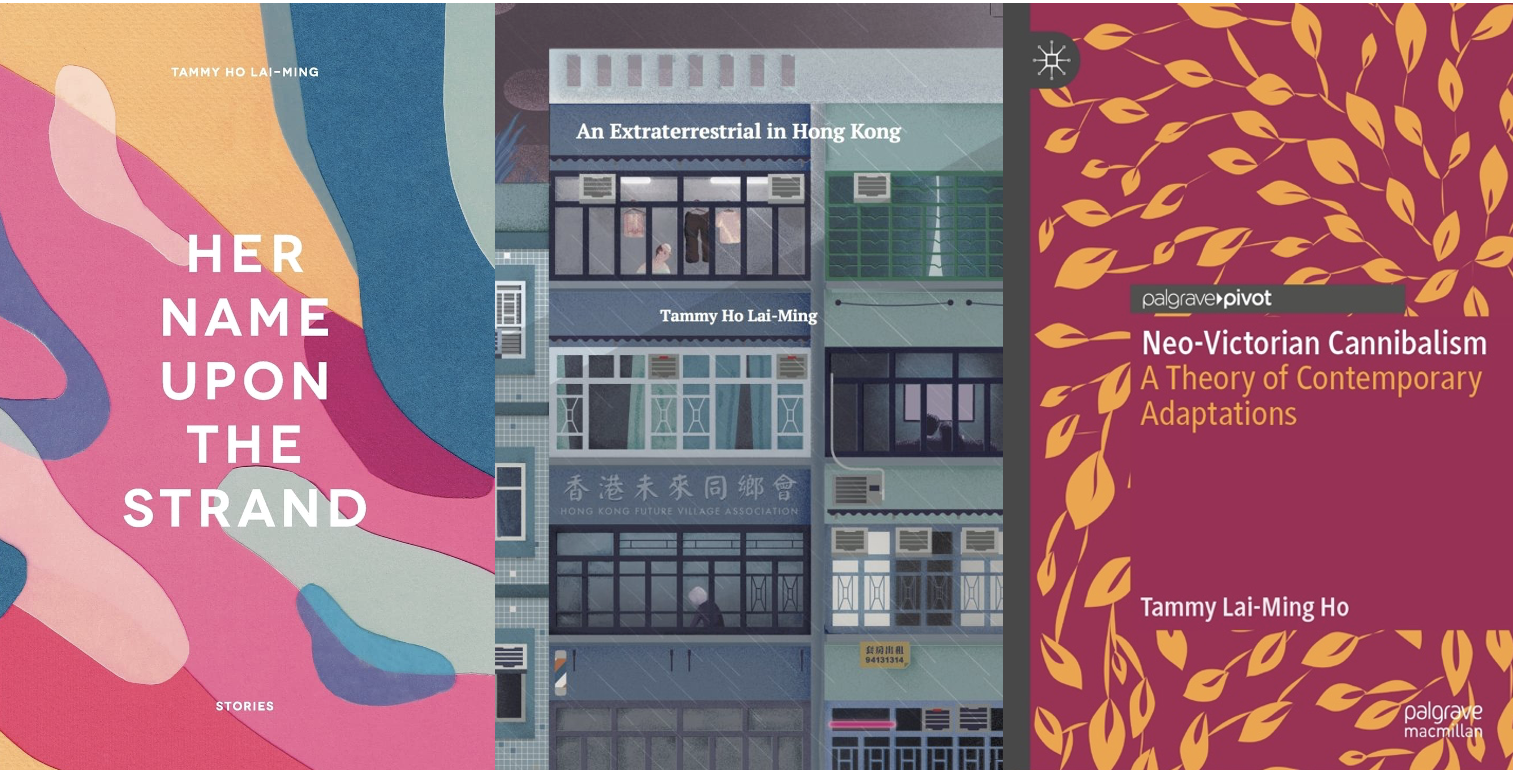
🌻 Tammy Lai-Ming Ho, Her Name Upon the Strand, Delere Press, 2018, 100 pgs.
🌻Tammy Lai-Ming Ho, An Extraterrestrial in Hong Kong, Musical Stone Publishing (co-published with the Hong Kong Arts Development Council), 2018, 45 pgs.
🌻Tammy Lai-Ming Ho, Neo-Victorian Cannibalism. A Theory of Contemporary Adaptations, Palgrave, 2019, 150 pgs.

Since I am planning to review Tammy Lai-Ming Ho’s third full poetry collection If I Do Not Reply (Shearsman Books, 2024) soon, I thought I might preface it by gathering, in as orderly a way as possible (and in English), the various thoughts I have expressed over the years, in different quarters and in French, about some of the wonderful books that have emerged from the mind of the editor-in-chief of the present website.
There is obviously no need to present Ho to the readers of this journal, so I will dispense with quoting her résumé in extenso, from her academic achievements to her indefatigable commitment to Cha and many other publications she has edited, to her stances that make one worried as well as deeply admiring, and I will cut right through the bone (quite uncharacteristically for me, as some of you may know, but the joy of talking about her texts cannot wait).
)
In 2018, when her Sisyphean editing work had seemingly not yet become quite so all-consuming, she blessed the world with no fewer than three different books: Too Too Too Too (reviewed in this journal by Aaron Chan and Lucas Klein), which is her widely acclaimed second poetry collection (after her stellar debut Hula Hooping, reviewed in this journal by Michael Tsang); then a collection of short stories and photographs, entitled Her Name Upon the Strand; finally, a collection of poems and one story, entitled An Extraterrestrial in Hong Kong, published by Voice and Verse Poetry Magazine’s Musical Stone Publishing imprint (reviewed in this journal by Phill Provance), while the eponymous novella-essay was also published in Italian in the Roman daily La Repubblica. That piece is certainly a great text, very much inspired by the work of Chris Marker, both as weird contemplative science fiction reminiscent of La Jetée (1962) and in the way it blurs the line between documentary and fiction, also with a distinctly reflective mood, in the manner of Sans Soleil (1983).


Indeed, “An Extraterrestrial in Hong Kong” is a documentary account of the worried state of mind of Hongkongers just before Typhoon Mangkhut hit the island in the autumn of 2018; but it is also science fiction in that the witness who is the narrative and reflecting voice is an extraterrestrial sent to Hong Kong to observe what is going on; finally, it is real-life prospective dystopia, as it draws a haunting parallel between the growing anxiety caused by the approaching hurricane and the more long-term (but not long enough) fear inspired by the approach of 2047, the date when the “one country, two systems” principle guaranteed by the Chinese constitution since the retrocession will cease to protect the island from the mainland’s oppressive grip. Obviously, and sadly, we have learned since that even the years separating our time from that fateful deadline were not enough to protect the Hongkongers whose fears are dramatised in this multi-faceted text from the object of their fear. So, not just haunting, but devastatingly prescient, in fact.
)
Blessed times, though, when Ho did not yet have to devote the entirety of her days to responding to email, and she could actually be the great writer that she obviously is.
A striking testament to this greatness, Her Name Upon the Strand is a delightful patchwork of micro-fragments that are sometimes realist or minimalist, and one never knows to what extent they are autobiographical or resolutely fictional, sometimes Kafkaesque or discreetly surrealistic, along with a few longer texts (some four pages long) in a similar vein.

Among those, I particularly enjoyed “Eyes”, which is a kind of crossover between Saramago’s Blindness and Lucile Hadzihalilović’s Evolution, with a colony of blind children who play quietly, unaware of the fate that awaits them.
I was also struck by two stories about the grandmothers of some of those female narrators who sound possibly autobiographical but not necessarily; perhaps it is some trace, in Ho’s narrative prose, of her usual practice and mastery of meditative, testimonial and intimate poetry. One of the grandmothers, in the story called “Summer”, dies peacefully, and is the object of a soft, pensive narrative focused on the anticipation, and then on the mourning. The other, “Grandma”, is more dramatic. Shortly before her death, the titular elder unveils to her granddaughter the sordid details of her unsuspected, dissolute life, replete with abandoned children and an aborted one. The story focuses on the narrator’s shock at discovering, in someone close to her, an entire reality she could not have imagined.
Among the little gems scattered about in this thin but rich little jewel of a book, this fragment (one of the “Tales of Departure”) also stands out in its subtle use of poetic language (“a lost soul in the sunset of everlasting disappointment”) or images evocative of childlike wonder (“be best friends, sharing […] evil secrets”) to confer an aura of whimsy and quasi-fantasy on a text that is about a very un-phantasmagorical and realistically melancholy anecdote of people lost and found, and others who flee the world and seem to have left no mark, to be missed by no one, despite their good works:
My sister’s friend knows a friend who knows someone whose job was to locate missing people. For a few years, she was confided to many inside stories of moderately rich families and she retrieved teenagers and adults alike from dire and humiliating situations. She enjoyed an odd sense of satisfaction mingled with hatred whenever someone thanked her for unearthing the precise location of a lost soul in the sunset of everlasting disappointment. One day, she was gone. Nobody knew where she went. Perhaps she wanted to be found by someone like herself; and the two of them could be best friends, sharing strategies and evil secrets. But no one seems to care about her enough to take the initiative to consult a detective. And therefore she is free. Somewhere between this world and the next.
Did I mention that the writing and ideas in Her Name Upon the Strand also often show a remarkable sense of humour? It is usually subtler and more deadpan than in the example quoted below, but this fanciful display of “female-Kafkaesque trash” certainly gives a strong sense of how hilarious Tammy Ho can be:
DREAMS
i.
I had a weird dream the other night, possibly inspired by the Brexit vote. In the dream there was a referendum about whether books should be universally banned. In the end, more people voted for the motion than against it, and so the world became officially bookless. In this new order, I belonged to a secret group, very much like in Fahrenheit 451, who memorised texts, and turned ourselves into walking and breathing books. But not all members could choose which books to read and become. And so I was assigned to be porn. And regardless of which members in the secret group came to me to release my book memory, I had to oblige.
ii.
I had a dream that some might consider sexy. In it, I applied to be a high-end escort and on the application form I ticked “SM possible”. So I was given some training. The male instructor made us watch some SM-inflected porn, and then ordered us to take off our clothes. I noticed that the other women were wet, aroused by what they’d seen. I, instead, found myself bleeding (in reality I was having a heavy period) so I said I am sorry but I cannot go on because it is my time of the month. Upon hearing this, the trainer, beaming, said, “That is great. You and I can do something very special indeed. I will teach you.” I got very scared and uncomfortable, and said that I was suffering great period pain (I was in real life as well). And so I fled, ran as fast as I could out of the training barn and onto the grassland. With each step, my blood stained the white and yellow flowers.
Just before, in the collection, there is also a slightly longer story called “Black Me”, which reminds me a bit, in some of its aspects, of Yōko Ogawa’s The Ring Finger, but in a darker tone. This story is particularly captivating, with, again, some flashes of delightfully offbeat humour.
)
Finally, another telling example of how much the world would gain if Tammy Lai-Ming Ho were allowed to go easy on the editing work and to write her own stuff, dammit, is her academic monograph published the following year, in 2019, Neo-Victorian Cannibalism: A Theory of Contemporary Adaptations, developed from her PhD dissertation completed at King’s College London. It studies books that remake, rewrite and subvert canonical Victorian works. The best-known, and the first that is analysed, is Jean Rhys’s Wide Sargasso Sea, which famously rewrites Charlotte Brontë’s Jane Eyre by focusing on the life of the former Creole wife whom the creepy Mr Rochester hides in his attic because (according to Jane Eyre) she unfortunately became crazy after the wedding, or (according to Wide Sargasso Sea) that imperialist pig made her crazy, by tearing her from her native Caribbean to turn her into his maid and his doormat in a freezing English manor…
Ho studies Wide Sargasso Sea and several later works that remake both Jane Eyre and Wide Sargasso Sea, then her monograph moves on to a chapter about various works that purport to be sensationalist biographical novels on Dickens, then the book ends up dealing with several novels that remake Dracula, usually with Bram Stoker as a character, and the idea that Stoker has not made up anything, only fictionalising the real confrontation of real people with a real vampire (one may say, like H.P. Lovecraft in Alan Moore and Jacen Burrows’s 2015-2017 graphic novel Providence).

Of that last chapter, one can gather, among other things, that Leslie S. Klinger’s Annotated Dracula seems much more interesting than his underwhelming Annotated Sandman, since, in the former, the notes are a pretext to create a new piece of fiction that is juxtaposed to the original text, Pale Fire-style. On the contrary, the Dracula chapter also fortunately warns Ho’s readers about the novel Dracula, or the Un-Dead, an “official” sequel, “authorised” inasmuch as it was co-written by one of Stoker’s scions, with the blessing of Stoker’s family (even though this is not required as the original novel is in the public domain). Indeed, this authorised sequel sounds rather stupid:
If The Un-Dead sets out to subvert the social order established in Stoker’s text, it does so more overtly by revealing that Dracula, the ultimate evil in the original, is in fact a wronged hero. He travels to London from Transylvania in 1888 […] to stop the real villainess, the lesbian vampiress Elizabeth Bathory, who is also “Jack the Ripper”, from killing more prostitutes in Whitechapel.
)
Overall, the monograph is of course fascinating, both rich and insightful, and constitutes more proof of the loss endured by the world when Tammy Lai-Ming Ho started to work much more on other people’s works than she has found time to write her own. Hence my plea to the people who might read this and whose work is or has been edited by this brilliant author, and who might be or have been tempted to be impatient, demanding, insistent in the barrages of email they send her, etc., that they be more considerate and decent, and realise that every hour spent by her on their work is an hour less dedicated to the growth of an important oeuvre.
Some of the photographs by Tammy Lai-Ming Ho in Her Name Upon the Strand:


How to cite: Camus, Cyril. “Scattered Thoughts and Admiration for Her Name Upon the Strand and Other Tammythings: A Partial Retrospective.” Cha: An Asian Literary Journal, 14 Aug. 2026, chajournal.com/2026/08/14/retrospective.


Cyril Camus teaches English to post-secondary students at Lycée Ozenne in Toulouse and is an associate member of the Centre for Anglophone Studies at Toulouse University. He is the author of Myth and Fabulation in the Fantasy Fiction of Neil Gaiman, originally published in French in 2018, with an English-language edition published by McFarland in August 2026. He also wrote the historical horror novel Grand Guignol, published in October 2026, which had previously appeared with another publisher, in a slightly different version, under the title Sang de bœuf between 2019 and 2025. His academic publications address Neil Gaiman, Alan Moore, comics, music, and postmodern fantasy. He also co-edited a 2021 journal issue on societal and environmental collapse in fantasy and science fiction. Further information is available on his website. [All contributions by Cyril Camus.]