
茶 FIRST IMPRESSIONS
茶 REVIEW OF BOOKS & FILMS
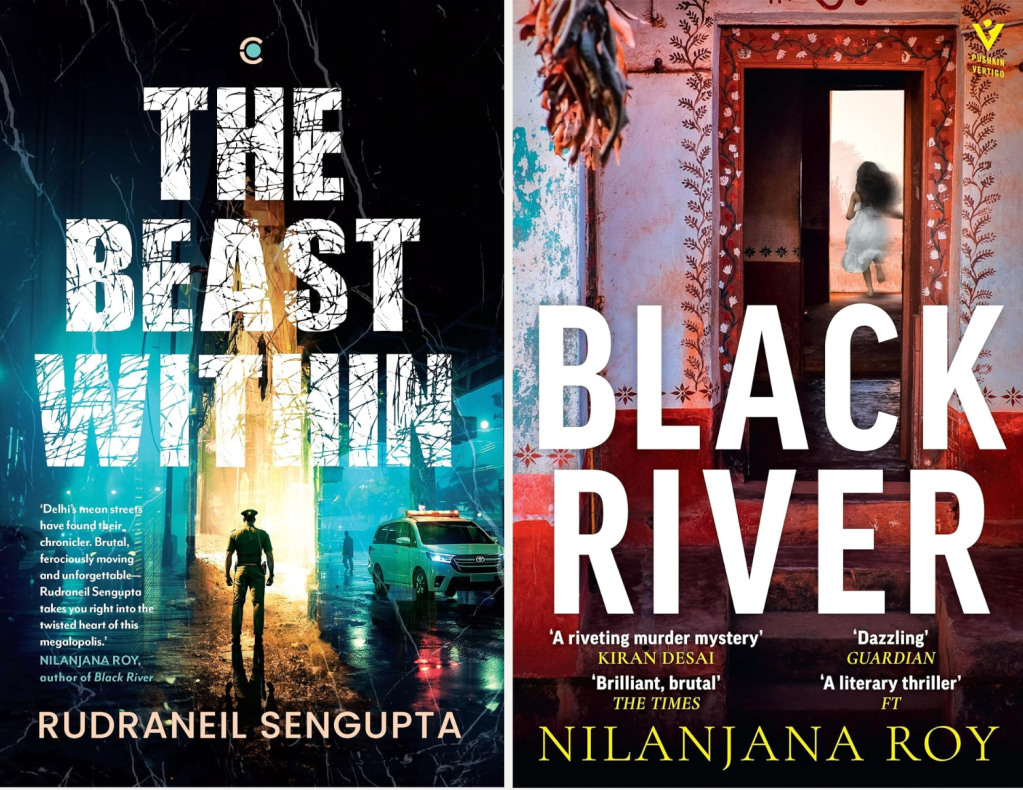
[ESSAY] “Into the Heart of Darkness in Rudraneil Sengupta’s The Beast Within and Nilanjana S. Roy’s Black River” by Rituparna Mukherjee
🌸 Rudraneil Sengupta. The Beast Within, Context, 2025. 352 pgs.
🌸 Nilanjana S. Roy. Black River, Context, 2022. 368 pgs.
Crime fiction, particularly the police procedural, endures as a genre of whodunits, filling bookshelves and OTT platforms alike, in acknowledgement that crime is never an isolated event. Beyond suspense, it exposes the deeper malaise beneath civilised society.
Both Rudraneil Sengupta’s The Beast Within (2025) and Nilanjana S. Roy’s Black River (2022) are hard-edged Delhi noirs set in a city often called India’s crime capital.
)
Sengupta’s The Beast Within unfolds in three sections (Bawana, South Delhi and Shahbad Dairy), mapping not only sites of crime but the city’s predatory relationship with its suburbs, where the neo-colonial drive for expansion and progress masks the entrenched fiefdom of its people.
Riding on the success of arresting the alleged leader of the Bawaniya gang, Inspector Prashant Kumar, seasoned and embittered, is transferred from the “badlands” of Outer Delhi to the relatively sedate enclave of Hauz Khas. There, he is assigned the murder of Jyoti Dhurwa, a tribal orphan from Chhattisgarh found impaled at the boundary wall of the upscale, upper-caste home of Tarun Srivastava, an affluent industrialist with deep ministerial ties, for whom she worked as domestic help.
The case assumes importance to the police department immediately because of this connection, and the DCP marks it as a cut-and-dried case of jilted love between Jyoti and Rajesh Mondal, a lower-caste migrant and the family’s driver, who is named the prime suspect. As the investigation deepens, the crime accrues unsettling layers, following a fatigued police team through a case that grows steadily more complex and disturbing. Inspector Prashant Kumar, haunted by his own grievous past, takes a personal interest in this matter and looks beyond the veneer to unravel the real murderer and the root cause of that crime, eventually snowballing into a double crime of sexual molestation and child trafficking.
From the very beginning, Jyoti’s character is shrouded in mystery. A quiet, withdrawn girl, she is easily dismissed as sullen and given an ill repute because of her friendship with Rajesh:
“Girls today, what can you say? They are asking for trouble. You know what I mean, I’m sure. Especially tribal girls like this one. Their parents sell them off when they are young, they know nothing about decency. Northeastern girls too, there’s a lot of them here. A bad influence” (p. 110).
This casual dismissal of the crime as the girl’s own fault reveals a mindset forged by upper-caste privilege and patriarchy, deeply xenophobic and reflexively suspicious of the other: the caste other, the gender other, the religious other.
Delhi’s migrant population, which ebbs and flows into the cityscape, sustains elite households.
Delhi’s migrant population, which ebbs and flows into the cityscape, sustains elite households, absorbed through neo-colonial rhetoric of upliftment, articulated most starkly by Srivastava’s wife: “She was an orphan. We took her in. Is that our sin? She came from a jungle. We wanted her to go to school, get a chance at life. She had more than she could ever hope for” (p. 95). This evident othering in the city spills into everyday crime. While the rich fortify themselves through surveillance, the poor remain exposed, a hypocrisy acutely noted by the police: “A girl had fallen to her death from her room on the terrace. Later, everyone got together to build walls” (p. 80).
)
Sengupta’s The Beast Within seethes in masculine rage. Its sharpest achievement is its unsparing gaze at North Indian machismo, a distorted masculinity that propels the title and suggests that every man on the city’s streets restrains his own bestiality, in differing measure. While the DCP and Tarun Srivastava shrink behind power and privilege, it is the middle rungs of society, policemen Kumar, Zeeshan, Colonel, Das, Sushil, Parveen Tomar and Srivastava’s manager Garg, that reveal the most layered and telling forms of masculinity. Zeeshan and Colonel embody a modest, middle-class, complicit masculinity, entirely loyal to their superior, Kumar, enabling their interrogations to run like a well-oiled routine. Steady family men, unambitious in rank yet committed in practice, they pursue cases with conviction and reflect a quiet urge to do some good within the system.
Kumar is morally ambiguous, having a history of sporadic violence against his wife that racks him with guilt; but even with a wavering moral compass, the seriousness with which both men approach their jobs remains unquestioned. It is Parveen Tomar, however, who portrays the most interesting shade of North Indian machismo. A caste-conscious head constable, he embraces policing for its licence to violence, abuses his authority to run a narcotics trade, and reproduces the same brutality at home. His abuse of his wife embodies upper-caste patriarchy that deems women weak and obstructive, fuelling his fantasy of “a world without women. Only men. Men fighting, men doing whatever they wanted. Men without desire. Men without children. Men without guilt or confusion or fear… It would be a perfect world, refreshing, clean, like riding his bike on a highway” (p. 252).
This gaze governs how the masculine collective views women in the force: ACP Sofia and Sub-Inspector Meera. While rank shields Sofia, Meera bears the brunt of institutional and street-level masculinity. An international wrestler recruited through the sports quota, Meera’s muscularity, sexual autonomy, caste indifference and non-vegetarian food habits make her simultaneously desirable and despised. Her competence is routinely dismissed and her gender relentlessly policed. At Shahbad Dairy, a mob gropes and restrains her during an arrest, laying bare the extra labour female officers must perform simply to endure in the system.
)
Capital refashions the terrain; Jaguars and Harleys replace fields and footpaths.
While Sengupta’s novel maps Delhi through the lens of caste and patriarchy, Roy’s Black River locates crime at the intersection of class and religion along the city’s shifting margins. Set in Teetarpur, a village on Delhi’s edge near the Aravallis, the narrative unfolds amidst rapid change as businessmen Jolly Singh and Saluja, beacons of ostentatious wealth, plan a luxury forest complex for the elite. Capital refashions the terrain; Jaguars and Harleys replace fields and footpaths. In this altered landscape, Munia, Chand’s nine-year-old daughter, is murdered for witnessing the killing of the local scamster-dancer Bachni. Asphyxiated by someone familiar, her death shatters the village’s fragile calm and ignites retributive mob violence.
This violence is directed at Mansoor, a Muslim vagrant who is fed by the villagers and accepted into their fold as a harmless lunatic due to his dim-witted ways. But when he is found by Munia’s corpse, weeping helplessly, the villagers immediately bay for his blood because of his religion. Led by Jolly Singh, the villagers storm the local thana, demanding swift street justice. As Singh coerces a confession out of Mansoor, Inspector Ombir looks on helplessly while Mansoor is handed to Chand’s family for revenge. Though Chand ultimately releases him, Ombir, like Kumar in Sengupta’s novel, rejects a naïve faith in justice, observing that “his years in the police have not convinced him that there is much justice in the universe, or that it is his job to commit acts of justice” (p. 190).
Ombir and Bhim Sain, like Kumar and his colleagues in Sengupta’s procedural, embody the exhaustion of policing, shaped by relentless crime, paucity of human and digital resources and a fraying system stretched thin by elite entitlement and suburban neglect. What persists within the constraints of this job is acute loneliness and a diminished capacity for ordinary family life. As Roy’s procedural unfolds, elite predatory tendencies emerge: land cheaply acquired, forests quietly encroached upon and sexual demands of the rich imposed on poor women and children. Unlike Tarun Srivastava’s bluster, Jolly Singh works quietly, fortified by generational wealth and masked by benevolence. While commiserating with Chand over his loss, he covets the fields beside his mansion and installs the sign “Muslims not Allowed,” to realise his vision of a Hindu-only estate.
Development and waste choke the river until it runs black and metallic.
What appears microcosmic in this village speaks to the macrocosmic malaise of right-wing nationalism that takes on many forms. Roy frames religious xenophobia in the Hindi heartland as an outgrowth of caste and class privilege, most sharply directed at migrants. This aspect emerges in Chand’s bond with Badshah Miyan and Rabia, forged in youth as he sought escape from village confinement, drawn by the lure of the city. His past with Khalid and Rabia in reed huts along the Yamuna evokes an enterprising, river-bound, idyllic life, later undone by Delhi’s voracious growth. Development and waste choke the river until it runs black and metallic, “a sluggish choked band of polluted water that runs between two sets of apartments, one a set of luxury high-rises, the other a set of unfinished, unpainted and illegal homes built by workers and migrants over the years” (p. 111).
)
Both Bright Dairy in Roy’s work and Shahbad Dairy in Sengupta’s novel are inhabited by lower-caste, lower-class and religious minority communities, defined by skewed infrastructure, open drains and garbage dumps: zones that absorb what the city expels. Mountains of waste interspersed with cosmetic beautification projects signify the consuming city’s attempt to mask the ugliness at its margins. Bright Dairy’s once-enterprising terrain is further reshaped by militant youth, mobilised for elections, propaganda and communal division. In a chilling scene, Rabia and her daughter-in-law move through a crowd of young men playing “Lynching videos. Rape videos. Each man playing a different one” (p. 300).
This fear tactic drives communities inland or abroad, weighted by memories of a lost homeland. Rabia, unlike her family, resists exile, selling her house in Bright Dairy to live wherever she is permitted. When Chand, still in love, suggests they leave together after his daughter’s killer is punished, Rabia articulates the impossibility of their future: “Some days I wonder whether there is a place in this city, this country, for me to breathe freely without this Hindu-Muslim, Hindu-Muslim trouble, a place where I can rest and be myself. Then what space is left for a Chand and a Rabia? The mountains are infected with the same prejudices and terrors as the plains. I am tired of battling these tides of hate” (p. 308). Together, Chand and Rabia embody the secular optimism of post-Independence India, now steadily eroded by parochialism, greed and right-wing militancy.
The Beast Within and Black River pose a shared question through the recurring symbolism of waste: whom does society deem fungible?
The Beast Within and Black River pose a shared question through the recurring symbolism of waste: whom does society deem fungible? In both texts, we see a subversion of the cosmopolitan dream: migrants who sustain elite urban life circulate from the margins yet remain the most dispossessed. Lower-caste and lower-class communities, women, children and religious minorities inhabit the city fleetingly and precariously, yet continue to love and live meaningfully alongside the mainstream, showing that colonialism might be over, but the centre-margin divide sustains.
How to cite: Mukherjee, Rituparna. “Into the Heart of Darkness in Rudraneil Sengupta’s The Beast Within and Nilanjana S. Roy’s Black River.” Cha: An Asian Literary Journal, 8 Jul. 2026, chajournal.com/2026/07/08/into-the-heart.



Rituparna Mukherjee teaches English and Communication Studies at Jogamaya Devi College, Kolkata. She is a research scholar working on gendered mobilities in Nigerian fiction at IIIT Bhubaneswar. Her academic interests include gender studies, food-and-memory studies, precarity, and urban studies. She has published academic work with Routledge and Brill Rodopi. A Pushcart Prize nominee and a multilingual translator, her debut translation, The One-Legged, translated from Sakyajit Bhattacharya’s Ekanore, has been shortlisted for the JCB Prize for Literature 2024 and has won the KALA Literature Awards 2025. She has several creative publications in leading magazines. [Read all contributions by Rituparna Mukherjee.]
 Cha
Cha 