
茶 FIRST IMPRESSIONS
茶 REVIEW OF BOOKS & FILMS
[FIRST IMPRESSIONS] “On the Horizon: Xu Xi’s Hong Kong Across Three Decades” by Jonathan Han
Click HERE to read all entries in Cha
on Horizon Hong Kong.
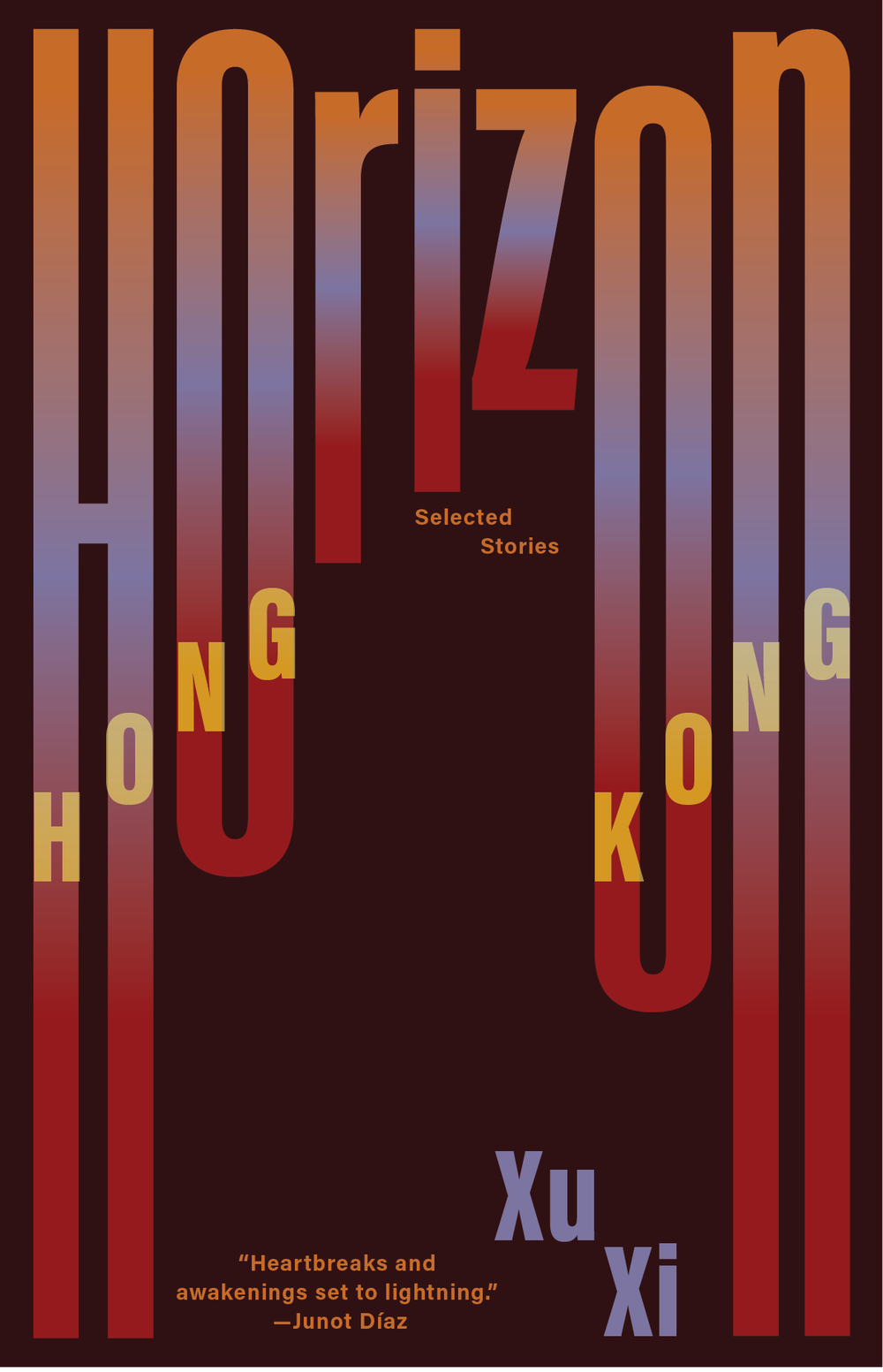
Xu Xi. Horizon Hong Kong: Selected Stories, Gaudy Boy, 2026. 288 pgs.

A few of these stories were published before I was born.
Xu Xi’s latest book, Horizon Hong Kong, is a collection of her stories from the last thirty years. Reading a collection spanning so long affords certain pleasures unattainable elsewhere. Observing how Hong Kong has changed is one. Xu Xi’s steady prose, regardless of these turbulent changes, is another. A few of these stories were published before I was born. Many were written about a time I can only imagine, and with Xu Xi’s prose I do imagine it clearly.
The stories are especially convincing when written from a child’s perspective. Two stories selected from her earlier collection, History’s Fiction, “Chung King Mansion” and “The Yellow Line,” both follow a child as they explore the city around them. In “The Yellow Line,” a boy takes the Mass Transit Railway for the first time, so enthralled by the experience that he steals money from his mother to pay for the ticket. A girl in “Chung King Mansion” peers into the famous building in Tsim Sha Tsui and follows an orange-haired lady.
There’s something strangely magical about her tonight, like a costumed actress on stage who appears and disappears, declaiming lines to her audience on Nathan Road. She is not a beautiful woman. Her face is chalk white with powder, and her orange hair is a blackish coppery color, like an orange on the market fruit stand that has been scarred and bruised and not fit for sale, as Mum would say.
The metaphors work on two levels. First, the striking images extend and populate the setting of the city. Second, they establish a balance between the innocence of the child and the reality of prostitution. Throughout, the prose also manages to sustain the voice of the child. That same care towards building an authentic narrator is applied in “The Yellow Line,” as a boy from the public estates of Lok Fu takes the train to the affluent Kowloon Tong.
He saw some children playing there. They were foreign devil children with golden hair. How rich they must be because they had gold-colored hair. Everyone knew gold meant lots of money. Like his golden Underground Iron ticket, which cost money. Money was important because his mother was always shouting at his father about money. Last night, he had hidden under the covers as his mother threw an ashtray at his father for gambling again and losing money. These little boys had golden hair and didn’t need any money.
The geographical proximity of two distinct neighbourhoods serves as the backdrop to a dysfunctional family. The Underground Iron, a direct translation of the Chinese name 地鐵, becomes a mode of escapism for the protagonist. The tragedy, however, is that despite what the Underground Iron and its golden ticket symbolise, there is no magical way to avoid the trappings of poverty and family toxicity. Indeed, after being caught, the boy incites a fury that proves a traumatic cycle, one from which he becomes desperate to break free, by any means necessary.
“Famine” further develops the themes of class and escapism, but this time through the lens of an older woman. Freed from the burden of caring for her parents, she splurges on a trip to New York. The story oscillates between the decadence of her current journey and the self-imposed famine she endured at home:
Hot scones, oozing with butter. To ooze. I like the lasciviousness of that word, with its excess of vowels, the way an excess of wealth allows people to waste kindness on me, as my former student still does, every Lunar New Year, by sending me a laisee packet with a generous check which I deposit in my parent’s bank account, the way I surrender all my earnings, as any filial and responsible unmarried child should, or so they said.
In other stories in the collection, Hong Kong remains on the periphery.
Half a world away, and the pressures of the past can still spoil the pleasures of the present. In other stories in the collection, Hong Kong remains on the periphery, often not even mentioned. The protagonists find themselves jetting off to New York, San Francisco, or Stockholm, putting distance between themselves and the city. The experience of the diaspora is well served by Xu Xi’s treatment of what it means to be away from home. Nostalgia, rather than being treated as sappy sentiment, is invoked by small and genuine reminders of Hong Kong. In “Citizenship,” Regina takes a bus to Buffalo after her student visa is cancelled, and smokes with the man sitting next to her:
His smoke rings bounced against the seat, their circumferences dissolving into a vaporous mass. Four years ago, she had watched a tail of smoke disappear into the sky from the flight ahead of hers. Then, her plane rolled forward on the narrow runway toward the South China Sea, and she ascended into the air for the first time in her life, going away to America away, she hoped, for good. Her mother’s face, awash in tears, came into focus. I can’t bear for you to leave. Regina had vanished behind the partition toward the immigration counters. The excitement, after years of impatient longing, of escape at last, overrode her family’s sorrow. But at that moment of liftoff, as Hong Kong receded behind her, she suddenly wept, unaccountably, uncontrollably.
Yet Regina does not consider returning a first course of action. Instead, she remains determined to attain citizenship, to become legal in a land that has rejected her right to stay. Deep in thought, Regina steps off the bus and leaves behind her copy of Paradise Lost, a critical text for her upcoming postgraduate studies on Milton. The references to that classic tale of banishment are hard to miss, but the question then is: which is Regina, Eve or Lucifer? Which is Hong Kong, Eden or Hell?
That duality runs throughout the book, a beloved but deeply flawed city, matched only by the complexity of those who keep the city in their hearts and at a distance. Given the quality and the scope, it is tempting to see Horizon Hong Kong as representative not only of Xu Xi’s body of work, but of the city itself. Yet the book, by lacing together stories from different collections, reminds us that there is more still to be told.
How to cite: Han, Jonathan. “On the Horizon: Xu Xi’s Hong Kong Across Three Decades.” Cha: An Asian Literary Journal, 1 Jul. 2026, chajournal.com/2026/07/01/horizon-hong-kong.


Jonathan Han is a Hong Kong-based writer. His work has appeared in Essays in Criticism, Hong Kong Review of Books, and Asian Review of Books. His chapbook Quinquennial was published by Pen and Anvil Press. Follow his Substack @jhantheman. [All contributions by Jonathan Han.]