
[ESSAY] “Memory and Music: Smells Like Teen Spirit” by Michael Raymond
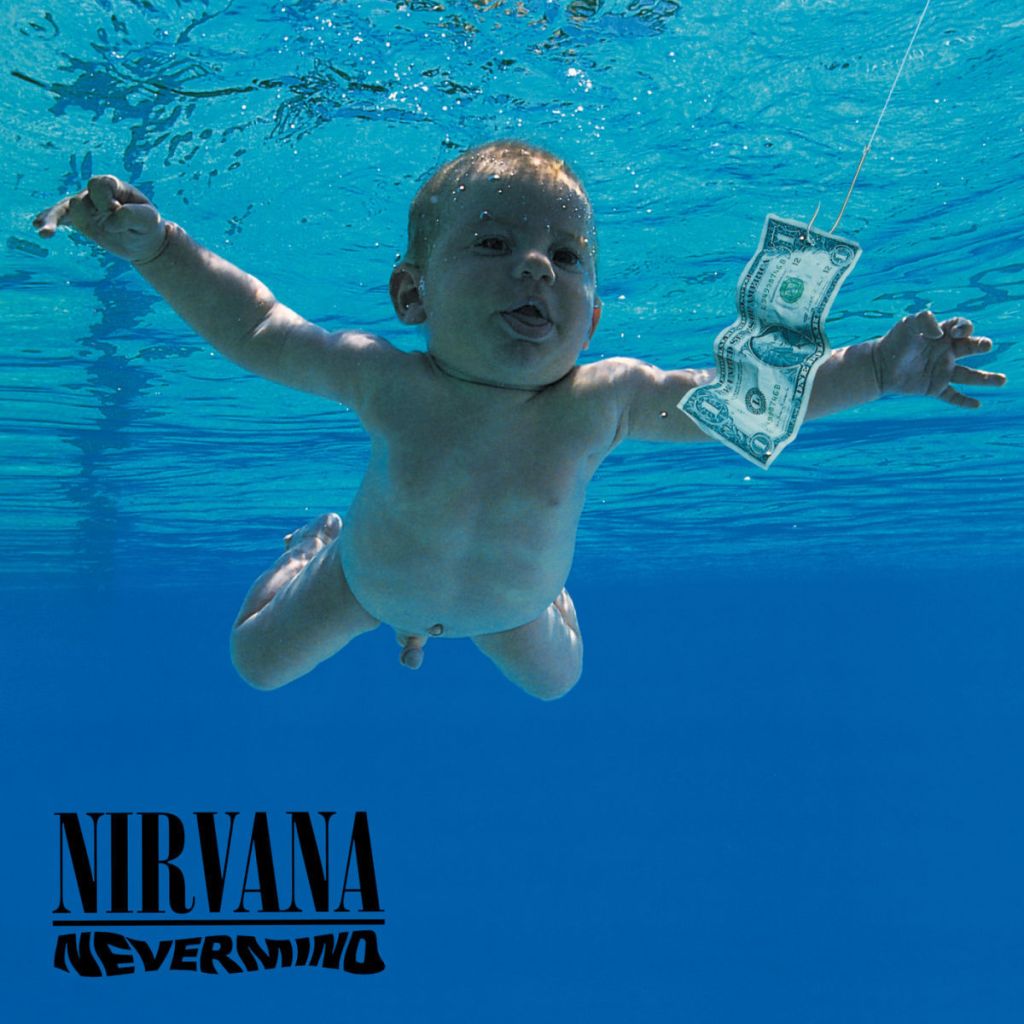
The first time I ever heard Nirvana’s “Smells Like Teen Spirit,” I was watching the music video through a mosquito net late at night. Just me and the dim, flickering glow of the television. And a woman named Carina lying next to me. I tried to wake her up, but I couldn’t move. Or speak.
The volume on the TV was barely audible, yet it shook the room like a sonic boom. The music was incendiary, but somehow still melodic. It rushed towards me like a heat-seeking dolly-zoom shot. I was Chief Brody sitting on the beach in Jaws. It sent a shiver down my spine.
The song, with its iconic guitar riff, was a siren call I had seldom encountered in my lifetime. Singer Kurt Cobain held your gaze with an angst-ridden, I-don’t-give-a-fuck scowl that felt both seductive and dangerous. A beautiful train wreck. He was irresistible. You didn’t dare look away.
It was 1992 and, since I had spent the previous year backpacking around Europe before making a brief stop at my parents’ place in Houston, I had somehow missed the dawn of the grunge movement. It’s possible I heard the song whilst in Houston, but I’m certain I would have remembered.
“Smells Like Teen Spirit” is not a song or video a person easily forgets, even if I wasn’t necessarily the target audience. Having just turned thirty, youth and rebellion weren’t quite my calling card any more, but this musical turning point strangely mirrored my own life.
Carina and I were living in a spartan yet tidy second-storey flat on Cheung Chau Island outside Hong Kong. I hesitate to call Carina a “girlfriend,” given that we had only met six months earlier in Turkey before parting ways in Istanbul, promising to eventually rendezvous. Ten days in Turkey, six months apart, and here we were. We had obviously taken complete leave of our senses.
Carina and I had gone from carefree vagabonds living in the moment when we first met to now pondering an uncertain future together whilst making our home in the British colony of Hong Kong, itself awaiting its own ambiguous appointment with destiny. It was forever time-stamped by “Smells Like Teen Spirit.”
I knew things would never be quite the same again. For music. For Hong Kong.
I knew things would never be quite the same again. For music. For Hong Kong. And especially for me and Carina. Our transient, nomadic life had to end sometime. Once it did, what would happen to us?

Hong Kong in 1992. You could quite literally smell the money in the air, yet something else was happening. You could feel it everywhere. Big Brother was an approaching dark storm cloud, with its “one country, two systems” slogan that essentially meant: keep making money, just don’t get any ideas.
The looming handover to China permeated all aspects of life and created a perpetual sense of foreboding.
The looming handover to China permeated all aspects of life and created a perpetual sense of foreboding. A heightened, agitated feeling of trepidation. Nobody knew whether the handover was something to embrace or fear. A strange anxiety and nervous excitement pervaded everything, creating a constant undercurrent of unease. Just like with me and Carina. And my classroom was no different.
I taught English at the K. Chung English Institute in Mong Kok in Kowloon. I found the job by phoning every language school listed in the Yellow Pages. I made at least forty calls. The arrangement was Hong Kong in a nutshell. Cash only. All under the table. Mutually beneficial.
My students were young teenagers preparing for university. More uncertain futures. I taught class on Saturday mornings, but my real bread-and-butter was developing essays for the writing class taught by the head of the school. I was paid six hundred Hong Kong dollars (eighty USD) to draft the “example” essay. I used a prehistoric manual typewriter to produce dozens of essays on social and political topics such as “Mass Demonstrations” and “The New Governor of Hong Kong.”
We were only three years removed from the Tiananmen Square massacre, so classroom discussion on several of these topics was always fraught with emotion and considerable delicacy.
My students were also fascinated by Western culture. They asked if I liked Cantopop (I did) and I asked what they thought about “Smells Like Teen Spirit.” I received responses such as “loud” and “in your face,” a phrase we discussed in the context of English slang drawn from American and British films and television programmes.
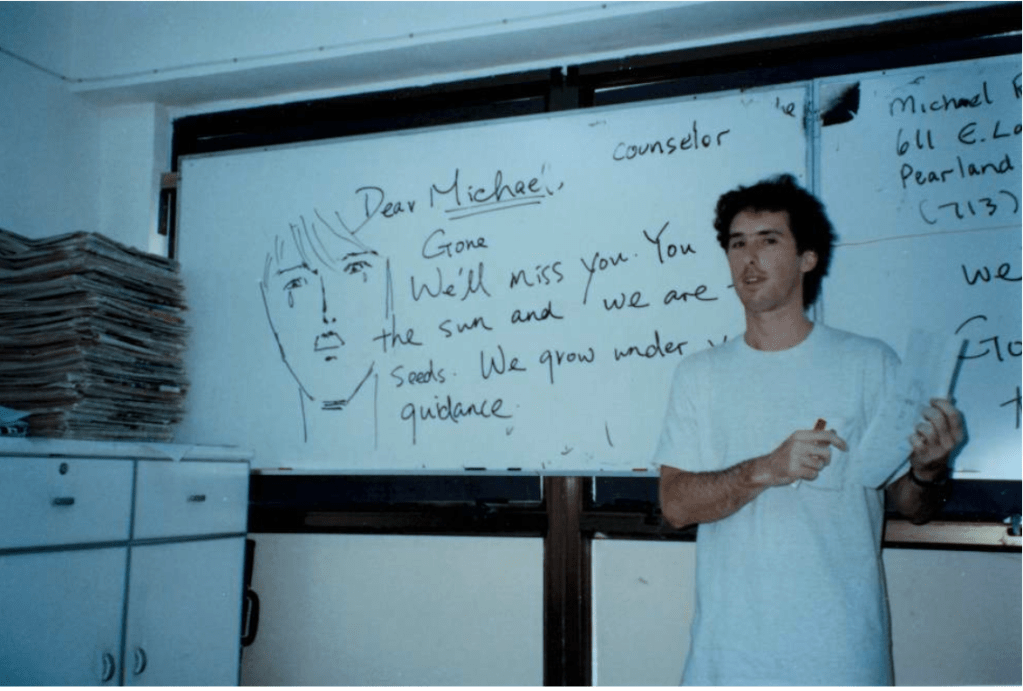
On my last day, the class surprised me with a message on the whiteboard: “Dear Michael: We’ll miss you. You are the sun and we are the seeds. We grow under your guidance.”
I often wonder how their lives turned out after the handover. Or whether they ever remembered me.
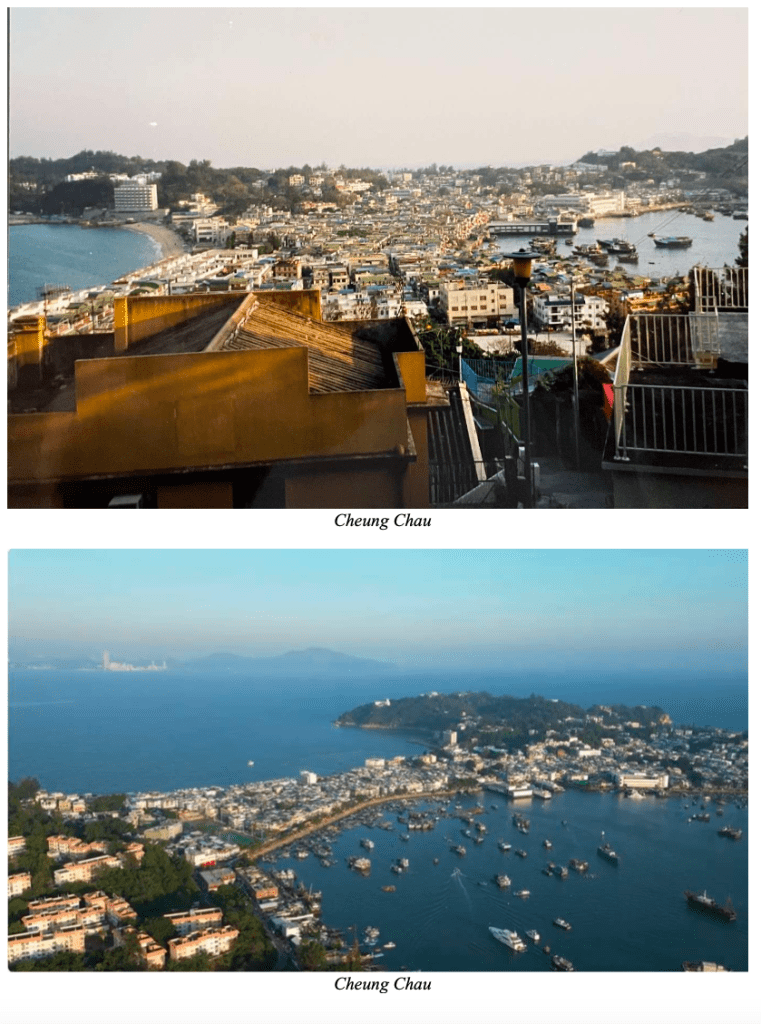
Our first flat in Cheung Chau was on the ground floor and an endless battle with mould and moisture. The rain in Hong Kong never stopped. Biblical, relentless downpours. I learned the true meaning of “the rainy season,” but our living conditions were borderline substandard. The gecko crawling on the wall never bothered me, but clothes and towels were perpetually damp. When the flat upstairs with its complimentary dehumidifier became available, we leapt at the chance.
We had to break the news to a mangy stray dog who had followed us home from the ferry one day and insisted on curling up outside our front door. Torrential rain notwithstanding, he remained undaunted even though we never fed him. He developed a strange attachment to us, probably because the pack of stray dogs that roamed the island all seemed to despise him. He was an outcast. We gave him the name “Muttface,” though we meant it more as a term of endearment. After we moved upstairs, we never quite knew what became of him.
The upstairs flat was bone-dry, but we had other battles. Oversized, aggressive mosquitoes invaded the flat in waves. Diabolical and relentless. Coordinated attacks. They mostly preyed on Carina; they even bit her through the mosquito net. My nemesis was a gargantuan centipede that bit me on the shoulder whilst I was sound asleep. I flung it to the floor, where it met its demise at the heel of my shoe, though it went down fighting. Half of its body flattened whilst the other half lunged skyward, wiggling and flailing its tiny legs before I delivered the final blow.
I suppose the centipede had the last laugh when my shoulder began to spasm and twitch, but Carina’s Hong Kong relatives furnished me with an unmarked brown bottle of an unknown ointment to rub on the wound, swearing it would do the trick. They weren’t lying, though to this day I have no idea what Chinese remedy or mysterious potion was contained inside that nameless bottle.
Much like the rain, the countdown never stopped.
Hong Kong 1992. Record rainfall. Mutant insects. Strained relationships. Geopolitical tension. Much like the rain, the countdown never stopped. It just kept going. Where was it all heading?
Carina and I were saving up money to resume our backpacking adventures in south-east Asia. She taught at a public primary school on Lantau Island, a short ferry ride from Cheung Chau. We’d wake early and descend the long staircase to the small harbour, dotted with fishing boats and ramshackle liveaboards. Sampans and junks. A total throwback. The Opium Wars, Warlord Era and Chinese Civil War were long gone, but I sometimes felt like Steve McQueen in The Sand Pebbles.
Cheung Chau was my respite from the human treadmill that overwhelmed me every time I stepped off the ferry onto Hong Kong Island. The waterfront was lined with modest eateries and storefronts, teeming with early-morning dim sum crowds and fishermen. I’d escort Carina to her ferry, drawing a number of curious stares, but over time my presence among the island residents became less of a novelty. Eventually, I was regarded as one of the locals. I suppose everyone had grown accustomed to seeing the “gweilo” every day.
The old man who ran the place spoke no English, but we developed our own convivial rapport.
I’d order my own dim sum and then return in the late afternoon to wait for Carina’s ferry. I’d sit at an outdoor table, order a beer and read the South China Morning Post. The old man who ran the place spoke no English, but we developed our own convivial rapport. Carina had taught me a few Cantonese phrases for ordering a “large” or “small” beer, along with the Cantonese equivalent of “check, please.” I think the old man found my rudimentary Cantonese rather amusing, though Carina scolded my overuse of replying “hiya, hiya, hiya” as if saying “yeah, yeah, yeah.”
Carina was born in Kowloon in the late 1960s, a few years before her family emigrated to New Zealand. She spoke Cantonese with a New Zealand accent, yet the locals in Hong Kong always seemed to know she was an outsider.
This was Hong Kong in 1992. The final chapter of British rule. The countdown was very much a real thing.
Kurt Cobain was still alive. Hong Kong still independent. And Carina and I were still living out of our backpacks. But the future was beckoning. For all of us.
If love makes you do crazy things, we were living proof.
Amid the geopolitical tension swirling around Hong Kong, there was me and Carina. If love makes you do crazy things, we were living proof. After I left Carina in Turkey, she ended up at a kibbutz in Israel. We exchanged letters for a few months and, after a few reverse-charge phone calls, we both flew halfway around the world to re-ignite our whirlwind affair in Hong Kong, hoping that something far more meaningful was in store. Like any fledgling relationship, who could really say for certain?
So we distracted ourselves with travel plans. We’d discuss the perils of travelling through Pakistan on the rugged Karakoram Highway, as if we preferred to risk death on the most dangerous road in the world rather than face questions about our future once our wandering days were over and an inevitable parting loomed.
We were barely a few months into our relationship, yet everything felt far more heightened and accelerated than had we been living an ordinary life somewhere and going out on a Saturday evening to the cinema. We both assumed Carina would eventually return to New Zealand and I’d go back to the States, so parting ways was a distinct possibility that created an unspoken sense of dread.
It was a confusing mixture of fear and excitement. We feared that this unlikely, meet-cute story might amount to nothing more than a memorable travel romance, yet were genuinely thrilled and eager to discover whether it might also be the real thing. It all carried a serious once-in-a-lifetime weight. Our version of “Smells Like Teen Spirit” or the handover. Hong Kong was on pins and needles. And so were we.
It raised the other unanswered and studiously ignored question. If we vowed to stay together, what exactly did that mean? What then? We were still two people living in different hemispheres.
It was easier to simply not talk about it. So Carina and I pretended our future didn’t exist. We stayed in the moment whilst living in the most densely populated place in the world. We may have fallen in love in Turkey, but our true courtship took place amid the vibrant frenzy of Hong Kong. I wrote at the time: “Suppressed concerns hang in the air, but we don’t want to be apart anymore.”
One might say Carina and I had our own personal countdown, but we chose to ignore it.
Carina and I felt as though we were living in a Wong Kar-wai film. Dreamy and surreal. If you ever watch Chungking Express (1994), you might catch a glimpse of me and Carina drifting past the camera like background characters or extras. Celluloid ghosts from a bygone past. Still images frozen in time.
Carina and I spent a great deal of time in Kowloon and Tsim Sha Tsui, as it was just a few MTR stops from my school in Mong Kok. We’d wander aimlessly and lose ourselves in the labyrinth of Chungking Mansions, as well as the back alleys and hidden lanes that formed the surrounding nightlife.
There was something poetic about getting lost in Hong Kong, where I had grown accustomed to the constant press of bodies.
There was something poetic about getting lost in Hong Kong, where I had grown accustomed to the constant press of bodies. Personal space, as I had previously known it, no longer existed for me. The crush of humanity and sensory overload sometimes put me in mind of Blade Runner (1982), though without the dystopian overtones.
Somehow, Carina and I still found our own quiet retreats. We’d sit on a bench along the Tsim Sha Tsui waterfront and gaze across the harbour at the celestial lights of the Hong Kong skyline. Futuristic glass-and-steel glow sticks. We rode the Star Ferry across Victoria Harbour constantly, especially at night, gazing into the water at the reflection of the neon-lit, technicolour skyline.
Carina and I were witnesses to the final days of a Hong Kong that now seems to exist only in memory. In retrospect, it feels rather like a strange loss of innocence for Hong Kong itself.
The dizzying pace of Hong Kong was both exhausting and exhilarating. I’ve never lived anywhere that left me so utterly spent yet still completely charged with adrenalin. Luckily, we still had Cheung Chau. Stepping off the ferry there always steadied the heartbeat and slowed the pulse.
During the rainy season, we’d run through the deluge with open umbrellas.
During the rainy season, we’d run through the deluge with open umbrellas, stomping through puddles. We’d dash up the steep concrete staircase to our hilltop flat with its peekaboo view of the South China Sea. Carina and I would arrive invariably soaking wet with rain and sweat, gasping for air.
Hong Kong 1992. The story of Hong Kong had now become part of our story. In a strange, almost uncanny way, our stories were forever intertwined.
Of the many nicknames for Hong Kong, my favourite might be the “Hollywood of the East.” I once sent one of my screenplays to the legendary Golden Harvest Studios almost on a whim and was startled when they rang and asked me to come in for a meeting. The script was a romantic thriller set in Turkey. I described it as “Romancing the Stone without the laughs.”
I met with a man named Chua Lam, who had frequently worked with Jackie Chan on several of his films. If only I had known. Here was a man whom, upon his death, Jackie Chan referred to as his “half master,” and who was known in Hong Kong creative circles as “one of the Four Great Talents of Hong Kong.” Of course, I knew none of this when I met him. Ignorance is bliss.
Chua Lam was suave and assured, with an infectious, all-knowing laugh reminiscent of the Dalai Lama that put me immediately at ease. It was one of those rare instances where you meet someone for the first time and feel as though you have known them all your life. I could have talked to him for hours.
Chua Lam sat behind an enormous desk, surrounded by film memorabilia in a tastefully decorated space that felt like a cosy study or private retreat. We spoke at length, and he pointed out buildings where Bruce Lee had filmed classics such as Fist of Fury and The Way of the Dragon. Eventually we discussed a project for a “famous Asian action film star,” though he only hinted at names. Chow Yun-fat? Jackie Chan? Jet Li? He told me that if I had any ideas, he would be delighted to read a treatment.
Not wishing to appear too eager, I played it cool. I left and dashed off a 27-page treatment on my manual typewriter. Well, perhaps not so cool after all. A few days later, I sent it to Chua Lam but never heard back. We never spoke again, though I didn’t mind. I knew something remarkable had happened that day at Golden Harvest the moment I walked through its iconic white-arched entrance.
I had been granted a small part in a moment in time. The epicentre of the golden age of Hong Kong action cinema. Meanwhile, the epicentre of grunge and “Smells Like Teen Spirit” was exploding in Seattle.
They say nothing lasts forever, but I beg to differ. Music. Cinema. And two kindred spirits.
As our time in Hong Kong began to wind down, the “Smells Like Teen Spirit” video no longer played on television every night, having been supplanted by “Black or White” by Michael Jackson. I took that as a sign, even though Radio Macau continued to play the song between broadcasts. I loved the station’s “rock you Macau” broken-English tagline between songs and commercial breaks.
But if time was running out for Hong Kong, it was surely time for me and Carina to face our own future. Much as we had in Turkey, it was time to discover how this storybook romance would unfold and take that first great step into the unknown, or at least get back on the open road again. Confucius would have been proud.
Prior to our departure, we marked the occasion with a few “one last time” experiences, revisiting familiar haunts in Lan Kwai Fong and Tsim Sha Tsui. A final ascent to the top of Victoria Peak. And, of course, one last crossing on the Star Ferry, two figures dwarfed by the Hong Kong skyline.
We both completed our teaching assignments and had saved enough money to set out for Indonesia. Against this backdrop of political intrigue and mounting tensions in the lead-up to the British handover, new adventures awaited in Bali and beyond.
Shortly after the last British Governor of Hong Kong arrived ahead of the eventual transfer of sovereignty to China, Carina and I left Hong Kong.
A new chapter awaited Hong Kong.
And me and Carina.
Carina and I left our hearts in Hong Kong.
We had touched a part of history and then set off to make our own.
Epilogue
One year after we left Hong Kong, Carina and I got married. A few years later, the Hong Kong handover took place at midnight on 1 July 1997. Two different union ceremonies.
Our ceremony took place before a San Diego Justice of the Peace, with ten-dollar rings we no longer wear. Hong Kong’s formal handover featured British and Chinese heads of state and the British Royal Family. Prince Charles delivered a farewell address on behalf of Queen Elizabeth II.
Hong Kong has since endured a series of political crackdowns from the mainland that have stripped away much of the autonomy it enjoyed since the handover. One can only hope that Hong Kong’s demise has been greatly exaggerated.
“Smells Like Teen Spirit” changed everything. One of those songs that comes along once in a generation. Once in a lifetime. Like two soul mates drawn together from opposite sides of the globe.
For me, the song and its Hong Kong connection remains a “where were you when” moment, akin to seeing Elvis perform for the first time or watching the Beatles on The Ed Sullivan Show. Though far removed from the Seattle grunge scene, I was living in the right place at the right time, even if I didn’t fully realise it then.
The grunge movement faded around the mid-1990s, a few years after Kurt Cobain’s suicide. Golden Harvest ceased film production in 2003. The studio and its arched entrance on Hammer Hill Road were demolished, replaced by high-rise apartment buildings.
Much like Hong Kong, the legacies and impact of Kurt Cobain and Golden Harvest, with its celluloid heroes such as Bruce Lee and Jackie Chan, will endure for generations to come.
Lantau Island has undergone a few changes. The most popular tourist attraction was once the “Big Buddha” bronze statue, but it has since been overtaken by Hong Kong Disneyland, which opened in 2005. The ultimate Trojan Horse for spreading the influence of Western culture and capitalism. Resistance is futile.
Then there’s me and Carina.
We were simply two people who met in Turkey through pure happenstance and then reunited six months later in a city and country on the precipice of a historic moment. Two separate stories were unfolding on a global stage, though ours was far more personal and intimate.
I often find myself seized by sudden, unexpected flashes of memory from those pre-handover days in Hong Kong.
I often find myself seized by sudden, unexpected flashes of memory from those pre-handover days in Hong Kong. I don’t believe I fully appreciated many of those experiences whilst they were happening.
Even though I tend to romanticise much of our time in Hong Kong, there were plenty of hardships and challenges that occasionally made both of us question what on earth we were doing.
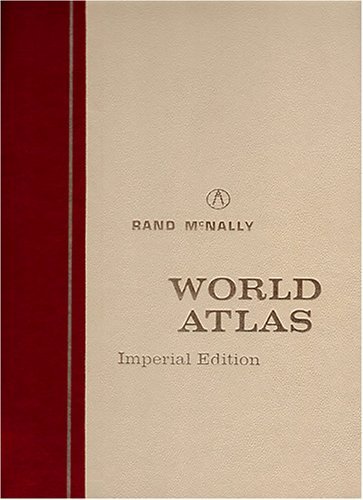
The term “culture shock” is much overused, but for a young man from a small western Pennsylvanian steel town that barely registers as a dot on a map, being dropped into the middle of Hong Kong was something I had never imagined, even as a pre-adolescent hurling a tennis ball against the brick wall in my back alley or spending endless hours poring over the maps and photographs in my Rand McNally World Atlas. The 1970 Imperial Edition, for the record, with its distinctive hardback red and tan cover.
Despite the emotional roller coaster of those pre-handover Hong Kong days with Carina, I shall always hold a genuine and heartfelt fondness for the time we spent there.
We often talk about returning to Hong Kong, though I suspect the disappointment will begin the moment the plane touches down at the “new” airport, built on reclaimed land not far from Cheung Chau and opened in 1998. I’ll always have a soft spot for the “Kai Tak Heart Attack” of the old airport and its hair-raising, low-altitude approach skimming over apartment buildings and crowded streets.
Carina and I never did travel through Pakistan into China along the Karakoram Highway. Instead, we kept things considerably simpler and safer, making our way across Indonesia via Bali and Java before departing Jakarta for the southern beaches of Thailand. We used Bangkok as a jumping-off point for a side trip to Nepal, then entered China through the city of Kunming.
Temples and volcanoes. Pristine coastal waters and full-moon rave beach parties. Glistening, snow-capped mountains and the highest peaks of the Himalayas. The Great Wall and the ever-watchful eye of Mao Zedong overlooking Tiananmen Square. We embraced all of it.
While in Bali, we had our first major argument whilst staying in Lovina Beach. Something about our future and where we would spend the rest of our days together. Funny, that. The same questions from our Hong Kong days that we had always ignored or pretended didn’t exist. But at least now we were certain of one thing: we were true kindred spirits who no longer wished to live apart.
After Asia, we passed through a succession of transient stops during a five-year nomadic period, living in San Diego, Auckland and Melbourne. We never quite finished unpacking.
Eventually, we dropped anchor, rejoined society and set about raising a family. Our adopted home had a certain irony, along with a pleasing sense of harmony and symmetry.
We settled on a place that had once served as a temporary home to both Kurt Cobain and Bruce Lee, with his metaphysical wisdom and “be like water” philosophy for adapting to any situation or circumstance. Both are timeless cultural icons, interred in a city often regarded as something of a frontier outpost for adventurous spirits and seekers of something more.
Perfect for me and Carina.
It isn’t exactly the Emerald City from The Wizard of Oz, but the nickname still fits.
It was finally somewhere to call home for the foreseeable future, and to raise a family.
Like the song says: “This Must Be the Place.”
The birthplace of grunge.
Yes, we left our hearts in Hong Kong.
But we found our home in the most unlikely of places.
Seattle, Washington.
How to cite: Raymond, Michael. “Memory and Music: Smells Like Teen Spirit.” Cha: An Asian Literary Journal, 27 May 2026. chajournal.com/2026/05/27/memory-music.

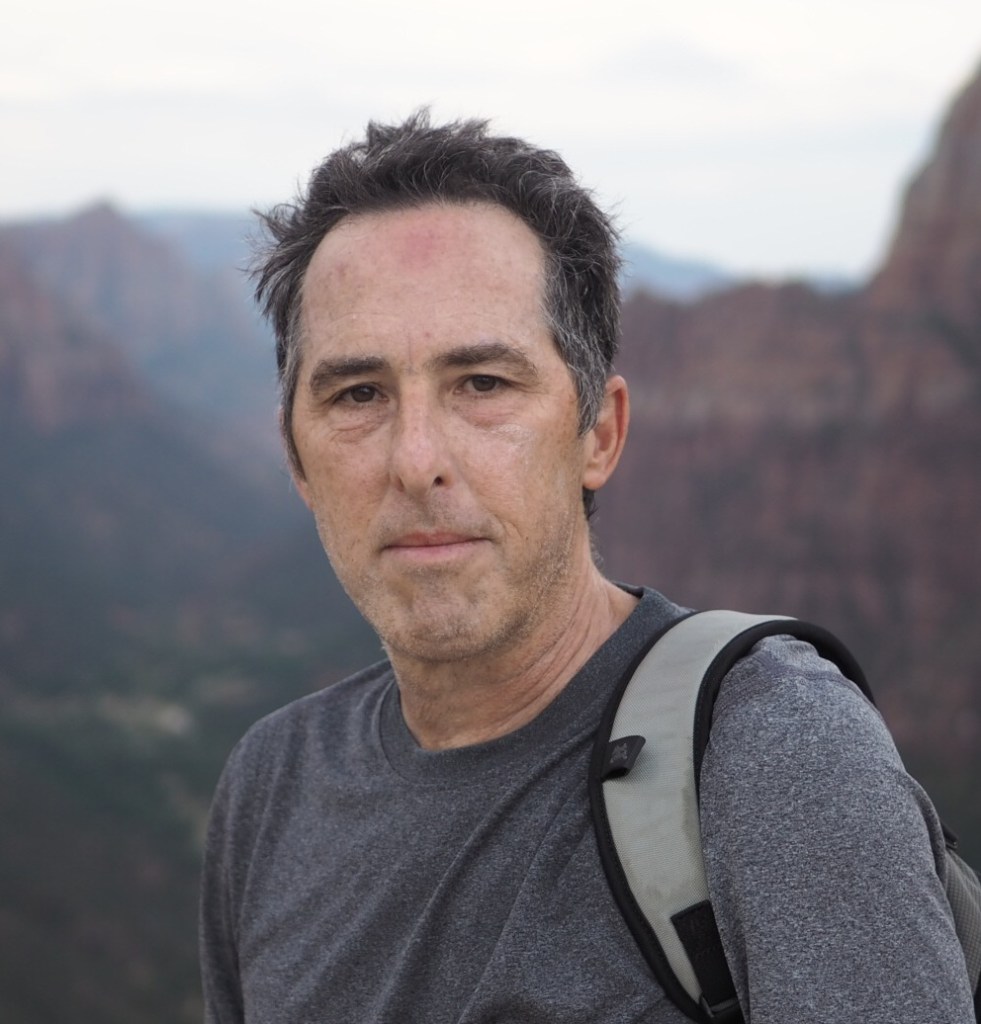
Michael Raymond is a Seattle-based writer with a diverse body of screenwriting work that has earned considerable distinction, including recognition as a Nicholl Fellowship Finalist and receiving the award for Best Screenplay at the Austin Film Festival. Michael once quit his job and sold everything he owned in order to pursue a more nomadic lifestyle overseas, working as an English teacher in Hong Kong and as a DJ in a bar on the Greek island of Santorini. Despite his formerly vagabond tendencies, Michael now resides in his adopted home of Seattle, Washington, with his Hong Kong-born, New Zealand-expatriate wife, whom he met in Turkey while backpacking abroad.
 Cha
Cha 