
FIRST IMPRESSIONS
茶 REVIEW OF BOOKS & FILMS
[ESSAY] “Yi-Ling Liu’s Portrait of China’s Digital Dissidents in The Wall Dancers” by Johanna M. Costigan
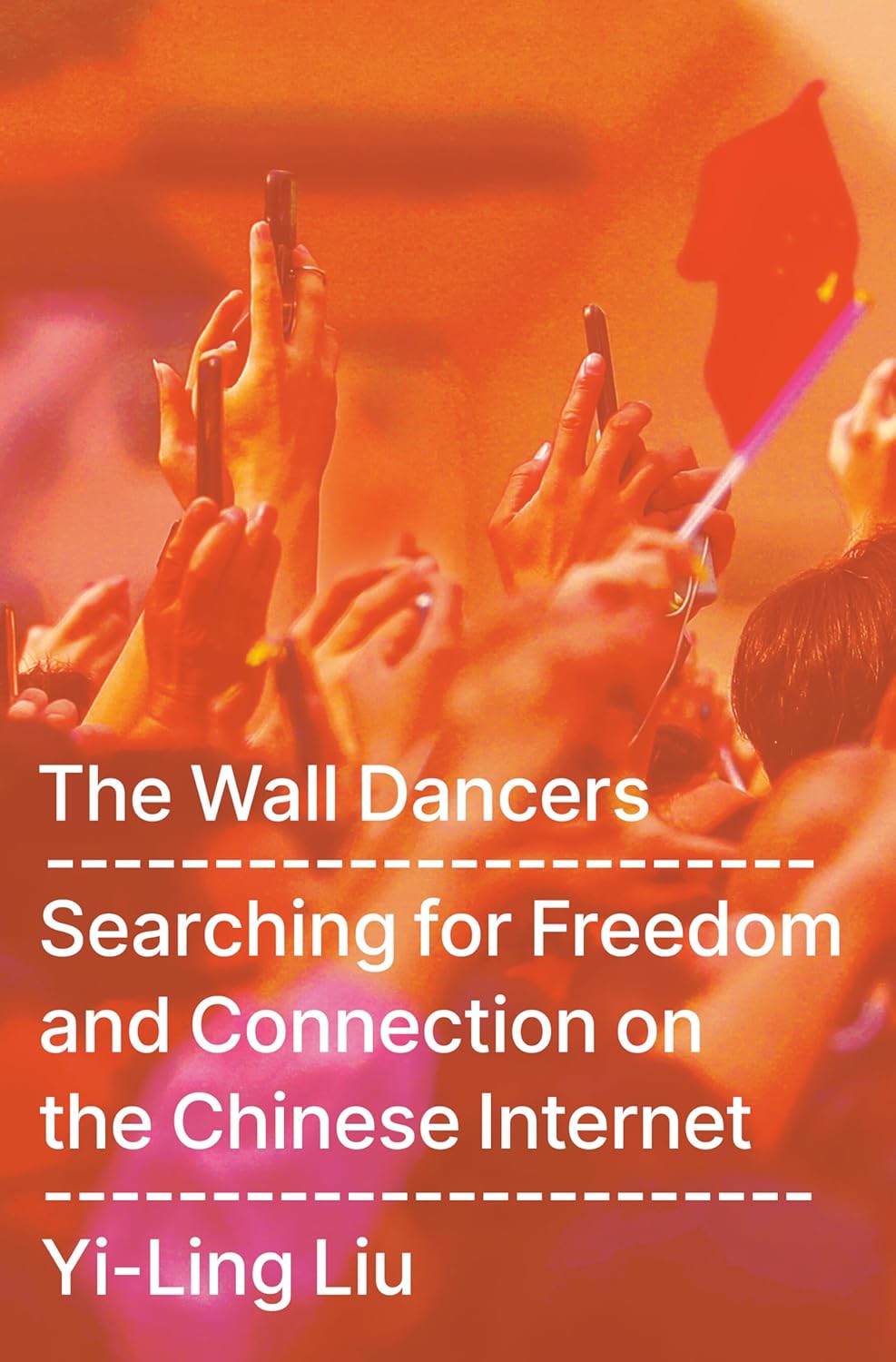
Yi-Ling Liu. The Wall Dancers: Searching for Freedom and Connection on the Chinese Internet, Knopf, 2026, 336 pgs.

When hip-hop artist Kafe Hu appeared on The Rap of China, the long-simmering tension between his craft and his livelihood reached a boiling point. In accordance with regulators’ demands, he stopped wearing foreign shoes (Nike) on stage, covered his tattoos, censored his lyrics, and agreed to submit pre-taped recordings of his performances for approval.
A younger Hu would probably have told the authorities what they could do with their censorship demands. But now, he had a child to think about. It would have been irresponsible to scoff at commercial recognition.

Hip-hop artist Kafe Hu
Yet, he said, all those would-be Kendricks face a Great Wall of content control in contemporary China.
Still, his original goal was never to become rich; he had wanted to become China’s Kendrick Lamar. “China probably has ten thousand artists who could be as influential as Kendrick Lamar,” he told Yi-Ling Liu, author of The Wall Dancers: Searching for Freedom and Connection on the Chinese Internet. Yet, he said, all those would-be Kendricks face a Great Wall of content control in contemporary China. “Real hip-hop is sung by those who are truly suffering, by those who are marginalised, by ethnic and racial minorities,” he said. “Do you think those people would dare to speak out now?”
)
Of the twenty-two countries designated “Not Free” on the internet by Freedom House, China is the only nation to have created what feels and functions like a separate internet from that of the rest of the world. The dataset classifies Thailand, for example, as “Not Free” (albeit with a score of 39 compared with China’s 9). Yet in Thailand, Google, Facebook, and international news sites remain freely accessible. More significantly, Thai authorities have not made it their mission to restrict and steer domestic discourse in the way China’s authorities have.
Only China, under the rule of the Communist Party, has created a “walled-off” internet that is both effectively, if imperfectly, controlled by the authorities and an extreme commercial thoroughfare in which merchants race to undercut one another. There are, as Liu points out in The Wall Dancers, twice as many users of China’s internet as there are people in the United States. So much for President Bill Clinton’s 2000 prediction that Beijing’s attempt to control the internet would be “like nailing Jell-O to a wall.”
)
Wall Dancers merges the technical and the personal through the story of Eric Liu, who worked as one of China’s “rank-and-file” human censors at the major social-media platform Weibo. (His official title was “editor”.) Each “editor” processed an average of three thousand posts per hour and received a monthly salary of $490. His entire team consisted of men because managers believed women lacked the “stamina” for night shifts.
A breaking point came when Eric was instructed to suppress coverage of a deadly train derailment in Wenzhou.
We know these details because Eric defected from the censorship apparatus, though not before compiling extensive evidence of the directives he received and the duties he carried out as a censor, duties that, he says, evolved as Chinese netizens became more sophisticated. A breaking point came when Eric was instructed to suppress coverage of a deadly train derailment in Wenzhou. “Sometimes, the act of deleting a post made him so uncomfortable that [Eric] would read it and, even knowing that a post had crossed a red line, let it go through,” Liu writes.
)
Wall Dancers focuses on the online fate of four demographic groups in China: feminists, LGBTQ advocates, sci-fi writers, and hip-hop artists who, like the rest of us, have struggled to use the internet to do more good than harm. The seamlessly integrated stories of Liu’s subjects, together with their stereotype-proof range, serve as the book’s driving force. As Wall Dancers demonstrates, feminists and members of the LGBTQ community use their stories and identities to foster social tolerance; sci-fi authors use fiction as a vehicle through which to critique the present by imagining the future; and hip-hop artists use the form to deliver direct diagnoses of society’s ailments.
Rather than crossing over the wall, Liu’s subjects dance along its summit.
At first, they, like everyone else, found community and inspiration online. Then, as enshittification crept across the “western” internet, a politically and technically empowered censorship regime emerged in China. Rather than crossing over the wall, Liu’s subjects dance along its summit, intermittently dangling their feet over the edge before pulling them back to escape danger. Wall Dancers traces with considerable empathy how, within contemporary Chinese culture, both online and offline, the instinct to defend and express oneself collides with the stronger instinct to survive.
)

PG One
In 2018, China’s media regulator announced new legislation prohibiting television programmes from depicting hip-hop culture. PG One, an artist who had won The Rap of China the previous year, was removed from China’s streaming platforms. He later resurfaced as a changed man. “I will add more positive energy in my music works and serve as a better model for my fans,” he announced, invoking one of the Cyberspace Administration of China’s favourite near-meaningless phrases: “positive energy”.
The book chronicles similar setbacks within China’s LGBTQ community. When Blued, once China’s leading gay dating app founded by Ma Baoli, was acquired in 2022, its new owners requested that Ma resign as chief executive officer. He found himself directionless. There was no longer either the appetite or the tolerance for his advocacy work. Ma told Liu that he anticipated Chinese society would become more conservative and that nothing would prevent bullies from targeting queer people.

)
In parallel, The Wall Dancers explores how the creation of sci-fi dystopias under conditions of censorship intensifies their atmosphere. Liu describes the work of Chen Qiufan (also known as Stanley Chan), a science-fiction writer whose decade-old stories now appear uncannily prescient. She highlights his 2005 story “The Fish of Lijiang,” in which a burnt-out office worker travels to a holiday town in China’s south-western Yunnan province. He admires the blue sky, obedient dogs, and meticulously ordered surroundings, only to become distressed when he realises that everything has been artificially engineered for his enjoyment.
“Fifteen years later, this imaginary world of Chen’s had transformed into reality,” Liu writes. “Walking through the streets of Beijing or Chengdu often felt like inhabiting one of Stanley’s works of cyberpunk fiction: Bright yellow shared bikes lined the streets, facial-recognition cameras hung from streetlamps, and robot servers delivered hot-pot dinners to your table.”
Chen is not the only Chinese science-fiction writer to have inadvertently depicted the short-term future with striking accuracy. In her novella Folding Beijing, Hao Jingfang portrays a future version of the city in which three castes exist, divided not only by space, but also by time. In Folding Beijing, those who inhabit the “Third Space” constitute an unwanted underclass. They built the city, yet the elites and officials of the First Space are unwilling to live alongside them within it.
Back in reality, Liu tells us that, in 2016, Beijing officials announced a population-reduction target of 23 million within four years. Official documents referred to a “low-end population”, namely the people who would be displaced. “Like the waste workers of Third Space, Beijing’s migrant workers had served their purpose,” Liu writes. “The skyscrapers were built; the factories’ need for cheap labour was dwindling. It was time to clear them out.”
)
The four demographic groups upon which the book concentrates possess a disproportionate degree of potential energy, a quality that may be especially significant in a country that remains perpetually kinetic. It may not be coincidental that Liu, alongside other writers concerned with technology in China, has chosen to write about Chinese science fiction, hip-hop, and gay-rights activists in tandem with analyses of Communist Party policy. We may be drawn both to technology and to these groups of “wall dancers” for the same reason: they possess the capacity to change China.
While the Chinese internet remains walled off, it is nevertheless subject to many of the same engagement metrics as the rest of the world’s. As Trump, in his second term, has attempted to silence his perceived “enemies”, clearer parallels have begun to emerge, although Washington’s censorship tools remain blunter and less effective than Beijing’s, at least for now.
That time may prove limited. The Wall Dancers is a story of the evolution and costs of China’s internet censorship, rooted in individual choices and personal stakes. One of the clearest insights the book offers is that timing is everything. Figures such as Ma Baoli and Lü Pin, a prominent feminist now living in exile, seized the opportunity to build communities and support networks online when such possibilities still existed, before withdrawing in order to protect both their supporters and themselves from the gravest consequences once the political climate shifted.
)
Particle physicist and research scholar Yangyang Cheng wrote last year in Dissent about the question of when to speak out. She recounts discussing the Tiananmen protestors with an elderly professor of hers, who remarked that they had been “ahead of their time”. But, Cheng asks, when is the right time?
“Doing the right thing when it no longer exacts a cost may help consolidate the gains of liberation, but it means someone else has paid the price to break free from the shackles,” Cheng writes:
The idea that one could bide one’s time to speak up also assumes that progress is linear and freedom is a one-way street. Yet Chinese citizens under Xi Jinping have less room for political expression than they did in the 1980s. History teaches us that the future is always contingent, and the path is not predetermined. One cannot choose the time one is born into, but one can choose what to do with the time one has.
A necessary retreat is not the same thing as permanent disappearance. No one understands this better than a Chinese netizen.
Liu’s subjects make ample use of the time available to them. They also recognise when it has run out, yet even then they resist surrendering hope. A necessary retreat is not the same thing as permanent disappearance. No one understands this better than a Chinese netizen. Just when it seems the censors have sealed everything off, an Eric Liu speaks up, complete with receipts. Once social media appears destined to become nothing more than a vehicle for state-sanctioned “positive energy”, broad and vocal support for Dr Li Wenliang, who spoke out against the Chinese government’s suppression of COVID-19, floods WeChat feeds. When one resigns oneself to the authorities’ ability to prevent online discontent from becoming offline action, the White Paper protests, led largely by women, erupt across China.
“There is no shame in the fact that everyone has fear in their hearts, some lesson of a past repression,” feminist Lü Pin wrote in an excerpt featured in Wall Dancers. She continued:
Yet there is still space in people’s hearts that authority cannot reach, even if people outwardly submit and silence themselves. So when you do decide to speak out, trust that there are people who are silent and listening. And that eventually, you will hear an echo.
How to cite: Costigan, Johanna M. “Yi-Ling Liu’s Portrait of China’s Digital Dissidents in The Wall Dancers.” Cha: An Asian Literary Journal, 18 May 2026, chajournal.com/2026/05/18/wall-dancers.


Johanna M. Costigan is a writer and editor whose work has appeared in Nikkei Asia, Forbes, WIRED, MIT Technology Review, Los Angeles Review of Books, ChinaFile, and other publications. She also writes the newsletter The Long Game. Visit her website for more information.