
Editor’s note: In this essay, Chris Song reflects on debates in Hong Kong’s Sinophone literary field since the 2019 Biennial Awards, where tensions between everyday poetics and politically engaged writing surfaced. He shows how prizes, criticism, and institutions shape poetic value, arguing that disputes over style conceal deeper struggles over authority, experience, and representation.

[ESSAY] “Poetics Debates and the Shadow of Power in Hong Kong’s Sinophone Literary Field” by Chris Song
This year, Hong Kong Sinophone poets have once again found themselves embroiled in arguments on social media over questions of poetics.
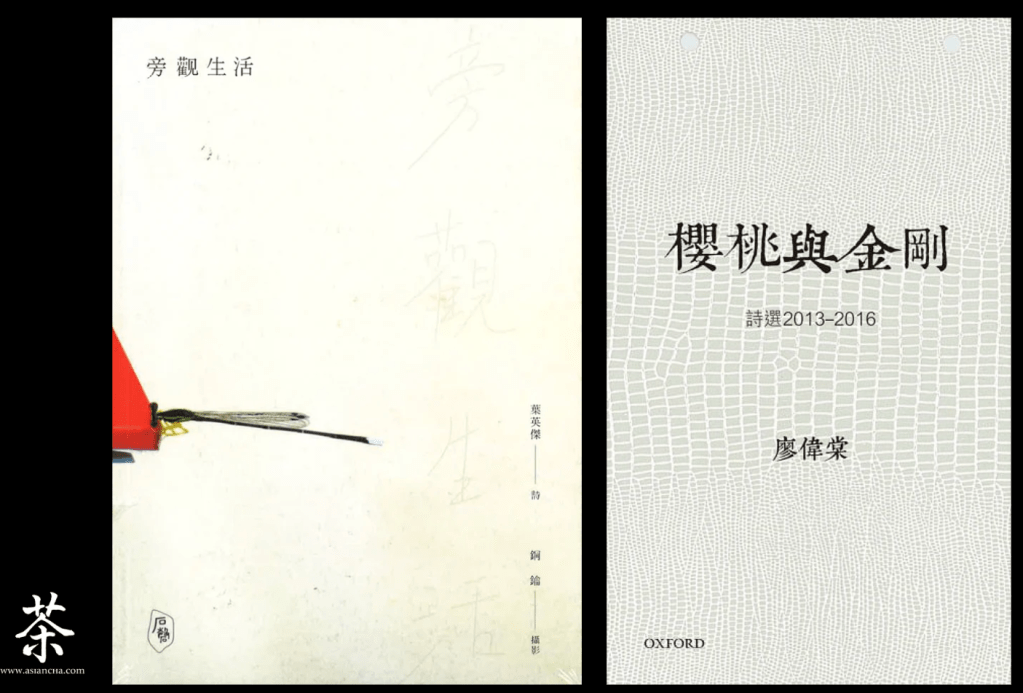
The immediate spark, however, reaches back to the controversy surrounding the poetry category of the 2019 Hong Kong Biennial Awards for Chinese Literature. That year, Yip Ying-kit 葉英傑 received the top prize for Observing Life 旁觀生活, while Liu Waitong 廖偉棠’s Cherries and Diamonds 櫻桃與金剛 was given a recommendation award.
The result drew immediate scepticism and, more importantly, exposed a deeper fault line between two poetic orientations. On one side was an emphasis on the everyday: plain language, proximity to ordinary life, and the belief that lived experience forms the ground of local poetry. On the other was the insistence that poetry should actively engage reality, bear historical and political responsibility, and push language and form towards greater tension and invention. In the climate of the time, this divide became more than an aesthetic disagreement, being entangled with generational conflict, poetic affiliation, and the struggle for discursive authority within Hong Kong’s literary world.
)
Recently, Jacky Man-leuk Yuen 阮文略 revisited the episode at a poetry criticism event, describing it as a “struggle over style and line in poetry” 詩的風格與路線之爭. The discussion quickly resurfaced and widened into a many-sided debate over poetic principle, creative ethics, and critical method. However sharp the disagreements, there remains something heartening in the fact that poetics itself is still open to public argument.
Yuen’s phrase, “a struggle over style and line,” is worth lingering over. It links literary prizes, criticism, poetic belief, and the workings of power in the literary field. To say that criticism establishes and defends a view of poetry is already to move beyond criticism as a mere response to the poem on the page. Criticism becomes, instead, a declaration of position. In judging works, the critic defines what poetry is, what counts as good poetry, and what kind of poetry deserves to be preserved, taught, and passed on. In this way, criticism helps to consolidate an aesthetic order.
And yet the language of “line” 路線 is also troubling. It risks hardening complex poetic differences into camps, as if poetry must divide neatly into opposites: engagement or detachment, reality or the everyday, politics or life, difficulty or clarity, avant-garde or mediocrity. But poems are often born precisely where such oppositions blur. Detachment can itself be a lucid mode of engagement, while engagement can contain its own discipline of distance. The everyday can be a refuge from reality, but it can also carry reality’s violence in its smallest, most granular traces. Narrative can flatten into prose, yet it can also become another way of compressing experience into poetry. Once the dispute is cast as a battle of “lines,” criticism may cease to read closely. It begins by assigning poems their place, then retroactively justifies those placements with ideology.
)
This is what makes the episode so revealing: the establishment of a poetic worldview is both necessary and dangerous. Necessary, because criticism without a poetics too easily collapses into impression, preference, and mood. Dangerous, because once a poetic worldview is ratified by prizes, classrooms, judging systems, and public discourse, it can harden from a way of reading into a mechanism of selection. The moment a certain poetics is described as “more Hong Kong,” “more true-to-life,” “more sincere,” “more engaged,” or “more accomplished,” it does more than merely interpret works. It ranks them. Once such a hierarchy settles into place, it shapes how poems are read, how poets are remembered, and how younger writers imagine the possibilities of their own work.
Taken a step further, this also places an unspoken demand on poets themselves. To secure a place within such an aesthetic order, it is no longer enough merely to write poems. One must also become, in some measure, a critic. Through reviews, essays, interviews, and public replies, poets intervene in the interpretation of their own work and attempt to retain some agency over how their poetics are situated amid the competing voices of the literary field.
)
Yuen’s formulation can therefore be both affirmed and revised. What is valuable in it is that he does not dismiss the 2019 dispute as a petty quarrel over awards; instead, he probes the evaluative structures and poetic assumptions beneath it, opening the way for further discussion. Yet the phrase “struggle over line” should not be understood too narrowly, as if two poetic paths were simply facing off against one another. The struggle is not only among poets. It also unfolds among judges, critics, teachers, students, publishers, readers, and the shifting currents of social-media opinion. Each, in one way or another, participates in the making of poetic value and literary authority.
By “power” here I mean the diffuse, microscopic forms of power that permeate the literary field. They are often subtle, difficult to discern, and easy to disavow.
By “power” here I mean the diffuse, microscopic forms of power that permeate the literary field. They are often subtle, difficult to discern, and easy to disavow. Whether someone believes they possess power or none at all, they are already caught within it and participating in its operations. Different poetics can, in principle, coexist within the same literary world: poetry of everyday narrative, political lyric, modernist poetry, surrealist poetry, prose poetry, language experiment, academic poetry, colloquial verse. Each can find its place across different journals, readerships, and historical moments. But literary prizes rearrange this plural ecology. Through judging panels, citation language, prize rankings, and the public record, they reorder a diverse poetic system into a hierarchy. The question is not whether one kind of poetry may win an award. The question is whether one kind of poetry winning an award then comes to be read as the triumph of one poetics, thereby diminishing the legitimacy of others.
Seen in this light, Yip Ying-kit’s response appears less a simple defence of accessibility than a defence of another poetic legitimacy. He argues that once a poem is written, it necessarily has readers; and if those readers are not only oneself, then one must consider how the work might be felt by more people. He imagines his audience as including not only literary insiders and cultural critics, but also family members and those not already steeped in poetry. By taking narrative and the language of daily life as his point of entry, he seeks to preserve poetry’s public reach. In doing so, he also challenges an aesthetic regime that monopolises poetic value through difficulty, obscurity, and formal density. Yet once “being understandable to more readers” becomes a value, it too can be absorbed by literary institutions and turned into a new orthodoxy. Part of what made the 2019 controversy so sharp was the feeling, among some observers, that the judges had elevated the prose-like, the lucid, and the everyday into the standard of good poetry, and in doing so had downgraded work marked by stronger political tension, historical imagination, and rhetorical density. Any poet is free to choose a style. The problem begins when that choice, through the institution of the literary prize, hardens into an evaluative norm.
)
Ian Pang 彭依仁, meanwhile, shifts the discussion away from awards and style towards the limits of experience. Each of us, he argues, can only begin from our own experience; none of us can truly take possession of another’s suffering. Reading Du Fu, Celan, or Brecht does not grant us their fate, their trauma, or their place in history. This is especially important for any discussion of “engagement.” Poetry may respond to injustice, certainly. But when poets imagine engagement as speaking in the place of others, the suffering of others can easily be converted into symbolic capital for the self. The fact that suffering appears in a poem does not mean justice has been realised. It may instead become a style, a posture, a way of claiming moral altitude within the literary field. Pang therefore asks poets to acknowledge the boundaries of experience. One may answer the world, but one cannot pretend to occupy the position of every sufferer. One may simulate, transform, or translate the experience of others, but must remain alert to the indirectness of that act. His view also usefully complicates Yip’s position: ordinary experience is not lesser because it is ordinary, and personal experience is not unworthy because it lacks historical grandeur. The real question is not the scale of the subject, but how poetry handles experience: how it avoids trespassing on the lives of others without collapsing into the prison of the self.
Keith Liu 池荒懸, for his part, returns the focus to literary prizes and the ethics of criticism. If there is something wrong with a literary prize, he suggests, then what should be discussed is the judging system itself: the criteria, the reasoning, the procedures, the mechanisms of disclosure. The prizewinner should not be turned into a poetic enemy. This matters enormously, because in literary culture, individuals so often become the visible surface onto which institutional contradictions are projected. A literary prize is never a neutral machine of evaluation. It is an institution that ranks, authorises, and confers legitimacy. The top prize, the recommendation award, the judges’ comments, the public aftermath, the later institutional discussions, and scholarship together form part of a machinery of canonisation. Certain works are placed at the centre and marked as worthy of reward; others are pushed outward, diminished by commentary grounded in an already established poetics. Yip became the target of criticism because the prize placed him in an institutionally authorised position. The frustration surrounding Liu Waitong, meanwhile, reflected the sense that a particular poetic position had not been recognised as certain younger poets had expected. When criticism fixes on individual writers alone, it risks concealing the evaluative mechanisms that most urgently require scrutiny.
)
The best criticism does not dress up struggles over literary power as timeless aesthetic truth.
The essays written at the time criticising Yip Ying-kit or defending Liu Waitong are, on one level, historical documents carrying strong and sometimes partisan views of poetry. But once they enter the teaching of poetry criticism today, they also become cultural instruments for shaping new readers, new critics, and new poets. How teachers choose texts, how they narrate the controversy, whether they present competing positions, whether they allow students to see judging records alongside multiple responses: all of this matters. If a classroom simply repeats one position, then a debate that ought to remain open is transformed into a new pedagogy of orthodoxy. That is why Keith Liu insists that if the episode is to be used as teaching material, it must include differing criticism, judging records, and related responses. Students do not need to learn which side to take. They need to learn how to ask whether an argument is adequate, whether its concepts are precise, whether its evaluations rest on close reading, and whether a critique of institutions has been displaced into a critique of personality. The best criticism does not dress up struggles over literary power as timeless aesthetic truth. It makes visible the ways aesthetic judgement is shaped by institutions, generations, prestige, journals, prizes, and social relations.
This brings us back to the opposition between “observation” 旁觀 and “engagement” 介入. The pair is provocative precisely because it is both illuminating and misleading. It is illuminating because Hong Kong Sinophone poetry has long had to negotiate among political reality, urban trauma, exile, and everyday life. It is misleading because it too readily turns complex formal questions into matters of attitude. A poem’s engagement cannot be measured simply by whether its subject is political. A poem’s detachment cannot be inferred simply from a cool tone. A poem that appears ordinary may, through silence, fracture, and detail, expose structural violence. A poem that loudly invokes its historical moment may still fail to touch reality at all if its language is stale. The more pressing questions are formal ones: how does a poem organise experience? How does it handle voice? How does it calibrate distance? How does it make form bear the reality it claims to confront?
What this controversy ultimately makes visible is that once poetry enters the circuits of prizes, criticism, classrooms, social media, and literary history, its value is redistributed. Who gets called “local,” who gets called “difficult,” who gets dismissed as “mediocre,” who gets declared “important”: none of these designations is natural. They are produced, contested, and institutionalised within the field.
In a literary environment marked by political pressure, media saturation, generational fracture, and institutional instability, how do poets write?
From 2019 to 2026, and indeed long before, these debates over poetics have revealed an ongoing process by which the field of Hong Kong Sinophone poetry sorts itself, manufactures canons, and distributes symbolic power. Rather than rushing to reduce the dispute to the tired question of who understands poetry and who does not, criticism can and must do better by treating it as a case study: in a literary environment marked by political pressure, media saturation, generational fracture, and institutional instability, how do poets write, how do critics judge, and how do all sides struggle over poetry’s meaning, position, and power?
How to cite: Song, Chris. “Poetics Debates and the Shadow of Power in Hong Kong’s Sinophone Literary Field.” Cha: An Asian Literary Journal, 1 May 2026. chajournal.com/2026/05/01/poetics-debates.


Chris Song is a poet, editor, and translator from Hong Kong, and is an assistant professor teaching Hong Kong literature and culture as well as English and Chinese translation at the University of Toronto. He won the “Extraordinary Mention” of the 2013 Nosside International Poetry Prize in Italy and the Award for Young Artist (Literary Arts) of the 2017 Hong Kong Arts Development Awards. In 2019, he won the 5th Haizi Poetry Award. He is a founding councilor of the Hong Kong Poetry Festival Foundation, executive director of the International Poetry Nights in Hong Kong, and editor-in-chief of Voice & Verse Poetry Magazine. He also serves as an advisor to various literary organisations. [Hong Kong Fiction in Translation.] [Chris Song & ChaJournal.]
 Cha
Cha 