
Editor’s note: We are delighted to present Akin Jeje’s vivid essay tracing the evolution of Peel Street Poetry, a Hong Kong-based, community-driven collective that grew from informal bar gatherings into a dynamic literary force. This essay serves as a shorter version of his introduction to the Peel Street Poetry anthology, capturing its history and spirit. Cha has previously published winning and finalist pieces from Peel Street Poetry slam competitions, turning live, time-constrained performances into curated literary texts, as seen in features such as the Peel Street Poetry Annual Slam 2015 and 2016.

[ESSAY] “A History of Peel Street Poetry” by Akin Jeje
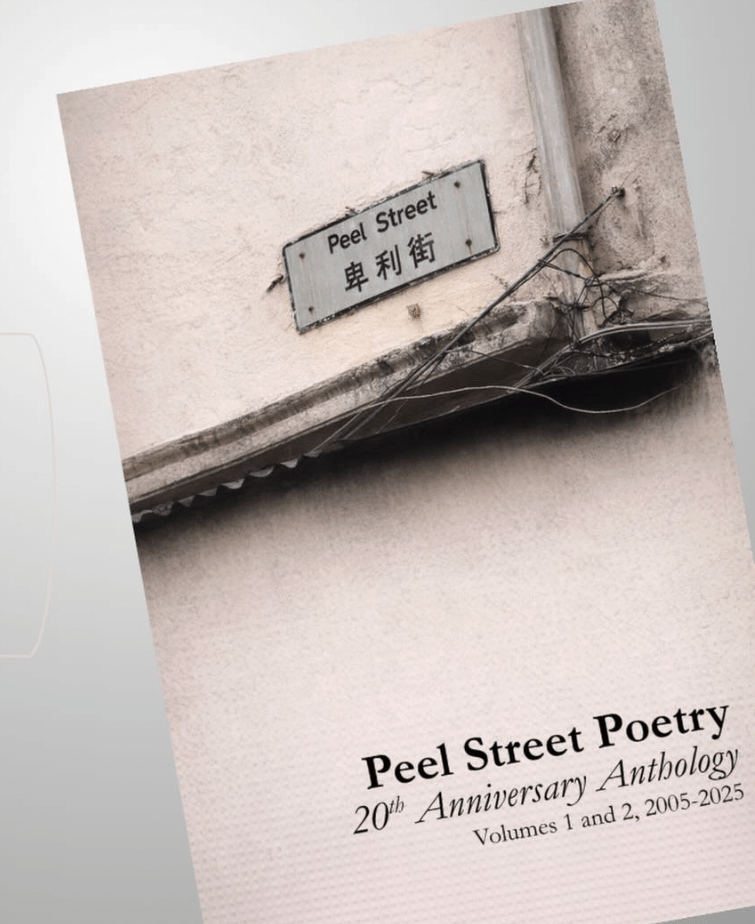
In the summer of 2005, a new bar and café opened in Hong Kong’s Central District on Peel Street, just above Hollywood Road. Joyce Is Not Here Bar and Café was small, quiet, and unassuming, bathed in blue neon and plastered with surrealist posters of human forms. Its proprietors, Beijing-born Joyce Peng and Canadian Rob Baker, had created an oasis for those seeking to avoid expat-dominated Soho nightlife.
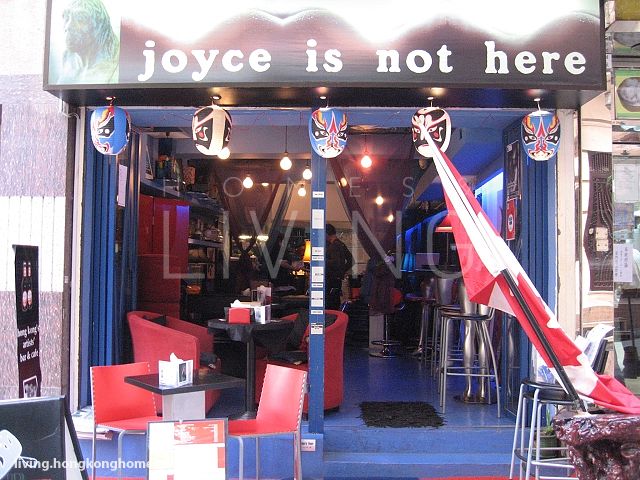
Its very name attracted writers and poets, unaware that the Joyce in question was not the celebrated Irish writer of Ulysses and Finnegans Wake but its madcap, ebullient proprietress, always busy far from her eponymous bar and café. Even when Joyce was not there, an eclectic blend of expats, tourists, and locals kept the place lively. It was here that Peel Street Poetry was born.
A teenage Hong Konger of Sri Lankan descent and a middle-aged Australian newcomer struck up an unlikely friendship at Joyce’s one June evening. Afterwards, Nash (Nashua Gallagher) and Keith McMullen began to share their writings with each other. Gradually, other customers brought their own verse to share. By the following spring, a small group of people gathered every week at Joyce’s to share poetry, with occasional contributions from Joyce and Rob.
On the first Wednesday of each month, the group also went to the Fringe Club to join OutLoud (now known as OutLoudHK隨言香港). An older literary gathering (since 1998), OutLoud had a well-deserved reputation as a fountainhead of poets, writers, playwrights, and academics. I discovered both in 2006 through mutual friends.
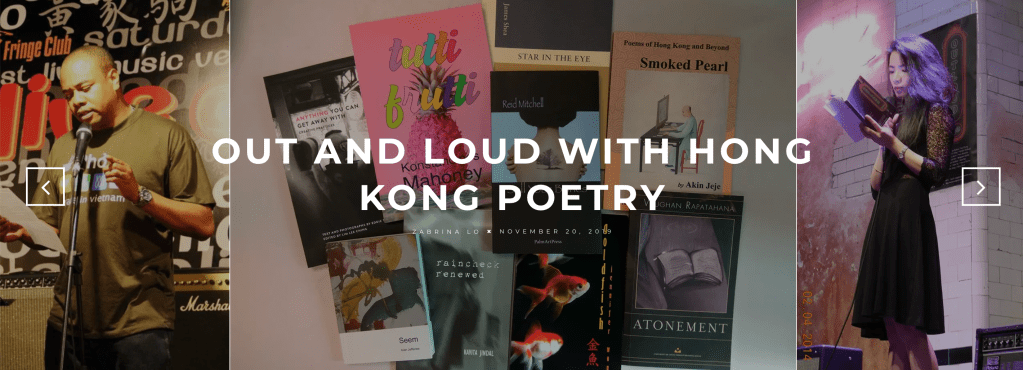
Soon, writers and poets from OutLoud, including Martin Alexander, chief editor of the Asia Literary Review, Canadian poet Kate Rogers, Hong Kong’s original China Hand David McKirdy, Viki Holmes, Pauline Burton, Paul Ulrich, Peter Kennedy, and Nicolette Wong, began to attend our gatherings at Joyce Is Not Here.
A symbiotic relationship developed as OutLoud and the Joyce crowd became sister groups. The first Wednesday of each month was a general gathering of wordsmiths and verse-slingers at the Fringe Club for OutLoud, with a stage for performers and a convivial, if somewhat formal, atmosphere where a revolving roster of OutLoud MCs introduced novices, veterans, visiting poets, and new authors eager to launch their books to the wider literary world. The other Wednesdays of the month were at Joyce’s, among a cosy litter of couches and stools in a relaxed, dimly lit atmosphere where newcomers felt at ease.
Soon, I became the MC at Joyce’s. In the beginning, Nash or Keith would introduce each session by counting at whichever number session they felt it was. With a metal spoon tapping against a glass, poetry would commence. I observed the ritual by ringing in each session, but I stopped counting after strenuous complaints from a certain hooligan poet.
A new ritual was thus born:
Immediately after that poet’s complaint, he then engaged in loud, opinionated conversation with another poet, oblivious to our proceedings. There was only one thing to do. “Clap, damn you, clap!!!” I yelled in his direction. His head swivelled, transfixed, a would-be star caught in the flash of paparazzi cameras. “Clap, damn you, clap!!!” I repeated, to his shock and the rest of the crowd’s delight. From then on, we knew what it meant when we heard “Clap, damn you, clap!” We later extended our sessions to two rounds instead of one.
At first, attendance was variable. There were times when the house was packed, and others when Joyce’s was nearly empty. Eventually, we established a quorum of four poets and any number of others to begin another weekly session. If our numbers were few, we termed these “intimate gatherings”.
Our first name was “Poetry for Sad Drinkers”, but that name did not last long, since a few drinks achieved quite the opposite effect. We were then known informally as the “Joyce Is Not Here Crew”, but eventually, since we ended up at two locations on Peel Street and a third bearing its name, we became known as the Peel Street Poets, or “Peel Street Poetry”.
What impresses me to this day is the sheer range of talent that came through Joyce Is Not Here. We were people from various backgrounds and walks of life, brought together by the love of the written word. What we produced was moving, haunting, harrowing, side-splitting, thought-provoking, and marvellous.
We endured, despite falling victim to market forces. In the summer of 2013, we held our last Joyce Is Not Here gathering in July. Fortunately, the ever-resourceful Joyce already had an alternative locale right across the street. Peel Fresco Music Lounge, or more informally Peel Fresco, was a venue for the city’s jazz musicians and boasted a considerably different crowd. Peel Fresco welcomed us, but it was an adjustment. Gone was the dark, cushioned, cosy environment of Joyce Is Not Here, replaced by a brightly lit stage and a tight arrangement of chairs, tables, and stools that crowded us in.
However, we received a new crowd of devotees, mostly university students who had heard about us on campus through word of mouth. They brought fresh, fearless voices to our gatherings. A Facebook site was added by Nashua to connect poets who by now had a presence not only in Hong Kong but were spread worldwide, across Asia, Europe, Australasia, and North America. Our activities began to flourish. We held our first Annual Poetry Slam in honour of one of our departing poets, and it was a resounding success, with Dave Kunerd as our first Slam champion. By the time I stepped down as MC in 2014, we had grown from a handful of poets to over 100 members, many of them fierce devotees. I had served seven years as MC, and we had grown.
Henrik Hoeg, who was to go on to serve as MC for nine years, stepped into the breach. Had I known beforehand what an amazing impact Henrik would have on Peel Street Poetry, I would have stepped down even earlier. Soon after Henrik became MC, we learned in the autumn of 2015 that our patron saint Joyce was going to move into Lan Kwai Fong to a new music lounge named Orange Peel.
We settled into Orange Peel, and Henrik began to work his magic. A connection that Henrik had with TEDx gave us the opportunity to work with TEDxWanChai and co-host one of their major events. This event at Orange Peel went so well that the Peel Street Poets were invited to a major TEDxWanChai event, TEDxWanChai Women, to perform alongside the likes of former Chief Secretary Anson Chan, Angie Lau of Bloomberg, Leonie Valentine, Director of Google for the Asia-Pacific region, and other Hong Kong and Asia luminaries.
We had an event honouring poets of the African diaspora that exceeded all expectations and amazed our over-capacity audience during Black History Month in February. We organised a benefit event termed Rhymes for Nepal, which we did in conjunction with the literacy organisation Room to Read. It was also a resounding success, raising thousands of dollars towards relief in Nepal in the aftermath of its earthquake in April 2015.
We saw our numbers grow exponentially, from a little over a hundred poets when I left as MC to twice that number under Henrik’s leadership. We blossomed from a cult following of quirky verse-slingers into literary performers known throughout Hong Kong and even region-wide. In recognition of the phenomenal growth of Peel Street Poetry, HKELD, the English-language arts association of the city, awarded our fearless MC Henrik the Heart Award for his outstanding commitment to Peel Street Poetry.
Our series of social events at that time culminated in our 10th Anniversary Annual Slam on 21 October 2015, with a line-up of 21 contestants, an overflowing crowd, and a series of brilliant performances that ended with the crowning of our second annual Slam Champion, Keisha Siriboe, whose tribute to Orange Peel was poignant and passionate.
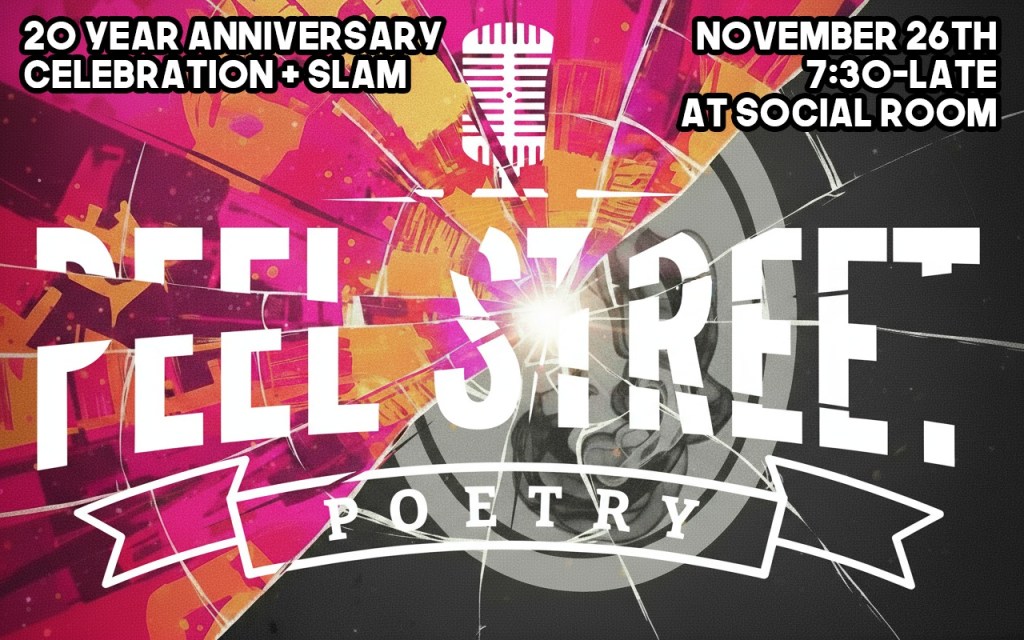
We grew considerably, but then outside forces came into play. Political unrest made Lan Kwai Fong less safe for nightlife. We parted ways with Joyce and Orange Peel to move to The Social Room, near the Mid-Levels escalators. Then Covid hit, making it challenging to continue in the face of venue closures and, at times, complete isolation from our poetic community. Yet, thanks to our gracious venue hosts, Hem and Siba Gurung, and the resilience of our team, we have managed to persevere to our 20th anniversary.
We have held numerous book launches. We have hosted various cultural, theatrical, and philanthropic events with partners as diverse as Impact HK, TEDxWanChai, Liberty Asia, City University, The Refugee Union, Flow Books, Canadian Club Hong Kong, HKILF (Hong Kong International Literary Festival), Baptist University, and Mind HK. We have created strong ties with our sister groups OutLoudHK隨言香港, Kubrick Poetry, and Hong Kong Writer’s Circle. Best of all, we as a group have breathed new life into English-language poetry in the city, as a collective that shares our literary expression not only here in Hong Kong and the Asia-Pacific region but worldwide.
In this anthology, readers will encounter our multifarious voices. I hope that we will continue to grow in our expression of poetry. We have come a long way, and we look forward to the future, which we hope will continue to be bright.
Hong Kong
January 2026
How to cite: Jeje, Akin. “A History of Peel Street Poetry.” Cha: An Asian Literary Journal, 24 Apr. 2026, chajournal.com/2026/04/24/peel-street.



Akin Jeje‘s works have been published and featured in Canada, the United States, Singapore, Australia, the United Kingdom and Hong Kong. His first full-length poetry collection, Smoked Pearl was published by Proverse Hong Kong in 2010. Jeje’s latest publication is another full-length poetry collection entitled write about here, published in January 2024. He is currently at work on a novel entitled Maroon. Jeje is a previous MC of the Hong Kong English language poetry collective Peel Street Poetry, and one of its three directors. He is a regular contributor to Voice & Verse Poetry Magazine and Cha. [All contributions by Akin Jeje.]
 Cha
Cha 