
茶 FIRST IMPRESSIONS
茶 REVIEW OF BOOKS & FILMS
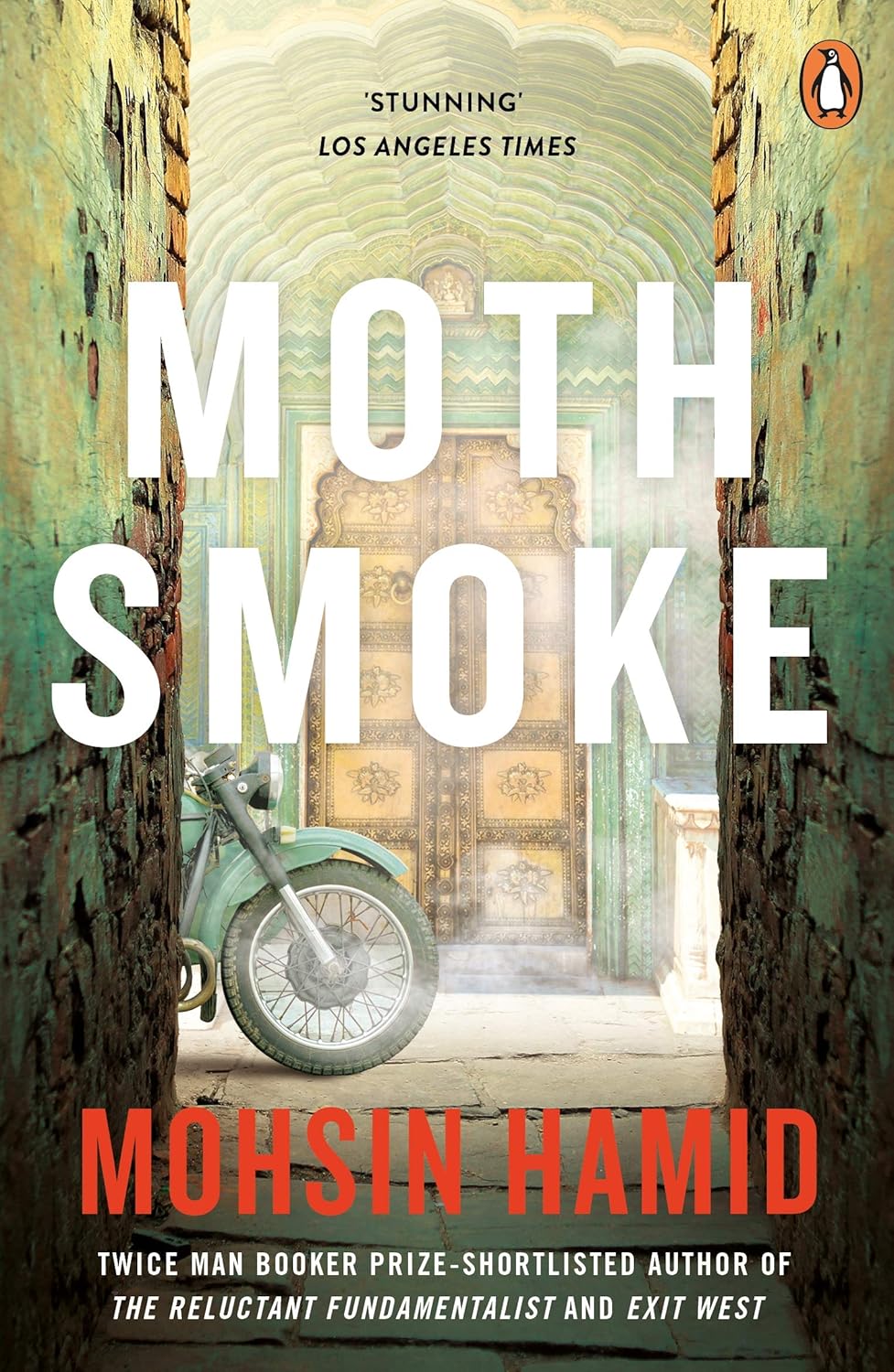
[REVIEW] “Moshin Hamid’s Moth Smoke: What Binds and What Breaks Us” by Abhinav Tulachan
Moshin Hamid, Moth Smoke, Farrar, Straus and Giroux, 2000. 256 pgs.

I was, much to my own astonishment, left with a great deal to ponder after finishing this book. Admittedly, it was an older work of literature, older than myself, recommended to me for a research project, and I approached it with the intention of merely skimming a few pages to determine whether it aligned with the theme of “brotherhood” for said research. Yet it appears the book ensnared me so completely with its narrative that I found myself compelled to set down my reflections upon it.
Mohsin Hamid’s Moth Smoke is a story of scandal involving two friends and a wife. We follow Darashikoh “Daru” Shezad, an ostensibly ordinary banker who, driven by stress and envy of his more successful childhood friend, Ozi, embarks upon an affair with Ozi’s wife, Mumtaz. The narrative unfolds by tracing the consequences of this adultery and its effects upon the relationships between these characters. Had it ended there, it would already have satisfied many readers as a well-written account of emotional entanglement; however, Hamid enriches the novel by layering numerous contextual elements, which, combined with his distinctive prose, elevate it into a far deeper and more compelling work than one might initially expect.
What precisely do I mean by this? Upon opening the prelude, one is immediately confronted with a court hearing in which our protagonist, Daru, stands accused of the murder of a child. The subsequent chapters gradually reveal the sequence of events that culminate in this trial.
Life has not been kind to Darashikoh Shezad. His father perished in military service when Daru was scarcely old enough to shave, while his mother was killed in a tragic and senseless manner by a stray bullet fired skywards during a celebration. Daru may once have been a boxer and a brilliant student, even attaining a Master’s degree, yet the earlier chapters depict how fate has battered him so relentlessly that he has become a bitter and arrogant man, increasingly reliant upon drugs to numb his pain as he languishes in his mouldy apartment.
Indeed, the theme of addiction emerges as central to the novel, as do its consequences, both of which are embodied in Daru’s character arc. His consumption and sale of hash, combined with his resentment towards a wealthier client, result in his dismissal from his banking position, setting him upon a slow and painful trajectory towards self-destruction. It is not an especially favourable introduction to our protagonist, particularly given his degrading treatment of his sole domestic worker, yet it remains difficult not to feel a measure of pity for his condition.
Thus, while Daru immerses himself in hash and his own despair, Ozi, his childhood friend, bound to him through their fathers’ shared military service, returns home.
One of Daru’s defining traits is his resentment of Pakistan’s elite, whom he regards as little more than frauds who have attained wealth and status through corruption.
Ozi stands in stark contrast to Daru’s existence, embodying the very lifestyle Daru both covets and despises. One of Daru’s defining traits is his resentment of Pakistan’s elite, whom he regards as little more than frauds who have attained wealth and status through corruption. In this light, Ozi is not merely a successful man in Daru’s eyes, nor simply a childhood companion; rather, he represents everything Daru believes himself entitled to possess: an air-conditioned house, a Mitsubishi Pajero driven with reckless abandon, a foreign education that has secured him a lucrative career, and, of course, his beautiful wife, Mumtaz.
)
To quote a section from my own ongoing research:
Daru looks at everything Ozi has, everything he possesses that has been passed down to him, and, in comparison, Daru feels emasculated. […]
The extreme class stratification rooted in Pakistani society, together with his own comparison to Ozi, provides the backdrop for Daru’s crisis of masculinity and serves as the tipping point that ultimately compels him to betray Ozi’s trust.”
This leads to the manner in which Moth Smoke addresses the issue of class division that has long afflicted South Asia as a whole. In Daru’s eyes, Ozi’s success is not honestly earned, for it has been handed to him by his corrupt and affluent father, whereas Daru has had to struggle for scraps and endure repeated rejection on account of his social standing. This disparity renders his present self all the more envious of Ozi’s fortune.
At the same time, Hamid deepens this complexity, which is precisely what captured my interest in an already intricate narrative, by revealing the layered nature of his characters. While Ozi might initially appear to be a typical silver-spooned, arrogant youth, he is also charismatic and genuinely kind, inviting Daru to dinner out of sincere friendship. Likewise, for all of Daru’s bravado, his pride, and his disdain for the upper class, he still attends Ozi’s gatherings because, in his own words, “a free meal is a free meal.” Such nuances prevent the novel from collapsing into a simplistic morality tale centred solely upon envy.
During these gatherings, Daru is introduced to Ozi’s wife, Mumtaz, who herself embodies another central theme of the novel. The two quickly establish a connection, sharing clandestine moments while smoking together. Mumtaz is drawn to Daru’s comparatively carefree disposition, and both he and the reader come to learn that she leads a secret life as an investigative journalist under the pseudonym Zufi Kar Manu, examining the social issues of 1990s Pakistan, including corruption and inequality. It is through these investigations that she draws Daru into her world, and the two, one driven by envy and the other by dissatisfaction within her marriage, gradually form an intimate bond that culminates in an affair.
Love and desire, class and inequality, pride and humiliation, and the culmination of a decade-old resentment that spirals into betrayal and scandal all operate simultaneously within the novel. These interwoven forces complicate both the narrative and its characters in a manner that is ultimately enriching. From this point onwards, the novel deploys these themes to unravel its own trajectory with a sense of inevitability. The affair humanises Daru by granting him a fragile intimacy he has long lacked; yet, paradoxically, it accelerates his decline as he sinks deeper into substance abuse and increasingly dubious schemes, including the sale of drugs to various clients, even students, while drifting further into isolation. This descent fosters an ever-intensifying craving for indulgence, both emotional and chemical.
Gradually, it becomes evident that the other figures entangled in this web of adultery are neither unchanged nor blameless. Mumtaz’s own narrative sections, presented as interspersed chapters, reveal her sense of confinement within her marriage to Ozi and the expectations imposed by a patriarchal society. These pressures drive her towards a search for autonomy through her clandestine journalism and her relationship with Daru. Yet she emerges as deeply indecisive, a trait that is both understandable and frustrating. She is perpetually torn between her desire for independence, her attachment to Daru, her guilt, and her love for her son, whom she fears she has neglected. Ultimately, her choices play a decisive role in shaping Daru’s fate.
Meanwhile, for all his charm and generosity, Ozi harbours his own concealed transgressions. In a manner that appears to validate Daru’s critique of the corrupt elite, he evades accountability after running over a child with his prized Pajero and implores Daru to remain silent. This appeal is later revealed to be part of a broader pattern of manipulation, one he employs to maintain control over those around him, including Mumtaz, and ultimately to deflect responsibility for the crime onto Daru himself. Yet Ozi’s own narrative complicates this portrayal. He recounts Daru’s unpleasant behaviour during their youth and questions how one might survive in what he describes as a “cut-throat” society governed by the logic of survival. As he remarks, “You have to have money these days… People are pulling their pieces out of the pie, and the pie is getting smaller, so if you love your family, you had better take your piece now, while there is still some left.” In this moment, Ozi becomes, if not sympathetic, then at least comprehensible.
)
In the end, it proves exceedingly difficult to assign absolute blame to any single character, for each bears a measure of responsibility, even as their motivations are rendered intelligible. Life has dealt Daru a cruel hand, yet it is through his own choices that he continues to gamble with it, even at the risk of self-destruction. Mumtaz, for her part, makes decisions that are at once understandable and disastrous, while Ozi’s actions demonstrate how power can both shield and corrupt.
It is also worth acknowledging that each narrator’s account may be coloured by personal bias, as was the case for me, as I found myself more inclined to sympathise with Ozi. Yet does this not reflect the essence of human nature and morality? There is no absolute right or wrong, no singular perspective that prevails; rather, the world exists in shades of moral ambiguity.
Moth Smoke offers a penetrating exploration of the social realities of 1990s Pakistan while presenting a narrative that poses enduring questions.
Moth Smoke offers a penetrating exploration of the social realities of 1990s Pakistan while presenting a narrative that poses enduring questions: what does loyalty signify when the rules themselves are unjust? To what extent are private failures shaped by public injustice? One is likely to close the book unsettled, perhaps chastened, and certainly compelled to reconsider what binds individuals together and what ultimately drives them apart.
How to cite: Tulachan, Abhinav. “Moshin Hamid’s Moth Smoke: What Binds and What Breaks Us.” Cha: An Asian Literary Journal, 20 Apr. 2026, chajournal.com/2026/04/20/moth-smoke.


Abhinav Tulachan is an undergraduate student in the Department of English Language and Literature at Hong Kong Baptist University. He loves reading, writing, and sharing the knowledge he has gained through his academic journey. [All contributions by Abhinav Tulachan.]