
[REVIEW] “Collecting the Dead, Preserving the Lives: On Vinu P and Niyas Kareem’s The Corpse Collector” by Kabir Deb
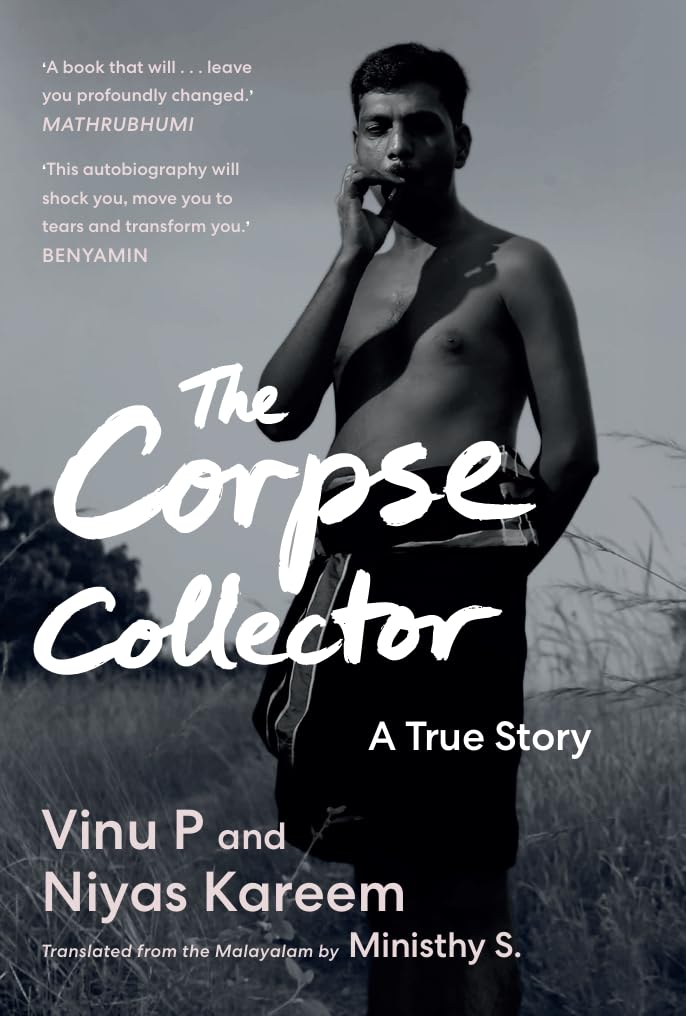
Vinu P and Niyas Kareem (authors), Ministhy S. (translator). The Corpse Collector: A True Story. Juggernaut Books, 2023. 237 pgs.
Death, while a natural end-point of life, takes on a harsher meaning when viewed through a socio-political lens, where it is treated as a threat to the lives that continue around the deceased. Social rituals and customs give rise to beliefs that cast death as impure, pushing the bereaved to the margins and disrupting their ability to live ordinary daily lives. This exclusion operates as a loud form of othering, often overlooked because many of us are trained to hold two opposing ideas at once, where death is unavoidable, yet the dead, and those closest to them, must be shunned unless some divine will intervenes. Such thinking grows out of Vedic orthodoxy, where upper-caste Brahmins alone are granted authority to instruct the living and absolve the dead of sin. Until that sanctioned release occurs, close relatives are compelled to obey rules set by Brahmins, which are designed less for spiritual care than for preserving a rigid, puritanical, and deeply oppressive system.
}
Amidst widespread social indifference exists a community persistently pushed to the margins. Their personal lives remain scarcely recorded or examined by the larger society. Scholars have produced volumes on lower castes, oppressed groups, and minorities, both in the past and the present. Yet those who make a living collecting corpses, identified or unknown, named or discarded, remain largely unacknowledged and seldom appear in literature, public policy, or newsroom discussions.
The Corpse Collector opens a rare window into the professional and private world of a shavamvari, or corpse collector.
Vinu P and Niyas Kareem’s The Corpse Collector: A True Story, translated from Malayalam by Ministhy S., opens a rare window into the professional and private world of a shavamvari, or corpse collector. Shaped through conversations with Kareem, the book marks the first time Vinu reflects openly on the meaning of death, on how his work has offered both liberation and constraint, and on what exists beyond the labels imposed on those who retrieve bodies from perilous spaces so that justice may be served to the dead and grieving families may catch a final glimpse of their loved ones.
In the book’s preface, Kareem recalls his first meeting with Vinu, writing, “The man who sat near me, with his face blazing, was someone ostracised by society because of his chosen work, not due to caste, religion, or the colour of his skin.” The line serves as a blunt reality check. This community is pushed aside not for who they are, but for what they do, and as a result, little is known about how routinely they are denied even their most basic rights.
}
As he searches for the dead, Vinu often thinks of those left waiting behind, or of bodies scattered beyond recognition. While corpse collectors painstakingly gather these remains so that the police can identify them, their compassion rarely earns recognition. Puritanical beliefs nullify empathy, even when people like Vinu risk their lives to recover strangers for whom they bear no obligation. The book exposes a striking contradiction. In worshipping Yama, the God of Death, or Shiva, the Destroyer of Worlds, we symbolically honour this labour, yet in everyday life we shun those who perform it, preserving our customs and beliefs within the closed spaces of fear.
Vinu’s turn towards corpse collection grew out of two deeply rooted desires, money and freedom. He noticed that those who retrieved bodies could stand before the police, often the most feared authority for the poor and marginalised, and light a beedi or exist on their own terms. In that ease, Vinu sensed a freedom missing from the lives around him, especially among those shaped by fear of power and uniform. Praise, even in words alone, felt like a luxury to someone raised amidst constant struggle. The money he received from the police, first in his youth and later as a professional corpse collector, offered a relief few in his surroundings experienced. This mixture of dignity and survival explains his request in the preface, where he writes, “You can write whatever you wish about me. But not a single word should degrade a corpse or the Kerala police.” While society pushed him into a corner for his work, police officers, out of necessity, supported him with payment and small gestures of equality, sharing tea or exchanging money hand to hand, rather than treating him with the disdain he faced in his own neighbourhood. Such moments of kindness are rare in marginalised lives, and when they appear, they endure.
Ostracisation, when endured without pause, can taste more bitter than death itself.
Ostracisation, when endured without pause, can taste more bitter than death itself. In the book, Vinu’s account of being turned away from restaurants, tea stalls, and family gatherings forces him to question his own moral world, one shaped by compassion for the dead. He lives in fear of being recognised, because recognition, when it leads only to abuse and exploitation, offers no comfort. As Vinu reflects, “At night, I was blissful. Nobody could see me. Darkness belonged to me. Darkness guarded me. Darkness embraced me. Darkness was not for sleeping, it was for celebrating my freedom.” The passage reveals how those pushed to the margins often attempt to shed the weight of identity, knowing that it is precisely this identity that exposes them to relentless harm. Sleepless nights become routine for Vinu, as daylight brings public shame, and only the police and his fellow corpse collectors treat him as human. It is unsettling to witness how a state as progressive as Kerala can erode a person’s spirit for practising a profession that sustains not only public hygiene, but also the promise of justice and closure for the bereaved.
When Shaun David Hutchinson wrote in We Are the Ants (2016), “I saw the world from the stars’ point of view, and it looked unbearably lonely,” he captured a truth about suffering being shaped by how one chooses to live. In the book, Vinu is not a casualty of his decisions or of the freedom he claims through his work. He carries the dead on his shoulders with pride, knowing that every ritual that follows, from prayers to tombstones, begins with his labour. His victimhood lies elsewhere, particularly among those consumed by loneliness, who find meaning in mocking others because ridicule grants them a purpose they themselves lack. For Vinu, speaking to corpses becomes a way to keep loneliness at bay, a loneliness society attempts to impose upon him for doing work it deems unacceptable. His sense of purpose remains unwavering, to bring solace to those waiting for the dead, and to cremate or bury abandoned, unidentified bodies with dignity. At the same time, he does not deny the presence of kindness. Some offer help from positions of power or privilege, shielded from scrutiny, while others choose anonymity, protecting themselves as they support him in quiet, necessary ways.
For Vinu, it is the dead who offer a steady purpose, allowing him to act with relevance and compassion in the world.
Most people form bonds with the living to serve a personal end. For Vinu, it is the dead who offer a steady purpose, allowing him to act with relevance and compassion in the world. Victims of murder or suicide may become newspaper headlines, yet they too are quietly pushed aside, their lives reduced to brief mentions and their contributions erased. Vinu recognises a parallel in his own life, as society casts him out without understanding the intent or meaning of his work. His vision of life is clear to him and to those who stand by his side, but to others it remains an uncomfortable blur, easily dismissed by those unwilling to question the rigid rules they have built for themselves. Even as crime rates rise, corpse collectors like Vinu continue to be othered and confined to the margins. His resolve to create a graveyard for unclaimed bodies stands apart from society’s narrow morality, yet for him it is a purpose he refuses to compromise.
The Corpse Collector is an essential read for anyone seeking to understand a life lived at the edge of death while holding fast to a sense of purpose. The book also urges reflection on a community whose existence remains largely unseen and unacknowledged. The translator deserves credit for preserving a lucid, simple prose, as anything more ornate would have weakened the force of Vinu’s story.
How to cite: Deb, Kabir. “Collecting the Dead, Preserving the Lives: On Vinu P and Niyas Kareem’s The Corpse Collector.” Cha: An Asian Literary Journal, 20 Apr. 2026, chajournal.com/2026/04/20/corpse-collector.



Kabir Deb is a writer based in Karimganj, Assam. He is the recipient of the Social Journalism Award (2017), the Reuel International Award for Best Upcoming Poet (2019), and the Nissim International Award (2021) for Excellence in Literature for his book Irrfan: His Life, Philosophy and Shades. He reviews books, many of which have appeared in national and international magazines. His most recent book, The Biography of the Bloodless Battles, has been shortlisted for the Sahitya Akademi Yuva Puraskar (2025) and the Muse India Young Writer’s Award (2024). He currently serves as the Interview Editor for the Usawa Literary Review. Instagram: @the_bare_buddha [All contributions by Kabir Deb.]
 Cha
Cha 