
茶 FIRST IMPRESSIONS
茶 REVIEW OF BOOKS & FILMS
[FIRST IMPRESSIONS] “Understanding China Beyond the Headlines: Jeffrey Wasserstrom’s Everything You Wanted to Know About China” by Jennifer Eagleton
Click HERE to read ALL entries in Cha
on Everything You Wanted to Know
Jeffrey Wasserstrom. Everything You Wanted to Know About China (But Were Afraid to Ask), Bui Jones Books, 2026. 112 pgs.
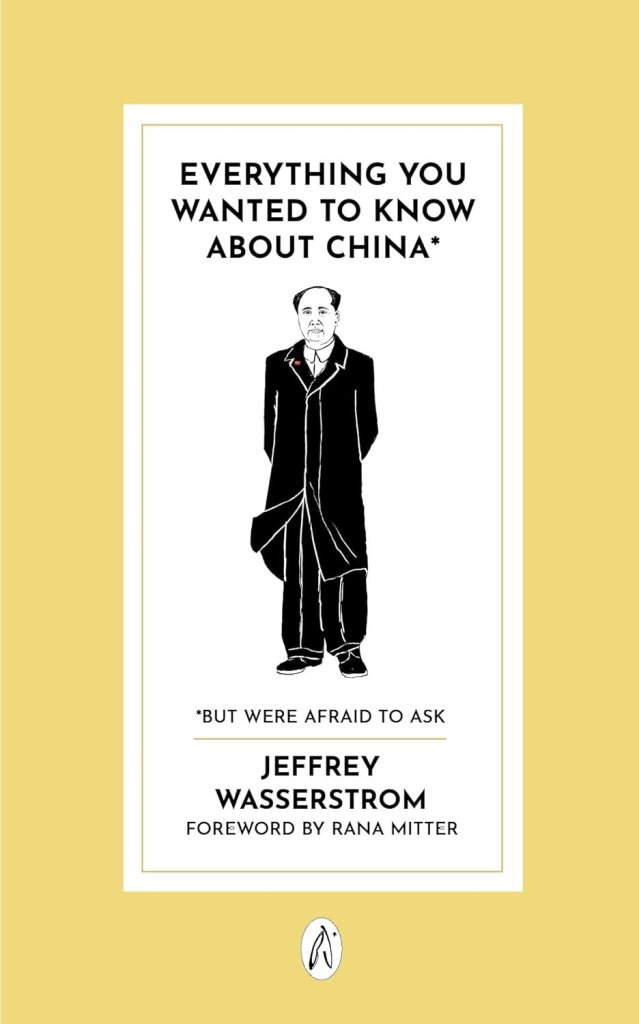
People might be “afraid to ask” what they wish to “know about China” because of the difficulty of gaining a clear understanding of the complex history and ideological background of a nation that plays such an important role on the modern world stage. Jeffrey Wasserstrom, a noted China historian and scholar, is well qualified to provide this insight, since “understanding the past is vital to reading the present”, as Rana Mitter observes in his useful preface to the book. Mitter also notes that an understanding of the “wider framing that shapes the country and its relationship with the world” offers a more meaningful perspective on China than one derived from news headlines alone. In Everything You Wanted to Know About China (But Were Afraid to Ask), Wasserstrom strips away the complexities of this vast nation to present the essential elements in just over 100 pages, organised into three sections: (1) History & Ideology, (2) Politics & Power, and (3) Culture & Control.
In the first section, “History and Ideology”, there is a useful comparison of Mao Zedong and Xi Jinping. The former embraced disorder and chaos, was a populist, and a proponent of mass movements, while the latter is associated with order and stability, along with a penchant for grand military parades. Both were effective in consolidating political power, and both shared the goal of maintaining Communist Party rule while elevating China’s status in the world. This section also addresses the Chinese Civil War, the rise of Mao as a “Great Man”, and the missteps of the Great Leap Forward and the Cultural Revolution, two mass movements that continue to shape discourse on China today. The rise of Deng Xiaoping, the Open-Door Policy, and the enduring legacy of Mao are also examined. These themes form the background to nearly any discussion of China’s actions and reactions in modern times.
In the second section, “Politics & Power”, the events of Tiananmen in 1989 are given prominence, and are best understood within the context of the decline of the Eastern Communist bloc. The student protests emerged in response to the state’s focus on economic liberalisation without corresponding political reform. The figure of “Tank Man” from the well known photograph is also discussed, with the image gaining its power from the perception of the PLA as an “invading force” confronting “patriotic students”. These students were accused of “creating chaos”, with “chaos”, according to Wasserstrom, serving as “a coded term” for the Cultural Revolution. A similar rhetoric appeared during the 2019 protests in Hong Kong, which were likewise accused of “creating chaos” and “threatening stability”. Xi Jinping, initially regarded as a potential reformer at the beginning of his rise, is now seen as a proponent of a Mao-like cult accompanied by intensified censorship. The section also examines three past leaders in relation to “myths” surrounding territorial loss and potential recovery: Mao with Tibet, Deng with Hong Kong and Macau, and Xi with Taiwan.
The third section, “Culture & Control”, is essential for understanding China at a conceptual level. Confucius remains significant, despite the apparent tension between Confucianism and Marxist thought, as the former looks to an “ideal past” while the latter gestures towards an “ideal future”. Nevertheless, as a home-grown philosophy associated with obedience to authority and moral discipline, Confucianism continues to have practical relevance. The section also addresses re education following political purges, as well as themes such as meritocracy and nepotism.
The book concludes with an epilogue that considers what China might look like over the next half century. Such speculation is fitting, as it allows future readers to return to the text and assess how its insights continue to illuminate an evolving nation.
How to cite, Eagleton, Jennifer. “Understanding China Beyond the Headlines: Jeffrey Wasserstrom’s Everything You Wanted to Know About China.” Cha: An Asian Literary Journal, 20 Apr. 2026. chajournal.com/2026/04/20/everything-you-wanted.


Jennifer Eagleton, a Hong Kong resident since October 1997, is a close observer of Hong Kong society and politics. Jennifer has written for Hong Kong Free Press, Mekong Review, and Education about Asia. She has published two books on Hong Kong political discourse: Discursive Change in Hong Kong(Rowman & Littlefield, 2022) and Hong Kong’s Second Return to China, A Critical Discourse Study of the National Security Law and its Aftermath(Palgrave Macmillan, 2025). Her poetry has appeared in Voice & Verse Poetry Magazine, People, Pandemic & ####### (Verve Poetry Press, 2020), and Making Space: A Collection of Writing and Art (Cart Noodles Press, 2023). [All contributions by Jennifer Eagleton.]
 Cha
Cha 