
茶 FIRST IMPRESSIONS
茶 REVIEW OF BOOKS & FILMS
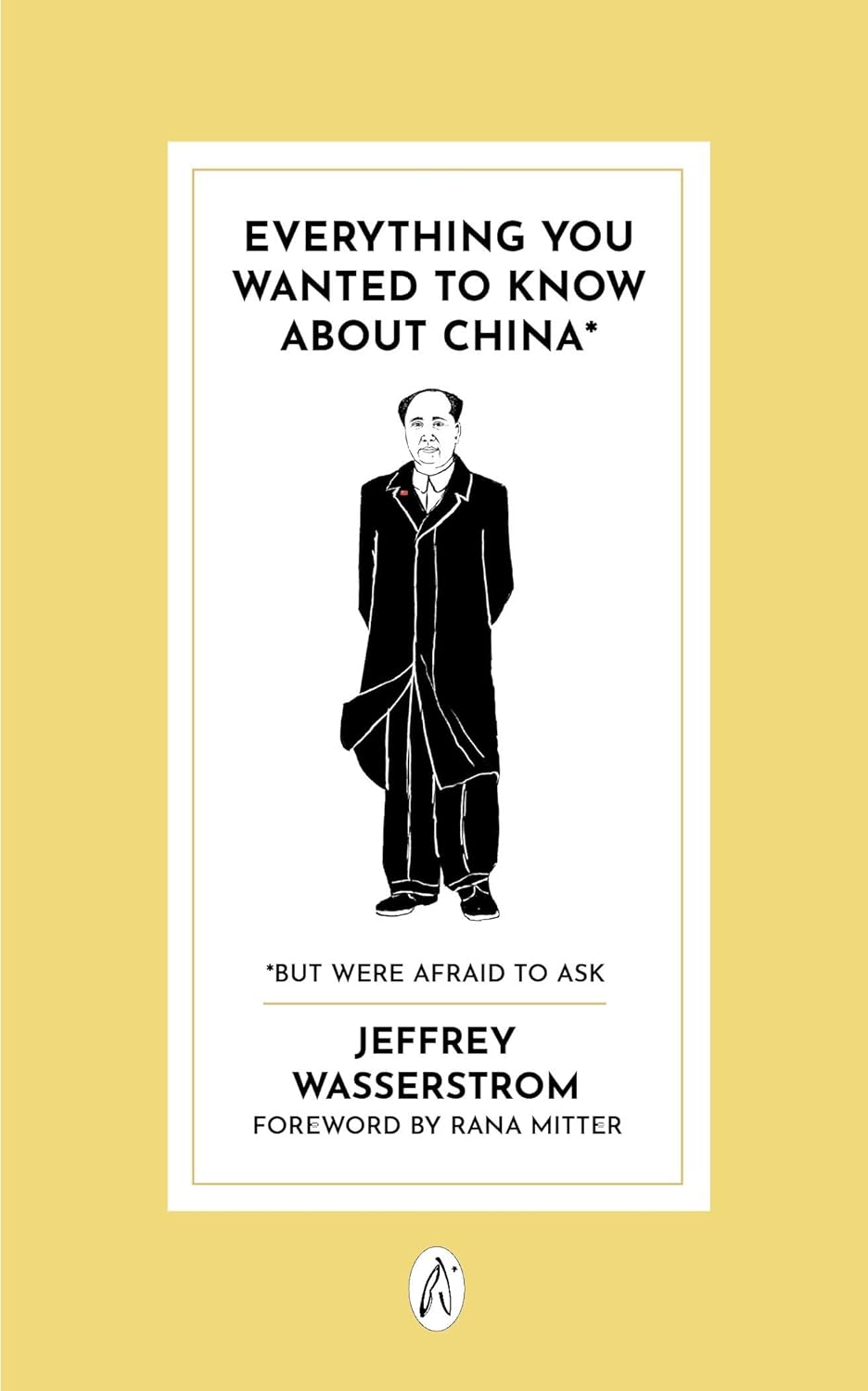
[FIRST IMPRESSIONS] “For Novice and Expert: Jeffrey Wasserstrom’s Everything You Wanted to Know About China (But Were Afraid to Ask)” by Susan Blumberg-Kason
Click HERE to read ALL entries in Cha
on Everything You Wanted to Know
Jeffrey Wasserstrom. Everything You Wanted to Know About China (But Were Afraid to Ask), Bui Jones Books, 2026. 112 pgs.

When I was young and my parents were still Woody Allen fans, a certain film always seemed taboo even to mention: Everything You Wanted to Know About Sex (But Were Afraid to Ask) (1972). I eventually watched it in my twenties, a couple of decades after its release, and recall that it did not seem particularly risqué. Allen’s title may have been provocative at the time, but the film differs very little from others in his early years as a director.
It is common knowledge that the three Ts, Tiananmen, Taiwan, and Tibet, are especially sensitive.
Now, decades later, I have found that other topics feel taboo, though for different reasons. Chinese politics is one such subject that can give one pause, depending on where and what is being said. It is common knowledge that the three Ts, Tiananmen, Taiwan, and Tibet, are especially sensitive. When I came across Jeffrey Wasserstrom’s new book, Everything You Wanted to Know About China (But Were Afraid to Ask), I was both curious and intrigued.
From the outset, Wasserstrom reaches the core of his argument by making an incisive point about Xi Jinping (b. 1953) and Mao Zedong (1893-1976). The former has often been compared to the latter, yet, according to Wasserstrom, this is not the most accurate parallel. Mao sought to sever China from its traditional foundations, that is, Confucian values. Xi Jinping’s ideas, by contrast, reflect a form of neo-Confucianism, not unlike the principles advanced by Chiang Kai-shek (1887-1975). Mao thrived on chaos, whereas Xi appears intent on maintaining order, which lies at the heart of Confucian thought. Wasserstrom credits Mao, the anti-Confucianist, with dismantling many entrenched gender norms, while Xi advocates for a return to more traditional roles for women, roles that do not disrupt the Confucian hierarchy in which men hold authority over women.
These are only some of the comparisons and contrasts explored in the book, and I particularly appreciate the clarity with which Wasserstrom presents them. His explanations are accessible to readers with little prior knowledge of figures such as Mao or Chiang Kai-shek, while still offering insights that resonate with those already familiar with Chinese history.
)
Wasserstrom’s book is divided into three sections, history and ideology, politics and power, and culture and control, each containing subheadings that address major events in modern Chinese, Hong Kong, and Taiwanese history. Within each subheading, Wasserstrom poses a question, as though engaged in conversation with a reader who is curious about China but somewhat hesitant to ask. These questions include “How important is Taiwan to China?”, “How much censorship is there in modern-day China?”, and “How difficult is it to operate in China as a foreign journalist today?”, among many others. In his answer to the question about foreign journalists, Wasserstrom writes:
It’s certainly gotten harder for journalists to operate in China. There is a sense in which now journalists look back to the late 1990s and early 2000s, feeling it was quite extraordinary what they could do back then. Foreign reporters I know and sometimes hung out with in China then would complain about the challenges they faced. They were followed a lot, sometimes hassled if they pushed too hard on specific sorts of stories. It was hard to get permission to go to some places. There were people who would only be quoted anonymously, people who wouldn’t talk to them at all. It was no picnic then, and yet, in retrospect, all of the reporters I know feel that it was a lot easier then than it is now.
As for the three Ts, Wasserstrom does not shy away from them. In a notably matter-of-fact manner, he explains that Chinese leaders have long sought to expand the nation’s borders. Mao Zedong brought Tibet into the People’s Republic of China, and Deng Xiaoping ushered in the return of Hong Kong, yet it is only under Xi Jinping that Hong Kong has been all but fully absorbed into China. It may be that Hong Kong suffices for now, and that there is no pressing urgency regarding Taiwan, given that China’s borders are already more expansive than they were fifteen years ago.
As for Tiananmen, Wasserstrom reminds readers, or informs those to whom this history is unfamiliar, that the student protesters in 1989 were not calling for regime change. This distinction sets Tiananmen apart from the collapse of the Soviet Union and the fall of the Berlin Wall. Those transformations were driven by regime change, whereas the protesters in Tiananmen were advocating reforms within the existing system. Comparisons between China in 1989 and East Germany in that same year, or the Soviet Union a few years later, are therefore not entirely accurate.
He cautions that making predictions in world affairs, including China’s internal politics, is often a futile exercise.
Unlike Everything You Wanted to Know About Sex (But Were Afraid to Ask), in which the title and content do not entirely align, Wasserstrom’s book addresses dozens of questions that readers from a wide range of backgrounds may have about China. In presenting these questions and answers, he cautions that making predictions in world affairs, including China’s internal politics, is often a futile exercise. Nevertheless, he concludes the book with a note of cautious optimism:
It’s a dark time. But developments in Chinese history and in world history have surprised us before. There is no reason to assume that at some point, perhaps after the time of both Xi and Trump, they will surprise us again.
How to cite: Blumberg-Kason, Susan. “For Novice and Expert: Jeffrey Wasserstrom’s Everything You Wanted to Know About China (But Were Afraid to Ask).” Cha: An Asian Literary Journal, 20 Apr. 2026. chajournal.com/2026/04/20/afraid-to-ask.


Susan Blumberg-Kason is the author of Bernardine’s Shanghai Salon: The Story of the Doyenne of Old China, a 2023 Zibby Awards finalist for Best Book for the History Lover. She is also the author of Good Chinese Wife: A Love Affair With China Gone Wrong and the 2024 Zibby Awards winner When Friends Come From Afar: The Remarkable Story of Bernie Wong and Chicago’s Chinese American Service League (University of Illinois Press, 2024). She is the co-editor of Hong Kong Noir and a regular contributor to the Asian Review of Books, Cha and World Literature Today. Her work has also appeared in the Los Angeles Review of Books and PopMatters. Visit her website for more information. (Photo credit: Annette Patko) [Susan Blumberg-Kason and ChaJournal.]