
茶 FIRST IMPRESSIONS
茶 REVIEW OF BOOKS & FILMS
[REVIEW] “The Almost Everything Card—Rob Noble’s Octopus: The Pioneering Story of the World’s First Contactless Payment Card” by Mario Rustan
Rob Noble, Octopus: The Pioneering Story of the World’s First Contactless Payment Card, Blacksmith Books, 2023, 396 pgs.

As a resident of a city bereft of a comprehensive public transport system, I often find myself yearning for its existence—an aspiration that remains elusive for many across the Global South. Even cities in the Global North grapple with upholding the quality of their systems in terms of safety, punctuality, and cleanliness.
Curiously, the most efficiently operated mass transit networks in the world are found in Asia, with three cities standing out in particular: Tokyo, Hong Kong, and Singapore. When Hong Kong and Singapore began planning their metro systems in the 1970s, such undertakings appeared superfluous for a pair of islands and a peninsula that could ostensibly be served by buses. Yet, in a striking turn of events, while the metro systems in Hong Kong and Singapore continue to expand, other locales—such as Bali and Oahu—struggle to maintain even a functional bus network. Meanwhile, affluent nations like Australia remain in the nascent stages of metro development.
Rob Noble’s book on the Octopus card captured my attention by uniting two hallmarks of 21st-century life—the subway and the contactless payment card. The Australian-born Noble arrived in Hong Kong in 1976 as a transport planner for the newly established Mass Transit Railway (MTR), and in the 1980s, he played a pivotal role in developing the system’s magnetic, stored-value multi-ride tickets. As the payment system evolved into a contactless smart card in the 1990s, Noble assumed leadership of Octopus Cards Limited, overseeing its launch and operation until 2001. The book is dedicated to his late wife, Sally, while the acknowledgements section names only one individual—his fact-checker and former colleague, Eddie So.
The advance reader copy came with a cautionary note from the publisher: “This is a business book with a dry language.” I took the warning to heart and soon understood its implication. In selecting this title for my next review, I had anticipated a narrative rich in cultural revelations and unexpected discoveries—tales of tight deadlines and tender moments—akin to Laura Kriska’s The Accidental Office Lady (1997), which recounts the experiences of the first female American trainee at Honda’s Tokyo headquarters.
Noble adopts a markedly different approach—he omits himself almost entirely from the narrative. We learn nothing of his life in Australia, nor of the circumstances that led him to relocate to Hong Kong. We are told nothing of how he adapted to life there, nor of any personal challenges he may have faced in bringing the Octopus project to fruition amid the uncertainty surrounding Hong Kong’s 1997 handover to China, or in shepherding its transformation into an integral part of daily life for Hongkongers. His reflections on the city in the 21st century are likewise absent.
This is, unequivocally, a business book—an account of how the Octopus card came into being, how it evolved from a transport pass into a multi-purpose smart card, the advantages and limitations of the system, and how it compares with similar technologies worldwide. It is written primarily for professionals in the fields of transport and smart card innovation, as well as historians with a particular interest in Hong Kong’s technological and infrastructural development.
Hong Kong’s ambition to construct its MTR was hampered by the recession of the 1970s and by the city’s geography—politically, the line could not terminate on the island alone but was expected to extend to the New Territories, perhaps even into Guangdong. Improved economic conditions after 1975 enabled the completion of the full Modified Initial System, which was officially inaugurated by Princess Alexandra on 12 February 1980, when she rode the immersed tube beneath Victoria Harbour to Central.
Thirteen years later, the MTR had become an integral part of daily life in Hong Kong, and the MTR Corporation began exploring the adoption of smart card technology. This proposed card would be usable not only on the MTR but also across other modes of transport—bus, ferry, tram, and regional rail. With the exception of taxi associations, other transport operators agreed to the proposal, and a public competition was launched to name the new system. The deadline was set for 29 February 1996, with the winning entrants awarded 8-tael, 999.9-purity gold tickets.
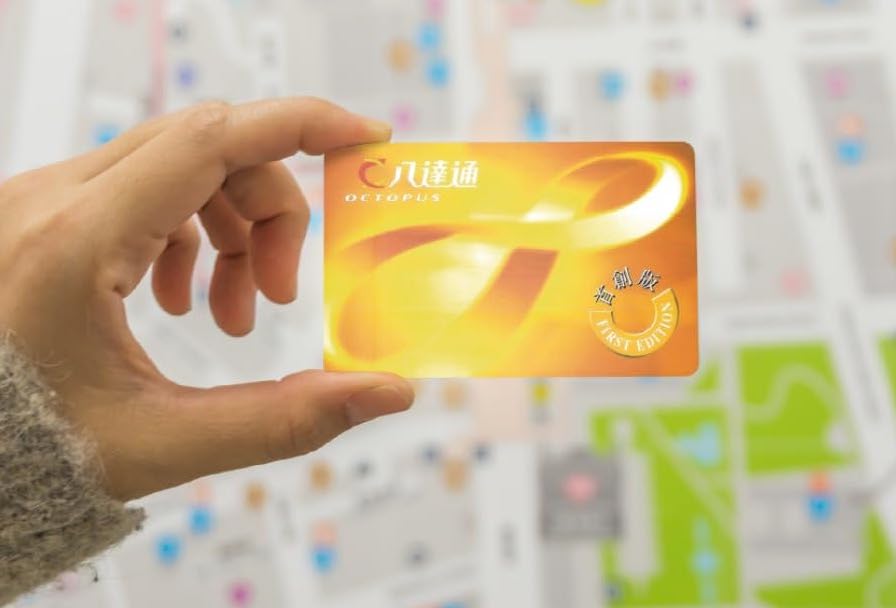
The winning Cantonese entry, 八達通 (baat daat tung), gained immediate popularity. Literally meaning “eight arrived pass” or “go everywhere pass”, it is commonly understood as an idiom implying “accessible in all directions”—and, as a felicitous bonus, it rhymes with faat daat, meaning “to get rich”. The English name, “Octopus”, was initially met with some reluctance by the MTR Corporation, though it was eventually approved in September 1996—particularly as the chosen logo resembled the mathematical infinity symbol, which could also be interpreted as the number eight.
Rather than adopting the more widely used Philips MIFARE RFID (Radio Frequency Identification) chips, the Octopus system’s developer, ERG Group, opted for the more secure Sony FeliCa technology. Technical issues arose during testing in September 1997, and Noble attributed the heightened public and media scrutiny to the post-handover atmosphere—as though the Octopus card had become a symbol of yet another unwelcome change for Hong Kong. By 1999, however, the system was functioning reliably, and bus companies enthusiastically embraced it, as it resolved longstanding issues with fare collection—such as the handling of small change, deliberate or accidental incorrect payments, and disputes between drivers and passengers.
True to its name, Octopus soon expanded beyond transport-related transactions, achieving a major breakthrough when 7-Eleven Hong Kong adopted the system in October 2000—becoming the first 7-Eleven outlet in the world to accept cashless payment. Advertising campaigns in the early 2000s spurred further uptake among consumers, particularly at popular restaurant chains such as Fairwood and Café de Coral. Although Octopus gained some traction with businesses in Shenzhen and Macau, the broader ambitions of Octopus Cards Limited (OCL) to expand into mainland China and even Europe were ultimately constrained—hampered by limited enthusiasm from local markets and regulators, as well as by OCL’s own shortage of manpower and capital.
Taxis remain the one mode of transport untouched by Octopus, and Noble—perhaps unfortunately—refers to them as one of the “recalcitrant players”. He does, however, offer a sympathetic account of the taxi drivers’ perspective. A taxi typically completes around forty trips per day, compared to six hundred for a bus. While a bus driver must manage forty passengers at once, a taxi driver interacts with only one at a time. Moreover, while buses are operated by a small number of companies, Hong Kong’s taxi fleet is highly fragmented, with approximately 9,000 individual owners—and the average driver is 58 years old.
Despite Octopus’s strategic efforts, taxi associations had declined cooperation by the late 2000s. While some drivers welcomed the relief of no longer having to fumble for change, many remained reliant on cash tips simply to meet daily expenses—tolls, fuel, and taxi rental. Even with the advent of newer technologies such as QR code payments and Near Field Communication (NFC) via smartphones, the cash economy has continued to dominate within Hong Kong’s taxi industry. Noble expresses scepticism regarding the potential of Chinese apps like WeChat Pay and Alipay to succeed where Octopus has not—arguing that their popularity on the mainland stems largely from heavy corporate investment in discounts and subsidies for taxi associations.
Toll and parking operators have also resisted collaboration with Octopus. As the book progresses, it becomes increasingly clear that Noble views partnership with Octopus as a civic good—while hesitation or rejection appears, to him, not only short-sighted but irrational.
To his credit, Noble acknowledges several controversies surrounding the card: supply shortages in 1998, a payment system failure in 2007, and data-selling scandals in the 2010s. Yet one might infer that, in Noble’s telling, responsibility lies almost exclusively elsewhere—with consumers who purchased secondary cards, subcontractors who delivered faulty components, and even the MTR itself. The book offers no commentary on the Hong Kong protests of the 2010s, though it does highlight the role of Octopus during the pandemic—praising its utility in reducing physical contact and assisting the authorities in tracing movement and assessing transmission risk.
Ultimately, I found the final third of the book particularly engaging, as it delves into comparisons between Octopus and its leading counterparts in Singapore, London, Seoul, and Tokyo. Singapore’s EZ-Link, for instance, can be used to pay for taxis and tolls, yet its utility beyond transit hubs is limited, facing stiff competition from the banks’ NETS cards.
London’s Oyster, meanwhile, is hampered by the capital’s notoriously high fares and Transport for London’s inclusive approach—which allows all of Oyster’s competitors to coexist, from single-ride paper tickets to newer contactless payment methods. Its potential beyond transport has been largely overlooked—even the station toilets, tellingly, do not accept Oyster as a form of payment.
Remarkably, one year before the launch of Octopus, Seoul’s bus network had already implemented the world’s first automated fare collection system. However, its subway system at the time accepted only the Kookmin credit card as an alternative to the traditional magnetic stripe card. The system was later unified under the T-money brand in 2004, which can be used for taxis across the country—yet, like others, it is seldom promoted as a general-purpose retail card.
Visitors to Tokyo—particularly Hongkongers accustomed to the convenience of Octopus—may find themselves perplexed by the limitations of Suica. Much like London’s Oyster, Suica continues to coexist with paper and magnetic stripe tickets. Somewhat ironically, tourists holding a Japan Rail Pass must still present it to a station attendant for inspection—in a country famed for automation. Whereas 7-Eleven Hong Kong had accepted Octopus as early as 2000, its Japanese counterpart did not begin accepting Suica until 2011. Tourists may well marvel at the sheer variety of vending machines across Japan, only to be equally bemused by the fact that many of them still do not accept contactless smart cards. Rakuten’s attempt to address this gap with its Edy card (short for Euro, Dollar, Yen) has met with limited success. As the old joke goes: in Japan, it is always the year 2000.
Noble concludes the book by outlining his philosophy on the cashless society. One of Octopus’s founding objectives was to reduce coin usage in Hong Kong—a goal it has largely achieved. While Sweden and China both pursue cashless societies, their motivations differ—minimalism in Sweden, and social control in China. Conversely, countries such as Switzerland and Austria argue that a cash-based economy safeguards national identity, trust, and personal freedom. Predictably, Noble refrains from engaging with the debate between freedom and control in the context of Hong Kong—despite it being the core of contemporary political tensions.
Politics aside, cash remains a daily reality in Hong Kong. Doctors do not accept Octopus; small shops and their customers continue to favour cash; and vending machine operators also prefer it—many people, after all, purchase drinks or snacks simply to offload excess coins rather than to satisfy a craving. Unsurprisingly, the gambling industry—both legal and underground—also operates strictly in cash.
While Hong Kong residents may link their savings or credit accounts to their Octopus balance, tourists must still use cash to top up theirs. Interestingly, Sweden’s zeal for a fully cashless society appears to have waned in recent years, suggesting that the world’s first truly cashless society may instead emerge from a Confucian context—Singapore, Hong Kong, or China, the very birthplace of paper currency.
Had this book taken the form of a Taschen-style photobook, it might have been an absolute delight—perhaps even becoming a coveted piece of official Octopus merchandise. But it is a resolutely non-commercial volume, packed with tables and graphs (including an exhaustive listing of all special editions of Octopus cards and related items), interspersed with a selection of photographs. Yet buried within this trove of data are moments of genuine charm and insight. It is indeed fair to say that Octopus is Hong Kong’s unsung icon—and arguably one of the city’s most remarkable innovations of the 21st century.
How to cite: Rustan, Mario. “The Almost Everything Card—Rob Noble’s Octopus: The Pioneering Story of the World’s First Contactless Payment Card.” Cha: An Asian Literary Journal, 4 Apr. 2025, chajournal.com/2025/04/04/octopus.


Mario Rustan is a writer and reviewer living in Bandung, Indonesia. [All contributions by Mario Rustan.]