
📁 RETURN TO FIRST IMPRESSIONS
📁 RETURN TO CHA REVIEW OF BOOKS AND FILMS
Click HERE to read all entries in Cha on Ezra Pound’s Chinese Friends.
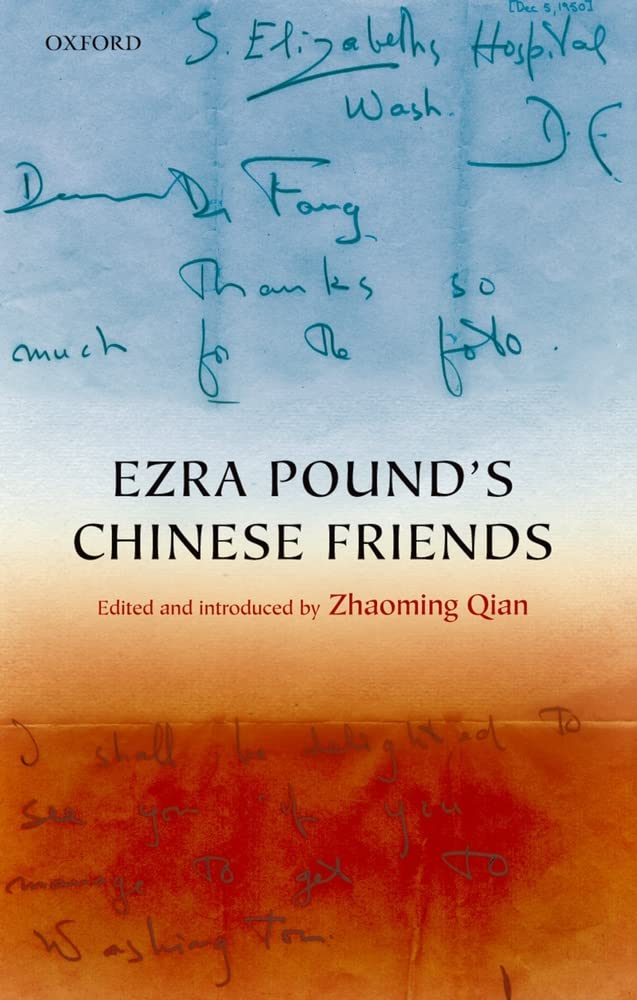
Zhaoming Qian (editor), Ezra Pound’s Chinese Friends: Stories in Letters, Oxford University Press. 2008. 272 pgs.

A fascination with literary modernism, kindled during my schoolboy years in the 1980s, led me one afternoon to the library of the school I attended at the time. There, on one of the shelves, sat a formidable, thick volume with a stark black cover. The title—monumental and rendered in stark white—stood out dramatically against the surrounding darkness: Ezra Pound: The Cantos.
At the time, the only thing I knew about cantos was that Dante had composed his great masterpiece, The Divine Comedy, in them. But when I borrowed the book and began to read, I realised—even on that first encounter—that no obvious uniformity governed its hundreds of pages. Before long, strange characters seemed to leap from the text, often standing aloof from the surrounding prose. Most of the writing was in the Roman alphabet, with the occasional departure into Greek script—but the Chinese ideograms almost shouted from the page: starkly visible and, at the time, utterly unknowable.
Pound’s friend in later life, the fellow poet Basil Bunting, described this monumental sequence of poems—written in an epic style on epic themes—as akin to a mountain before which every reader must first stand and gaze, before attempting the ascent. The opening Canto, composed decades prior to the final ones, presents a version of the Greek myth of Odysseus rendered in contemporary English. In its lyricism and the almost musical cadence of the language, it offers a foretaste of what is to come.
Years later, idling away time in Sydney during my years of living and teaching there, I recall carrying a new edition of the poems to the ocean’s edge. There, I encountered that peculiar blend of frustration and elation which I came to understand as the hallmark of reading Pound—journeying through pages composed across decades, witnessing disintegration followed by momentary, potent flashes of integration that define the later sequences.
One major difference stood out between my schoolboy engagement with Pound’s masterpiece and my later experience of it: by then, I had learnt to read and understand Chinese. Those once-impenetrable symbols, so baffling in my youth, now revealed their meanings. I could discern the strikingly liberal and inventive ways in which Pound employed them within the English fabric of his text.
What, then, was Pound’s understanding and knowledge of Chinese? He never visited the country—despite an early plan to do so—and, as Zhaoming Qian’s edited collection of letters between Pound and various correspondents, Ezra Pound’s Chinese Friends, makes clear, his attempts to learn both written and spoken Chinese were intermittent at best. Nevertheless, they were sufficient to enable him, during his incarceration for mental illness at St Elizabeths Hospital in Washington, D.C., from 1946 to 1952, to devote himself to translating sections of the Confucian Book of Poetry 詩經, and to distinguish between the Shanghai dialect and standard Mandarin Chinese.
From the outset—around the time Pound began work on the Cantos during the First World War in 1915—his interest in Chinese language and culture was piqued, albeit indirectly, through the writings of the American art historian and Japanologist Ernest Fenollosa.
Fenollosa’s influence on Pound is well recognised, but as Qian observes, the notion—prevalent from an early stage—that Pound subscribed to the pure idea of Chinese written characters as “ideograms” conveying meaning without sound (a view perhaps unfairly associated with Fenollosa) was one that, even if Pound initially entertained, he soon abandoned. He may not have possessed as deep a knowledge of Chinese literature and language as a superficial reading of the Cantos or his translations—often from English versions into his own idiom—might suggest. Yet he was by no means entirely unversed. He had access to the first Chinese–English dictionary, compiled by the great scholar-missionary Robert Morrison in Canton in the 1810s. Through this, he came to understand that Chinese characters often contain phonetic components—they are not purely pictographic.
Pound was also familiar with James Legge’s 19th-century renderings of the major classical Chinese texts. To argue that Pound’s work would have been impossible without collaborators such as those featured in Qian’s volume—Achilles Fang, for instance, who assisted him in his later years with Chinese–English translation—is to overlook the fact that the efforts of both Morrison and Legge were themselves profoundly collaborative. They, too, relied on the expertise of native Chinese speakers and scholars. Sinology, ultimately, has always been—and will no doubt remain—a shared endeavour between two linguistic and cultural traditions, not a monopolistic undertaking by one to decipher the other in isolation.
There is ample evidence in these letters—edited, annotated, and in some instances translated from various languages into English—that Pound possessed considerable knowledge of China, as well as of Chinese history and literature. To some extent, then, his engagement with the subject was direct and first-hand, rather than wholly mediated or distant. Yet, as with many other areas of his intellectual inquiry, Pound’s understanding was often idiosyncratic—shaped and propelled by his distinctive political, philosophical, and cultural convictions. That these were indeed convictions—and that they became increasingly controversial—is evident not only in what he said and wrote, but in the manner in which he expressed himself.
In the early years, when his prose in these letters is at its most lucid, Pound regarded China—as Qian puts it—as “an alternative to modernity” (5). To some extent, he came to believe that “China replaced Greece in the intellectual life of so many occidentals.” This idealised vision of a land he never visited, and with which he had only limited direct contact, was not unusual within certain intellectual circles of the time. The impulse either to romanticise or to demonise China and Chinese culture—and, in its worst forms, the Chinese people themselves—had deep historical roots. It stretched back to the Enlightenment of the seventeenth century, when towering figures such as Voltaire, Leibniz, and Montesquieu respectively expressed positive, neutral, and negative views of the great civilisation on the far side of the world. What united this triad of European thinkers, however, was that none had any first-hand experience of China; all relied upon mediated accounts, principally those of Jesuit missionaries active during the Ming and Qing dynasties, up until their expulsion under the Yongzheng Emperor in the 1720s.
The evolution of Pound’s aesthetic and intellectual outlook had a marked influence on his engagement with the Chinese language—both in its usage and in its visual presence within his work. Writing to his father in 1928, he remarked that working with Chinese texts, particularly their layout and physical form, was a source of creative stimulation. “For Cathay“—an early collection of poems based on Chinese sources—he wrote, “I had a crab book made by [Morrison] … not translation or anything shaped into sentences, but word for sign, and explanation with each character.” In this manner, he constructed his own interpretations from these somewhat fragmentary materials, assembling meaning through a process that was as much imaginative as philological.
Yet it was not merely the visual structure of the characters that inspired him. Chinese painting, to which he had access during the 1930s and 1940s, also exerted a powerful influence. He was drawn to their near-static quality, and to the way human figures were often depicted as diminutive presences within vast, enveloping landscapes—subsumed by the natural world rather than dominant over it. These aesthetic sensibilities found their way into his poetry, notably in the “Seven Lakes Canto” (Canto XLIX), published in 1937:
For the seven lakes, and by no man these verses:
Rain; empty river; a voyage,
Fire from frozen cloud, heavy rain in the twilight
Under the cabin roof was one lantern.
The reeds are heavy; bent;
and the bamboos speak as if weeping.
It is not just the imagery here—lanterns, reeds, bamboos—that evokes a sense of place and atmosphere distinct from the Western world, but also the way in which Pound writes. He attempts to mirror the quality of Chinese when translated literally into English: abrupt, staccato, highly abbreviated. The language Pound employs in the letters included in this volume, particularly those sent after the Second World War, brings his already distinctive style into full expression. It may have been politics rather than genuine madness that led to his incarceration in 1946. His years of support for the Fascist regime in Italy had nearly been his undoing following its defeat. Even so, many of the letters—especially those addressed to Achilles Fang—contain extended passages that are every bit as chaotic, disassociated, and fragmentary as some of the later Cantos, such as those in the Rock Drill (1957) and Thrones (1960) sequences. Consider this excerpt, from March 1951:

Sporadically, there is coherence here—and this is one of the more accessible passages.
Intellectually, Pound’s development in the latter half of his life is difficult to comprehend—but for altogether different reasons. In the late 1930s, as war loomed and China was already engaged in conflict with Japan, Pound began to weave his emerging obsessions into a broader discourse on China’s place in the world. To Fengchan Yang, he declared, “the democracies aren’t democracies, they are USUROCRACIES” (23). His tirades against the evils of usury would find their way into the Cantos, shaping his worldview from the time of the financial collapse of the late 1920s onwards. These preoccupations ultimately led him to increasingly controversial—and at times sinister—conclusions, some of them overtly antisemitic.
China, however, was largely spared from the full force of these later obsessions. Toward it, Pound adopted a comparatively benign mode of essentialism, declaring to one Chinese correspondent that the Chinese had changed everyone who had ever interacted with them. This romanticised assertion was firmly rejected by the recipient, who pointed out that the Koreans and Japanese, despite China’s historical cultural influence, had developed strong and distinct identities of their own.
This volume offers genuine insight into the vexed question of Pound’s relationship with both the Chinese language and Chinese culture. That insight, however—much like the nature of the relationship itself—is scattered across words, sentences, and fragments. It remains largely subliminal, never rising to the level of an explicit manifesto. One suspects that the reason Pound never travelled to China was precisely because he preferred a posture of distance and detachment—an aloofness from the subject that, while abstracted, proved to be creatively fertile. From that vantage, he produced some of his most beautiful, profound, and moving poetry.
How to cite: Brown, Kerry. “Ezra Pound’s Chinese Character: What Did the Great Modernist Author Really Know About Confucius in the Original?” Cha: An Asian Literary Journal, 4 Apr. 2025, chajournal.blog/2025/04/04/ezra-pound.


Kerry Brown is Professor of Chinese Studies and Director of the Lau China Institute at King’s College London. From 2012 to 2015, he served as Professor of Chinese Politics and Director of the China Studies Centre at the University of Sydney, Australia. Prior to this, he was based at Chatham House from 2006 to 2012, first as Senior Fellow and subsequently as Head of the Asia Programme. Between 1998 and 2005, he worked at the British Foreign and Commonwealth Office. He is the author of more than twenty books on modern Chinese politics. His most recent publications include The Great Reversal: Britain, China and the 400-Year Contest for Power (Yale, 2023) and The Taiwan Story (Random House, 2023). His forthcoming work, Mao, will be published by Reaktion in early 2026. He holds an MA in English Literature from the University of Cambridge and a PhD in Chinese politics and language from the University of Leeds.