

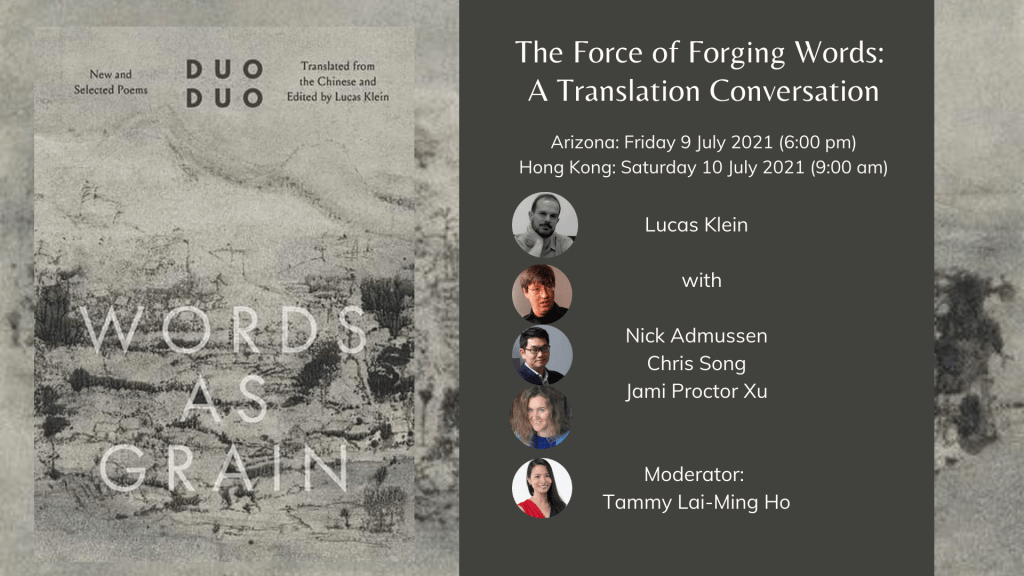
Translation Editor Lucas Klein‘s note: On the 9th or 10th of July, depending on where you are in the world, Cha hosted “The Force of Forging Words: A Translation Conversation” to launch my translation of Words as Grain: New and Selected Poems by Duo Duo 多多, published as part of The Cecile and Theodore Margellos World Republic of Letters by Yale University Press. Moderated by Cha’s editor-in-chief Tammy Lai-Ming Ho, the event put me in conversation with my fellow poetry translators Nick Admussen, Chris Song, and Jami Proctor Xu. They had been prepped with the following prompt for discussion:
In “The Force of Forging Words,” Duo Duo writes: “outside force, continuing on / from enough, is insufficient hallucination // … // this is rationale’s wasteland / but the ethics of poetry.”
What are the ethics of poetry? Is poetry the wasteland of the rationale, or of the rational? Is translation a kind of hallucination, and is it sufficient? What care needs to be taken to translate such poetry? Our speakers will discuss these questions with the translator to celebrate the publication of Words as Grain.
With apologies for the cliché, I was blown away by both the warmth and wisdom of what Nick, Chris, and Jami had to say in response to these questions and my translations, and by Tammy’s follow-up questions, as well. The following suite of poems are those that we read during the event.
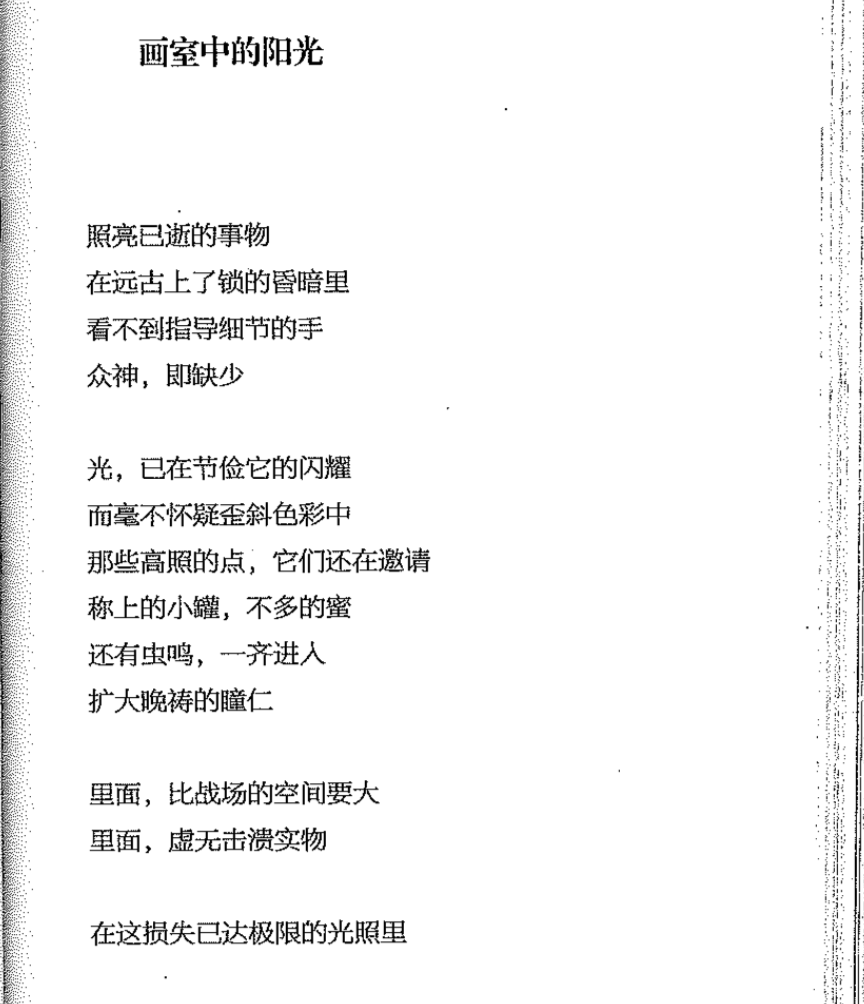
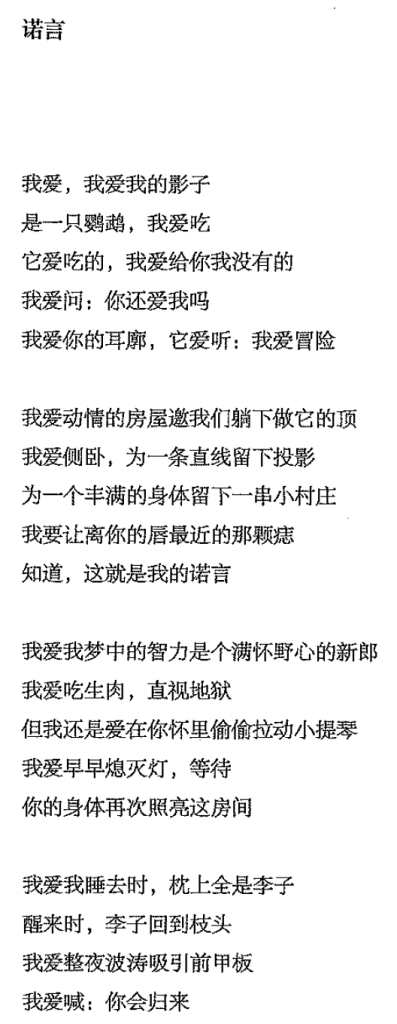
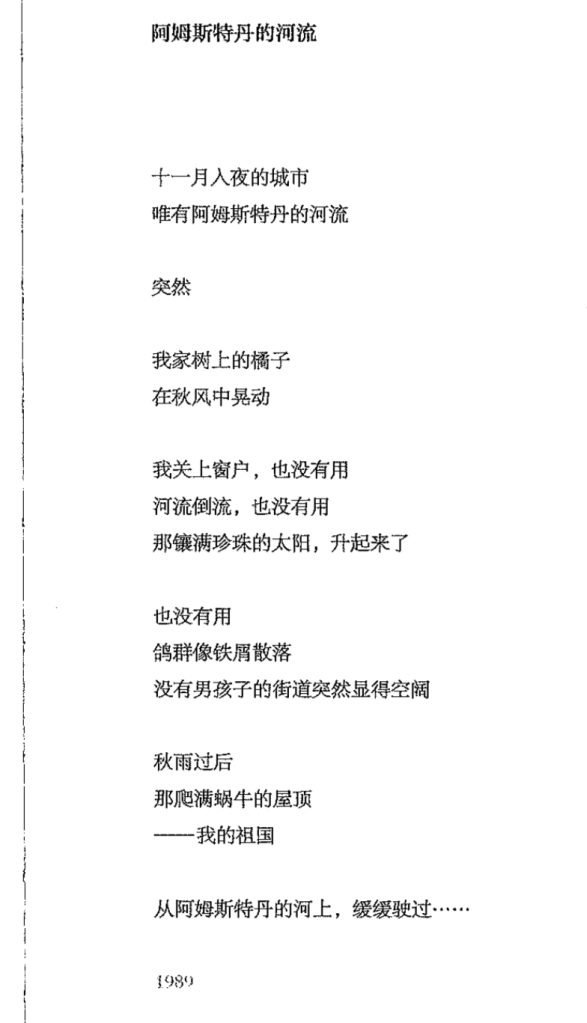
I began the event by reading “The Force of Forging Words,” as it served as the title poem for our event. I chose it because the poem best defines for me some of Duo Duo’s literary philosophy. As part of his speech, Nick read “Writing That Can’t Let Go of Its Grief Examines the Cotton Field,” which he described in a tweet, “One of those poems that touches and incites me in a way far afield from its denotation, but well inside its design.” This was followed by Chris reading “Words”—in part to disagree with what he saw implied by Duo Duo’s poem; you can read his rundown of what he said in “Entering a State of No-Self: Some Thoughts on Poetry and Translation.” After that, Jami read “The Sunlight at the Art Studio” as part of her contribution. Later I read “Promise,” a poem I find atypical for Duo Duo for being so accessible, though at the same time it is characteristically Duo Duo in its linguistic sensuality. I also read “Amsterdam’s River,” a poem I discuss in the introduction for how it demonstrates the active choices the translator must make.
Hopefully these poems will go some of the way to present and also recapture the warmth and wisdom of what was said during the Translation Conversation. The poems span much of Duo Duo’s literary career, and they offer, I think, an excellent entryway into the work presented in Words as Grain. That, too, is a force from the forging of words.

THE FORCE OF FORGING WORDS
鑄詞之力
outside force, continuing on
from enough, is insufficient hallucination
light vanishes with feathers
stillness cannot be forfended
candles stuck with wings know only to advance
what’s most loved is dark and quiet
this is rationale’s wasteland
but the ethics of poetry
dream and the boat on the shore must join forces
if words can spill from their own bounds
only there, to test the hearing of the end
2014
铸词之力
在力之外,在足够处
持续,是不够的幻觉
光,是和羽毛一起消逝的
沉寂是无法防御的
插翅的烛只知向前
至爱,是暗澹的
这是理由的荒芜
却是诗歌的伦理
需要梦与岸上的船合力
如果词语能溢出自身的边际
只在那里,考验尽头的听力
2014

WRITING THAT CAN’T LET GO OF ITS GRIEF EXAMINES THE COTTON FIELD
不放哀愁的文字檢查棉田
bronze has exiled the witness’s tongue
grass relates the incompetence of words
after hearing the family leave with their antibodies
the ripping left by the twig fence is unheard
river and riverbed in endless litigation
the bitter woman has kneeled the embankment white and clean
see the bowl-holding statue standing forever
driving out locusts with collective pacing
the river engages once again in the explanation of blood
the weak who despise the journey will have only mileage
2000

WORDS
字
they are autonomous
clambering together
to resist their own meanings
read them and they murder at point-blank
every morning I get angry at these things
I hate these things that as soon as they’re
written are his writing
the dreams I’ve had
are gas leaked from his head
a composure behind having
plucked the last good tooth
quivering on his face
like a patient who’s forgotten to get a blood transfusion
he rushes out the door
he’s looked down on himself for a long time.
1986

THE SUNLIGHT IN THE ART STUDIO
畫室中的陽光
illuminate the bygone things
in the locked-up dimness of the distant past
you cannot see the hand that guides details
gods are absent
light is conserving its shine
and does not suspect amid crooked color
those points of highlight, which yet invite
the small jar on the scale, a little honey
and insect chirps, to enter together
the pupil of expanding evensong
within, more spacious than a battlefield
within, things are vanquished by emptiness
in this illumination where loss has hit its limit
see the beauty of the hand that wipes the tears
the beauty of the hand that shatters the dish
there is still tragedy, but then there is still the landscape
2006

PROMISE
諾言
I love, love that my shadow
is a parrot, that I love to eat
what it loves to eat, that I love to give you what I don’t have
I love asking, do you still love me
I love your auriculae, that they love to hear: I love adventure
I love aroused rooms inviting us to lie down as their roof
I love lying on my side, casting a shadow for a straight line
casting a string of villages for a voluptuous body
I want the mole nearest your lip
to know, this is my promise
I love that the intelligence in my dreams is an ambitious groom
I love eating raw meat, staring straight at hell
but I still love secretly playing the violin in your embrace
I love putting out the lights early, and waiting
for your body to relight the room
I love that when I go to sleep, the pillow is covered in plums
and that when I wake, the plums go back to their branches
I love that the waves attract the forward deck all night long
I love to shout: you’ll be back
I love tormenting the port like this, and tormenting words
I love controlling myself before the table
I love sticking my hand in the sea
I love spreading my five fingers out at once
to grab tightly to the edge of the wheat field
I love that my five fingers are still your five boyfriends
I love that memory is a life a bit less
but still more than what a woman misses when
walking toward me, as if that girl with the violin case
thirty years ago, on the street, in the dusk
were still smiling at me for no reason
and I love even more that we are still a pair of torpedoes
waiting for someone to shoot us again
I love joining with you in the depths of the sea, that you
are mine, only mine, I still
love to say it, love to sing my promise—
2001

AMSTERDAM’S RIVER
阿姆斯特丹的河流
in the November nightfall city
there is only Amsterdam’s river
suddenly
the tangerines on my tree at home
shake in the autumn wind
I close the window, but no use
the river flows upstream, but no use
that sun inlaid with pearls, rising
no use
pigeons disperse like iron filings
and the streets with no boys suddenly seem so spacious
after autumn rain
the roof that’s crawling with snails
—my country
slowly floats by, on Amsterdam’s river
1989


Lucas Klein has lived on three continents, in five US states, and in the capital, in internationally unrecognised, and in special administrative regions of China. He has been a radio DJ, a union organiser, and a factotum for a literary journal whose editor later died a day after losing a congressional election. He earned a PEN/Heim grant for his translations of Duo Duo’s 𝑊𝑜𝑟𝑑𝑠 𝑎𝑠 𝐺𝑟𝑎𝑖𝑛 (Yale University Press, 2021), and has also published translations of Xi Chuan (New Directions, 2012, 2023), Mang Ke (Zephyr, 2018), and Li Shangyin (NYRB, 2018), and is executive editor of the Hsu-Tang Library of Classical Chinese Literature (Oxford). He has two kids and teaches at Arizona State University. PHOTO of Lucas Klein © Zhai Yongming. [Lucas Klein and chajournal.blog.] [Cha Staff]
 Cha
Cha 