
{Return to Cha Review of Books and Films.}
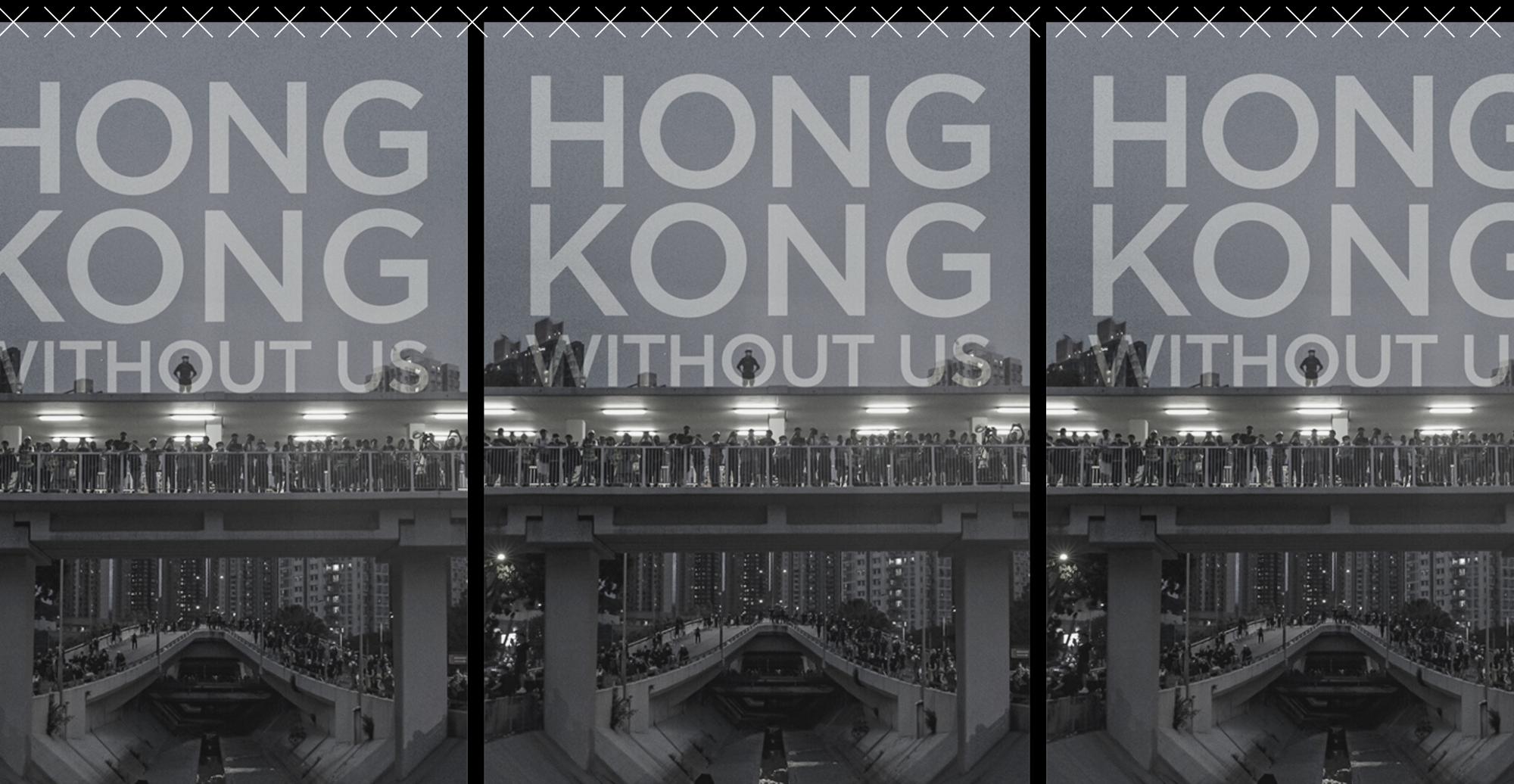
The Bauhinia Project, Hong Kong Without Us: A People’s Poetry, University of Georgia Press, 2021. 120 pgs.

Unusual times call for unusual ways of self-expression. At a time when civil freedoms in Hong Kong are being continually encroached upon, Hong Kong Without Us presents us with a possibility of making poetry in the worst of times.
One of the many aims of the anti-extradition bill protests of 2019 was to make resistance blossom everywhere (pindei hoifaa片地開花). In a way, Hong Kong Without Us perhaps reminds us that the verb “blossom” is even redundant, because poetry of resistance already exists and is everywhere in Hong Kong—in people’s day-to-day communication. This was what enabled the editors and translators of this volume to collect materials of self-expression from the protests and recraft them into poetic verse. These may not be the most ornate poems, but they all record the truths on the streets and translate the voices of Hong Kong people for the world.
One such truth recurring in many poems is selflessness and conviviality, an altruism that unite people on the streets at the moment of protest. Whether it is the sacrifice of teenage protesters standing on the frontline to buy time for others, or people giving each other a hug, “there’s something / you can do, for everyone”, as one poem says. Civil-mindedness and altruism were indeed distinctive features in the Hong Kong protests, as pictures of volunteers cleaning up rubbish after protests made headlines on international media. At the same time, while these poems are not desperate or polemical despite the dire situation, sometimes the emotion is so strong that there are short, impactful one-liners (often a stanza of its own) that declare strongly a viewpoint or an identity—other truths on the streets:
I have no fear. (4)
I stand on my own two feet. (58)
He was the manager. (28)
I am a father. (6)
This is no longer my Hong Kong! (9)
While reading, I was particularly struck by two feelings. The first interesting feeling came from the way each of the first four sections was designed. The core poems of each section are in English (and the “raw materials” before the poetic rework are not shown), but each section begins with a Chinese poem that appears alongside its English translation. But the Chinese poems are written in a literary language with grandiose words, which therefore sets the atmosphere for the following section but which the English translation often fails to capture. This is inevitable: current trends in English poetry simply do not favour exaggerated language. Hence the core poems of each section are quotidian, measured, short and crisp, momentous, but they are preceded by something of too great a scale:
天亡 post-mortem sky
血咒 大地起 blood spell rising from earth
牢牢大海 locked-down sea
連根拔起 yanked by the roots
Even the last section, an interesting collage of Post-its of “last wills and testaments, along with dreams for a post-reclamation Hong Kong” reminiscent of the Lennon Wall during the Umbrella Movement, is prefaced by these philosophically sounding lines that heavily rely on the context of the book to infer its relevance to Hong Kong’s situation:
大地 the earth
一片黃沙肅清 yellow sand expunged
萬世轉 ten thousand lives revolve
如空空替 empty replacing empty
換人間 swap out this mortal coil
一草之善 one grassleaf of grace
The English translation lacks the momentum of the rhythm and the cosmological atmosphere of those short Chinese lines. This does not mean the translation is a bad one; it is just that some styles of Chinese poetry do not lend themselves easily to translation. Nonetheless, the grand scale of these Chinese poems is quite out of sync with the style of most of the other poems, and readers who value variety of style over consistency would find them a welcome change.
The other feeling is an incongruence between the tone of these poems and the discretion that has gone into protecting the identities of those involved in the project. Reading these poems felt like eavesdropping, as if I was in a cha chaan teng 茶餐廳 (an informal Hong Kong café) in a local neighbourhood, overhearing customers chirping at the next table. The poems are that quotidian, even though the protest was about such an urgent matter. Thus, enveloping these poems are a “Note on Authorship and Process” (which also gives a helpful overview of the intricate linguistic situation of Hong Kong for those who are not familiar) and a postscript on the situation of the National Security Law, where the editors describe the experimental gesture of making this volume “authorless” and the careful precaution they put into protecting the identities of people involved in the project. They also meticulously denote the source of the poems, from graffiti on Hong Kong’s walls, writings on journalism platforms, or social media or forum posts. Although the word “anonymous” does appear later in the note to describe the poems, to use the word “authorless” for a tagline is extraordinary. In a way, the poems in this book are authorless, but they are not “anonymous” as in they do not have a name. They do: their name is Heung Gong Yan 香港人, Hongkonger. Whether it is the poets, the translators or the editors, whether they are in Hong Kong or not, those who were involved in this project are simply Hongkongers.
The “authorlessness” of the entire project, from writing, translating and editing, is a remarkable mode of resistance-writing, one that may bring fruitful implication on other contexts of protests as well. In this sense, what has emerged is not one or two single poems, but, as the book cover reads, a people’s poetry, or simply a poetry: a poetry of Hong Kong resistance by Hongkongers. Perhaps, soon, to be able to remain anonymous will be a privilege—can this book review be anonymous, for example? In imminently authoritarian Hong Kong, can readers also remain anonymous in future?
For now, “watch for Hong Kong”, as the last paragraph of the book’s postscript says. Watch for Hong Kong, and watch for Hong Kong poetry.
Also see these reviews in Cha:
- “A Time Capsule and a Seed: Reviewing Hong Kong Without Us” by Sam Cheuk (24 April 2021)
- “Across the Silence of Oceans: A Review of Hong Kong Without Us” by Arwi Y. Wong (16 April 2021)
How to cite: Tsang, Michael. “Poetry Blossoms Everywhere: A Review of Hong Kong Without Us.” Cha: An Asian Literary Journal, 18 Jul. 2021, chajournal.blog/2021/07/18/blossoms-everywhere/.


Michael Tsang is a native of Hong Kong, and is Lecturer in Japanese Studies at Birkbeck College, University of London, with previous academic experiences in Newcastle University, the University of Warwick, and the Chinese University of Hong Kong. His interests lie in East Asian literatures and popular cultures, as well as postcolonial and world literatures at large. He is the co-editor of Murakami Haruki and Our Years of Pilgrimage (Routledge, 2021). He writes stories and poems in his spare time, and is always interested in languages, literatures and cultures. In April 2012, Michael joined Cha’s editorial team as Staff Reviewer. He is a founding co-editor of the academic journal, Hong Kong Studies (Chinese University Press). [Cha Profile]