
{Return to Cha Review of Books and Films.}
Sakinu Ahronglong (author), Darryl Sterk (translator), Hunter School, Honford Star, 2020. 184 pgs.

Sakinu Ahronglong’s Hunter School, in a brilliant English translation by Darryl Sterk, is an engaging exploration of indigenous selfhood. Sakinu is Paiwan—as he proudly affirms more than once in the book—one of the sixteen indigenous groups currently recognised in Taiwan. Sterk mentions in his informative translator’s note that the language of Paiwan—Paiwanese—belongs to the Austronesian language family, and first became a subject of study during Taiwan’s Japanese colonial period (1895-1945). Today, Paiwanese is spoken by very few people, mostly those of Sakinu’s age (he was born in 1972), and it risks dying out completely, if attempts to preserve it are unsuccessful.
But this book was originally written in Chinese, not Paiwanese, and was published in 2000, with a different title: Mountain Boar, Flying Squirrel, Sakinu. In Sterk’s translation, the title has been changed to Hunter School, in honour of the actual school that the author built to teach Paiwan culture to younger generations and to anybody else wishing to learn.
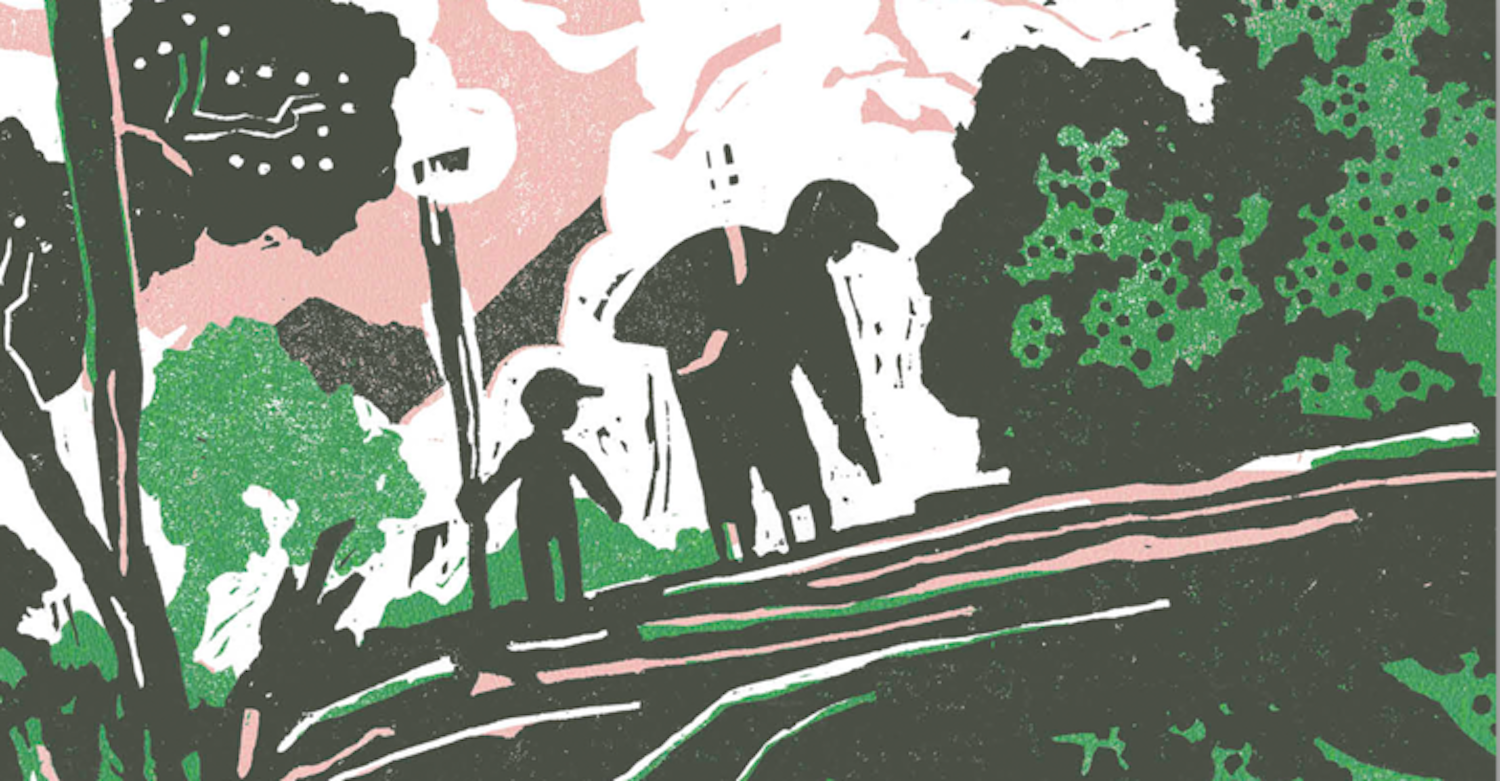
The short pieces in Hunter School are divided into three parts arranged by the translator to chronologically follow Sakinu’s journey in finding his Paiwan identity. The first part, “A Paiwan Boyhood”, is a recollection of Sakinu’s childhood, following his father across the mountains and the forests of south-eastern Taiwan, tracking down wild boars, flying squirrels and “royal” monkeys. Father teaches his son his “hunting philosophy” (hunting being a foundational practice of Paiwan culture and identity), which might be summarised as follows: “Relate to each creature in nature like it is a fellow person.” And so, in the stories that his father tells Sakinu, the squirrels and the boars, like us, also go to school and learn how not to get caught by humans. Father knows the language of the animals and translates their stories to his curious and attentive son. In a similar way, Sakinu’s grandfather knows that the birds have come a long way to his millet field, and even though he might lose some of the harvest, he lets them have their share, so they can safely return to their homes and to their waiting partners. This way of understanding and narrating the non-human world is not a fable of anthropomorphism but rather a way of integrating both humans and non-humans within a broader ecology in which there is space, both narrative and physical, for healthy cohabitation.
At the time this book was written, hunting grounds had been taken away by Taiwan’s Bureau of Forestry and indigenous people were not allowed to hunt, as Sakinu says. While Han Chinese people were cutting down trees in the mountains and replacing them with cash crops, indigenous peoples were blamed for the degradation of the land and the extinction of some animal species. Hunting continues to be a highly controversial issue in 2021. Amendments to the Wildlife Conservation Act have made it possible today for indigenous peoples to hunt for “self-use” and “non-profit” purposes. However, hunting is strictly controlled by the state, in ways that conflict with certain traditional values and beliefs that indigenous communities associate with hunting, and which obliges them to ask the State permission to practise their own culture.
The second part, “Indigenous Trajectories”, features six stories that provide us with as many different entry points into what it means to be a person of indigenous heritage in Taiwan, past and present. In addition to his own story, Sakinu tells those of some Paiwan people he met along the way—friends, family members, but also strangers. “Hawk Man” recounts the unfortunate life of Sakinu’s cousin: hard worker, motorcycle lover, relentless dreamer Sheng-hsiung. After quitting school, he had no other choice but take up physically exerting menial jobs. He became an alcoholic, booze being, according to Sakinu, “his way of keeping a balance between tradition and the pressures that his everyday reality place[d] on him”. Unfortunately, Sheng-hsiung didn’t live to see his dreams of independence and self-realisation come true. Through the words of Sakinu, the young man will be remembered and his life celebrated.
But the character that really stands out in the stories, and who recurs in all three parts of the book, is Sakinu’s father—his kama. “The last hunter in the village of Lalaoran,” Sakinu sees his father as the true repository of Paiwan culture, a person he looks up to and the one he has to thank for initiating him to Paiwan traditions and values. Sakinu’s father was born in times of great changes. When indigenous villages started to be invaded by an “alien culture”, and traditional lifestyle was made unsustainable, he, like other men and women, had to find other ways to make a living. Circumstances forced them to leave the mountains and head to the cities, where they would take low-waged factory jobs. Displacement and the separation from their beloved mountains left a scar in a whole generation—“a struggle in his soul”—as the author puts it, referring to his kama.
One of the most interesting aspects this book gives voice to is the distinctive ways in which different generations of Paiwan people—such as Sakinu’s and his father’s—perceive and perform their indigenous identity. While Sakinu has eventually come to embrace tout court his “Paiwanness” (“For I am Paiwan! This is an unalterable fact.”), his father’s relation to Paiwan culture is rather different. For instance, kama is a Christian, and he firmly objected to his son’s resolution to be married following the Paiwan rite, which, to Sakinu was an identity statement and a mission to honour his culture. For the Sakinu’s father’s generation, and possibly even for the one before it, Christianity was a cultural marker collectively embraced as a way to marking a distance from the Han Chinese, who followed Buddhism, Taoism and other forms of Chinese religious folklore. Christian missionaries arrived in Taiwan in the early 17th century, but only after 1945, with the arrival of the Republic of China, did indigenous communities convert en masse.[1] But to Sakinu, born a generation later, Christianity does not have the same meaning it has for his father.
[…] I don’t understand why we have allowed God to replace our ancestral spirits, and Bible stories our myths. Is God really so jealous? Can’t we agree to coexist? You learned from the missionaries—why can’t you let me learn from the people of Kavulungan? Why can’t we combine the good things the people of Kavulungan are doing with the practices we have preserved in Paqaluqalu. That would be the best of both worlds. That would be a true eastern Paiwan culture.
—Sakinu Ahronglong’s Hunter School, translated by Darryl Sterk.
Sakinu has a very pragmatic, syncretic understanding of religion (and also of culture in general); he respects his father’s faith but also expects him to in turn respect his decision to celebrate his Paiwan wedding. This and other reflections on “Paiwanness” are articulated in the third section of the book, “Reclaiming What Was Lost”, where Sakinu relates a few key episodes that contributed to the construction of his Paiwan identity. One of the most intense and cathartic experiences was the discovery of an abandoned Paiwan village at the end of a mountain path, which to Sakinu felt like a homecoming of sorts. Afterwards, he would meet the people who once inhabited that village in his dreams. They present themselves as Sakinu’s ancestors and ask him to remember them. In a sense, Sakinu’s activism, his advocacy for the re-appropriation of Paiwan culture, is a way to honour those ancestors and save them from oblivion. From this perspective, Hunter School can be framed not only as a personal memoir, but also as a public testament to the existence and celebration of Paiwan culture.
For Sakinu, being Paiwan is not, or not only, a question of blood. In the last chapter of the book, Sakinu’s wife makes her appearance. She is not Paiwan—she belongs to another indigenous group, the Pingpu—and therefore soon after their marriage the question of their future children’s education arises. Will they be initiated in Paiwan or Pingpu culture? The wife suggests that it should be up to the children to decide whom they want to be, and Sakinu is of the same idea:
My wife’s comment about our future children has made me reconsider the importance of ancestry. If it’s our children’s choice, and if it’s my wife’s choice, then identity is more important than ancestry.
—Sakinu Ahronglong’s Hunter School, translated by Darryl Sterk.
Hunter School is an unapologetic, proud celebration of Paiwan identity. Sakinu’s stories, while describing old and new articulations of Paiwan culture, open up space for a discussion of contemporary expressions of indigenous experiences in today’s Taiwan. But, if Sakinu’s writing was originally directed at a national readership, with Sterk’s translation the scope of this discourse is drastically widened. In its English translation, Sakinu’s testimony becomes part of a transnational, transcultural, and also multilingual narrative effort that contributes to a worldly configuration of the multiple voices of indigenous selfhood that inhabit our present.
[1] For more information about the relationship between Christianity and Taiwan indigenous people please see Scott Simon’s “Making God’s country: A phenomenological approach to Christianity among the Sediq-Truku of Taiwan” (pp. 34-52) in Taiwan’s Contemporary Indigenous Peoples (Routledge, 2021), edited by Chia-yuan Huang, Daniel Davies, and Dafydd Fell.
How to cite: De Marchi, Serena. “An Unapologetic, Proud Celebration of Paiwan identity: Sakinu Ahronglong’s Hunter School.” Cha: An Asian Literary Journal, 16 Jul. 2021, chajournal.blog/2021/07/16/hunter-school/.


Serena De Marchi is a postdoctoral researcher at Stockholm University. She is interested in contemporary Sinophone fiction that plays with memory and history, lived and imagined spaces, narrative bodies. [All contributions by Serena De Marchi.]