
茶 LEEDS
茶 FIRST IMPRESSIONS
茶 REVIEW OF BOOKS & FILMS
[LEEDS | REVIEW] “Around the Hot Pot: Love, Kinship and the Question of Happiness” by Xunnan Li
Click HERE to read all entries in Cha
on Hot Pot.
Hongwei Bao (playwright). Hot Pot: A Queer East Asian Play About A Meal, Four Friends and What Remains Unsaid. Directed by Namoo Chae Lee. Produced by Auka Productions. Stage@Leeds, 26 June 2026, supported by The Leeds Centre for New Chinese Writing.


Have you ever shared a hot pot, the traditional Chinese meal that brings people together to cook, eat and tell stories?
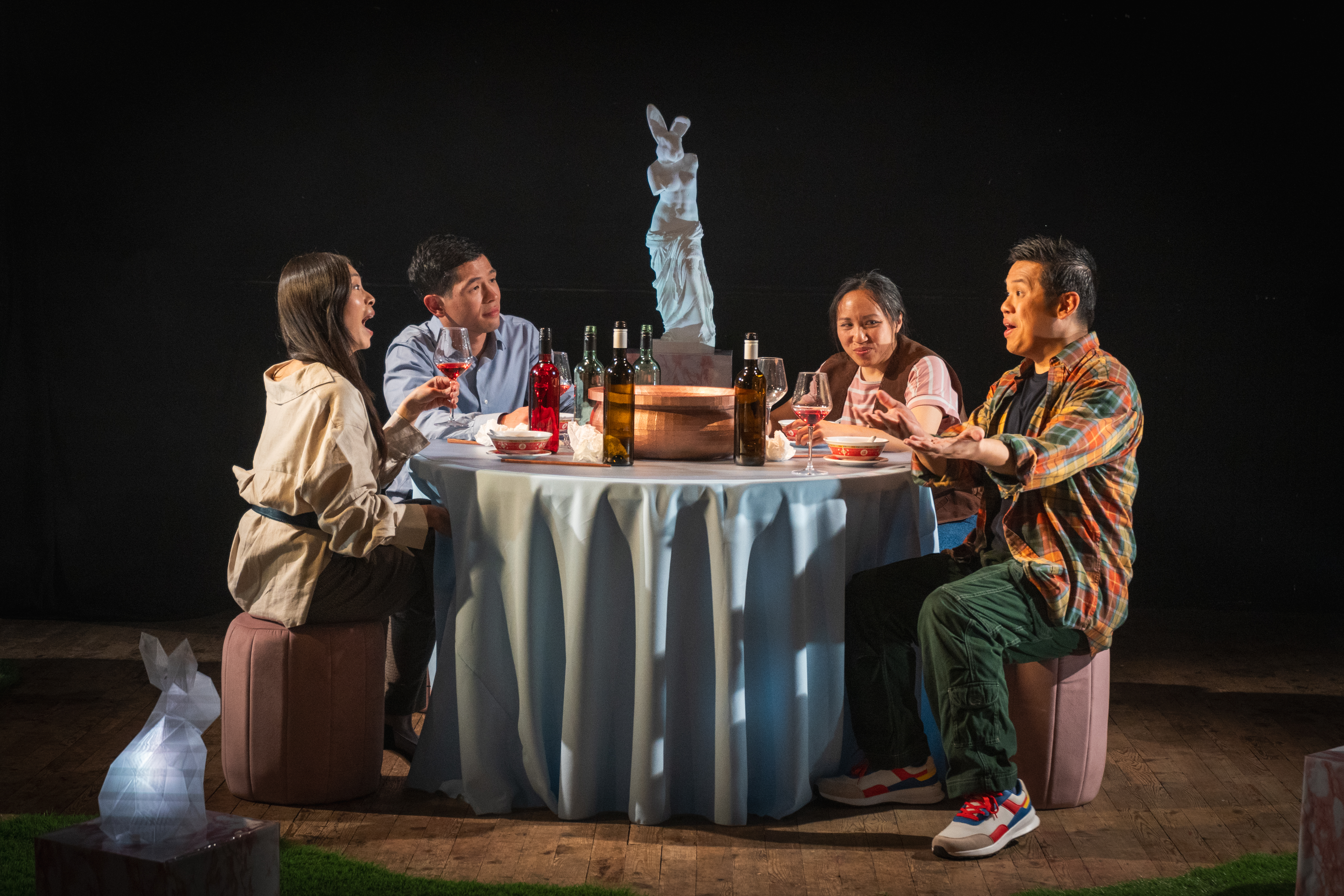
Hot pot is a social ritual in which conversation moves easily between past and present. Hot Pot captures that rhythm through the reunion of four Chinese friends. Ming is a gay man who married a woman, Mei is a married woman, Tao is a gay man preparing to marry an Englishman, and Lin is an unmarried woman. As they gather around the pot, their shared memories give way to more intimate accounts of their lives today.
❧
Written by Hongwei Bao, a distinguished UK scholar of East Asian queer studies, and produced by Auka Productions, Hot Pot speaks to Chinese audiences across a range of experiences.
Gay audience members may recognise the emotional and cultural pressures surrounding coming out, while women may recognise the delicate boundary between sisterhood and romantic intimacy. Heterosexual audience members may also identify with the tensions between love, marriage and the expectation of having children. In the friends’ conversation, these experiences illuminate how love, desire and family obligations intersect in contemporary Chinese society.

❧
The play’s cultural symbolism remains accessible to audiences unfamiliar with Chinese language and culture. Brief passages of Chinese dialogue are easy to follow in context. In one memorable scene, a character quotes the Chinese proverb “不孝有三,无后为大” and immediately renders it in English: “Of the three forms of unfilial behaviour, the greatest is leaving no descendants.” The audience hears the proverb in its original language and can grasp its significance as the conversation unfolds.
❧
One of the production’s greatest strengths is the way sound, scenography and lighting work together to give its cultural symbols emotional weight.
The sound design is particularly effective. Between scenes, the audience hears water boiling, a reminder of the hot pot simmering at the centre of the story. I also heard in that insistent sound the pressure of traditional Chinese family expectations on queer people who feel unable to come out. Each time the boiling returns, the tension between personal identity and patriarchal values makes itself felt again.
The scenography brings the production’s British setting and Chinese cultural context into conversation through the details of the meal. The friends drink red wine in place of traditional Chinese spirits, yet they observe Chinese drinking etiquette and play drinking games such as 划拳 (hua quan). For Western audience members, a familiar detail offers a way into the traditions and social expectations that shape the friends’ lives.
❧
At the centre of the stage stands a statue of Venus wearing rabbit ears. The ears evoke the Rabbit God, the Chinese deity associated with same-sex love, while the familiar figure of the Venus de Milo evokes Aphrodite, the Greek goddess of love. The statue’s missing arms take on a symbolic significance, suggesting the constraints that sexual minorities face. The image gives visual form to one of the play’s central ideas: love may be universal, but the freedom to express it is unevenly shared.
The lighting develops the Rabbit God motif through four rabbit-shaped floor lamps. Their colours shift with the emotional atmosphere of each scene. These subtle changes give the motif an emotional dimension, drawing the audience closer to the characters’ inner lives.

❧
For me, the most moving moment comes whenever one of the friends asks, “Are you happy?” Each of the four poses the question in turn. Its power lies in how differently it can be heard as one person gives voice to it and another listens. The question also reaches beyond the table, inviting each audience member to consider how expectations surrounding sexuality, gender, marriage and family have shaped their own pursuit of happiness. Through the particular experiences of its queer characters and their friends, Hot Pot explores love, belonging and the desire to live on one’s own terms.

How to cite: Li, Xunnan. “Around the Hot Pot: Love, Kinship and the Question of Happiness.” Cha: An Asian Literary Journal, 27 Nov. 2026, chajournal.com/2026/11/27/hot-pot-leeds.


Xunnan Li is Deputy Director of the Leeds Centre for New Chinese Writing and Lecturer in Performance and Cultural Industries at the University of Leeds. He trained as a Peking opera actor from an early age and brings a deep understanding of Chinese theatrical traditions to his research on neoliberal economic policies and the Chinese theatre industry. He previously managed an arts organisation and served as Artistic Director and Editor of The Theatre Times and the IOTF Theatre Festival.