
茶 FIRST IMPRESSIONS
茶 REVIEW OF BOOKS & FILMS
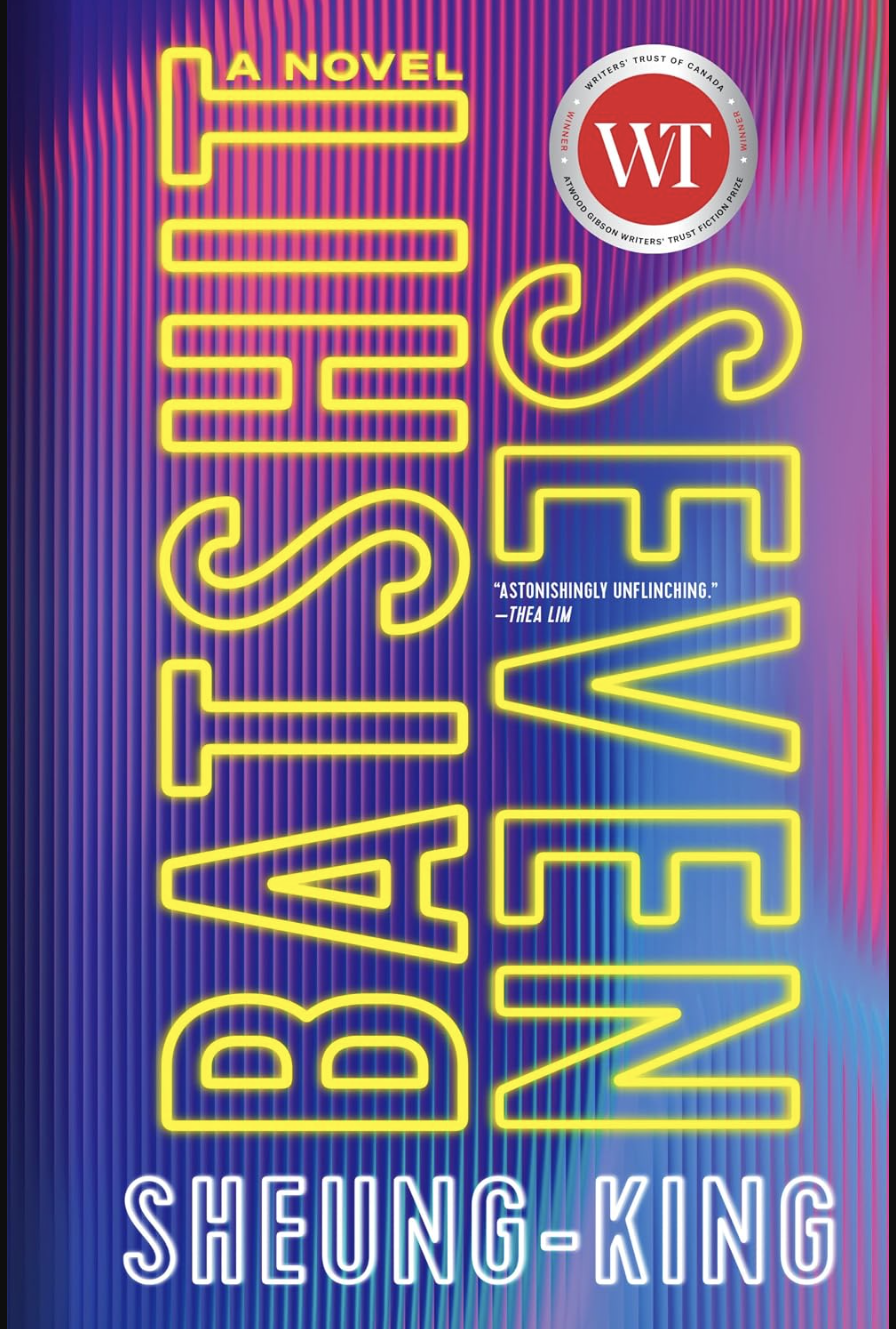
[ESSAY] “Contextualising Hong Kongese sorrows in Sheung-King’s Batshit Seven” by Stella Kwok
Sheung-King. Batshit Seven, Penguin Canada, 2024. 336 pgs.


You are home and homeless at the same time.
For a third-culture kid who grew up in Hong Kong, there is a particular kind of melancholy that comes with going back to visit. It is your penultimate day. You have just enough time to eat the fish siu mai with sweet soy once more, but not enough to return to the housing estate where you grew up. Your slang is outdated, you cannot even swear properly, and your grandma’s tong lau no longer exists. You are about to cross a major intersection, perhaps in Central, perhaps in Causeway Bay, as the lights come on at twilight. You look up at a sky carved up by tram lines and suddenly you are utterly alone amid this ever-moving mass of people. You are home and homeless at the same time. This was how I felt when I finished reading Sheung-King’s Batshit Seven.
❧
Batshit Seven weaves complex social commentary through the everyday ennui of Glue, a nihilistic youth from Canada who struggles to find work and purpose after returning to Hong Kong. Set in 2019 against the backdrop of the student protests, the novel follows Glue as he navigates his multiple cultural identities at a time when the city’s own identity is also in flux.
In truth our memories are Christopher Doyle-coloured.
Throughout the novel, Glue cannot shake the feeling that May, his friend with benefits, has stolen something from him. This sense of missing something that was never yours, and was never going to last, is a quintessentially Hong Kong emotion. As I write this review, the Cantonese diaspora is still reeling from The Weeknd’s new song “Hong Kong”, which samples a Faye Wong classic. The feverish revival of 1990s Cantopop has left some wondering why nostalgia holds Hong Kong people in so particular a grip. To call it nostalgia would imply that there is a preferable past to return to, but in truth our memories are Christopher Doyle-coloured. There is no “better” in the before and after of a post-colonial city. Whoever needed to move on moved on; whoever could not was left trapped between Lion Rock and a hard place.

❧
Being Hong Kongese means grappling with the desire to find narratives that contextualise your sorrows. It is difficult to articulate the feeling of existing on borrowed time, suspended between having been a colony of a former empire and becoming a city within one of the largest countries in the world.
A sorrow that needs contextualising demands the narrative of a doomed love, made gorgeous by its destined unattainability. So we romanticise it in Cantopop ballads, in Wong Kar-wai’s films, even in melancholic triad dramas.
To be Hong Kongese is to feel trapped between cultures, political systems and economic structures… It is to want to leave but also to find a reason not to leave… It is to feel heartbroken, to miss a past in which a better future was promised… All of this, Glue grew up thinking, was romantic. As a result, he decided to remain heartbroken.
This kind of heartbreak is as homegrown as silk-stocking milk tea, and we like it smooth, bitter and a little rough on the tongue.
❧
Speaking of tongues, Sheung-King captures with exceptional precision what it means to be caught in the no man’s land between languages and the personalities attached to them. The novel opens with Glue having to choose between working for his brother-in-law’s immigration consultancy and becoming an ESL teacher, both of which, in his view, are “self-orientalizing” under the colonial construct. With English fluency as his only skill as a CBC (Canadian-born Chinese), he is also mourning his lost proficiency in his mother tongue.
His Chinese is imperfect now, because he has not used it since he left for Canada at the age of eighteen. He can’t read simplified characters and cannot write traditional Chinese using any input system other than Pinyin, which requires nothing more than to use the English alphabet to simulate the sound of Chinese characters.
Glue is an ESL student, no language belongs to Glue. But poetry undermines linguistics. Though Glue can’t articulate this, it was one of the main reasons why, at a certain point in time, he wanted to write.
Word for word, this is why I chose poetry as my creative medium. I am ashamed to admit that, although I was formally educated in classical Chinese literature, I can no longer write a good line of it. For decades, beginning as a young adult in the US, I was convinced that the English language was not mine to create with. Despite my English degree, my essays were often graded “excellent analysis, but watch for syntax”. With no other means of expressing myself, I found success in the sterile safety of corporate correspondence, a third language that specialises in emotional detachment. I wonder whether that is why Glue switches to Chinglish in the latter part of the book. In embracing his in-between-ness, he is under no pressure to choose, has no conflict to resolve and leaves no room for introspection.
❧

As in his first book, You Are Eating an Orange. You Are Naked., the prose in Batshit Seven is sardonic, stoic and crisp. Sheung-King has a singular ability to write English novels with the rhythm and colour of Cantonese. The novel’s short chapters convey a sense of speed and fragmentation, a distinctly Hong Kong quality, creating a world in which everything is weightless and transient. His imagery is evocative, often juxtaposing poignant emotional breakthroughs with bodily functions, and tenderness with violence. I found myself thinking a great deal, for instance, about why Glue is perpetually either constipated or masturbating.
What is Glue holding in his guts? Perhaps a copious quantity of alcohol mixed with the guilt of privilege, repressed anger and uncontextualised grief? Glue is not white, yet he commits a violent crime and escapes with barely a slap on the wrist. He can afford to be philosophical about his ESL teaching job being “self-orientalizing”, yet even the best-educated locals will never have the same opportunity, simply because they were not educated abroad.
❧
The book never offers a direct view of the protests unfolding in the background. None of the characters is involved in the student movement, yet its aftermath is felt at the periphery. Glue, with his geographical mobility and privilege, has nothing personal at stake in these events. No battle here is truly his, and there is no point in taking sides. Yet he is unsettled, trapped in this liminal space, subsisting on beer and sex for some form of artificial release. Sheung-King writes of Glue, in a pivotal moment of clarity:
“You’re not thinking about what I stole, right? If that’s the case, you don’t need to worry about it. I promise you that whatever it is, it’s not something you really need to have.”
Glue thinks that is probably something that never belonged to him in the first place. All he can think about right now, lying face down on his pillow, with the butt plug still up his ass, is the Tung Chung MTR station that was completely destroyed, and of the police, in riot gear, patrolling the scene. The same station was fully fixed and functional the morning after.
❧
The bodily functions in the book, from constipation to sex to acts of violence, are, I would argue, a deconstruction of the collective grief and helplessness that permeate Glue’s world. It is safer to lose oneself in consensual submission than to make oneself vulnerable over a loss one can do nothing about. It is through the creation of an artificial distance, in body and mind, in language and culture, between what is said and what is left unsaid, that we as readers experience the full force of this particular flavour of uncontextualised sorrow.
Batshit Seven concludes with the arrival of COVID-19 and its aftermath. The pandemic arrives like a deus ex machina: the student movement is largely dismantled, Glue is not reunited with May for five years, and nothing is ever the same again. Glue eventually falls in line with the system, content with the cards he has been dealt. For what he has lost along the way, he still has no name.
How to cite: Kwok, Stella. “Contextualising Hong Kongese sorrows in Sheung-King’s Batshit Seven.” Cha: An Asian Literary Journal, 18 Nov. 2026. chajournal.com/2026/11/18/batshit-seven.


Stella Kwok is a third-culture kid raised in Hong Kong, Singapore and Los Angeles. Her writing explores bilingualism, multiple cultural identities and a lifelong pursuit of belonging. She is a writer by night, a product designer by day and a mother at all times. [All contributions by Stella Kwok.]