
茶 FIRST IMPRESSIONS
茶 REVIEW OF BOOKS & FILMS
[REVIEW] “The Madwoman in the Courtyard: Zhang Yimou’s Raise the Red Lantern” by Bea Phi
Click HERE to read all entries in Cha
on Raise the Red Lantern.
Zhang Yimou (director), Raise the Red Lantern, 1991. 125 min.


For millennia, the colour red has been regarded as auspicious in Chinese culture, signifying luck, wealth and happiness along with a host of other virtues. For Songlian (Gong Li), a nineteen-year-old girl in 1920s Republican China, however, its meaning could scarcely be more different. In Zhang Yimou’s 1991 period drama Raise the Red Lantern, recently restored and returned to cinemas, Songlian faces a difficult choice when the sudden death of her father bankrupts her family and robs her of her future. Unable to further her studies, she is instead compelled by her stepmother to become the fourth wife, or mistress, of Master Chen (Ma Jingwu), a wealthy man who lives in a colossal, opulent compound.
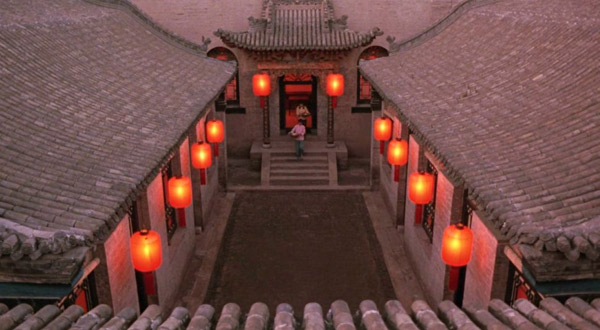
In reality, the compound once belonged to Qiao Zhiyong, a patriarch and financier of the Qing dynasty. Erected in the eighteenth century and lavishly expanded by him in the nineteenth, it displays the distinctive flair of northern Chinese architecture at its most maximalist: towering gates and walls of grey brick, ornate etchings and carvings, and elaborately decorated roofs with upturned eaves, spanning nearly a hundred thousand square feet and comprising more than three hundred rooms and some two dozen courtyards. Throughout this labyrinth, in Zhang’s film, red lanterns are hung and lit by Master Chen’s servants, dotting the premises with the supposed colour of good fortune. But for whom is it auspicious?
At first, Songlian appears to share in some of Master Chen’s luxuries. She has her own living quarters and her own maid, Yan’er (Kong Lin), and even has her feet occasionally massaged by servants. As she soon discovers, however, such treatment comes at the cost of her autonomy and dignity, instead contingent entirely upon which of the four wives Master Chen chooses for each night. Be chosen, and your red lanterns will be lit; your feet will then be massaged, your dinner will be replete with every delicacy your heart desires, and you will receive due deference from every maid along with Master Chen’s undivided attention. Be ignored, however, and you are nobody.
From beginning to end, Zhang never allows us a clear view of Master Chen’s face, which is always tucked away behind the camera or veiled before us. The words patriarch and patriarchy are but a single letter apart, and Zhang resolutely makes Master Chen the embodiment of the system writ large as he disappears into the magnitude and grandeur of the Qiao Family Compound whose lofty ceilings and cavernous rooms make his voice reverberate throughout, suggesting that he might be anywhere and everywhere at once. Even in panoramic, distant shots, Zhang struggles to capture the full enormity and oppressiveness of this apparent prison, though his camera still makes Songlian and the other women appear diminished, belittled, and barely discernible as they walk along its balustrades and through its quadrangles.
While Master Chen scarcely appears, Zhang instead trains his camera closely on each of the women, following them and their interpersonal politics as they begin to clash. Even in so vast and sprawling a compound, their competing presences prove too much for one another, particularly once Songlian’s defiant and scheming nature begins to throw everything into disarray. It is through these power struggles, magnified by Songlian’s rebelliousness, that Raise the Red Lantern is at its most treacherous and conniving, demonstrating not merely the force of patriarchy as directly imposed by men but also how their depravity can indirectly turn women against one another.
From the outset, Songlian is at odds with Yan’er, the one woman she can toy with and, in so doing, feel empowered. Yan’er, in turn, resents Songlian, believing that she has usurped her place as fourth mistress, and quietly seeks to supplant her. Meanwhile, the second mistress, Zhuoyun (Cao Cuifen), ingratiates herself with Songlian and warns her about the third mistress, Meishan (He Saifei), who may feel threatened now that she is no longer the youngest. Later, however, Meishan tells Songlian that Zhuoyun once tried causing her to miscarry while they were both pregnant, thereby exposing the deceit and malice behind her cordial appearance. Bearing Master Chen a son, Meishan then suggests, is the true means of being recognised by him above the rest. After all, the first mistress, Yuru (Jin Shuyuan), bore him a son decades ago, allowing her to remain secure in her standing no matter how fiercely the other mistresses vie for power.
Songlian therefore resolves to feign pregnancy, a last-ditch attempt to draw closer to Master Chen and undercut the other three mistresses. From then on, chaos ensue the compound as each woman takes part in a total war waged through trickery and deceit, secrets kept by some and exposed by others, and alliances brokered and broken. But to what end? Most horrifying of all is that for all their efforts, the women have achieved nothing but to destroy one another one by one. In the aftermath, Master Chen’s life goes on, and his ways merely repeat themselves. When a fifth mistress eventually arrives and has her feet massaged for the first time, she gazes out from her living quarters and asks about the madwoman in the courtyard: a defeated Songlian, wandering about in her schoolgirl clothes, driven insane by all that has transpired.

Particularly in the West, it can be easy to regard Zhang first and foremost as a filmmaker of engrossing visual spectacle. Faced with the gorgeous images he brings to the screen, many critics have succumbed to the temptation to exoticise his work, whether in the colourful, high-flying combat of Hero (2002) and House of Flying Daggers (2004) or in the monochromatic Shadow (2018), which recalls ink calligraphy. Alongside those of his fellow Beijing Film Academy alumnus Chen Kaige, Zhang’s films typify the Fifth Generation of Chinese cinema in their rendering of pre-Communist Chinese history through astonishingly elegant compositions, and Raise the Red Lantern, decades later, still stands out as one of his finest examples of this approach.
But for whom is Raise the Red Lantern beautiful? However easy it may be to lose oneself in the vividness of its reds and the awe of its architecture, one cannot forget the crushing weight of its horror and social critique. Here, many positive markers of Chinese culture, whether the lighting of red lanterns or the splendour of the Qiao Family Compound, are turned on their heads, revealing the ways in which misogyny has been laid into the very foundations of Chinese civil society. It is little wonder, then, that the Chinese government temporarily banned Raise the Red Lantern upon its release in 1991. Although no official reason has been given, many have read the film as a critique not merely of an older, antiquated feudalism but of present-day authority in China as well.
On revisiting Zhang’s film, one finds it hard indeed to regard it as merely a period drama from a bygone age. Rather, the despotism that Raise the Red Lantern scathingly depicts remains ever present, drawn out by Gong’s legendary performance which established her as a Chinese actress of international renown in 1991. Whether in Raise the Red Lantern or in Zhang’s other films about the harsh lives of women in twentieth-century China, such as Red Sorghum (1987), Ju Dou (1990) and The Story of Qiu Ju (1992), her acting continues to stand in for the countless women throughout history whose stories have not been heard. How many women like Songlian were disappeared behind the lofty gates and walls of compounds such as Master Chen’s? Even as Zhang’s camera remains high and remote in the final scene, gazing down on her as she drifts aimlessly through the courtyard of another century and another China, the truth of her pain still reaches us across the decades and will forever remind us of untold suffering.

How to cite: Phi, Bea. “The Madwoman in the Courtyard: Zhang Yimou’s Raise the Red Lantern.” Cha: An Asian Literary Journal, 1 Nov. 2026, chajournal.com/2026/11/06/raise-lantern.


Bea Phi is a Vietnamese-American editor and film critic based in Brooklyn. [All contributions by Bea Phi.]