
茶 FIRST IMPRESSIONS
茶 REVIEW OF BOOKS & FILMS
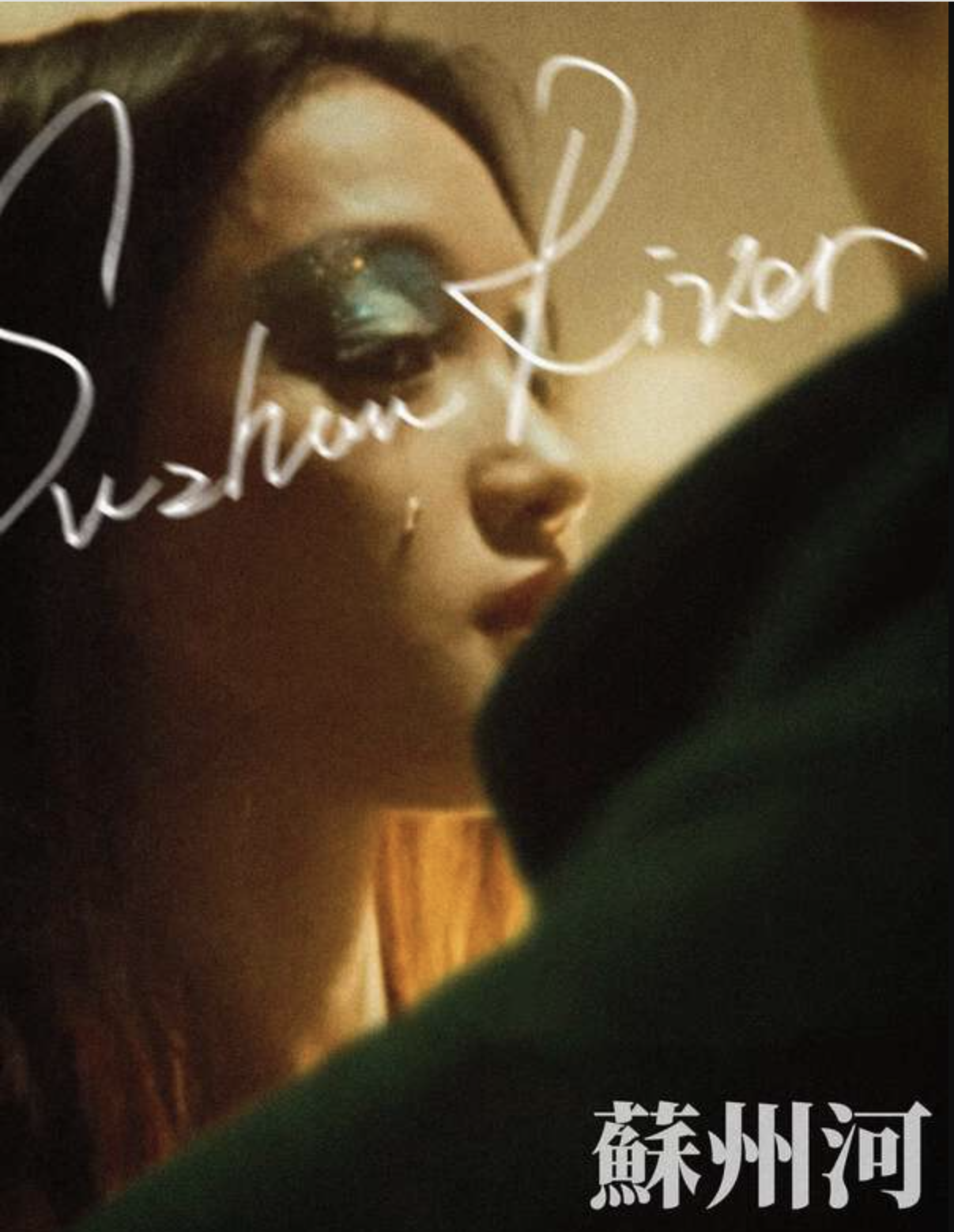
[ESSAY] “A Tale of Two Suzhou Rivers” by Bea Phi
Lou Ye (director). Suzhou River, 2000. 79 min.


Recently curated by Kogonada for the Metrograph in Manhattan, Lou Ye’s 2000 film Suzhou River opens through the viewfinder of a handheld camera held by a Shanghai videographer (Zhang Ming Fan). Through its lens, we find ourselves on a boat drifting along the Suzhou River, the most polluted river in nineties China, where we glimpse rubbish bobbing in murky, black waters; high-rises and smokestacks made ghastly by thick smog; and construction workers perched on hollowed-out edifices reduced to nothing but steel skeletons. Are they putting up new buildings, or tearing old ones down? In the distance, the Oriental Pearl Tower looms ominously, newly erected in 1994 as China’s beacon of the future; yet from where we stand, its promise appears distant and obscured, hidden from those further below on boats, docks and embankments.
Laden with post-industrial melancholy, our excursion down the Suzhou River is immediately punctuated by a question: “If I leave you someday, would you look for me?” It is posed by Meimei (Zhou Xun), the videographer’s girlfriend, who dresses every night as a mermaid in a blonde wig and swims in a fish tank at a club called the Happy Tavern. Leaping through time, as Lou frequently does in Suzhou River, the film then doubles back to the couple’s first meeting, when the videographer is hired to record her. From then on, they begin seeing each other, and through his footage we witness their day-to-day life together in the lonesome, run-down parts of Shanghai. Sometimes, however, Meimei inexplicably vanishes for days at a time, leaving him waiting for her return.


As we learn, Meimei’s question stems from an urban legend that the videographer goes on to recount, one involving a Shanghai courier named Mardar (Jia Hongsheng) and his affair with Moudan (also Zhou), the daughter of a liquor importer. Whenever Moudan’s father wishes to spend an evening alone with one of his mistresses, he hires Mardar to whisk Moudan away on his motorcycle to stay with her aunt. In time, the two fall in love, spending some evenings out and others at his flat, but their time together is soon imperilled when Mardar suddenly becomes an accomplice to a kidnapping, reluctantly taking Moudan hostage. Although her father does pay the ransom, the paltry sum of 45,000 yuan leaves Moudan feeling undervalued, prompting her to run away and leap into the Suzhou River. Despite Mardar’s efforts to find her, she is never seen again.

❧
The Suzhou River is what unites the two tales: the romance of Meimei and the videographer, and the tragedy of Mardar and Moudan. Both are sad, surreal and made wholly of the stuff of dreams, much like the river itself, which seems at once a character in its own right and a synecdoche for Shanghai’s dark side. “There’s a century worth of stories here,” the videographer says, “and rubbish.” By 1998, the year Lou shot the film, the Suzhou River had been incessantly polluted since the 1910s, choked with the excesses of development and blackened by all its waste. The industrial neighbourhoods along its banks, too, had recently fallen lifeless: once bustling with hundreds of textile factories employing hundreds of thousands of workers, they were emptied by the restructuring of state-owned enterprises in the nineties, which brought widespread lay-offs across Shanghai and left many buildings along the Suzhou River abandoned.
Part romantic tragedy, part noir set in this ghost town of Shanghai, Lou’s film immediately established him as one of the finest directors of the Sixth Generation of Chinese cinema, an often-censored movement largely characterised by gritty, edgy social realism exposing the ills of government and the woes of civil society; low-budget, amateur filmmaking devoid of studio polish; and individual rather than collective, nationalist forms of expression. Suzhou River excels as an arthouse film possessing all of these qualities. The videographer’s rough-hewn first-person point of view offers one of the most damning, lifelike portraits of China’s post-industrial despair committed to film in the nineties, rivalled only by the work of similarly esteemed peers such as Jia Zhangke and Wang Bing, and one could almost mistake it for a documentary.
❧
Yet Suzhou River is more than a mere political statement or mood piece attuned to the doom and gloom of nineties Shanghai. A magnificent story is still unfolding by the river, too, as we suddenly discover that Mardar is no urban legend after all. Having served time in prison for the kidnapping, he returns to Shanghai, still working as a courier, still searching for Moudan. One night, he stumbles upon the Happy Tavern and, on seeing Meimei in her mermaid costume and blonde wig, naturally believes her to be Moudan. Through twists and turns best left undisclosed, the two tales then begin to merge chaotically, provoking an anxious uncertainty not merely about the obsessive loves of two lonely men but also about the very nature of truth itself.
For this reason, Suzhou River is often likened to the psychologically thrilling, mind-bending spirit of Alfred Hitchcock’s Vertigo (1958), as well as to the aesthetics of urban alienation found in Wong Kar-wai’s pre-Handover studies of Hong Kong. To offer a more contemporary example, Bi Gan’s 2015 debut Kaili Blues also comes to mind in its treatment of the modern Chinese city: part downbeat and ghostly, part dreamy and poetic. For the most part, however, Lou’s Suzhou River still lingers hauntingly in a league of its own, combining dreary cityscapes, charming romances, unreliable narrators, multiple realities and versatile camerawork in a taut seventy-nine minutes without once missing a beat or failing to engross us in its bizarre mystery.

❧
Tying together Lou’s brilliance in Suzhou River is an equally brilliant performance by Zhou in her breakthrough role. Just as a doppelgänger unsettles the reality of Vertigo, she too drives us to distraction by making us guess whether Moudan and Meimei are one and the same: as the younger Moudan, she appears light-hearted and innocent, nursing a fairy-tale fantasy of romance kindled by Mardar; as the older Meimei, however, she seems largely jaded and aloof, the light gone from her eyes even when she appears to be enjoying herself. By making them seem different at some moments and the same at others, Zhou displays an extraordinary, inexhaustible range of both emotions and possibilities in what remains an unforgettable performance decades later. For it, she won Best Actress at the historic Festival du Film de Paris, after which the Chinese media crowned her one of the Four Dan Actresses, alongside Zhang Ziyi, Xu Jinglei and Zhao Wei.
In the end, Suzhou River returns us to the waters of its namesake with its conundrums still unresolved, leaving us with an emptiness deep within that we share with both the videographer and Mardar, a feeling all too fitting for their time and still for ours. From that void, we sense the loss of what once was but can never be again, yet at the same time our imagination races ahead to what the future might hold: the chance of meeting again, the opportunity to begin anew. Though stylistically bleak, Suzhou River neither resigns itself to pessimism nor pivots cheaply to optimism. Instead, it holds the door open to anything and everything, leaving it to us to decide what to think and feel when all is said and done. Somehow, the weight of that responsibility feels even more crushing.
❧
“If you watch it long enough, the river will show you everything,” the videographer says at the very beginning. “It will show you people working, it will show you friendship, families, love, and loneliness as well.” Even decades later, the Suzhou River continues to offer the image of a Shanghai in flux, for better or for worse. In 1998, when Lou shot Suzhou River, the city finalised its plans for the Suzhou Creek Rehabilitation Project, a multi-year effort not only to clean up the river itself but also to revitalise the decrepit areas along its banks. In the new millennium, old industrial buildings came down as new apartment blocks rose, and pedestrian walkways and green spaces were laid along the waterfronts of a river now far cleaner than it had been for the whole of the preceding century.
Meanwhile, artists were beginning to devise their own plans to renew the Suzhou River. In 1998, the Taiwanese architect Teng Kun-yan rented a disused granary overlooking its waters at 1305 South Suzhou Road and converted it into a studio and workshop, thereby launching a movement in which many underground, experimental artists flocked to the industrial neighbourhood to follow suit. By 2000, when Lou premiered Suzhou River to great acclaim at the International Film Festival Rotterdam, Xue Song, a figurehead of Chinese Pop Art and the New Shanghai School, had famously transformed a textile factory at 50 Moganshan Road into a studio whose unprecedented scale offered a glimpse of the industrial neighbourhood’s twenty-first-century future.
Still, the Suzhou River’s new lease of life for artists was hard-won. In the same year that Xue moved in, the artist Ai Weiwei and the curator Feng Boyi mounted an exhibition nearby called Bù Hézuò Fāngshì (Chinese: 不合作方式; literally “Uncooperative attitude”), better known in English as Fuck Off. Held at the Eastlink Gallery, itself a former granary, it showcased protest art by forty-eight artists and included some of Ai’s most iconic photographs still revered today: one in which he raises a middle finger to the White House and the Forbidden City, and another in which he drops a Han dynasty vase. Upon opening, the gallery was ransacked, censored and shut down by the Chinese government; at the same time, the authorities banned Lou from filmmaking for two years and prohibited Suzhou River from being screened.

In the early 2000s, the Chinese government even sought to demolish and redevelop the arts quarter around the Suzhou River entirely, intending to replace its studios with luxury residential properties. Artists, architects and activists swiftly rallied to ward off these plans and defend the industrial neighbourhood’s history and heritage, prompting the government instead to designate a new arts district around the Suzhou River called M50, after Xue’s address. Home to hundreds of studios, galleries, designers and other arts organisations, M50 in its early years bore comparison with the heyday of Lower Manhattan’s SoHo from the sixties to the eighties. The artists of the Suzhou River had triumphed at last.
❧
But as Suzhou River reminds us, things cannot always stay as they are, at least not here. In modern-day Asian cities such as Shanghai, perpetually at the mercy of change at breakneck speed, everything is forever at risk of disappearing: a person, a building, even a memory. By the 2010s, many galleries had already left M50 for newer, more developed corners of Shanghai’s art scene, such as the West Bund along the Huangpu River, and less established artists on the fringes of contemporary art have since been priced out of what was once a mecca for the avant-garde. Now gentrified, even M50 seems upmarket and commercialised, a place for luxury shopping rather than for the rebellious art of dissidents like Ai and Lou.
Just as some parts of the Suzhou River soon became unrecognisable from what Lou first captured in 1998, there is no telling what the river might look like a decade, a year or a month from now, or even tomorrow. At present, the architecturally ambitious Tian’an Sunshine Plaza is under construction at 600 Moganshan Road, neighbouring M50, and will soon raise a thousand concrete columns, crowned with trees and filled with shopping centres and art installations, right beside waters once polluted and destitute. Still, it will always be the Suzhou River: a place of countless stories longing to be told, like the one in which a girl once leapt to her death, or the one in which two lovers were once pulled from its waters by the police, or the one in which a videographer once fell in love with a mermaid sitting on a muddy bank, combing her golden hair, or so he tells us. Whether he was telling the truth about any of these, we still do not know, and perhaps never will.
How to cite: Phi, Bea. “A Tale of Two Suzhou Rivers.” Cha: An Asian Literary Journal, 4 Nov. 2026, chajournal.com/2026/11/04/suzhou.


Bea Phi is a Vietnamese-American editor and film critic based in Brooklyn. [All contributions by Bea Phi.]