
[ESSAY] “On the Edge, Revisited” by Margaret Hillenbrand
Click HERE to read an excerpt
from On the Edge.
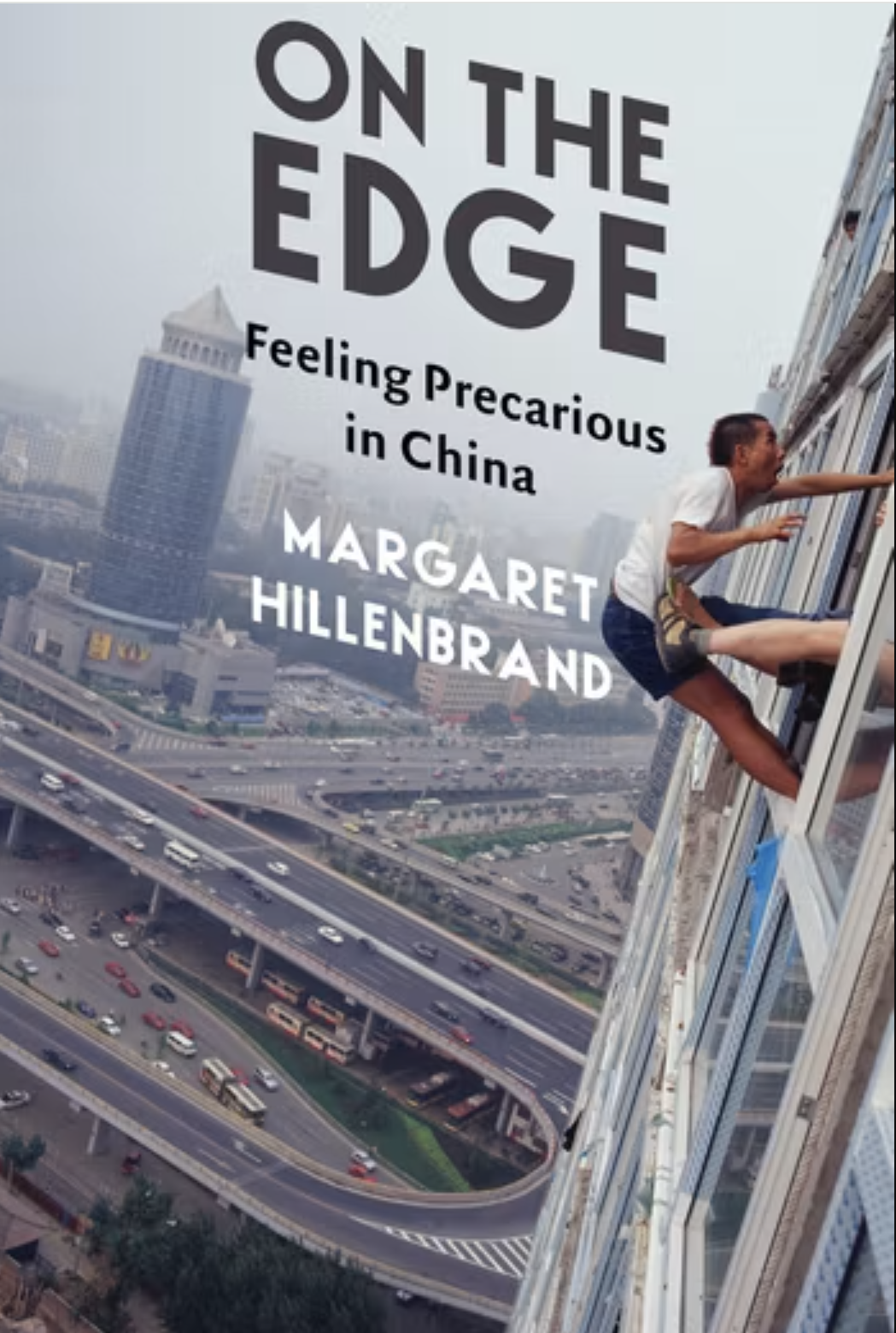
Margaret Hillenbrand. On the Edge: Feeling Precarious in China, Columbia University Press, 2023. 408 pgs.


My book, On the Edge: Feeling Precarious in China, investigates precarity in contemporary China. Spanning the period from the early 2000s to the eve of the pandemic, it argues that a vast underclass of Chinese workers exists in “zombie citizenship”, a realm of dehumanising exile from the law and its safeguards. This condition, the book contends, is contagious: many others in seemingly safer circumstances feel the chill of imminent expulsion from security and comfort. On the Edge focuses on a range of volatile cultural forms, from livestreaming apps to performance art, through which people on the brink give vent to their fear and rage at a life without guardrails.
On the Edge was published in late 2023, although the research behind it had, of course, been conducted several years earlier. The book went into production in early 2023, at around the same time that ChatGPT reached 100 million active users in January of that year, a milestone it attained barely two months after its launch. Looking back on the book now, I cannot help wondering whether I would have written it differently had LLMs already stormed the citadel and had the term “AI underclass” already entered common parlance.
Indeed, even before the book had gone into production (though too late for me to make any further changes to it), I had already begun closely following an upsurge of media reports and personal narratives about the worsening predicament of digital gig workers in post-Covid China. Their plight alone led me to suspect that the ambit of “zombie citizenship”, as I had defined it, might be too narrow. The accelerated platformisation of Chinese society since the pandemic has created, for example, a vast workforce of food-delivery riders at the mercy of opaque algorithms that compress delivery windows, route them perilously through traffic, encourage speeding, penalise them for lateness, and drive down pay rates.1 Some of these workers are lured into predatory financing arrangements to acquire the vehicles and equipment they need for their work,2 and must vie with one another for a limited number of jobs.
❧
If platformisation spreads underclass conditions outwards, drawing ever more workers into algorithmically policed labour, AI pushes that plight upwards into previously safer demographic groups. Entry-level white-collar hiring is increasingly constricted as AI takes over the routine coding, data-entry, and customer-service tasks through which new employees once began their corporate careers.3 In one notorious recent case in Hangzhou, a worker employed to review and correct the outputs of an LLM found himself displaced when the model he had helped to refine learned to do his job.4 And as AI reaches ever deeper into once-secure white-collar occupations, China’s already vast realm of unstable flexible employment looms below.5 New cohorts of digital labourers (shuzi mingong 数字民工) have emerged: data labellers, content scrubbers, or click workers whose cognitive faculties are mined as they toil for a pittance at repetitive tagging tasks, only to be readily discarded as training needs change.6 They describe themselves as “hot-swappable” (rechaba 热插拔) components, performing “work that turns people into machines in order to make machines become like people”.7
In a short span of time, the entrenchment of the digital gig economy and the rise of the synthetic intellect industry have both deepened and widened social jeopardy in China. So swift has this momentum been that it compels us to revisit the famous remark attributed to Lenin: “there are decades where nothing happens; and there are weeks where decades happen”. Perhaps we must now reckon with the notion that AI time has dialled up the speedometer so violently that there are years in which centuries happen.
These changes have heightened the culture of fear and friction that I discussed in On the Edge: from clashes between delivery riders and security guards on city streets to far more violent forms of lashing out. In October 2026, the New York Times reported on how “China’s Stressed People Are Starting to Turn on Each Other”.8 This is because platformisation and AI alike intensify a culture of hyper-competition. Human-to-human rivalry, as much as code, constitutes the basic operating system of both: the winner-takes-all dynamic of engagement metrics, the sink-or-swim logic of the planetary talent pool, the scramble to stand out in AI-saturated content markets. Researching and writing On the Edge often left me feeling bleak. Yet the cliff edge now looms so much closer, for so many more people, that 2018 feels almost like an age of innocence.
❧
Wherever it arises, precarity means disposability, casualisation, and workfare rather than welfare. In On the Edge, I examined how China’s most precarious people have endured all this and worse since the turn of the millennium, pincered between the twin regimes of hukou (household registration) and suzhi (human quality). These mechanisms of social sorting specifically targeted rural-to-urban migrants during the long peak of China’s rise. Today, the state is actively seeking to reform hukou policies (albeit with limited success thus far), while some scholars argue that suzhi may be losing its primacy as an instrument of social sorting.9 Yet capitalism, as we know, abhors a vacuum. Over the past few short years, platformisation and AI have emerged as new and mercilessly effective mechanisms for classifying, evaluating, filtering, and excluding ever broader swathes of people.
In On the Edge, I argued that China had for years been excluded from discussions of precarity, even though Chinese experiences of what it means to feel precarious were globally germane. In many respects, this omission formed part of a far broader pattern in both media and academic accounts of China. As Nicholas Loubere and Ivan Franceschini put it: “Is China part of the world? Based on much of the political, media, and popular discourse in the West the answer is seemingly no”.10 The past three years have made this specious view increasingly difficult to sustain.
To say this is not to deny that the kind of social vertigo I explored in On the Edge was, in certain ways, a local phenomenon. It was shaped by hukou and suzhi; by the strategic silencing of class as a category of political action in China, even as a de facto caste system has hardened; and by the immense governmental power wielded by the Chinese state, a power that inevitably bears down on the most absolutely on the most vulnerable. These distinctly Chinese experiences mattered globally, I believed at the time, because they were not merely about precarity. They were object lessons in precarisation (the process whereby power forcibly vulnerabilises its subjects), and their relevance extended everywhere.
The entrenchment of platformisation and the rise of AI are now globalising that process. Yet in doing so, they are also revealing the many ways in which code mimics authoritarian power, even in places that do not regard themselves as authoritarian. Algorithmic governance hires, fires, and wage-throttles. It exempts powerful actors from obligation and accountability. It generates “surplus” populations and then expels them. And as authoritarian forms of power become as much computational as political, they render civic peril all the more menacing, precisely because they are so methodical.
Were I to write the book again, then, I would pace and structure it differently. The chapters that form its backbone would instead serve as a steady build-up to a long culminating chapter, one that would tell the story of how platformisation and AI are building on existing mechanisms of sorting and expulsion in China to become pitiless agents of precarisation. At the heart of that chapter would be the cultural forms these agents are stirring into life: modes of art arguably even more inventive than the breakout forms I discussed in On the Edge, such as suicidal performance on the rooftop or predatory performance art on the street.
❧
I shall close this piece by offering two examples of the kinds of innovative cultural forms that I would explore if I could rewrite the book now. On 22 December 2025, an unusual street protest erupted in the city of Changsha. The trigger was a seemingly trivial moment of urban strife: a security guard barred a delivery rider from riding his electric scooter into a residential compound to deliver an order, after the residents’ committee had ruled that delivery riders could enter the compound only on foot. The rider was reluctant to comply, because platform algorithms penalise late deliveries and delivering on foot consumes extra time. He knocked the security guard down with his scooter, and the incident escalated as other riders, alerted via WeChat, rode to the scene in a show of camaraderie. Riot police were dispatched to disperse the gathering and “maintain stability”. Later that night, however, several hundred riders reassembled, driving around in a daring cavalcade until 5am, honking their horns, flashing their headlights, and shouting “uprising” (qiyi 起义).11
Several aspects of this episode are striking. The first is that algorithmic control fuels not merely human-to-human friction but outright aggression on the street between two people in high-risk, low-paid jobs. The second is the raw creative force of the riders’ response. Observers likened it to a form of “performance art”, a “grassroots carnival”, even an “Olympic opening ceremony”.12 There is unquestionably something mesmerising about the footage of the bikers: the speed, the noise, the skilled co-ordination, the latent violence. Like the cliffhangers in the extract from my book above, the riders are engaged in extreme embodied edgework; and, as with the cliffhangers, this edgework constitutes a freshly minted, high-stakes mode of political protest. Yet unlike the creative pushback against precarity that I explore in On the Edge, the riders came together in an act of spontaneous solidarity. Conservative estimates put the number of delivery and courier riders in China at 14 million. For a few exhilarating hours, the Changsha bikers became the face of that vast cohort of precarious people, suggesting that their identity might yet become a collective one. Their performance, improvised in less than a day, arose directly from the time compression that so ruthlessly structures their lives.
The second example I wish to discuss concerns another grassroots, creatively charged act of pushback, this time against generative AI. In March 2023, the creative fan-art platform LOFTER launched a built-in AI image generator without warning. The reaction amongst users was instantaneous and furious. They deleted their accounts, removed their artworks from the platform, and started an #AntiAI hashtag on Weibo that garnered approximately 90 million views in under six hours.13 At first glance, this form of protest seems to belong to the same category of dissent as the “lying flat” (tangping 躺平) and “let it rot” (bailan 摆烂) counter-cultures that have emerged in China in recent years, which play on the paradox of mobilised apathy. Yet the LOFTER protest is more highly charged.
This is partly because, as a long-established and close-knit creative community, the fan-artists on the site possess a cohesive identity and presence, quite unlike those lying flat and letting it rot, who form a far more amorphous and scattered group. As Jiaru Tang and Xiyao Liu observe, it was the fan-artists’ deeply held community norms that the platform began to trample when it introduced an AI image generator.14 The new feature appeared to turn their unpaid creative labour into raw material, thereby extending the logic of extraction and disposability to a new group. As with the riders’ cavalcade, tech predation pushed a pre-existing esprit de corps into a sharper, more self-aware formation. In this sense, the LOFTER protest may be understood as an instance of what Kuba Szreder calls “productive withdrawals”: art strikes or boycotts that “invigorate ways of practicing and thinking about art by revamping existing infrastructures and giving shape to new institutional assemblages [which] … sustain art as a practice of freedom”.15
It is also worth considering the particular visuality of this creative withdrawal. Terms such as “withdrawal”, “deletion”, and “removal” imply the replacement of presence with absence, a shift from creative something to creative nothing. The screenshot below shows that this is far from the case. Here, multiple users have replaced their content with the “NO TO AI GENERATED IMAGES” poster, the globally recognised digital badge of the anti-AI-art movement, created by Alexander Nanitchkov in late 2022. On his Instagram account, Nanitchkov writes: “everyone can use this image”, a gesture of voluntary sharing that renders the platform’s threat of appropriation all the more jarring.16 By replacing their creations with Nanitchkov’s logo, the fan-artists help to build this emergent “institutional assemblage” of anti-AI protest. Moreover, the switch from artwork to logo does not entirely strip the site of content: rather, it creates a palimpsest, a surface scored over with different histories. One user in the screenshot has in fact left their work intact, thereby making visible the layered historicity of the platform and the before and after of AI implementation. Meanwhile, the fan-artist in the top left-hand corner literalises this idea of the palimpsest by applying the strikethrough function to the platform’s professed mantra: “LOFTER protects various intellectual property rights held by its users. The intellectual property rights of all the original works you publish on LOFTER are yours”.

Screenshot of the LOFTER protest
In other words, the users of LOFTER, like the Changsha couriers, experienced the corrosive suction power of rule by code. On the Edge explored the fact and fear of zombie citizenship among people exiled from a legal system that purports to uphold their rights. By contrast, the fan-artists of LOFTER and the riders of Changsha are linked less by precarious legal status than by their forced enmeshment in a system that either harvests them or squeezes out their value and discards the husk left behind. Tellingly, both responded to this experience of extraction creatively. The fan-artists, already seasoned makers of content, embraced new understandings of what making means as the platform betrayed their trust, while the riders who swarmed in tight formation through the streets of Changsha coined a fresh idiom of protest. Of course, more conventional forms of artistic expression persist amongst people wrung out by algorithmic governance, and much of it is compelling. Hu Anyan’s 胡安焉 I Deliver Parcels in Beijing (Wo zai Beijing song kuaidi 我在北京送快递, 2023) and Wang Jibing’s 王计兵 Low Flight (Dichu feixing 低处飞行, 2024), works of memoir and poetry respectively about life as a courier, are standout examples. But if I could write my book again, I would seek out the breakout case studies: the pressure points at which novel modes of creative reckoning are erupting.
Footnotes
- Hui Huang, “The Food Delivered Is More Valuable Than My Life: Understanding the Platform Precarity of Online Food-Delivery Work in China”, Journal of Contemporary Asia 53, no. 5 (2023): 859-861. ↩︎
- Zhongguo Youchu Yinhang 中国邮储银行 [Postal Savings Bank of China], ““Liangsi liangyuan” jinrong fengxian tishi” “两司两员”金融风险提示 [Financial Risk Warning for “Two Types of Firms and Two Types of Professionals”], 4 June 2026, https://www.ghbank.com.cn/sy/ztzl/xfzqybh/jrzs_1/202606/t20260604_1027676.html. ↩︎
- Zhang Rong 张蓉, Shen Lin 沈琳, Tang Junyao 唐骏垚, and Jiang Xinru 蒋欣如, “Cong “renji zhi zheng” dao “renji xiezuo”: rengong zhineng dui jiuye de xin yi lun chongji diaocha” 从“人机之争”到“人机协作”:人工智能对就业的新一轮冲击调查 [From “Human-Machine Competition” to “Human-Machine Collaboration”: An Investigation into the Latest Round of AI Impact on Employment], Zhejiang Zaixian 浙江在线, 21 July 2026, https://zjnews.zjol.com.cn/zjnews/202607/t20260721_31798950.shtml. ↩︎
- Chen Shiyu 陈诗雨 and Qin Jianxing 覃建行, “AI tidai gangwei nengfou chengwei jiangxin jieyue de liyou? Hangzhou fayuan zheyang pan” AI替代岗位能否成为降薪解约的理由?杭州法院这样判 [Does AI Job Replacement Constitute Grounds for Cutting Wages and Termination? A Hangzhou Court’s Ruling], Caixin, 29 April 2026, https://china.caixin.com/2026-04-29/102439348.html. ↩︎
- Research by Chen et al. finds that “more educated, higher paid, white-collar occupations [are] the most exposed to LLMs” in China today. See Qin Chen, Jinfeng Ge, Huaqing Xie, Xingcheng Xu, and Yanqing Yang, “Large Language Models at Work in China’s Labor Market”, China Economic Review 92, no. 102413 (2025): 2. ↩︎
- Huang Hui 黄晖, “Zhineng zhizao ganyuan: rengong zhineng xunlian de laodong zuzhi xingshi yu kongzhi celüe” 智能制造甘愿:人工智能训练的劳动组织形式与控制策略 [AI Manufacturing Consent: Forms of Organising Labour and Control Strategies in AI Training], Shehui 社会 45, no. 2 (2025): 12. ↩︎
- Huang Hui, “Zhineng zhizao ganyuan”, 13, 25. ↩︎
- Helen Gao, “China’s Stressed People Are Starting to Turn on Each Other”, New York Times, 2 October 2026, https://www.nytimes.com/2026/10/02/opinion/china-anger-economic-frustration.html. ↩︎
- Carwyn Morris, “Spatial Governance in Beijing: Informality, Illegality and the Displacement of the “Low-end Population””, The China Quarterly 251 (2022): 838. ↩︎
- Nicholas Loubere and Ivan Franceschini, Global China as Method (Cambridge: Cambridge University Press, 2022), 1. ↩︎
- Li Muzi, “Changsha Delivery Drivers Take to the Streets as Grassroots Anger Boils Over”, Vision Times, 23 December 2025, https://www.visiontimes.com/2025/12/23/changsha-delivery-drivers-take-to-the-streets-as-grassroots-anger-boils-over.html; Wang Zhi’an 王志安, “Delivery Riders Ignite an All-Night Protest in Changsha: Rights Defense or Public Disorder?”, YouTube video, 24 December 2025, https://www.youtube.com/watch?v=WE0Pst4ctbI. ↩︎
- Li Yun 李韵 and Qiu Yue 邱越, “Zhongguo Changsha qishou qunti kangzheng “huangpao jiashen” fan baozheng” 中国长沙骑手群体抗争“黄袍加身”反暴政 [Changsha Riders Protest: “Wearing the Yellow Robe” to Oppose Tyranny], Xin Tangren dianshitai 新唐人电视台 [New Tang Dynasty Television], 26 December 2025, https://www.ntdtv.com/gb/2025/12/26/a104050117.html; Li Muzi, “Changsha Delivery Drivers Take to the Streets”; Wang Zhi’an, “Delivery Riders Ignite an All-Night Protest in Changsha”. ↩︎
- Hayley Zhao, “Creatives in China Are Pissed About Lofter’s A.I. Art Generator”, Radii.co, 10 March 2023, https://radii.co/article/lofter-under-fire-as-creators-protest-ai-art-generators. ↩︎
- Jiaru Tang and Xiyao Liu, ““NO TO AI GENERATED IMAGES”: Fan Art Creators Contesting AI Integration on Social Media Platforms”, Media International Australia 197, no. 1 (2025): 143. ↩︎
- Kuba Szreder, “Productive Withdrawals: Art Strikes, Art Worlds, and Art as a Practice of Freedom”, e-flux Journal 87 (2017), https://www.e-flux.com/journal/87/168899/productive-withdrawals-art-strikes-art-worlds-and-art-as-a-practice-of-freedom. ↩︎
- See https://www.instagram.com/p/Clx2ri-ojrd/?hl=en. ↩︎
How to cite: Hillenbrand, Margaret. “On the Edge, Revisited.” Cha: An Asian Literary Journal, 30 Oct. 2026, chajournal.com/2026/10/30/edge-revisited.


Margaret Hillenbrand is Professor of Modern Chinese Literature and Culture at the University of Oxford. Her research focuses on literary and visual studies in twentieth-century China, Hong Kong, Taiwan and Japan, particularly cultures of protest and secrecy. Her books include Negative Exposures: Knowing What Not to Know in Contemporary China (Duke University Press, 2020) and On the Edge: Feeling Precarious in China (Columbia University Press, 2023), which was awarded the Modern Language Association’s Scaglione Prize for East Asian Studies in 2024. She has recently completed a new book examining the cultural politics of the face in Chinese visual culture in an era of biometric surveillance, cosmetic surgery and masked protest.