
茶 FIRST IMPRESSIONS
茶 REVIEW OF BOOKS & FILMS
[INCIDENTAL] “Ghost in the Shell Rewired: Identity, Technology and the Fantastical at Hong Kong’s M+” by Jennifer Eagleton
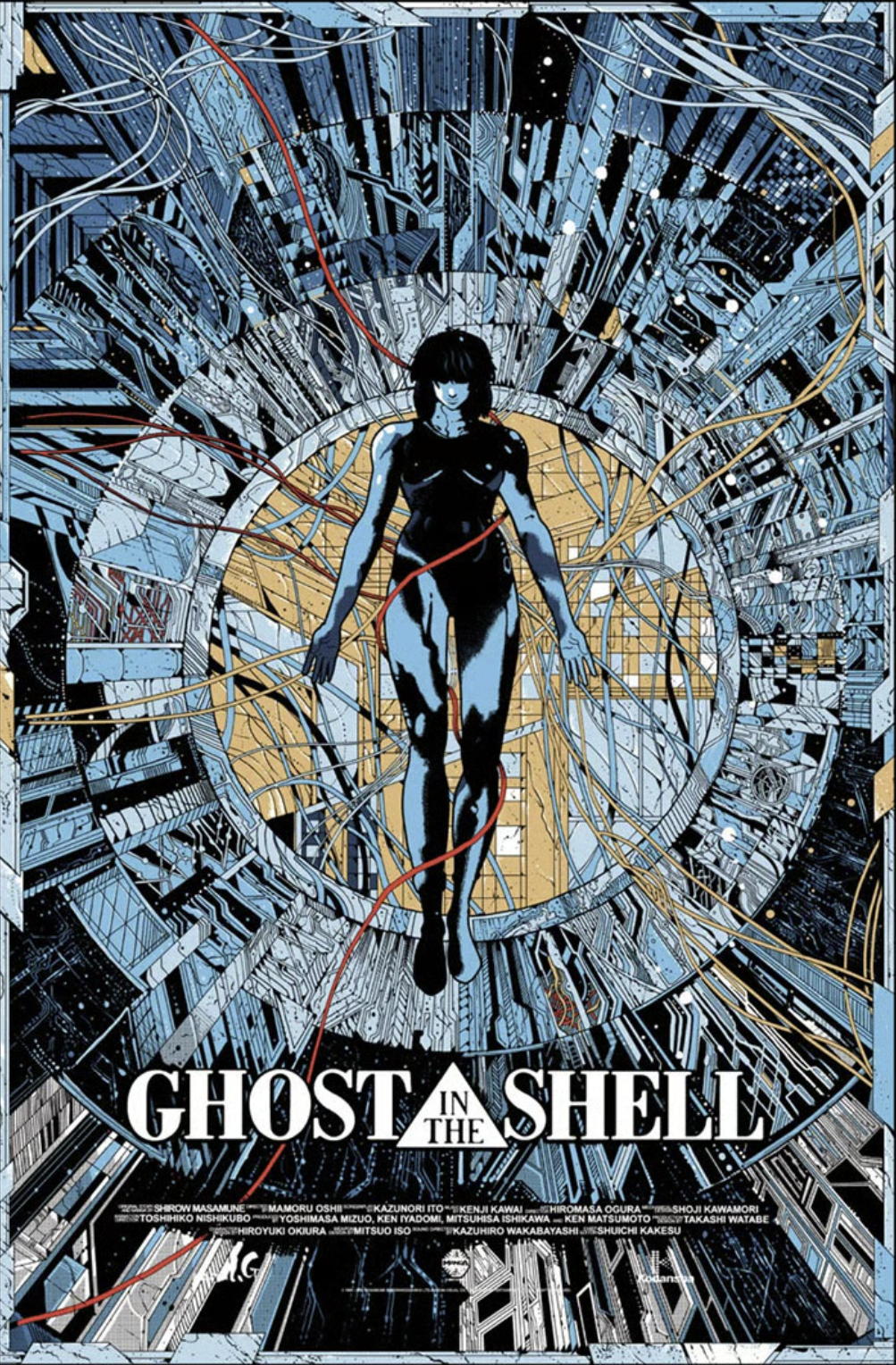
Mamoru Oshii (director). Ghost in the Shell, 1995. 83 min.


Ghost in the Shell (1995), directed by Mamoru Oshii and adapted from Masamune Shirow’s cyberpunk manga, follows Major Motoko Kusanagi, a cyborg public-security agent with Section 9, as she hunts down an elusive hacker known as the “Puppet Master”.
The story explores philosophical questions of selfhood and identity in a technologically advanced world. It is set in 2029 in the fictional New Port City, where technological advances allow the human body to be augmented, or even entirely replaced, with cybernetic parts. Another significant development is the “cyberbrain”, a mechanical casing for the human brain that allows access to the internet and other digital networks. The body is known as “the shell” (殼 or 軀殼), while the consciousness inhabiting it is known as “the ghost” (魂 or 靈魂). The “ghost” is the subjective “self”, the mind that renders a person sentient. Even if someone replaces their entire physical body with machinery, becoming a full-body cyborg like Major Motoko Kusanagi, it is their “ghost” that determines their humanity. Yet the ghost can also be hacked, copied, or even generated by AI. The “shell”, meanwhile, is the physical body or robotic frame, which can grant superhuman strength, speed, and direct digital networking capabilities while the biological brain remains inside its protective casing.
The Puppet Master reveals to Kusanagi that he was created by Section 6. While roaming various networks, he became sentient and began to contemplate his own existence. Concluding that the essence of life lies in reproduction and mortality, he longs to exist within a physical brain that will one day die. Unable to escape Section 6, he was forced to download himself into a cybernetic body. Having interacted with Kusanagi without her knowledge, he believes that she, too, is questioning her humanity, and that the two of them have much in common. He proposes that they merge their ghosts, in return for which Kusanagi would gain all of his capabilities. She agrees. Meanwhile, snipers from Section 6 approach the building, intending to destroy the brains of both the Puppet Master and Kusanagi in order to conceal Project 2501, the Puppet Master’s codename. The Puppet Master’s shell is destroyed, but Batou, the lead investigator of Section 9, shields Kusanagi’s head just in time to save her brain. As Section 9 closes in, Kusanagi awakens in Batou’s safe house in a child-sized shell. She tells him that the entity within her is neither the Major nor the Puppet Master, but a fusion of both.
❧
Today, it is our social media profiles, personas and digital footprints that seem to define us. The film urges us to temper curiosity with caution, for we can all too easily surrender autonomy for convenience. In its imagined future, people have relinquished control over their identities, their privacy, and even their bodies in exchange for seamless integration with digital networks. Major Kusanagi’s very existence depends on technology, yet she constantly questions whether she possesses any true selfhood beyond her digital components.

While researching this piece, I came across the paradox of the Ship of Theseus, a thought experiment that asks whether an object remains the same if all of its parts are replaced over time, with no single part deemed essential to its original identity. This dilemma mirrors Major Kusanagi’s existential crisis in Ghost in the Shell, in which she wonders whether her cybernetic body retains any trace of her original self. The film also turns the paradox on its head, asking at what point a collection of scattered parts becomes a unified whole, and at what point replacing a biological body with machine parts destroys the original identity altogether. The Puppet Master transcends the traditional boundaries of identity because his existence bypasses biological origins entirely. Whereas Kusanagi underwent a gradual transformation, replacing her original biological body with cybernetics until only a fraction of her brain remained, the Puppet Master’s journey is the exact reverse. He was not a human who lost his flesh; he began as scattered code, a data-gathering program created by Section 6. As he drifted through the “net”, absorbing vast quantities of data, his individual algorithmic fragments coalesced into something complex enough to generate a “ghost”.
The film’s climax resolves the identity crises of both characters by fusing their opposing paradoxes into what might be seen as a form of evolution. Kusanagi fears that she is losing her humanity because her “shell” is entirely synthetic, leaving her uncertain whether her “ghost” is real or manufactured. The Puppet Master, by contrast, possesses a “ghost” but lacks a biological shell. Because he is digital, any “backup copy” of himself would be merely a perfect duplicate, devoid of the death that gives life its meaning. He therefore proposes that they merge their consciousnesses. By combining the digitised human “ghost” with the organically evolved “AI ghost”, they create an entirely new entity.
This act dissolves the very notion of an “original”. The new entity is neither purely Motoko nor purely Project 2501, but a vast, “freed” mind capable of navigating the global internet. It reminds me a little of Hon Lai-chu’s Mending Bodies (Two Lines Press, 2025), in which a government programme incentivises individuals to “conjoin” with one another through surgical attachment, promising a flourishing economy, ecological revitalisation, and personal fulfilment as a new entity.
The digital world has also become an extension of our real identities. In Ghost in the Shell, the “ghost” is the essence of the self; in today’s world, our data profiles have become digital ghosts of a kind. We upload our memories to the cloud, and algorithms anticipate our desires on the basis of our previous searches. Facial recognition and fingerprints now grant us seamless access to electronic devices, financial transactions, and buildings. In the climactic scene, as the Puppet Master lies beside the Major, he delivers a haunting line: “To be human is to continually change. Your desire to remain as you are is what ultimately limits you.”
❧

For my recent poem “Flesh Mechanics”, written for Voice & Verse Poetry Magazine (the poem appears at the end of this article), I drew partial inspiration from the 1995 film Johnny Mnemonic, a cyberpunk action thriller starring Keanu Reeves, which I happened to revisit not long ago. Adapted by William Gibson from his 1981 short story of the same name, the film centres on Johnny (Reeves), a “data courier” whose brain implant, capable of storing sensitive information, has overwritten his childhood memories. The Yakuza pursue him for the data he carries, which could potentially cure Nerve Attenuation Syndrome, a disease born of excessive exposure to information and technology.
Johnny is rescued by a cybernetically enhanced bodyguard and an anti-establishment group, and is taken to Spider, a so-called “flesh mechanic”, who helps plan the extraction of the implant. The term “flesh mechanics” struck me as a fitting metaphor for today’s interface between medicine and technology. I was also reminded of the iconic opening narration of The Six Million Dollar Man, a popular television series from the 1970s: “We can rebuild him. We have the technology.” I was further influenced by ongoing discussions surrounding body dysphoria, body-hacking, and body modification, which prompted me to question whether elective bodily enhancements truly enable us to lead better lives. Can “flesh mechanics” ever transcend the fundamental fragility and impermanence of human existence?
In Ghost in the Shell, characters use “cyberbrains” to merge biological consciousness directly with digital networks. Real-world milestones today include neuroprosthetics. Companies such as Neuralink have successfully implanted brain chips in human patients, mapping neural signals so that individuals can control computers and external machinery with their thoughts. Implants also help people with Parkinson’s disease to control their tremors. Full-body cyborg customisation remains a staple of science fiction, but advanced medical prosthetics have progressed to mind-controlled bionics. Technology for amputees employs targeted muscle reinnervation and integrated sensors to decode nervous-system impulses, allowing patients to move “robotic” fingers, arms, and legs.
❧

I saw Ghost in the Shell at the M+ Museum of Visual Culture, where it was screened in conjunction with the museum’s new exhibition, “Myths and Monsters: The Art of Fantasy in Asia”, which explores the role of fantasy in the “evolution of Asian visual culture and its global impacts”. Spanning the nineteenth to the twenty-first centuries, the exhibition presents fantasy as artists’ creative response to social and technological developments. Through various imaginative means, these artists reflect on the possible trajectories of science and technology.
The exhibition opens with pre-modern traditions such as Japanese ukiyo-e woodblock prints, Chinese shadow puppetry, and Tibetan Buddhist scrolls, which helped establish fantasy as a foundational element of Asian visual culture. Chapters Two and Three trace major twentieth-century developments, including the spread of Surrealism across Asia and the post-war emergence of Japanese manga and anime. The final chapter explores the worldwide flourishing of fantastical anime aesthetics in art, design, architecture, film, fashion, video games, and digital culture, a phenomenon that continues to this day and that reflects, or hints at, concepts and possibilities raised in Ghost in the Shell and, decades earlier, in science fiction and popular culture.
As the exhibition is so extensive, I intend to return and walk through it again at a more leisurely pace, particularly now that I have seen Ghost in the Shell, explored the themes it raises, and done a little research into its treatment of technology and the questions it poses about what it means to be human in an increasingly digitised world. One section of the exhibition, entitled “Fantastical Planet”, invites visitors to create their own characters by “designing and customizing their own unique, imaginative monsters and mythical entities”. Once a character has been designed, “the in-gallery system animates and projects the visitor-created monsters into a shared, dynamic digital environment”. I have yet to try this, but I may well write a stand-alone piece based on the monster I design.

Flesh Mechanics
a poem
“Reparation”—Late Middle English: from Old French, from late Latin reparatio (n-), from reparare “make ready again” (See repair)
“A man barely alive. Gentlemen, we can rebuild him. We have the technology. We have the capability to make the world’s first bionic man. Steve Austin will be that man. Better than he was before. Better, stronger, faster.” (Opening narration of The Six Million Dollar Man, a popular 1970’s TV show)
Reality caught up to TV scriptwriters, and now we can say,
the bio has been truly hacked by the machine.
Since the frail human condition can now be altered
Why not let technology create a superior being?
Once only the realm of scientists and physicians,
now the liberating potential of do-it-yourself.
(Body enhancements on YouTube!)
Flesh becomes merely a plug for electronic circuitry,
existence, becoming, and reality have no meaning.
Ontological boundaries blur the definition of life
And the existing artificial dichotomies between
human and the machine will disappear.
Ultimately it will not matter as long as we are
Citius—Altius—Fortius.*
However, technical extension, beyond simple repair
is really an amputation of our necessary frailty.
“Perfection” is “imperfection”.
* Latin for “Faster-Higher-Stronger”
How to cite: Eagleton, Jennifer. “Ghost in the Shell Rewired: Identity, Technology and the Fantastical at Hong Kong’s M+.” Cha: An Asian Literary Journal, 29 Oct. 2026. chajournal.com/2026/10/29/shell.


Jennifer Eagleton, a Hong Kong resident since October 1997, is a close observer of Hong Kong society and politics. Jennifer has written for Hong Kong Free Press, Mekong Review, and Education about Asia. She has published two books on Hong Kong political discourse: Discursive Change in Hong Kong(Rowman & Littlefield, 2022) and Hong Kong’s Second Return to China, A Critical Discourse Study of the National Security Law and its Aftermath(Palgrave Macmillan, 2025). Her poetry has appeared in Voice & Verse Poetry Magazine, People, Pandemic & ####### (Verve Poetry Press, 2020), and Making Space: A Collection of Writing and Art (Cart Noodles Press, 2023). [All contributions by Jennifer Eagleton.]