
茶 FIRST IMPRESSIONS
茶 REVIEW OF BOOKS & FILMS
[REVIEW] “Sacred Body, Violated Soil: Semi-Colonialism, Social Hypocrisy and the Female Body in Wu Yonggang’s The Goddess” by Hilda Wong
Wu Yonggang (director). The Goddess, 1934. 73 min.


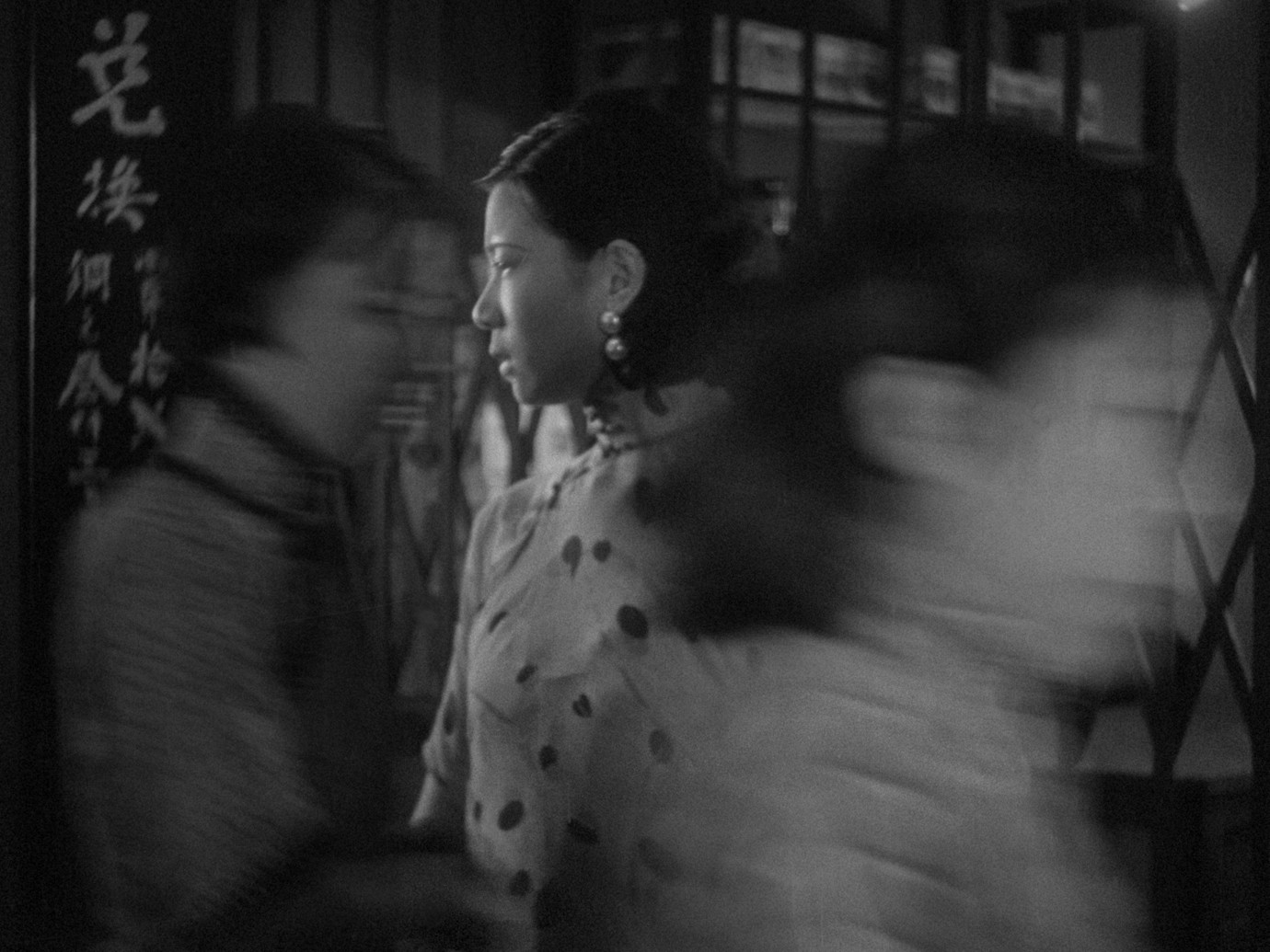
She is a “Goddess”: a woman with two lives in one body. Wu Yonggang’s silent film The Goddess (1934), starring Ruan Lingyu, is a defining work of China’s cinematic golden age. The film follows an unnamed protagonist who sacrifices everything, her body included, to support her son’s education.
Its title signifies the dichotomy between the self-sacrificing mother and the condemned prostitute. This dichotomy is not merely a complication of character; it reflects the fractured form of a semi-colonial nation, as crystallised in Shanghai. Viewed through this lens, The Goddess is at once a social critique of collective hypocrisy and a national allegory in which the female body is figured as violated territory.
❧
In the 1930s, Shanghai was a semi-colonial treaty port, a fractured space in which Chinese sovereignty was suspended and foreign powers, namely Britain, France, the US and Japan, held control over the military and economic sectors. This semi-colonial economic structure gave rise to a hyper-capitalist environment in which survival was a daily struggle, and within it the commodification of the female body became central to the urban economy. Prostitution served as an economic lifeline for hundreds of thousands of women. Statistics show that there were around 100,000 prostitutes in Shanghai in the 1930s, out of a population of 3 to 3.5 million (Hershatter, p. 463). Prostitution was, in other words, a product of the economic structure of semi-colonialism.
The unnamed protagonist of The Goddess is one of the many women who seek to survive by selling their bodies. By day, she is a caring mother; by night, a prostitute. While fleeing a police sweep, she is trapped by a local thug, who becomes her pimp. He exploits her, seizes her earnings and controls her life. When the other parents at her son’s school discover her occupation, they demand the boy’s expulsion. Determined to begin a new life, she resolves to leave for another city with her son, but the pimp steals her savings. Driven to despair, she kills him. The film ends with the principal visiting her in prison and promising to raise her son.
While The Goddess is undoubtedly a film about the misfortune and oppression women faced in the 1930s, its critique extends beyond individual suffering to collective hypocrisy. When the school board discovers her profession, it expels her son, not for any failing of his own, but because of his mother’s occupation. By preserving the sacred space of education in the name of “face” (面子, mianzi), the school board treats the protagonist as a threat to the symbolic purity of the entire social collective. This is “the tyranny of a village”: a system in which public opinion functions as a moral code and the individual is sacrificed to preserve collective reputation; here, the sacrifice is the child’s education. The tragic irony lies in a paradox: the city depends on her labour even as it condemns her impure existence. If the school board condemns her for selling her body to sustain her son, is the school not selling its empathy to sustain its reputation?
This condemnation tragically parallels the actress’s own fate. Ruan Lingyu was subjected to the very social hypocrisy that the film critiques. She took her own life the following year, and her suicide note reads: “Gossip is a fearful thing.” The true causes of her suicide remain contested, but scholars identify media scrutiny and her abusive relationships as possible catalysts. Life imitated art with horrifying precision: within a year, the film’s tragedy had returned as Ruan’s own.

❧
The Goddess was produced within the Left-Wing Cinema Movement of the 1930s, a movement whose critiques often centred on Confucian ideals of womanhood. Under censorship pressures from state regulation and the broader ideological climate, Wu engaged in self-censorship to navigate the diffuse and pervasive anxieties about ideology, politics and the market that confronted Chinese filmmakers (Harris, p. 130). On the surface, the film appears to affirm the maternal aspirations of its era and to enact the punishment of a fallen woman. Wu pitied the streetwalkers who were “forced to sell their own flesh to live” (Harris, p. 129), and he made the film out of sympathy, wishing to show more of the reality that women faced in Shanghai. As Wu noted, “When I first set out to write about the goddesses, I wished to show more of their real lives, but circumstances would not permit me to do so” (Harris, p. 130). Wu’s self-censorship thus suggests that the film’s social critique may serve as a mask, veiling a deeper critique of the semi-colonial condition that produced class suffering.
A colonial reading of The Goddess may appear anachronistic or overdetermined, given that Wu’s aim was to critique social conditions. Yet portraying the female body as a signifier of the nation is not uncommon, and The Goddess complicates this practice by fusing two contradictory roles within a single body.
When The Goddess is read as a national allegory, the protagonist’s body comes to represent the spiritual resilience of China in the war era. By casting the protagonist as the embodiment of China, the film employs the female body as territory to symbolise the violation of sovereignty over Shanghai. As McClintock observes, women are typically presented as the symbolic bearers of the nation; they fulfil a metaphorical role, yet they are often denied direct relations with national agency (p. 354). The protagonist of The Goddess becomes the site upon which national boundaries and territorial integrity are inscribed. As Nira Yuval-Davis notes, “A figure of a woman, often a mother, symbolizes in many cultures the spirit of the collectivity, whether it is Mother Russia, Mother Ireland or Mother India” (p. 45). The maternal body, as a site of fertilisation and biological reproductive potential, holds the power to sustain the nation. From this perspective, the violation of the protagonist’s body is the film’s outcry, voicing a desire to reclaim sovereignty over the territory. Thus, the control exerted over the protagonist’s body and the restriction of her movements symbolise the paralysis of the nation’s agency.
The agent of this paralysis in The Goddess is not a foreign coloniser but a Chinese one. The film’s colonial critique is directed not merely outwards, at foreign imperialists, but also inwards, at Chinese compradors. “The Boss”, the Chinese pimp, resembles what Homi Bhabha theorised as “colonial mimicry”, whereby the colonised subject imitates the coloniser, producing a subject that is “almost the same, but not quite” (Bhabha, p. 126). The local pimp mimics the extractive nature of the colonisers and the ruling class: he profits from the protagonist’s body while curtailing her freedom, thereby exploiting the semi-colonial environment.

❧
Yet, against this violation, the protagonist’s fierce maternal love and loyalty represent an untainted patriotism, in stark contrast to her body’s degradation. The gulf between a violated body and a noble spirit is the allegorical essence of the film, reflecting the nation’s humiliation on the one hand and its spiritual resilience on the other.
One might object that using the female body as a vessel for colonial allegory is an act of objectification. Given that The Goddess was made in 1934, it would be anachronistic to judge it by contemporary feminist standards. Yet the allegory does not reduce the woman’s body to a passive vessel; rather, the film elevates her to a sacralised figure, for only the dual role of mother and prostitute can bear the weight of both a violated territory and a loyal, steadfast spirit.
The Goddess is at once a social critique of collective hypocrisy and a national allegory in which a violated territory is inscribed upon a violated body. These two layers are not separate; rather, the social is itself a product of the semi-colonial situation, and the film thereby reveals the generative structure of the semi-colonial condition. It signals that the social, the sexual and the national are never isolated components. Nearly a century after the film’s release, the contradictions it explores continue to reverberate through later generations. Why do some of us imitate the hands that hold us down, even before they let go? And why does survival so often mean making a commodity of ourselves? The plot closes; the contradictions remain.

Bibliography
▚ Bhabha, Homi K. “Of Mimicry and Man: The Ambivalence of Colonial Discourse.” October, vol. 28, 1984, pp. 125-33.
▚ The Goddess. Directed by Wu Yonggang, Lianhua Film Company, 1934.
▚ Harris, Kristine. “The Goddess: Fallen Woman of Shanghai.” Chinese Films in Focus II, Palgrave Macmillan, 2008, pp. 128-36.
▚ Hershatter, Gail. “The Hierarchy of Shanghai Prostitution, 1870-1949.” Modern China, vol. 15, no. 4, October 1989, pp. 463-98.
▚ McClintock, Anne. Imperial Leather: Race, Gender, and Sexuality in the Colonial Contest. Routledge, 1995.
▚ Yuval-Davis, Nira. Gender and Nation. SAGE Publications, 1997.
How to cite: Wong, Hilda. “Sacred Body, Violated Soil: Semi-Colonialism, Social Hypocrisy and the Female Body in Wu Yonggang’s The Goddess.” Cha: An Asian Literary Journal, 28 Oct. 2026, chajournal.com/2026/10/28/goddess.


Hilda Wong is currently a master’s student at the University of Hong Kong (HKU). A graduate of the Department of English Language and Literature at Hong Kong Baptist University (HKBU), she has wide-ranging interests in multicultural writing, speculative fiction, Modernist literature, and postmodern and postcolonial studies. [All contributions by Hilda Wong.]