
[REVIEW] “Satire, Science, and Utopia: Wu Jianren’s New Story of the Stone” by Ronald Gray
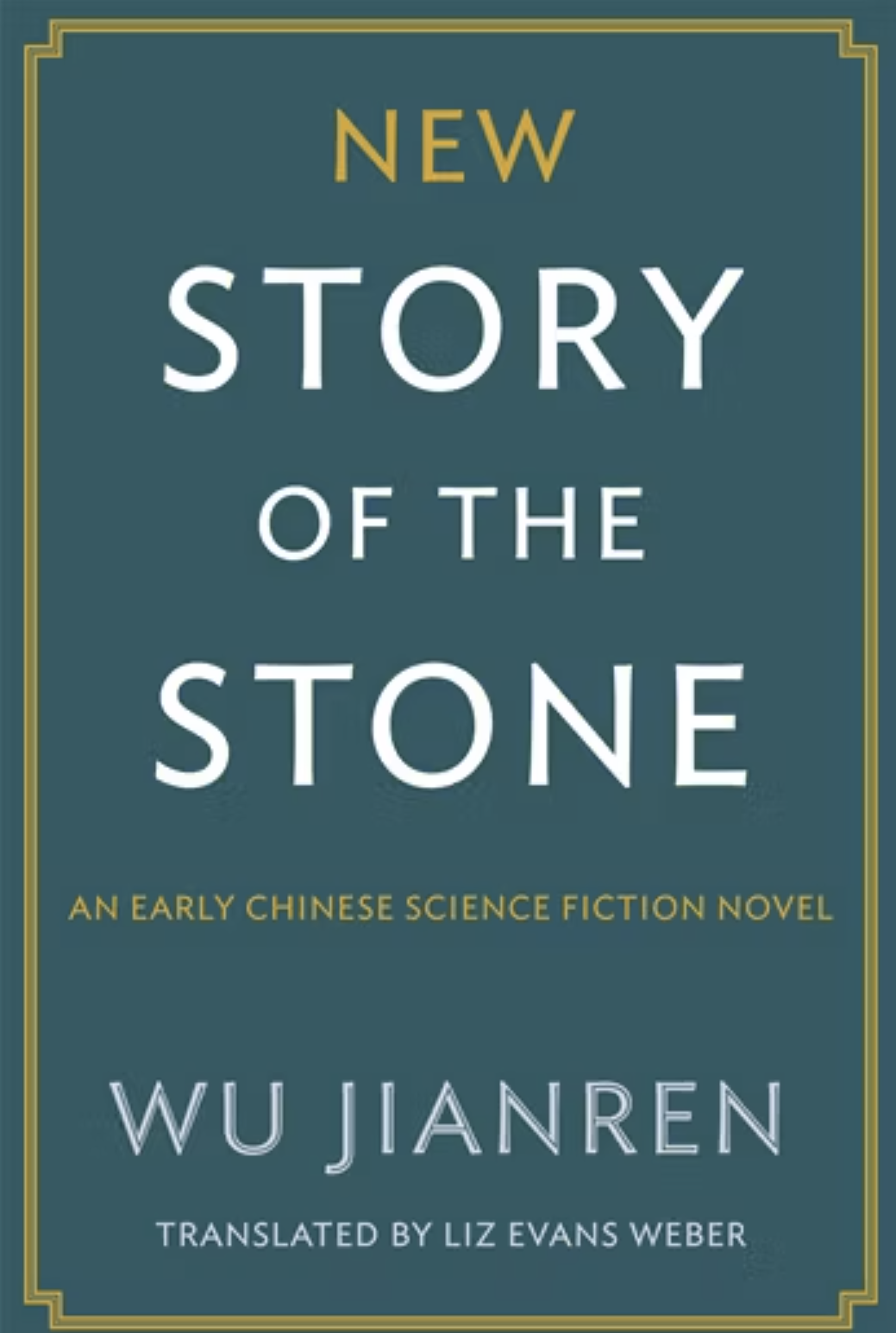
Wu Jianren (author), Liz Evans Weber (translator). New Story of the Stone: An Early Chinese Science Fiction Novel. Columbia University Press, 2025. 600 pgs.


Cao Xueqin’s Honglou meng (Dream of the Red Chamber), a classic of world literature, has been widely studied for its encyclopaedic scope and complex layers of meaning. Its many sequels have also attracted scholarly attention.
The first sequel appeared in 1796, a mere four years after Honglou meng’s publication. Since then, sequels have continued to appear periodically, even into the present day. By 1900 alone, at least twelve sequels had been published. These included Return to Dream of the Red Chamber, Revisiting the Silken Chambers, and The Illusion of the Story of the Stone. Some sequels sought to provide the novel with a less tragic ending; others were written to resolve inconsistencies in the plot, address what their authors perceived as flaws in the original, or further develop popular characters. One such sequel was written by the Mongol prince Injanasi, a direct descendant of Genghis Khan, and depicts Jia Baoyu, Honglou meng’s protagonist, finally consummating his relationship with his beloved Lin Daiyu. Another notable example is In the Shadow of the Dream of the Red Chamber, published in 1877 by Gu Taiqing, the first Chinese woman to write a novel. In recent years, these sequels have received considerable critical attention from Western scholars interested in what they reveal about attitudes towards the original novel and the status of women, who constituted the main readership for these sequels.
❧
In 1905, a sequel titled New Story of the Stone appeared, offering an entirely new twist. It was written by Wu Jianren (1866-1910), a novelist and essayist known for his exposé fiction and innovative techniques. Like Honglou meng, the work encompassed many genres: a biting and uproarious social satire of the decadence, widespread corruption, foreign domination, and worship of foreign things in late Qing China; a work of historical and utopian fiction; a modern update of Honglou meng; and a patriotic Confucian novel of ideas. It is also China’s first science fiction novel. Written during a period of national and cultural crisis in China, in the aftermath of China’s defeat in the 1894-1895 Sino-Japanese War and the 1900 Boxer Rebellion, the novel explores a question that preoccupied many Chinese intellectuals at the time: whether and how Western science and technology could be integrated into the core of China’s cultural and intellectual traditions.
Although New Story of the Stone has received attention from Western scholars such as Patrick Hanan and David Der-wei Wang, only four chapters had previously been translated into English. The publication of this new, complete translation by Liz Evans Weber is therefore most welcome. Weber does a good job in the introduction of situating the work historically, intellectually, and in relation to Honglou meng itself, but she fails to address the subversive and socially critical nature of Cao Xueqin’s masterpiece and its preoccupation with qing. She also provides much-needed endnotes explaining the cultural, literary, and historical allusions in the story. Her translation is faithful to the original and reads easily.
❧
Wu’s novel consists of forty chapters divided into two parts. The first takes place largely in modern Shanghai, while the second is set in an idealised technological utopia called the Realm of Civilization. Wu begins the novel by criticising previous sequels to Honglou meng, calling them fantastical, absurd, and poorly written, and promises that his own work will be different. Four characters from Honglou meng appear in the story: Jia Bao-yu, his servant Beiming, his brother-in-law Xue Pan, and his double, Zhen Bao-yu. Bao-yu is again the protagonist, but his former identity as an aesthete, eccentric, romantic, and apolitical figure with an anti-Confucian outlook gives way to that of a commanding, socially oriented, pragmatic, somewhat priggish, and patriotic Confucian, a radical departure from his former personality. Bao-yu’s role is to negotiate the relationship between tradition and modernity, the native and the foreign, and which beliefs work in the modern world.
In the story, Bao-yu encounters and becomes fascinated by Western objects and technologies in modern Shanghai, including trains, matches, sugar cubes, Western food, and light bulbs. When he travels to the Realm of Civilization, he is overwhelmed by its technological and scientific advances, which radically transform his outlook. These include flying and tunnel cars, life-saving medicines, top-notch factories, and defensive warships equipped with sophisticated weaponry. He even embarks on an adventurous submarine journey around the world. He is also deeply impressed by and comes to approve of the Realm’s benevolent and efficient, yet authoritarian, Confucian government.
At the end of the novel, Bao-yu discovers that his journey to the Realm was merely a dream. As Weber notes, his awakening poses the question of whether “the strong China he has just dreamed of [is] truly achievable” or “merely a mirage that dissipates upon waking”, concluding that “the real emotive weight here is the quiet pessimism implied by the idea that such a beautiful dream may in fact be an impossibility”.
How to cite: Gray, Ronald. “Satire, Science, and Utopia: Wu Jianren’s New Story of the Stone.” Cha: An Asian Literary Journal, 27 Oct. 2026, chajournal.com/2026/10/27/new-stone.


Ronald Gray has taught at universities in China, Japan, South Korea, and the United States. He has written and edited seven books, three of which deal with Honglou meng. He lives in Gongju, South Korea.