
茶 FIRST IMPRESSIONS
茶 REVIEW OF BOOKS & FILMS
[REVIEW] “Ghost in the Shellphone: TxT and the Rarity of Filipino Techno-horror”
by William Carlo Antonio Sanchez
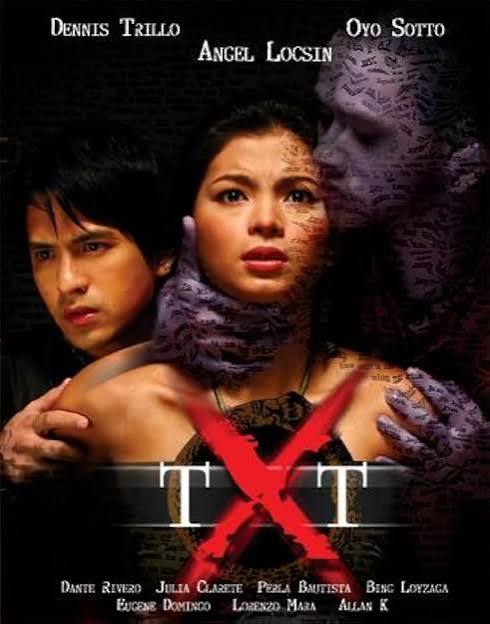
Mike Tuviera (director). TxT, 2006, 114 min.


For a country so chronically online and so engrossed in horror, the Philippines has left techno-horror largely underexplored. The subgenre has existed for decades, but the rapid technological advances of the 1990s and 2000s brought collective anxieties about the then-imminent digital age sharply to the fore. Phones and computers offered global access, but also an anonymity that could be abused with a single click: stalking, harassment and general hostility, to name but a few. TxT, a 2006 Filipino film, is often classified as supernatural horror, yet its treatment of these fears makes for a unique, albeit uneven, take on techno-horror.
The film follows Joyce, a caregiver at a home for the elderly, who is beset by threatening messages from Roman, her former boyfriend. Even public outings take a sinister turn when she receives unsolicited photographs of herself from an unseen presence nearby. Matters grow worse still when you recall that Roman is… dead, killed in a mysterious car accident caused by Joyce herself. The film wastes no time in showcasing its technological elements. Each change of name or frame in the opening credits is accompanied by a loud, hissing electrical buzz. These hisses play over images of phones, blood dripping onto their screens and occult symbolism.
In terms of sound design, the film succeeds admirably in making the audience fear even the most ordinary ringtone. Each time a phone chimes or rings, you simply know that something terrible is about to happen. You begin bracing yourself, all because of commonplace sounds. This visceral anticipation of fear is where horror is at its most potent. Better still, this accomplished sound design is matched by equally accomplished cinematography.

In key sequences, the cinematography is so well lit and so carefully composed that a single frame can tell the whole story. For example, an early flashback shockingly reveals Roman’s abusive nature in life, as he brutally beats a restaurant waiter merely for being polite to Joyce. Meanwhile, Joyce remains oblivious to the violence unfolding directly behind her, Roman’s possessiveness drowned out by the restaurant’s jazz. This dramatic revelation of their respective characters is achieved by strategically dividing a single frame in half. This keen awareness and maximisation of scenic space is evident throughout TxT, as when Alex, Joyce’s new love interest, realises that he is utterly alone in his call centre just as he, too, begins to receive threatening messages.

Overall, TxT is at its strongest in its first act, in which a grieving Joyce comes to terms with how volatile her relationship truly was. Her healing is interrupted by harassing texts ostensibly from Roman, and even after several changes of phone number, the harassment persists. Nevertheless, she suspects nothing supernatural. Instead, the film hints that the texts are pranks orchestrated by the wealthy Edith, Roman’s mother, who has always despised Joyce. Unfortunately, this red herring is dispensed with before the first act has even ended, when Roman’s vengeful spirit is revealed to be behind everything. The film makes no attempt to persuade you that it is merely some computer-generated ploy; it simply becomes a ghost story from that point onward.

A horror film is not automatically good simply because it is techno-horror. Likewise, a horror film is not automatically bad merely because it is supernatural. What weighs TxT down from here is its descent into formula, as it fails to capitalise on its first-act hook. Even beyond the slasher, a considerable number of horror films feature an antagonist systematically eliminating the protagonist’s allies, culminating in a final confrontation in which the protagonist is left with almost no one. TxT follows this pattern and even includes the all-knowing spiritual guru who unloads exposition just in time for the third act.
By the second act, the intrigue surrounding who is really behind the texts has dissipated, giving way instead to jump scares and a familiar formula in which Joyce rushes to save her friends but always arrives too late. Each friend is killed upon receiving a phone call from Roman. The moment they answer, their heads begin to twitch violently, in breakneck sequences reminiscent of the iconic reverse bear trap in the first Saw (2004), until they drop dead, skin flaking and mouths agape.

At no point does the film suggest that these attacks might be lethal computer viruses of some kind, perhaps unleashed by Edith in revenge for her son’s death. TxT’s major midpoint revelation is that Roman is in fact targeting those of Joyce’s friends who disparaged the relationship. Imagine a version of this film in which the revelation of Roman’s ghost comes later: the new midpoint would confirm Edith’s innocence, thereby horrifying both Joyce and the audience with the disturbing realisation that Roman’s abusive nature is so powerful it can persist even from beyond the grave. In this way, the film would be a techno-thriller in its first half and a supernatural techno-horror in its second, drawing the best from both subgenres within a single story.
As it stands, the film is a relic of the mid-2000s, encumbered by an excess of supernatural clichés which, for what it is worth, also encumber more popular horror films. Without revealing too much, even the recent award-winning Filipino techno-horror Deleter (2022) deals with vengeful spirits. This preference for the supernatural above all else says a great deal about local culture, which is understandable when you consider the many legends of lingering ghosts in both urban centres and more provincial areas. Still, TxT captures the constant unease of technology remarkably well for a film of its time. That one text, one picture or one call is all it takes to rob Joyce of her personal security is eerily plausible, and the film does not even need a smartphone to drive home a fear that is only more pronounced today.
Techno-horror explores what happens if we fail to keep man and machine distinct. TxT takes this rather literally, granted, but consider it an embodiment of the subgenre’s thesis that technology is no longer merely a means of evil; it can be an evil in and of itself. It recalls the Japanese cult classic Pulse (2001) in its presentation of technology as an alternate reality so distinct that it has become a viable avenue for spirits to wreak havoc upon us. Compared with other techno-horror media, TxT is lesser known, but that does not automatically make it a lesser film.
How to cite: Sanchez, William Carlo Antonio. “Ghost in the Shellphone: TxT and the Rarity of Filipino Techno-horror.” Cha: An Asian Literary Journal, 23 Oct. 2026. chajournal.com/2026/10/23/TxT.


William Carlo Antonio Sanchez is an aspiring novelist and lifelong horror fan from Butuan City, Philippines. His surrealist poetry and prose have appeared locally and internationally, notably in The Archipelago Press (California), Voice & Verse Poetry Magazine (Hong Kong), CultureCult Magazine & Press (India), TAKÓS: An Anthology of Gendered, Queered, Literary Genres, and Heritage Youth in his home country. He graduated magna cum laude with a BA in Communication from the University of the Philippines Cebu in 2024 and currently works full-time as a layout artist and production staff member at Father Saturnino Urios University. [All contributions by William Carlo Antonio Sanchez.]