
茶 FIRST IMPRESSIONS
茶 REVIEW OF BOOKS & FILMS
[REVIEW] “More Is Less: Cinco in the World of Anthology Horror” by William Carlo Antonio Sanchez
Cinco, 2010. 148 mins.
❀ Frasco Mortiz (director). Braso/Arm.
❀ Enrico Santos (director). Paa/Feet.
❀ Ato Bautista (director). Mata/Eyes.
❀ Nick Olanka (director). Mukha/Face.
❀ Cathy Garcia-Sampana (director). Puso/Heart.


The words “horror” and “anthology” are often synonymous. After all, what’s better than one horror story? Why, the more, the merrier! So long as it’s all for the price of one!
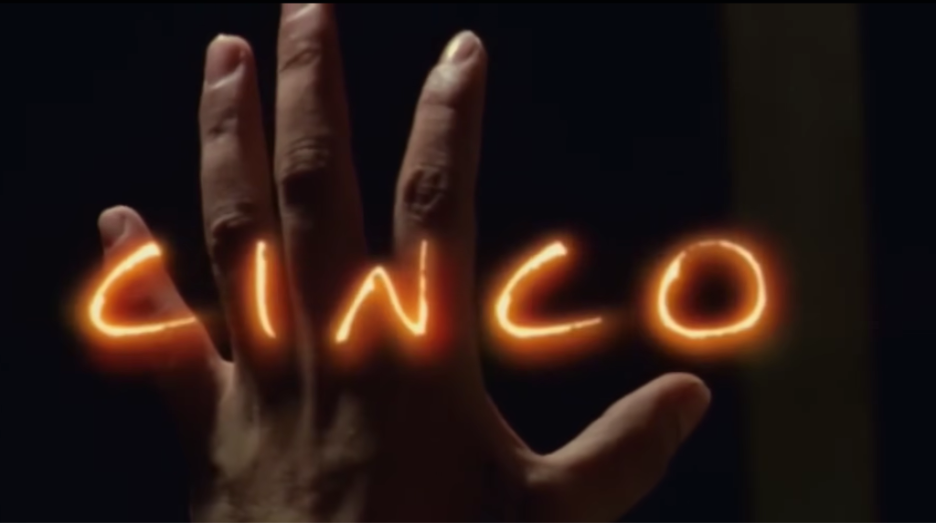
Every horror anthology is a single film made up of short segments, linked together by common themes or a framing story. Cinco (Five) is a Filipino horror anthology released in 2010, consisting of five different stories from five different directors, initially linked by a recurring hand with an R.I.P. tattoo. This mysterious hand is the subject of the opening credits, makes cameo appearances in segments two to five, and is even the main antagonist of the first segment, fittingly titled “Braso” (“Arm”).
❧

In “Arm”, three aspiring fraternity members dressed in lingerie are locked in a dark morgue for their initiation. While arguing over the merits of their situation, the brash Andrew pulls out a hidden corpse, whose severed arm… springs to life and attacks the three! After narrowly saving Andrew’s groin, the three escape, while the fraternity master is torn apart by the arm after entering the morgue to sleep with his girlfriend.
Having watched this over a decade ago, I never thought much about it. It’s a warm-up for the rest of the stories, but that’s about it. Morgues are inherently eerie, and the lighting and soundtrack early on highlight that. Years later, I can appreciate its exploration of toxic masculinity and the fatal hazing culture rampant in the Philippines.
It always bothered me that the tension between the three wannabe fraternity members isn’t fully resolved; the segment ends at what would normally be the end of a feature film’s second act and, thus, comes across as a proof-of-concept teaser rather than a fully realised anthology entry. Although, I now see that Andrew being the most frequently attacked is his comeuppance for being overly aggressive throughout the segment. The fraternity master’s brutal death extends this comeuppance, a grand symbolic death of the machismo haunting the narrative.
❧

“Paa” (“Feet”), in contrast, is your standard ghost story. An impoverished mother, Elisa, struggles to provide clean shoes for her young child, all while being haunted by the ghost of a little girl with whom she has a history. It’s a well-known setup in horror: parents protecting their children from malevolent spirits. Execution is everything, so there’s nothing wrong with familiar premises.
Alas, “Feet” is run-of-the-mill, carried only by an engaging performance from Jodi Sta. Maria as Elisa, together with superb make-up and wardrobe choices that emphasise just how exhausted she is from barely getting by in the country, something all Filipinos can relate to. In this sense, although all five segments tackle issues that remain astonishingly relevant to this day, the sheer relatability of “Paa” means it could potentially be the most timeless.
Ideally, it could have avoided the pitfalls of much horror media, namely showing too much of the monster and having an overly loud climax. “Paa” is at its best when the ghost girl haunts the frame from a distance; the latter half, which repeatedly shows off her fake blood-covered face, is less effective. The familiar third act of a horror film, in which the grotesque fiend actively chases our protagonist, is still scary, but in a different way: more of a rollercoaster ride than the crippling fear of the unknown.
In Stanley Kubrick’s The Shining (1980), Jack Torrance hunting down his family with an axe will forever be an iconic sequence. However, young Danny cycling around the sinister Overlook Hotel fills us with so much dread, even when there is no monster on screen (yet). This more visceral “less is more” approach to horror, compared with the threat of an axe murder, is something “Feet” could have employed to maintain its strengths.
❧

The lack of innovation in “Feet” may be why I’m drawn more to the third segment, “Mata” (“Eyes”). Rose, a young woman in a toxic relationship, witnesses Alvin, her boyfriend, murder a stranger in a fit of road rage. When she fails to tell the police and, therefore, cannot wash the literal blood off her hands, she becomes trapped in a time loop, reliving the same violent night over and over.
Horror and time travel are like peanut butter and jelly, as the combination is inherently entertaining: facing a ghost or killer is already a nightmare, but now imagine doing it again and again and again and again, as in Happy Death Day (2017). My only real gripe with “Eyes” is the ending: after mustering the strength to save the stranger (by shooting Alvin in the eye), Rose is finally able to wash her hands clean and wakes up to a bright new day. That is, until she receives a phone call from… Alvin, whose vengeful spirit attacks her as the segment cuts to black.
This is a typical horror-film “downer” ending, in which the main character survives the entire traumatic ordeal, only to be killed at the very last minute, thus negating their survival and risking making the whole film feel meaningless. Considering the subject matter of “Eyes”, “Is violence truly survivable?” actually makes for a great question to pose at the end, and the cliffhanger’s ambiguity may be the point. That said, a downer ending purely for the sake of a downer ending can, and will, bog down a story.
❧

Thankfully, the final two segments, “Mukha” (“Face”) and “Puso” (“Heart”), are where the film’s connective tissue finally clicked for me. In the former, magazine editor Rizza is dealing with a gravely ill mother at home and is (seemingly) all by herself in the office after hours. Before she can leave, she is terrorised by photographs of Mang Bong, an elderly janitor whom she publicly fired and humiliated earlier that day by pressing his face against a photocopier, presumably as an outlet for all her stress.
In the latter, Emily is a haunted-house performer who uses too many drops of a love potion to win the affections of a fellow performer, Elvis. When Elvis is stabbed to death by a violent guest, his corpse springs to life and massacres nearly the entire circus in pursuit of Emily. A terrified Emily dies of a heart attack, but not before cutting off Elvis’s… arm, which turns out to be the very same one with the R.I.P. tattoo from the morgue, a nonlinear revelation of its origins that brings the film full circle.

❧
Cinco follows Filipinos from various walks of life who have committed, or are actively committing, questionable deeds in pursuit of their needs. Each segment essentially shows them dealing with the consequences of their momentary sins, acts of desperation or outright selfishness that cost them everything. In “Arm”, three boys eager to assert their masculinity flee in terror from a single body part. In “Feet”, Elisa steals a little girl’s shoes, and the girl is immediately run over and killed by a car while chasing after her; the subsequent haunting costs Elisa a leg. In “Face”, Rizza takes out her frustrations on a subordinate, costing her safety and, before long, her sanity. In “Puso”, Emily robs a man of his autonomy to prove her worth, costing her own life and those of her circus troupe.
The only outlier is “Eyes”, as Rose is never shown to be on the same level as the other main characters, and the only thing she’s done is fail to leave a toxic relationship. Still, the connective tissue holds when you consider Alvin’s violent possessiveness of Rose, which costs him not only the relationship but also his life. A character’s selfishness coming back to bite them is quite a familiar trope in horror. Hence, whatever thematic substance Cinco possesses comes from its many conflicted and conflicting characters, not the severed arm.
In fact, the arm’s appearances in blink-and-you’ll-miss-them shots after the first segment feel like studio-mandated pick-ups intended to make the film more cohesive. Nonetheless, the arm is a great hook, since you might keep asking yourself, “What the heck is this thing, and why is it such a big deal?” all the way to the end. Not to mention, the added context from the fifth segment might provide enough incentive for some viewers to rewatch the first, and possibly the rest of the film, giving it potential rewatch value.
❧
Which brings me to this: almost every country with a horror-film industry has at least one anthology franchise. Cinco, for all its ups and downs, is not the Philippines’ flagship. That honour, instead, belongs to the long-running Shake, Rattle & Roll. Not every horror film is an anthology, but it’s as if the format itself is baked into the genre’s DNA; so much horror for the price of one, who could say no to that?

Even literature is no stranger to the genre’s “many for the price of one” packages, as exemplified by Alvin Schwartz’s Scary Stories to Tell in the Dark. This, however, means that every horror anthology ever made, or yet to be made, might share the exact same core issue of “more is less”.
Said issue is like sitting around a campfire with your best buddies at midnight, where someone always tells a “totally true” ghost story, then another, another and another. Until, finally, you start thinking to yourself, can we please stop? It’s just getting worse. “Inconsistent” would be an understatement. The stories become so all over the place that eventually, you can’t help but blurt out, “That’s it?!”
Cinco, a 2010 Filipino horror anthology, is perhaps a unique case in that it faces this issue, sure, but in reverse. It gets its weakest entries over with first, and the quality improves from there, somewhat.
How to cite: Sanchez, William Carlo Antonio. “More Is Less: Cinco in the World of Anthology Horror.” Cha: An Asian Literary Journal, 11 Oct. 2026. chajournal.com/2026/10/11/cinco.


William Carlo Antonio Sanchez is an aspiring novelist and lifelong horror fan from Butuan City, Philippines. His surrealist poetry and prose have appeared locally and internationally, notably in The Archipelago Press (California), Voice & Verse Poetry Magazine (Hong Kong), CultureCult Magazine & Press (India), TAKÓS: An Anthology of Gendered, Queered, Literary Genres, and Heritage Youth in his home country. He graduated magna cum laude with a BA in Communication from the University of the Philippines Cebu in 2024 and currently works full-time as a layout artist and production staff member at Father Saturnino Urios University. [All contributions by William Carlo Antonio Sanchez.]