
[ESSAY] “From Kuala Terengganu to Jakarta: The Job I Turned Down” by Daniel Regan

My Peace Corps service cost me a job.
I am aware that this sounds improbable, given the prevailing narrative, which holds that a record of Peace Corps service benefits returned volunteers, often giving them a leg up in subsequent employment or educational opportunities. “The Peace Corps opens doors” is a common refrain. It did for me, too. It was a stroke of luck that Professor Evers, while on a research trip, stopped at our house outside the small town of Kuala Terengganu, Malaysia. He turned out to direct the graduate programme in Southeast Asia Studies at Yale and, before leaving, suggested that I apply. This chimed with a desire of my own, which had been percolating by then, to make sense of what I had experienced in Malaysia and elsewhere in the region.
All that I acknowledge. Yet later, in a very real sense, Peace Corps service also cost me a job.


Nine years after my time in the Peace Corps, I sat, as I did most days, at my desk in a small office in what was then Mervis Hall. I was a couple of years into an assistant professorship at the University of Pittsburgh. A single grimy window looked out onto a concrete car park, across which stood another ageing brick building. The late winter afternoon had already grown dark. Suddenly the telephone rang, and a voice on the other end asked whether I would be willing to be a candidate for a Ford Foundation position in Indonesia. I do not remember how I concluded that the call was no prank. Once I had, the bleakness of the afternoon undoubtedly contributed to my reply: “Yes, sure.”
The next step was an agreeable interview for the position of Project Specialist, whose remit was to coordinate and lead the Foundation’s social scientific activities in Indonesia. Only later did I learn that more than eighty people had sought the post. Ford’s invitation took me to the Foundation’s headquarters in Manhattan, where I met the head of the Asia Pacific division and several others, but spent most of my time with Dr I., a prominent political scientist who advised Ford on Asian affairs.
The late 1970s were a heady time for the Foundation, which had become the largest grant-making philanthropy in the country. Its international division was particularly thriving and well funded. I surmised that my hosts had obtained my name from the then-current Project Specialist in the Social Sciences, whom I knew slightly. Dr I. was aware of the value I placed on academic work in the social sciences, but he insisted that, as he put it, “Universities are the worst place now to do university work.”
After lunch at the Ford facility, he made a forceful case for the Foundation’s approach, which emphasised applied social scientific research. In contrast to conventional academic research, he said, this position offered an opportunity to “throw money at the variables you consider important and see how they turn out.” Moreover, although we both knew that I could easily secure an approved leave of absence permitting an eventual return to the university, he offered further protection in the form of a prospective career at Ford after Indonesia.
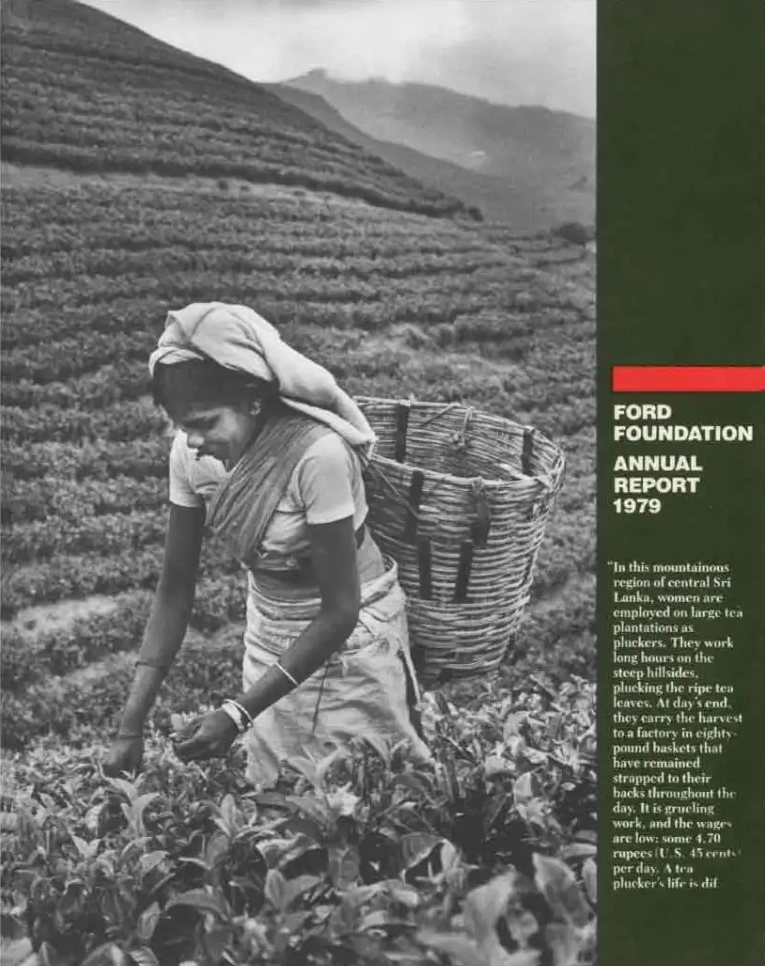
The Foundation then arranged for me to fly to Bangkok to join a small Ford conference on rural development and population. The proceedings aimed to set the stage for applied social research in Southeast Asia, particularly Indonesia, bearing on population control, one of the Foundation’s areas of international concentration. Although most of its population work in the Asia Pacific region focused on reducing growth rates in India and Bangladesh, ample funds were also set aside for Indonesia (Ford Foundation Annual Report 1979). Accordingly, the conference participants aimed high, hoping to shape a research agenda that would yield findings and recommendations relevant to national policy.
“You have to have an ear to a Minister,” declared one participant. The plenary sessions and smaller working groups were lively, substantive, and potentially influential, though I found it off-putting that a group of (mostly) white, male First Worlders were planning these population control efforts. Equally, I found myself thinking back to a time in a Malay village, during a six-month extension as a Peace Corps health worker, when a government official had come from Kuala Terengganu to promote family planning. His argument was an economic one: “If you have M$1,000 and only two children, you can spend M$500 on each, but with four kids, each can only benefit from M$250.” Afterwards, a knot of villagers included me in their post-mortem. “Where does he think we’re going to get that M$1,000?” they grumbled. And: “I don’t think he understands how much joy we get from having little ones around!” I doubted whether the Bangkok conferees had such considerations in mind as they drafted their working papers.

Family planning
From Bangkok the interview continued, doubling as an on-site introduction to the position. I flew to the Indonesian island of Sumatra to visit a small research station in Banda Aceh. There, Ford had assembled a handful of young social scientists from various regions, for stays of several months, to study research methods and conduct modest local research projects under the guidance of an international expert, also brought in by the Foundation. The twin goals were capacity-building in the social sciences and the accumulation of local knowledge.
This small centre and others like it around the country were the product of a report by the anthropologist Clifford Geertz, written in a temporary capacity as a consultant to Ford. His report had decried the centralisation of Indonesian intellectual life in Jakarta and the lack of attention to accumulating local knowledge about many parts of the far-flung Indonesian archipelago. The loose network of centres he proposed was one response to that imbalance. Coordinating them, and thereby advancing Geertz’s vision, was for me a significant part of the job’s appeal.
Besides my admiration for Geertz’s work in humanistic anthropology, there was another obvious attraction: I had just taught a course called Pittsburgh Area Studies, in which students organised themselves into a research team to study local attitudes. Unfortunately for the success of the programme Geertz had recommended, there was tension between it and the vision for the social sciences held by Foundation figures such as Dr I., who said he was “appalled” by the array of research topics at the centres. He was entirely uninterested, for example, in a “sociology of hawkers.”
Next, accompanied by the outgoing Project Specialist, I attended a meeting at which, seated around a large conference table, we conversed unremarkably with the deans of a local university. What struck me at the time was the significance to the local attendees of a visit by Ford Foundation representatives, towards whom the deans were predisposed to react favourably. Without being able to pinpoint exactly why, I had the feeling that when people saw my name tag, what they read was “Ford $$$.” I remember feeling embarrassment at being endowed with such unearned influence, but also feeling humbled, frustrated, and a little angered by the realisation that my own identity would be no match for the institutional might of the Foundation. This contrasted with my time in the Peace Corps, when interactions carried no such expectations. Local people had had no reason to expect anything more than my work or friendship from either the organisation or the country I belonged to and represented.
Before leaving Sumatra, the Project Specialist and I spent an evening with the governor of Aceh, to whose residence we had been invited for dinner. We then flew to the island of Java and the capital, Jakarta, where my first stop was the Ford guesthouse. There I happened upon the Minister of Finance conferring with two Foundation staff members about SAT testing for his daughter’s application to UC Berkeley. I then attended a meeting of the Social Science Foundation of Indonesia (Yayasan Ilmu-Ilmu Sosial). What I remember about the session is greeting the person seated beside me, who turned out to be the Vice President of the Republic of Indonesia. Afterwards I viewed what would be my living arrangements were a job offer to be made and accepted. The detached house stood in a leafy, exclusive neighbourhood where the neighbours tended to be fellow expatriates and Indonesian elites. It came staffed with a cook, a laundress and housecleaner (amah), as well as a gardener and a driver for an air-conditioned Ford car, likewise supplied by the Foundation. I also learned that the salary would be two and a half times my academic salary and, further, that the job would allow me to issue, on my signature alone, “small” grants of up to US$25,000.
All this was quite a change from teaching sociology classes to Pitt undergraduates only days before. But the greatest difference, by far, was the contrast with my time in the Peace Corps. Perhaps I would not need to commit myself, as several Foundation staff members I met apparently had, to exclusive clubs and the company of other foreign experts, expatriates, and Indonesian elites. But I was not so sure. In any case, Peace Corps life (at least as a rank-and-file volunteer) and Foundation life could not have felt more dissimilar. The ways of interacting with the host society, the lifestyles, the relationships formed, the experiences and perspectives gained: all were very different. I am not prepared to declare one superior to the other, or to judge which had the greater and more salutary impact; only that they are different, and that I was wedded to a style of engaging with host communities rooted in Peace Corps volunteer service. It was no accident that some of the most memorable conversations I had in Indonesia were with drivers and other “little” people.
By then I had discovered that intellectual or policy discussions with elites interested me less than conversations with villagers or small-town people that revealed something of their worlds and lives. I think this traces back to a time in a Malay village when many evenings were spent next door on Pak Embong’s veranda with him and his family. Conversations were modest, but a connection was born and deepened, less on the basis of words than in spite of their absence. These and other modest encounters changed the way I thought about human connection and nurtured a decades-long belief in the value of small talk and in the worth of casual ties, which may seem superficial but can provide great meaning and satisfaction. My Malaysian experiences helped me discover and practise this pleasure in human connection, which extended to Indonesia and continues to afford me lasting contentment and fulfilment today.

Pak Embong, Kampung Baharu Serada, Terengganu, Malaysia, 1969.
I do not mean to suggest that Ford had ignored these crucial aspects of human interaction during my visit. The Foundation had been a gracious and thoughtful host throughout the process and, in the end, its representative made a generous job offer, which I declined. I had ample reasons for that decision, foremost among them a firm commitment to a Peace Corps volunteer mindset. It was, however, the worst career decision I ever made.
True, I had reservations about some of the Foundation’s directions, had noticed uncomfortable tensions within its ranks on key projects in my portfolio, was unaccustomed to the extravagant lifestyles, and fretted about the unavoidably close ties with the Suharto regime. I questioned some of the assumptions underlying development work, as well as the frequent hubris of development planning and management.
Yet this is no paean to the Peace Corps.
I suspected, even as a youthful volunteer, that the well-intentioned efforts of many of us may have done more for our own development than for the communities we served. (On the other hand, who knows what worthwhile local scholarship or other positive outcomes might have come from a position with Ford?) Indeed, my two and a half years as a volunteer teacher and rural health worker were marked by ambivalence towards the organisation. The Peace Corps and its military counterpart, the War Corps (if you will), were both elements of a policy apparatus I had come to regard as misguided. During my time as a volunteer I felt engaged and yet, somehow, used. Afterwards, back in the States, I attended meetings of the Committee of Returned Volunteers, whose first tenet was the abolition of the Peace Corps. My affiliation did not last long, though my scepticism about US foreign policy and its institutions remained.
So, opting for a Peace Corps cast of mind and model of engagement, however satisfying and meaningful, came with consequences and a cost. Reflecting on my choice decades later, I am grateful for the mixture of anxiety I experienced alongside the privilege of choice I enjoyed at such a critical juncture. Yet on dark afternoons that awaken memories of a bleak day in Pittsburgh when my office telephone rang unexpectedly, I find myself not regretting, but wondering about, my decision and what might have been.

Kampung Baharu Serada, Terengganu, 1969.

Yearbook, Sekolah Panji Alam, 1967.
How to cite: Regan, Daniel. “From Kuala Terengganu to Jakarta: The Job I Turned Down.” Cha: An Asian Literary Journal, 6 Oct. 2026. chajournal.com/2026/10/06/peace-corps.


Daniel Regan, a sociologist, was a faculty member at the University of Pittsburgh in the United States for 21 years, six of them as department head. In recent decades, he has held senior academic-administrative positions in Idaho and Vermont. Regan is the author of Intellectual Conversations: Malaysian Writers and Thinkers in the 1970s (Palgrave Macmillan and Gerakbudaya/SIRD, 2024). His other academic writings include articles and chapters on higher education, religion and politics, intellectual life, and Malaysia. In retirement, he serves on local boards in Vermont, plays squash, and writes. His Peace Corps service, referred to in this essay, spanned late 1966 to mid-1969.