
茶 FIRST IMPRESSIONS
茶 REVIEW OF BOOKS & FILMS
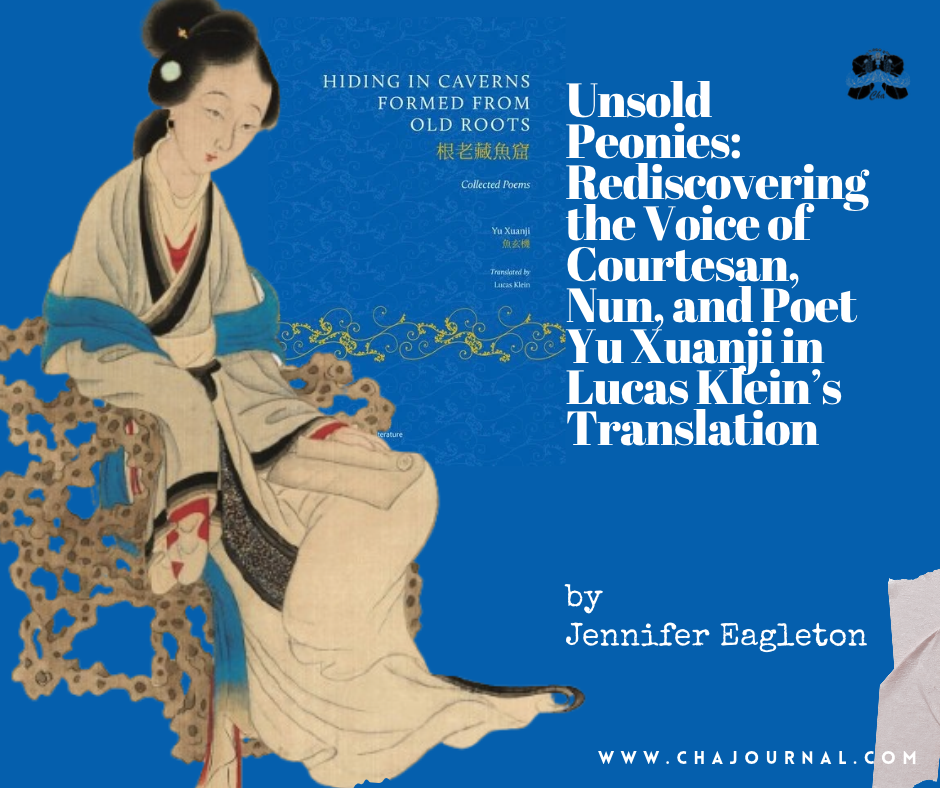
[REVIEW] “Unsold Peonies: Rediscovering the Voice of Courtesan, Nun, and Poet Yu Xuanji in Lucas Klein’s Translation” by Jennifer Eagleton
Yu Xuanji (author), Lucas Klein (translator). Hiding in Caverns Formed from Old Roots: The Collected Poems of Yu Xuanji, Oxford University Press, 2024. 160 pp.

Yu Xuanji 魚玄機 (c. 843-868) was a celebrated Tang dynasty poet, courtesan, and Daoist nun whose life was cut short when she was executed for murder at the age of twenty-six. Born a commoner in Chang’an (modern-day Xi’an), she became the concubine of a prominent man at fifteen, only to be abandoned by him. She subsequently entered a Daoist convent, which afforded her unusual freedom to practise her religion and devote herself to poetry. Although relatively few of her poems survive, she is celebrated as one of the most prominent female poets of premodern China. Her work combines the characteristic lyricism of late Tang poetry with a strikingly frank perspective on womanhood, love, sex, and abandonment. Accused of murder, she was executed after only two years as a Daoist nun.
In this bilingual collection, the translator Lucas Klein observes that Yu attained her legendary status in spite of a patriarchal and elitist culture that sought to marginalise her. The book opens with a critical introduction that elucidates the tradition of women’s poetry in premodern China and examines Yu’s relationship with, and possible subversion of, the dominant male poetic tradition. Klein combines scholarly precision with a creative, poetic sensibility to bridge the gap between the classical Chinese style and English, so that the poems read smoothly and fluently. He provides footnotes to each poem where necessary, particularly to illuminate allusions and references that would have been familiar only to those in Yu’s milieu and that modern readers would otherwise be unable to decipher. I suggest reading each poem first, drawing one’s own inferences, and only then turning to the footnotes to glean further meaning.
Although the Tang dynasty was a golden age of literature, women were largely excluded from the civil service examinations and official literary circles. Women who wrote poetry in Tang China tended to belong to particular groups whose circumstances afforded them education or mobility: those at the imperial court, or those who, like Yu Xuanji, became Daoist nuns. Convents, in particular, freed women from traditional filial and domestic obligations, granting them an unusual degree of independence to travel, study, associate with male scholars, and express their personal voices.
A clear instance of Yu Xuanji’s subversion of a Tang poetic genre can be found in her “boudoir” (閨房) poetry, exemplified by “A Boudoir Complaint” (p. 21). In traditional male-authored boudoir poetry, a lonely woman is depicted from a voyeuristic perspective: confined to her inner chambers, weeping over an absent husband or lover, and defined entirely by her dependence on a man. Yu, by contrast, writes from lived experience, and in doing so breaks through the stereotype.
Selinea flowers overwhelm my hands. I cry at slanting sunrays
and at word that the neighbor’s husband has come back.
The other day the southern swans went north, and
this morning northern wild geese flew south again.
Spring comes, autumn goes—it’s missing you that stays.
Autumn goes and springtime comes. News of you is rare.
The latch is shut on crimson gates. No one’s coming, anyway.
It isn’t the thumping of laundry that transgresses my bed curtains.
Saddened that her neighbour’s husband has returned while her own lover has not, Yu laments the enforced absence of intimacy as she leads a “nun-like” existence in her isolation. According to Klein, the image of the latched “crimson gates” carries a “vaginal” connotation (p. xxiv). Yu also conveys the sensory texture of her enforced loneliness, such as the sound of laundry being pounded outside her room, a loneliness that persists across the seasons.
Eschewing the typical boudoir setting, in “Selling Wilted Peonies” (p. 15) she uses the image of a beautiful, overripe flower to criticise a society that judges women’s worth and keeps them in isolation.
I sigh into the wind. My flowers are always falling,
their scent fading in silence. And that is spring.
Maybe they cost too much, so no one asks?
Even butterflies find their smell too strong and stay away.
Red petals should only grow inside the palace;
could their emerald leaves bear all the dust from the road?
Just wait until they’re transplanted to the Imperial Garden—
Won’t you regret not having bought them when you could!
Perhaps her talent, unrecognised, is left to decay. Or perhaps she is recommending herself, “selling” her poetry while no one is “buying” (that is, accepting) it. A footnote mentions a possible alternative title, “Unsold Peonies”, and explains: “Like the beautiful peonies, Yu is unappreciated and unsold. Yet, like those proud blossoms, she believes in her own worth: she is priceless and deserves to stay only in the noblest palace…the Daoist immortal world” (p. 15).
Women poets were not, however, entirely isolated; they actively exchanged poems with their male contemporaries. Yu Xuanji, for instance, maintained a celebrated poetic correspondence with the eminent late Tang poet Wen Tingyun, navigating his mentorship while asserting her own artistic identity. In poems such as “Winter Night, Sent to Wen Tingyun” (p. 29), she shares her inner emotional state and reflects on their relationship as an equal rather than as a submissive student.
Pains finding a poem to read you in the lamplight.
I haven’t slept all night long—I hate this cold quilt.
The courtyard is full of leaves blown off trees by a worried wind
and a sinking sad moon pierces the bed curtain and window scrim.
Dispersed, we have no time to carry out our wishes,
but in every rise and fall we see the mind in its original state.
Without a hidden perch in the paulownias,
the sparrows circle the grove, vacantly chirping all night.
A footnote explains that “pains finding a poem” might also be read as difficulty in composing a poem that captures the poet’s feelings. While other footnotes identify the classical texts from which the poem draws inspiration, one hardly needs them to see that nature and the seasons mirror her sorrow at Wen’s distance, and perhaps her “wishes” for poetic collaboration.
Yet despite women poets’ interaction with the male elite, their poetry was often regarded as minor or merely biographical. A central aim of Klein’s introduction is to demonstrate that Yu’s writing was neither an accident nor a historical anomaly, but a deliberate engagement with, and resistance to, the rigid, male-dominated genres of her time. Klein illustrates this through his discussion of “Traveling to the Daoist Temple of Reverent Authenticity, I See the Names of New Candidates Posted on the South Tower” (pp. xx, 39).
Peaks of clouds fill my eyes and let loose the clarity of spring:
clearly, great calligraphy is born beneath these fingers.
I hate how my clothes cover up these lines,
but I raise my head, looking up at the names of these successful candidates.
The civil service examinations were the supreme vehicle of political, intellectual, and literary power in the Tang dynasty, and they were reserved exclusively for men. By physically visiting the tower, reading the names of the successful men (displayed on high to signal their elite status), and composing a poem about the experience, Yu Xuanji directly confronts the barrier that separates her from the ruling elite. Rather than composing a traditional, passive “boudoir lament” over an absent lover, she frames her grief in institutional terms, mourning instead the loss of her own political and literary agency. By explicitly noting that her “woman’s clothing” is the only thing concealing her poetry, she forcefully asserts that her talent is at least equal to that of the men whose names are inscribed on the tower. Line 2 of the poem probably refers to the successful candidates, but the phrase “beneath these fingers” could equally refer to Yu herself, presenting her, without false modesty, as a poet of high calibre.
A number of poems in the collection also address the process of writing poetry, particularly as an activity shared with friends and acquaintances. One example is “Rhyming with My New Neighbor to the West, on Sharing Some Wine” (p. 33).
A poem comes—I read it a hundred times
and word on word its new feelings ring like gold.
To the west I see a thought already peeking over the wall,
though when I look far off, will my heart not turn to stone?
In the stars the lovers’ meeting is delayed. Nothing meets my eye,
so my dreams are broken between the Xiao and Xiang rivers. I put
down my zither.
Every time the Cold Food holiday comes around, it deepens my
longing for home;
Xi Kang never drank his fine wine alone.
Although several footnotes explain the poem’s intertextual and mythological references, this poem, ostensibly about longing for an absent friend or lover, can be appreciated without them. It suggests how poems, when reread, can take on new meanings in different contexts and give rise to new thoughts (or the potential for a new poem) that go “peeking over the wall”.
Reading this collection takes me back to the early to mid-1990s, when I was studying Chinese at the University of Sydney, where classical Chinese poetry formed a large part of the curriculum. This is an excellent volume, not only for enjoying the poetry on its own terms, but also for readers who wish to deepen their understanding of Tang dynasty poetry and of the process of rendering it in English.
How to cite: Eagleton, Jennifer. “Unsold Peonies: Rediscovering the Voice of Courtesan, Nun, and Poet Yu Xuanji in Lucas Klein’s Translation.” Cha: An Asian Literary Journal, 5 Oct. 2026. chajournal.com/2026/10/05/old-roots.


Jennifer Eagleton, a Hong Kong resident since October 1997, is a close observer of Hong Kong society and politics. Jennifer has written for Hong Kong Free Press, Mekong Review, and Education about Asia. She has published two books on Hong Kong political discourse: Discursive Change in Hong Kong(Rowman & Littlefield, 2022) and Hong Kong’s Second Return to China, A Critical Discourse Study of the National Security Law and its Aftermath(Palgrave Macmillan, 2025). Her poetry has appeared in Voice & Verse Poetry Magazine, People, Pandemic & ####### (Verve Poetry Press, 2020), and Making Space: A Collection of Writing and Art (Cart Noodles Press, 2023). [All contributions by Jennifer Eagleton.]