
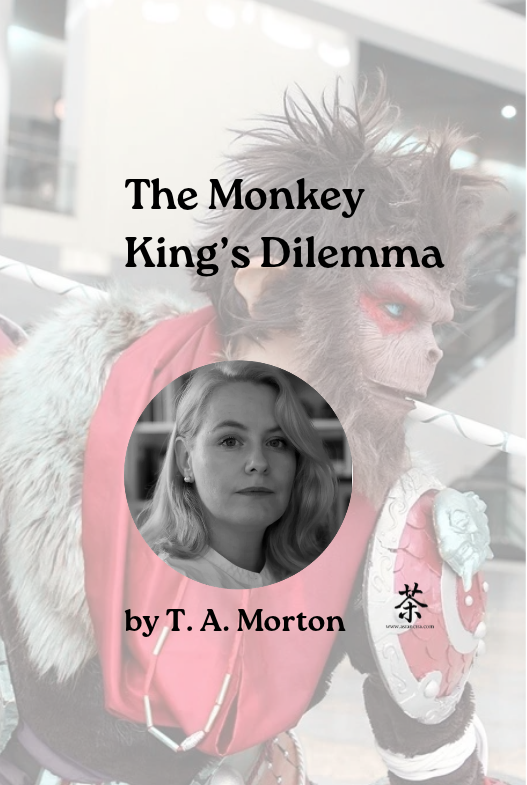
[FICTION] “The Monkey King’s Dilemma” by T. A. Morton
T. A. Morton’s introduction: The Monkey King is a known troublemaker. He has always pushed boundaries, from his time stealing peaches of immortality to wrecking the Queen Mother of the West’s banquet. Wild, untamed perhaps, but he is also clever, vain and nearly all-powerful. A demigod who can’t sit idle when things are going wrong around him.
As a child growing up in Australia, I watched the famed 1970s Japanese TV show called Monkey (Monkey Magic for those of us who loved the theme tune). The ABC programmed it for weekday afternoons, and every day I would rush home from school to watch it.
Monkey and his friends would get up to all sorts of adventures on the journey west. I watched as they visited towns, endured trials, protected young maidens from demons, fell victim to trickery and were often reprimanded by Buddha. I watched them fight, attack and protect, but each was riddled with their own very human flaws: Pigsy was gluttonous, Monkey arrogant and Sandy passive. They each battled against themselves as much as they battled with others. In a way, they showed us, the viewers, how the battle against our nature can be as great as the battle against each other.
I have taught and lived in Hong Kong, a place that never let me go, and in witnessing from afar what went on in the not-so-distant past, I started to imagine what Monkey would do if Buddha gave Hong Kong to him to take care of. At first, I imagined Monkey would grow lazy, with nothing to defend. Then, when the rumblings of freedom started to call, he would make his descent from the top of IFC to try and help. But he would face a new struggle, as his power was no match for what humans do to each other.
In the story below, Hong Kong is referred to as Tching-Yen, the name invented by Somerset Maugham, who used it in his novel The Painted Veil after colonial officials threatened legal action over the use of the original name. I borrowed it, a name with a real story of censorship behind it. It gives the story enough distance to plainly say what it means.
This story is a fable, not a report. But fables often have a way of highlighting a truth when it is hard to say it out loud, and the Monkey King, who never did what he was told, seemed the right messenger.

The Monkey King’s Dilemma

Photo: William Tung, via Wikimedia Commons.
The Monkey King sits on top of the IFC tower in Tching-Yen.1 The cloud that lifted him has faded into the smog. Up here it is crystal clear, like the ocean two hundred years ago. A distant plane roars.
Monkey sighs. His feet hang off the building. He murmurs, “Shame those delivery men do not carry beer up here.”
He climbed Jardine House with a six-pack of beer a few nights ago. He drank them quickly and hurled the empty cans down, alerting security guards looking for troublemakers. He considered facing them and having an old-fashioned fight, but why? They would look confused or laugh at his huge stomach, and he would soar off on his cloud again, humiliated.
Monkey looks up at the blue sky. Breathing in the cool air, he counts to 1,000 before exhaling. His feet kick the laminated glass so hard that he bounces up and almost falls off. A moment of laughter precedes another sigh. He whispers, “Monkey is bored.”
His pals retired centuries ago and had families. Palaces in the sky, peach orchards. Even Pigsy had been loyal for almost a millennium. His wife, pretty but tough, would not take his crap any more. Their wedding was fun, with dancing, drinking and delicious food. Afterwards, Monkey flew a young maiden to the cloud forest to track the sun. After kissing and holding hands, the Jade Emperor suddenly appeared, angry.
“She is my sister, Monkey. She is sacred. Don’t disrespect me, Monkey! You are only one move away from banishment again.”
The rest of the wedding party had heard the commotion and crammed themselves into the cloud forest. Their curious eyes watched the Jade Emperor as he held his sword to Monkey’s throat.
Pigsy begged the Jade Emperor, “Please, it’s our wedding day. Allow us a day of no fighting or banishment.”
Under Buddha’s watchful eye, the Jade Emperor lowered his sword and let Monkey go. The bridal party applauded and returned to the peach orchard. The last time Monkey saw all his friends was at that wedding over a millennium ago.
Monkey’s dilemma prompted Buddha to give him Tching-Yen. She said, “Listen to your people, Monkey. Help them. Rise beyond your own demands.”
But Man rarely saw Monkey any more, too busy always travelling somewhere but never leaving.
The Tching-Yen police knew about Monkey, and so did the Government, but they had decided to follow the English before them and keep quiet about him. Some knew of his existence. Most considered him an annoyance but no real threat. His drinking habits were the only thing to be wary of.
Monkey sighs. Another plane roars past him. He picks a tick from his fur and eats it. No one ever bothered to look up any more, and if they did, it was only to see whether they were being watched by those tiny cameras they placed everywhere. Cameras that mark their faces, their whereabouts, their clothes, their moods. There is no time to see Monkey jumping from roof to roof, no time to see him ride clouds and blow away the thick smog that made him cough. Man only made time for Buddha in the temples, praying, wishing, asking, mostly for new phones, more money, smart children.
Then one day all of that stopped. It was as if a demon had come in and cast a dangerous spell. People looked more tired. They grew angry, and then they started to walk the streets, holding up umbrellas to protect their faces from the cameras. Monkey had come down and walked among them, his face covered by a mask he had found on the ground. He had started to talk to them. They were furious. It was unfair, unjust.
“Our rights, our freedom, we can’t just bow down,” they said.
Monkey nodded. “You can’t. They aren’t Buddha!” Most of the time, when he said that, people laughed. “No, they aren’t Buddha. They are wrong.”
Monkey aided during an underground fight but understood halfway through that he was on the wrong side. He was shocked when a boy yelled at him to stop striking his father. He quickly went back to the skyscrapers above the haze, ashamed. He didn’t know what to do. The world had changed so dramatically in a few years. Buddha gave him the island to protect and ensure smooth operations.
“Listen to your people, Monkey. Help them. Rise above your own needs.”
He tried to attend secret meetings, but no one recognised him and he was expelled.
“But I am Monkey,” he would cry.
“You stink like a monkey. Get out, crazy man.”
A flash of pink lightning. A sign. Buddha summoning him. He looks down at his engrossed stomach. Too much beer, too much sticky rice and not enough women. Buddha would have more than enough to say to him about everything. People were getting angry again. He could feel it rise from the ground. Whispers, worried looks, the island tense.
He remembered laughing with Pigsy about how stupid and silly Man was. Now he felt like the dumb one, hiding up here in the clouds. People were suffering. Violence, crying. Their fight was not fun. It was about something else, something he couldn’t relate to, a need for freedom. Perhaps I should go down and see what is going on, show Buddha that I am in control, he thinks.
He steals clothes from the back of a dry cleaner, one shirt and a suit. Shoes he had plenty of. He often found them in the dead of night lying in the streets, but none of them matched. The shirt was too small for him, the suit too big, but it covers his fur. He uses an old electric razor to shave his cheeks and chin. He pats down his hair and puts on one dark-brown shoe and one black one. They are similar in style.
He walks out into the day. People pass him. He immediately absorbs their angst. The army has been called in. They are coming with powerful, damaging weapons. He hears a woman mention the closure of the airport. He sees an older woman sitting outside the shop of the dead, her eyes filled with tears. The restaurants are empty. The tourists have stopped coming. People are afraid. The children have stopped going to school. Their need for goods has been surpassed by their need for freedom. Central is still like it was in the old days before the white people came and took over. Monkey looks down the empty road. It is a sunny day, but it feels as if there is a typhoon warning.
He catches his reflection in the window. He is hunched over, giving away his animal state. Immediately, he stands up tall like the guys who drive around in their noisy cars.
At the university, he comes across a group of students standing outside painting signs. They all wear masks and coloured sunglasses. Their hoods are up. They wear black jeans and trainers. One looks up and catches his eye. She smiles, and he walks over to her.
“Do you want to help?” she asks him.
Monkey nods. She leads him to a table and points to the pile of old cardboard.
“Could you paint this sign?”
“Yes, yes I can.”
He picks up the brush and dips it into red paint. Some of the colour latches onto the fur on his hand, and he quickly rubs it off on the inside of the oversized suit. He paints words. They are messy. He signs his own name and writes a cheeky message to Buddha.
The old church bells call out the time, the church of the other God, the God with a white beard and the famous son. Monkey thinks, where is he now?
He hears other bells call out, and then an odd bell, loud and hard. It stops, then cries out again, a warning. The students stop, look at each other and stare down at their devices.
They start to whisper.
“The tanks have arrived. Martial law. Curfew.”
He is about to ask who Martial is when the girl looks at him.
“Are you a student?”
He shakes his head.
“Who are you?”
He wants to say I am the Monkey King, His Holiness Equal to Heaven. Maybe they would laugh, maybe they would bow, but he feels that this is different. Something is wrong.
He says, “I just want to speak to someone about freedom.”
“Freedom? What do you mean? Who sent you? Are you from the mainland?”
“No, I am not from the mainland.” He tuts, genuinely offended. “I am from Water Curtain Cave.”
She rolls her eyes. “The Water Curtain Cave?”
“Where I was born.”
“But where were you born?”
“From the rock.”
“But where?”
“Not here. Why does it matter?”
“Because it does.”
“I don’t understand. Aren’t we all the same? We are born, we live and you,” he points, “you die younger than me.”
They stare at him, confused.
“How old are you?”
“Two hundred million years. I don’t look too bad, wouldn’t you say?” he replies proudly.
“Uh-huh. Well, thanks for helping, but I think we’ve got it from here.”
They take away his sign, and then one of them calls out. He is an old man with thick grey hair and glasses. He examines the sign Monkey drew. He gasps and stares at Monkey.
“This sign, how did you? I mean, I haven’t seen it in years, not since my grandfather showed me pictures.”
The others crowd around him.
“What is it, Professor? What does it mean?”
“It’s the Monkey King sign, and he is calling Buddha an old goat.”
Monkey bursts into laughter.
“You know what that says? Well, I guess you are smart. Buddha gets so angry. She has no sense of humour. But I think it’s important to have fun, you know, don’t take yourself so seriously.”
The others stare at him. The professor says, “These signs haven’t appeared for over a hundred years.”
“I have been busy.”
“Where have you been, Monkey?”
“Oh, you know, here and there, up and down.”
“Did you see them coming?”
“One day I see fireworks. Boats, white men leaving. Next years I see them coming, but I think it’s okay, everything seem okay, and then I see fighting, umbrellas and those cameras that follow everyone. Sometimes I bang on them to see if they can talk.”
“Are you here to help us, Monkey?”
“Yes, of course. That’s my job. This is my island. Buddha gave it to me.”
“You haven’t done a good job protecting us.”
Monkey looks down, embarrassed.
“I’m sorry, but now I will help. Fight for freedom.”
“Do you know what that means?”
“To be free?” Monkey answers hesitantly. He wants a beer, a large one, and some crispy duck and rice.
“They are going to try and hurt us, Monkey. Will you help us?”
“They can’t hurt you if I am here. I have fought many times, demons, gods. These men are nothing to me.”
The pink lightning hits twice, just by the table, and the students jump back.
Monkey looks up at the sky.
“I have to go,” he says sheepishly, “but wait for me.”
Monkey calls for a cloud, then jumps on it and flies off. The students are watching him, and he feels powerful for the first time in a long time.
They need me, they need my protection, and I will fight for them. The Monkey King is back!
The cloud brings him to the gates of the Jade Emperor.
Monkey is annoyed. He loathes the Jade Emperor.
“Oh no! What am I doing here?”
The guard looks at him.
“I’m supposed to see Buddha, not him.”
“Buddha is with him. You must enter.”
Monkey rolls his eyes. He enters and finds the Jade Emperor and Buddha sitting at a table set for tea. They both look at him. Buddha is clothed in white, her head bald. The Jade Emperor stands. He appears older and fatter, and for a moment Monkey is happy. He quickly sucks in his stomach and enters.
“You don’t wear your crown any more, Monkey?” Buddha asks.
“No, it was too heavy. I didn’t like it.”
“And what of your Staff? Is it still behind your ear?”
“Yes, right here.”
He takes it out and blinks. It grows to its rightful size.
Hey, he thinks, I’ll wave this around, show those idiots a thing or two.
As soon as he thinks that, the Staff disappears.
“What? Oh, come on!” he says, looking at Buddha.
“No, Monkey. You can’t use that.”
“But why? They need my help.”
“No, they don’t, Monkey. They need to sort it out themselves.”
“But it’s not right, their freedoms.”
“Freedom is an illusion, Monkey. To Man, he thinks he is free, but he is not. He isn’t free when he isn’t free in here.”
The Jade Emperor points to his head and heart.
“What? Oh, that’s just stupid. These people are suffering and you don’t want me to help. Why did you give me this island anyway?”
Buddha smiles at him.
“Because I knew they would entertain you, keep you at bay.”
“I don’t want to be entertained. I want to fight. I want to help.”
“Help whom?”
“Help them, those without their freedoms.”
The Jade Emperor starts, “Monkey…”
“No, I don’t want to listen to you, you old goat.”
“Monkey!” Buddha shouts. She lifts her hand, causing Monkey to be squeezed. “You will not talk to the Emperor that way.”
“Sorry, sorry, sorry. I’m sorry!” he replies, and Buddha relaxes her grip.
Monkey rubs his sides.
“So you want me to do nothing?”
“Yes, for now. Just keep watch.”
“But they are dying.”
“Monkey, this doesn’t concern you.”
“So, you give me the island and now you tell me not to care about them? That makes no sense.”
“Monkey,” the Jade Emperor speaks softly, “we have dealt with it. The people will make good decisions, and everyone will be happy. No more fighting is necessary.”
Monkey crosses his arms and stands tall.
“But sometimes fighting is good. Clears the air, allows Man to see his limitations.”
“We are done with that, Monkey. No more fighting, no more anger.”
“They get their freedom back?”
“Yes, well, some of it.”
“Some of it!?”
“Sometimes Man takes a while before he can see reason, but it is a good start.”
“And what if Man decides that he doesn’t want reason? What if you are asleep and he does it behind your back? He takes freedom away again.”
“Then he will be punished,” Buddha replies calmly.
The Jade Emperor adds, “Man has evolved, Monkey. He isn’t what he used to be.”
“I know.”
Monkey looks down. Man didn’t need gods any more, he wanted to say. He had a screen.
“Monkey, this is natural evolution.”
He rolls his eyes.
“Is that it? Can I go?”
The Jade Emperor and Buddha exchange looks.
“Monkey, we think it would be best if you spent the next few years here with us.”
“Up here in the sky? No way. I am Monkey. I need to be on the ground.”
“Well, Monkey, we think it would be better for you. You don’t seem very happy, and all your friends are soon going to return. You can stay here, rest, have fun and adventures. We could send you on another mission to recover some stones that were lost.”
Monkey sits on the floor like a spoiled child.
“I don’t want to look for any stones. I want to go back. I like it there.”
“Do you? Look at yourself, Monkey. You were never like this before. You don’t even wear your crown any more.”
“Man made fun of it, so I took it off. I don’t need to show off any more. It’s not important, my crown. Things like that aren’t important any more. I want to stay there in case anything happens and they need me.”
“Monkey, we can’t let you go back.”
“Why? And who are you to decide? I am Monkey, holier than Heaven.”
Buddha sighs.
“Monkey, it is decided.”
“By whom? You? You don’t decide for me.”
“Monkey, stop. You will do as I say, Monkey. You will return and give up the islands. The Jade Emperor will take care of them now.”
“What does he know? He knows nothing of what Man is like. He only pretends to know him. All men aren’t good inside, you know. Most of them don’t even want to be. You can’t compete with the things they have. Sure, they will burn things in your honour and beg for help when their families are being threatened, but they don’t care the rest of the time. Man isn’t evolved. He is as selfish as he has always been. He just wants more things now.”
“You will stay, Monkey. That is final.”
Buddha nods her head and a cage encloses Monkey.
“What is this? How can you do this? Hey, Buddha, come on. I was joking.”
“Stop it, Monkey.”
“You can’t do this. Take away my freedom. It isn’t fair. This isn’t fair.”
“Monkey, the price of freedom is simply choosing to be. Liberation is in the mind.”
“What a load of old rubbish! Let me out, Buddha!”
Monkey clings to the bars of the cage. It’s a birdcage. A tall, elegant, ornate golden birdcage with a swing.
“I am not a bird, Buddha! I am Monkey.”
The Jade Emperor watches him. His eyes are sad. Monkey looks at him.
“Let me out, old man. Come on. I promise not to say mean things behind your back again.”
“What mean things?”
“Oh, nothing. No mean things. I meant someone else. Help me out, will you?”
The Jade Emperor turns red and walks away, shaking his head.
Buddha smiles.
“You can get out of the cage, Monkey. You just need to know how to break the lock.”
They leave him in the garden. They don’t return for two years. Monkey has lost weight. He is still angry and feels like the students. He asks one of the maids for paper and paint, and he makes signs.
Down with Buddha. Freedom for all. Revolt against tyranny.
Buddha returns to the garden.
“You still haven’t broken the lock? Or did you decide to remain in there so you wouldn’t have to be out here?”
“What do you mean? But, of course, I don’t want to be a prisoner. Are you mad?”
“Then try the lock.”
Monkey never tried the lock before. He just assumed it was unbreakable. Walking over to it, he sees that it is made of paper. He rips it, and the cage door opens. He walks out.
“You just changed that now. That isn’t fair.”
“I didn’t, Monkey. It was always like that. You just didn’t think I would do something like that.”
“Hmm.”
Monkey looks down, angry. He feels foolish.
“You are only in a cage if you want to be. Your mind should know better.”
Monkey doesn’t look at them. Instead, he kicks at the soft grass.
“Can I go now? Can I go back to my islands?”
Buddha sighs.
“Yes, Monkey, if that is what you want.”
The Jade Emperor is about to speak, but Buddha hushes him.
“Monkey, you can return, but quietly. Don’t go looking for trouble. Those who are free from resentful thoughts find peace.”
Monkey nods.
Back on the IFC tower, he looks down and up. He knows they are watching him up there.
Freedom is an illusion, he thinks.
It’s the first real thought he has ever had. True freedom doesn’t exist, not even for gods. Even Buddha isn’t free, not really. He must answer to Man. He picks ticks from his fur. Freedom may be an illusion, but it is still an idea worth fighting for.
He goes down to the streets. They are eerily quiet, but as he walks he notices the graffiti lining the walls.
Monkey save us! Long live the Monkey King! Monkey, where are you? Monkey freedom!
Big glossy shops are closed. Lights that once beamed across squares are dimmed. Cameras move. Monkey hears them. They follow him. He comes to the underpass that was the scene of a recent battle. The path is covered in gas canisters, bullet shells and blood-stained concrete bollards. In the distance he can hear sirens. Their sound grows as he moves along the streets. He makes it to Wan Chai. All the bars are shut. A lone policeman is standing on the corner. He has a gun. Monkey heads towards him. The policeman turns and points his gun at him.
The policeman shouts, “You have broken curfew. You are under arrest.”
“Curfew? What is that?” Monkey asks.
“Who are you?” the policeman asks.
Monkey sees that he is young. His eyes give away his nervousness.
“I am Monkey.”
“The Monkey?”
“Yes, yes I am.”
“Where have you been?”
The young police officer walks towards him. His hands are shaking. It has started to rain. The rain dragons are at work. Thunder sounds in the distance. Monkey stands as still as he can while rain drips down his face.
“I have been with Buddha.”
“What does Buddha say?”
“Buddha says…” Monkey thinks for a moment. “Buddha says this is bad, bad behaviour. You take freedoms and you will be punished.”
The young policeman lowers his gun.
“Buddha said that?”
“Yes.” Monkey nods his head. “Buddha said you need to be nicer to each other. You need to stop all this. You much too serious. Go and love each other.”
There is a flash of pink lightning.
“Buddha says you let people live. No more fighting. This is their land. You leave now. Go home.”
There are more flashes and then a large crack, as if the world has snapped in two.
Buddha’s voice sounds.
“Monkey!”
“You see, she is telling you to be better. Protect these people. Don’t take away their freedoms. Anyway, it is my land.”
He smiles at the young policeman.
“And hey, you don’t want to fight me. Buddha is supporting me, and you don’t want to go against Buddha, do you?”
The policeman shakes his head.
“No, Monkey, I don’t.”
The sky flashes pink again.
“See, you upset Buddha. You let people have freedoms. You stop being a bully. No one likes a bully.”
Buddha’s voice sounds.
“Monkey, stop.”
Monkey can hear a crowd behind him. More police officers with guns and a small group of men. They are scared.
Monkey turns to them.
“No more fighting. Buddha commands it.”
A flash of pink lightning hits Monkey, stunning him. He falls to the ground.
The young policeman runs over to him.
“Monkey! Monkey, are you okay?”
Monkey looks up at the sky and smiles.
“All-knowing, all-loving Buddha,” he whispers.
He grabs the arm of the policeman.
“Hope is the one thing stronger than fear,” he laughs.
He stands up and shouts at the sky, “Man and Monkey will never stop wanting their freedom, Buddha. We will do and say anything to make sure we keep it, even if it is just an illusion.”
With that, a great flash of lightning strikes Monkey and he vanishes in front of Man. Summoned to heaven once more, he resides again in his birdcage.
Unfortunately for him, the lock is no longer made of paper and the door does not open. Monkey spends most of his days eating chicken legs, throwing the scraps into the Atlantic Ocean. At the weekends he drinks beer. His islands are covered in clouds, and he can no longer see what is going on, but he is patient, hopeful that he will return to his islands and be free one day soon.
Note
- Tching-Yen is a fictional name originally conceived by W. Somerset Maugham after the Hong Kong government threatened to sue Mr Maugham over the use of Hong Kong in his novel, The Painted Veil. ↩︎
How to cite: Morton, T. A. “January.” Cha: An Asian Literary Journal, 2 Oct. 2026, chajournal.com/2026/10/02/monkey-king.


T. A. Morton is a Singapore-based Irish-Australian writer. She was previously an editor at Pearson Longman in Hong Kong. Her writing has appeared in World Literature Today, while her short stories have been published in the Lakeview International Journal of Arts and Literature and The Best Asian Short Stories 2019. In 2020, she was shortlisted for the Virginia Prize for Fiction and the Bridport Prize. She holds an MSt in Crime and Thriller Writing from Cambridge. Her novel Someone Is Coming was published by Monsoon Books in August 2022 and has been optioned for television. Her Hong Kong novel, The Coffee Shop Masquerade, was published by Earnshaw Books in April 2025. She has also taught crime writing at the Singapore Book Council Academy. Visit her website for more information.