
茶 FIRST IMPRESSIONS
茶 REVIEW OF BOOKS & FILMS
[ESSAY] “Gigi L. Leung’s Everyday Movement: Momentum within Moments” by Tin Yuet Tam
Click HERE to read all entries in Cha
on Everyday Movement.
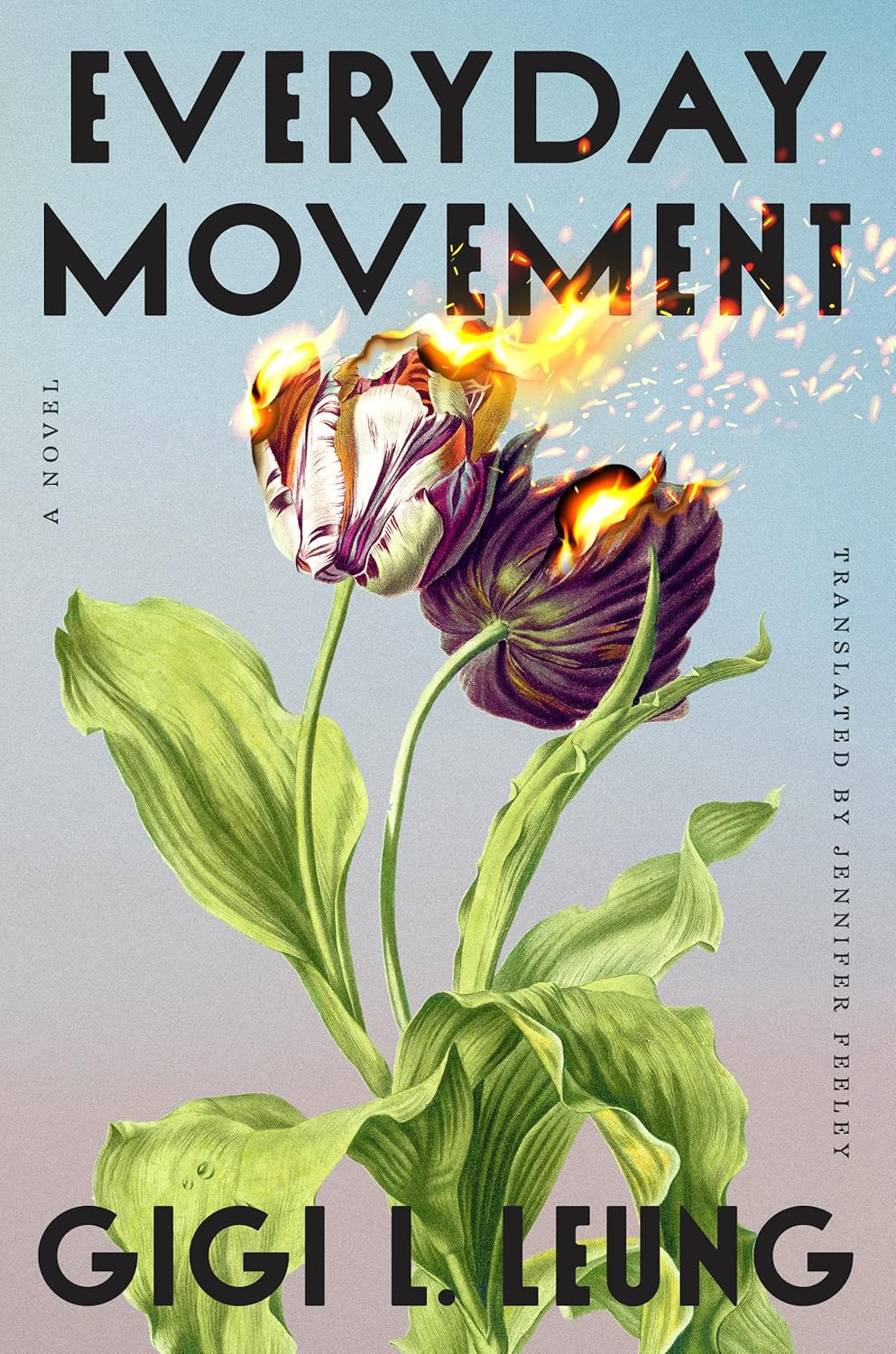
Gigi L. Leung (author), Jennifer Feeley (translator), Everyday Movement, Riverhead Books. 2026.

What becomes of us? What will become of us after anger and sorrow disguised in many twists and unexpected turns? Everyday Movement is a thread that weaves the past, present and future with 2019 Hong Kong in the background, bringing us to look at the kaleidoscopic and unprecedented social movements that overlap and blur people’s faces. The prior knowledge of what happened in Hong Kong in 2019 would bring you closer to the core of the novel, but even without it, you will find yourselves in a vantage point where textures of social movements unfold before your eyes. There are solid dates and events on the calendar, slices of people’s actions and silence, and slices of eventful happenings. Divided into 3 parts, Everyday Movement moves along according to the year of 2019, from early summer to early winter, to weave in and out people’s lives and districts in Hong Kong. If you know the geography of Hong Kong better, this helps you understand the novel is indeed depicting everyday movement that takes you out of the central business districts and thrust you into the many ordinary lives of Hongkongers.

When Movement Turns into Momentum
I had read bits and pieces of Gigi L. Leung’s writing in Chinese before, and this is the first time I read her full novel. The distance of reading translated novels like this one translated by Jennifer Feeley gives readers a space and buffer to read and ruminate things and events that had happened to them before their naked eyes. The once-familiar names and places might have become new in their translated forms; The phrases that once rang a bell have given a new meaning in their morphed, translated stages. At the beginning, I was pondering the translation of 運動 to “movement” in the book title. The original title 運動, to me, is intended to be a word pun. It can be a social movement but can also be physical movements for individuals’ fitness and daily exercises. The English title “movement” also shares these two common dictionary definitions which are able to sustain the original word pun. The adverb “Everyday”, given its moving sense, connotates a daily basis which stood true in 2019 that the movement lasted for months, spread across districts and swept into many individuals’ lives. At the same time, “Everyday” can carry a sense of ambiguity: How do you define “Everyday”? How long does “Everyday” last? Who gets to decide what “Everyday” is?
Reading Everyday Movement is an invitation to a Möbius strip. Everyone is independent but somehow he or she is connected and locked in the same circle. This contemporary novel that sets its stage in 2019’s Hong Kong reminds me of Jennifer Egan’s The Candy House of which the characters appear and re-enter the chapters at different times and eras. What sets Leung’s novel apart is her depictions of the individual differences of similar generations protesting and responding to the protests in the same era. Leung puts the readers right at the centre of the movement as she begins the novel with Ah Lei and Panda’s eyewitness accounts in Shatin, a New Town and in a plaza with the same name that dated back in July 2019. Given the physical familiarity and proximity, the characters Ah Lei and Panda are like the people we may know or cross paths in ordinary life: monolithic figures with their own backstories who are only known by their nicknames. Without knowing their given traditional Chinese first names, their nicknames are as common as the typical Cantonese nicknames typed in English with the befriending “Ah” as a prefix.
Physical and
Relational proximity
Everyday Movement puts people in a tangled web that they are sometimes too close in a physical or mental space beyond their imagination. In the novel, there are people as close as siblings who are elder and younger sisters, cousins, or as distant as teachers and students, merchants and customers, and ex-lovers. Scattered in ten chapters, there are trust and disillusionment, frustration and tenacity, gentleness and anger in these characters’ lives, which might have a fair share of some Hongkongers’ lives like yours and mine.
A few distinctive characters in the novel have families or friends who are originally with China. The cousins Ah Mak, Panda and Sai Mui have mothers who moved from China for marriage. Not binarizing people from different birthplaces, Leung depicts the closeness of sisters who marry far away. Ah Mak’s mother, and Panda and Sai Mui’s mother have no one else from their family except each other, so they share a secret bonding over talking in their home dialect in the kitchen and sharing survival skills to affirm that they and their offsprings can survive or even thrive in this new space. When Ah Mak’s parents were filing for divorce years ago, Ah Mak’s mum’s sister, who is Panda and Sai Mui’s mum took Ah Mak and her sister under her wing immediately. The closely-knit familial relationship with a home far away has been an emerging theme weaving the novel, although there might be a vast different definition of home.
To Ah Mak’s and Panda’s mums, their original selves float better in the tones of their first language; to Ah Mak, Panda and Sai Mui, Hong Kong is the only home they know. But the novel has no intention of dichotomizing the debate over home. Instead, Leung unearths the nuances of a connection with China through the two generations in her novel. Yet, sometimes this connection is challenged by the extremities. In Sai Mui’s narrative, while she is standing between her Cantonese-and Mandarin-speaking classmates, she is experiencing a push and pull with 2019’s social movements on the canvas. With her trying to understand why a classmate from mainland, Zhiyuan, is willing to go over the language barrier to be her friend (with the aid of Chan Yeuk in her booth), that once-in-a-while language harmony is broken by a punch in broad daylight. That punch punctures the seem-to-be harmony between the two language groups.
The movement also breaks people’s idealized and true selves. A section that grabs my attention is on Little Professor whose nickname foretells who he really is. Despite his name suggests, Little Professor is never a real one but someone who enjoys the centre of attention using abstract theories. He garners certain degree of respect from his junior at university. But the more Little Professor is described on pages throughout the movement, the more his true self is shown. Yes, he enjoys talking about democratic movements, but he doesn’t seem to be a practitioner. In his causal relationship with Ning On, the owner of a beauty salon, Little Professor still claims the spotlight of doing the talking, but what he enjoys is the excitement of being the leader of shouting chants. This character might bring back some Hongkongers’ memories on the people they meet and converse in real life, before or after the movement.
The Center Cannot Hold: Fissures Under Relationships
In this novel, relationships in many forms take the centre stage. One of them is the relationship between ex-lovers. Without spoiling the plot, I would say the novel writes the realities of some never-ending problems between couples who were together but drifted apart, and the couples who just start off their relationships. With the ongoing social movement in the background, the same movement has also been brought to the couples’ relationships that may spark deeper connection or put the last straw. The constant verbal fights over who did more in the protests and who were impassive were a common theme during the time of social movement. The couples’ quarrels in the novel are no exception. Their partners may change, but the struggle stays the same for the characters in this novel: Does the person we love replicate the patterns of the person who we used to date? Sometimes the anguish and disappointment towards a power penetrates the daily life of the ones who are part of it. The questions about who really understand us and have our backs in a turbulent time reveals the core values of any relationships. The closer we feel we are drawn to a person, the more hurtful we may feel at the end. Even the people who seem belong together with the same political stance could have drastic differences in their actions, values and choices.
At the centre of all relationships, Panda or Ah Mui or Hung Yi (depending on who she is with) is a key character who connects all the dots. Panda is at the beginning, with a self-titled chapter in the middle of the novel, and she stays until the end on the final pages. To Panda, her name changes reflect the changes of time, key moments in her life, as well as the ones in the protests. When Panda is Ah Mui, that name demarcates she is with her family and she is being seen as a girl. The name “Ah Mui” implies an endearment and youthfulness, but when her younger sister of Ah Mui was born, “Ah Mui” becomes a hierarchal symbol of being a senior to her younger sister. “Ah Mui” is no longer just a girl, but an elder sister that Sai Mui looks up to when Sai Mui is confused where her position in the huge social movement. Although Ah Mui and Sai Mui are sisters, their age differences keep a gap between them. Sai Mui, without knowing her real name in the novel, always seems too young to comprehend the full picture of what is happening on the street. She shares a jealousy over her elder sister who catches her mum’s attention and has own social circle known as Panda. Connected by the endearment “Mui”, Ah Mui and Sai Mui have different lives, sweeping into the constant harshness and occasional impotence in a protest era when they want more.
Beginning in July and ending in late November, Everyday Movement takes the readers to gaze upon the slices of everyday lives and unearth the long-gone emotions within those months in 2019. With a consistent change of names among Panda, Hung Yi, and Ah Mui, the novel ends with her narration under her original first name Hung Yi. With all protests behind her and unknown before her, Hung Yi is no longer known as Panda, a nickname she had picked for herself since 2008. She is alone, figuring out who she really is, aside from being someone’s girlfriend, daughter, sister, or a resident of the city. he questions in her mind still ring true to many readers: “Where had it all gone wrong? Hung Yi had wanted nothing but justice and love. Were such pursuits meaningless in the end?” (p. 277)
After all the clashes, Hung Yi has lost a sense of where she would go or where she belonged. Is anyone out there who shares the same feeling like Hung Yi did?
To Hung Yi, Ah Lei, Ah Mak, Sai Mui, Ning On, Little Professor, or the faceless characters in this novel, they are Hongkongers who were once connected in concentric circles. And their movements are ripples, spreading across the pool, shaking the shapes of water, then going on their ways. The movement has come and gone: Only time will tell where they are heading to.
How to cite: Tam, Tin Yuet. “Gigi L. Leung’s Everyday Movement: Momentum within Movements.” 1 Oct. 2026, chajournal.com/2026/10/01/momentum.


Tin Yuet Tam is a Hongkonger who writes about arts and culture. She has written critiques on performing arts in Chinese, for example, her theatre critiques can be found in Hong Kong Repertory Theatre’s Repazine. She has also been writing poetry, reviews, interviews, and essays in English. Tin Yuet’s poetry has been featured in Canto Cutie and Voice & Verse Poetry Magazine. When she is not writing, you might find her strolling along the streets for hours just to immerse herself in cities. She currently resides in Toronto, Canada. Find her work on Instagram: @walk_talk_chalk [All contributions by Tin Yuet Tam.]